Noticing God

Journal 2005. What might it look like if I practiced noticing Jesus’ presence? What if I mentally set a place at the table for Him at every meal? Would my “bless this food” prayer be different? Would our conversation be different? What would it be like to place Him at the head of the table?

What if I invite Him to sit in the living room with me and watch TV? Would we watch what He wanted to watch? Or would He prefer to turn it off so that we could talk together?

In my kitchen He’d help me prepare the meal and we’d chat while doing dishes. He’d make suggestions for good food to eat. At my computer, He’d sit beside me and help me figure things out and give me creative ideas and help me catch mistakes in my proofreading.

How? All I have to do is be aware. Notice. Listen. He’s right there all the time. I just don’t always take time to notice Him. I often take Him for granted.

Lord, reveal Yourself to me throughout this day. Help me to pay attention, sit up and take notice, to listen to You. I love spending time alone with You, all to myself, but You don’t go away just because I walk out of a prayer closet. You come too!

How do I pray for someone who can’t sense His presence because he/she has his/her eyes closed? God will not force their eyelids open. But perhaps He’ll woo them with sounds and touch and smell and taste, so they’ll open their eyes voluntarily—and then they’ll see and respond. Perhaps I should stop praying that God will open their eyes and instead ask Him to bring things into their lives so they’ll voluntarily open them. They’ve heard loud and scary noises, and they’re keeping their eyes shut so they won’t have to see the monsters. What can I do to encourage them to open their eyes? Give me the perfume of Your love today.

Photo by Ron Lach on Pexels.com

Tender Mercies

Journal 2008. When I read “. . . heart of tender mercy and lovingkindness of our God (Luke 1:78), I have a hard time reconciling in my mind God’s tender mercies with His terrible judgment. Sure, I believe that murderers and rapists and idolaters need God’s judgment, but He died for their sins too.

My dilemma, however, is not with them but with me. Where in my life have I misunderstood and not accepted God’s tender love and mercy? Am I self-condemning where I should be accepting? Do I have a false belief that if I accept His tender mercies, it means I deserve it? That cannot be, for if I deserve it, it becomes my works, and then pride follows.

I am no better than the pagan. I have simply followed the path God put me on. He gave me the parents, the heritage, the grounding, and the training. Why wouldn’t I respond the way I have? If I had been born into a peasant hut in China of Buddhist heritage, would I not have followed the path He set me on and gone into a Christless eternity? How fair is that?

I am blessed, chosen, humbled, undeserving. Why did God choose me? I don’t know. But once chosen, I had a choice—follow Him or disobey. I chose to follow; I don’t know why. I could have had a rebellious, angry, defiant heart. I credit my response to my parents and how they raised me.

I was chosen for some reason. God likes me and the way He made me. He thinks I’m special. I cannot worry about His relationship with the rest of humanity. I can only sit in awe and wonder that He loves me—me of all people!

Jesus gave me gifts—a bag of chocolates. And He wants me to share them—hand them out, give them away, offer them to anyone who comes into my path. I’ve been chosen, yes—to be a blessing.

Hypocrites

Journal 2006. Some people declare they won’t go to church because there are too many hypocrites there. Perhaps true. Perhaps we all have hypocrite blood in us.

Jesus wasn’t too tolerant of hypocrites. He preached against them, insulted them, and angrily confronted them. That was His right as the Son of God. Would it be appropriate for me, however, to speak to someone that way? To someone’s face? In public? One-on-one? I’d feel pretty uncomfortable saying directly to someone: “You hypocrite!” I don’t know a person’s heart. I can only judge outward action and speech.

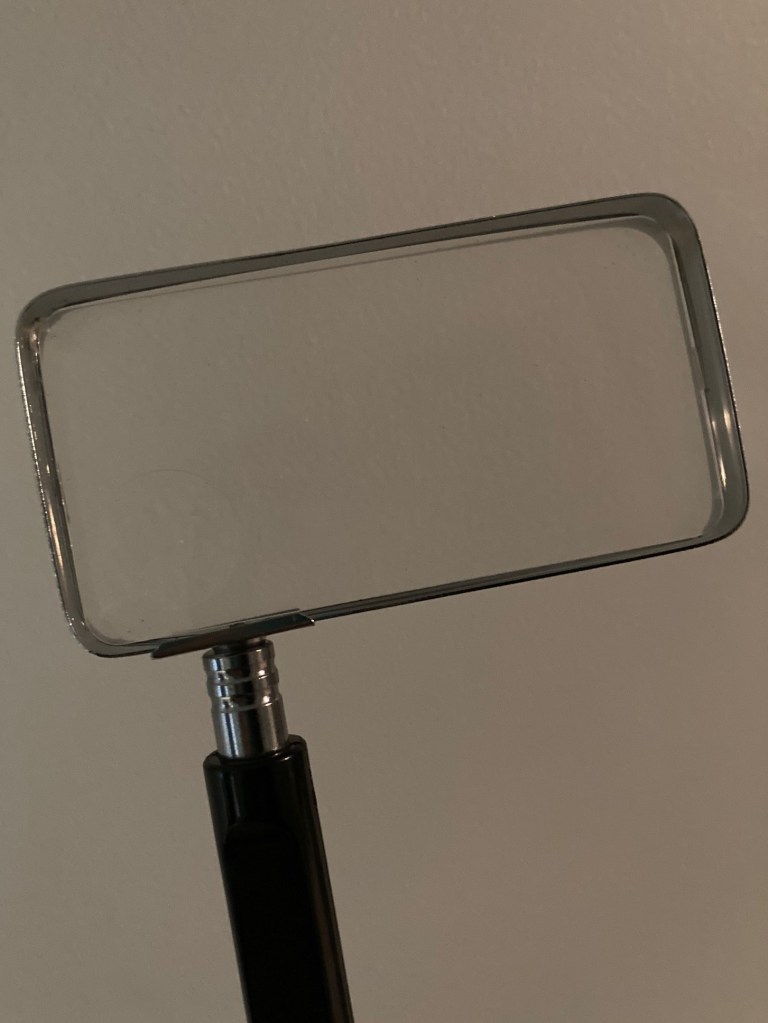
A hypocrite is someone who looks into a backless mirror—or is it a magnifying glass. . . . They cannot see their own reflection. They can only see others’ faults magnified.

Whose job is it to hold a mirror up to a person’s face? If I do it, the person may get angry at me, retaliate, and try to smash the mirror. If the Holy Spirit holds it up, then they are rejecting Him and not me. What if, however, God chooses to use me as someone’s mirror? Would I be willing? Only if He asked me to. Otherwise, I’d prefer the Holy Spirit to do the work.

And so, dear God, would You kindly hold up a mirror to my friend’s face? May she see her reflection, resulting in recognition and repentance. Yet You know the best time to give her that mirror. Too soon, and she may harden her heart. I have to trust You, Lord. Meanwhile . . . am I expected to love . . . a hypocrite?

Clothespins and B.O.

Journal 2005 Visual: We all have a lot of stinky stuff inside our hearts. And we walk about with clothespins on our noses so that we won’t (or can’t) smell ourselves. But others smell us, and they’re repelled. Eventually, the clothespin pinches hard enough that we remove it, or we start to sweat and it slips off, and when we smell ourselves, we don’t like it. I think God sometimes removes the clothespin, and we blame Him or others for the stench, never realizing it comes from or own b.o.! So, we have a choice—keep the clothespin on our nose or allow ourselves to smell and get motivated to clean up with God’s help. Freedom is not having to wear a clothespin on one’s nose because the inner aroma is now sweet.

Lord, in Your sovereign timing, would You remove the clothespins I’ve been keeping on my nose? And once removed, will You help me get rid of the stench and fill me with Your fresh air instead? Lilacs and cinnamon and peppermint and guava nectar and mangos and freshly baked bread, and sweet air after a rain and roast beef and rose petals—but mostly lilacs. Amen.

2022 Update. I’ve changed my mind about the statement “I think God sometimes removes the clothespin.” He never violates our will. It is our choice to leave the clothespin on, and He waits patiently for us to remove it before He can clean up what’s inside.

Possessions

Journal 2005. I remember my very first box of 64 crayons with a pencil sharpener on the side—a special gift from my beloved Grandpa Peterson, sent all the way across the ocean into the hands of a little girl whose mother taught the Africans by writing with her finger in the silky soft dirt. I guarded this treasure, arranging the colors by hue, gently returning each one to its proper slot, chagrined when I realized I had to peel back part of the paper in order to sharpen a crayon, and disappointed when it didn’t duplicate the original point.

When I pulled out my box of crayons at boarding school, someone borrowed them, leaving some crayons broken or misplaced. First, I got angry. They had no right to do that—even if done by accident. I felt disappointment, sadness, and Loss.

Possessions provide joy or creature comforts and can be great tools for accomplishing things for the kingdom. But holding onto them too tightly reveals what’s in my heart. Why do I feel so violated when someone touches my things? Am I too attached to them? Should I take care of my possessions? Of course. But I should not be in bondage to them. Eventually, I realized possessions are worthless in eternity. They are gifts from God for use here on earth, and if I recognize their source, I can hand ownership back to Him. I’m simply a steward of God’s possessions.

And so, Lord, I release that pristine box of crayons into Your hands. Break the bonds that hold me to it and color me a beautiful sunset instead.

To-Do List

Journal 2011. People talk about compartmentalizing their thought lives, and I’ve never fully grasped how they can do that. But one day when my to-do list was longer than my available hours, and my mind was too absorbed on one task to complete any others, I asked the Lord for a metaphor.

I mentally placed each of my tasks into a different room. One room is not more important than another, but I can’t be in two rooms at the same time. My brain is not wired to multi-task, so when I’m in one room, that’s all I focus on. People/relationships can walk in and out of each room I’m in, and I can stop and interact with them.

The first challenge for me right now is being in one room physically while I’m in another room mentally. I find I want to hurry up with the tasks in this room so I can get back to the Study or the Library or the Rec Room. The other challenge is deciding which room I need or want to be in and when. (Sadly, I tend to avoid going into the exercise room.)

And God? Thankfully He’s in every room of course. However, I desperately need concentrated, uninterrupted time in the Prayer Room.

Lord, help me to be mentally present with each person who enters my heart-house today. And will You be my Guide for what room(s) to work in and when?

January 2022 Update. This year started out with a large number of compounding stressors, and the jumbled stacks of papers in my office reflected the disorganization in my brain. Though disorienting, I didn’t cave or panic. I kept breathing and focusing on the next trouble-shooting task at hand until I could come to my scheduled Karen Day and hit the reset button.

The more we process our past, the healthier we get emotionally, and the more we can handle in the future.

The Calendar Box

Today
January 6, 2005Today is boxed
One rectangle of time
Empty, unplanned.
Oh, there are plans—
But I don’t control how events play themselves out.
People, doorbell, phone, emails, events, needs—
They all factor in to how this day gets written.
Don’t take it for granted.
Stop time, look, notice, feel and embrace the universe.
Cloak myself in His Spirit.
At the end of this day, God will write in His journal: I did good today.
Did I cooperate with His plan?
Did I write outside the lines?      

Word for the Year 2021: Handicap

I confess I have an abysmal sense of direction, and it’s getting worse with age. I Googled “bad sense of direction” to get some tips for improving my odds and collected maps for cities I frequent. Every day for the first month, I studied our local map, trying to memorize street names and cement a visual mind map to guide me. What a useless endeavor! Apparently, I am incapable of thinking and driving at the same time.

When I read a blog by someone who unashamedly labeled his poor sense of direction a HANDICAP (and many people resonated with his plight), I concluded I cannot change my brain enough to warrant shedding my trusty GPS. So, there you have it—one Word for the Year tossed in the trash, and I needed a replacement.

Following my recovery from Covid in November 2020, I decided to chronicle my journey with another hidden HANDICAP—loss of taste and smell. First, I tried the famous burnt-orange trick that went viral (useless) and sniffed three different essential oils three times daily for the suggested smell training ritual. For two weeks I quadrupled my intake of zinc. Nothing.

I spit out my first cup of coffee, tasteless as water. When I tried sniffing freshly ground coffee beans, a disgusting malodor greeted my nose. At least I’m smelling something, I reasoned, but this annoying odor lingered nonstop for months. Everything smelled the same: smoke, pizza, cat litter. I became the designated dirty-diaper queen for my youngest grandchild.

In the first three months, I burned up three frying pans because I couldn’t rely on smell to alert me. I no longer dared leave the kitchen during the simmering process. I lost what little interest I had in cooking or making menu decisions. For the first time in our 46 years of marriage, I didn’t care if I ate my husband’s bland-diet preference over my spicy palate. It all tasted the same, so what was the point?! I now had to rely on him to inform me if meat had spoiled or the seasoning wasn’t right in a casserole.

One day we decided to treat our grandsons to ice cream. As we approached the drive-through, I asked the 10-year-old what he thought I should order since I wouldn’t be able to taste it. “Cheapest thing on the menu, Grandma!” he said. Smart kid! And later, his 7-year-old brother asked, “Why eat anything at all?” I explained that food fuels the body, but regrettably, I had begun to choose peanut-butter-and-jelly sandwiches over healthy salads. Growing our Tower Garden felt pointless.

With the loss of eating pleasure, I learned to tune more into how hunger felt instead of eating what I craved but, disappointingly, I lost no weight. Eventually I began to differentiate between salty, sweet, bitter, and sour, but could taste no nuances of flavor. I put hot sauce on everything, trying to elicit a little zing for the tongue.

I tried hard not to complain but failed miserably and so began a regimen of gratitude for my other four senses. When I finally got tired of hearing myself complain, I asked God for a better solution and stumbled on Isaiah 65:5b: These people are a stench in my nostrils, an acrid smell that never goes away. (NLT)

And that’s when He gave me this idea: every time I smelled that repulsive odor, I would think about the stench in God’s nostrils and pray for someone. It helped refocus my attitude.

By August I noticed a subtle shift in relinquishing the malodor and enjoyed a hot curry Indian dish. Coffee became my gauge for progress. I went from gagging to tolerating a quarter cup, to drinking half a cup if I held my nose during the brewing process. I jumped in glee when I got a whiff of burnt toast. Someone claimed if you didn’t get your smell and taste back after nine months, it would be permanent. Oh, Lord, I hope not! I was into my ninth month and counting . . .

In September, someone suggested I try fascial counterpressure (whatever that was!). I found a practitioner 30 minutes away and promptly made an appointment but returned home with no noticeable results and fewer dollars in my wallet.

In October, I read Numbers 11:1-9 where the Israelites complained about eating manna every day. They missed their pungent fish, along with the flavorful cucumbers, melons, leeks, onions, and garlic. I could relate! I used to fault these people for their ingratitude, but now I felt convicted over my similar lament. I so missed the diversity of flavors. I wanted to discover the sweetness of holy manna and be thankful for what I had instead of grief over what I’d lost. How could I learn to leave Egypt behind and embrace the promise of a new land?

I continued to struggle with my attitude, complaining about my loss. I had an appointment with food three times a day, and three times a day I had to face the keen disappointment of loss of pleasure. Five times in Numbers 15 the phrase “an odor pleasing to the Lord” caught my attention. I couldn’t smell, but God could; and I wanted my attitude, thoughts, and deeds to be a pleasing odor in His nostrils.

It was like I was holding onto the end of a rope connected to taste and smell. Letting go of the rope didn’t mean I wouldn’t eat; it meant letting go the pleasure, the drug. When I dropped the rope, I watched in astonishment as it retracted like a tape measure into the food. The flavors were still there, but they were no longer tied to me. They don’t belong to me and therefore have no power over me. Now I can pick up food, examine it, see it, feel its texture, and experience it. It is what it is.

Over a year later now, I have adjusted (mostly) to my hidden handicap, and I rejoice in every whiff of smoke or incremental change in flavor. It’s okay that I can’t smell dirty diapers, but I sure do miss my coffee!

Oh taste and see that the Lord is good: blessed is the man that trusteth in him. (PS 34:8 KJV)

My biggest disappointment is not being able to taste injera ba wat (Ethiopian food)

For further reflection:

I checked out the Scriptures (RSV) and found the following words: Nose 12x, Nostrils 14x, Smell 20x, and Odor 43x. I even found a blog on the subject: Just a Thought . . . God’s Nose (constantcontact.com)

A Quiet Time

Journal 2005. Until we entered junior high, our boarding school devotions were conducted nightly in a group setting, led by one of the aunties. But there came a time when they wanted to instill in us the discipline of meeting with the Lord on our own, and they woke us half an hour early with the instructions to read our Bible and pray. I loved this quiet time of reflection that set the tone for my day, and I continued this daily habit long after it was a requirement. Many days, however, it was sheer discipline and will power and perhaps a little self-righteousness that kept me from quitting. Eventually that changed. Duty became delight. When you love someone, it’s not a chore to be in their presence. When I wake, the first thought on my mind is I get to spend some alone time with my Lord.

I’m starting a new journal today that has a prescribed format for a Quiet Time, but I never was one to follow the rules and outlines of a devotional. Some days I only read; other times I only pray; still others I take time to process emotions and memories to renew my mind.

Not everyone has the same upbringing, training, drive, or temperament as I, and I hear many friends lament that they can’t seem to be consistent in their Bible reading and prayer time, even if they desire it. Young mothers in survival mode, especially, struggle with carving time out of a busy, sleep-deprived day to spend extensive time with the Lord. Unlike some teaching from the pulpit, I know God doesn’t punish or berate me if I skip a day. Let’s lay aside once and for all the guilt and shame of not meeting someone else’s standards or spiritual disciplines. Having a daily QT doesn’t make a person holier or more righteous, but it does help to create space for God to speak, and I think that’s a good thing.

How Not to Study the Bible

Journal 2005

I’ve heard numerous sermons, sat through many classes, and read several books on how to study the Bible, and I’ve tried various techniques. I’m currently reading through a famous preacher’s study Bible, and I’m in awe of the massive amount of work and time he put into it. I’m grateful for those who have the gift of teaching, including a passion for research.

One pastor suggested we might want to diagram the sentences in the epistle we were studying. The exercise appealed to me as an English teacher, but I gave up in frustration. Sentence diagrams work well for the English language, but Hebrew and Greek don’t follow English rules of grammar. It’s like a two-dimensional object when you try to make sense of syllables and letters strung together. We would have to immerse ourselves in the original languages in order to truly understand the depth of the teaching.

The Western mind loves books like Romans and Hebrews because they fit neatly into an outline, but most Scripture does not. The African or Eastern reader would never think to box in a story using an outline. He would see it in three dimensions or four. The Bible has depth, layer on layer of meaning. Paul’s letters are not meant to be categorized and outlined, but to be read as emotional thoughts that randomly entered his head.

Obviously, there’s a need for scholarly textual analysis, but all the study in the world won’t replace the need for devotional reading. What good does it do to dissect a book into outlines, verb usage, sentence structure—if you don’t apply the words? Maybe our goal, instead, should be “how to live the Bible.” Now there’s a novel thought.

A 2021 Update. I’m in the middle of listening to a 204-episode podcast called Bema Discipleship by Marty Solomon, who teaches Scripture through the lens of a historical, Jewish perspective; and I’m slogging my way through the notes in the Jewish Study Bible. I’m excitedly learning a ton of new information, but in the end, the only benefit to me is when I live out the text.

What’s your favorite method of study?