God created man in His own image, in the image and likeness of God He created him: male and female He created them. (Genesis 1:27 AMP)
What, exactly, is God’s “image”? I know what the theologians say, but the word trips me up. By definition, image implies something visible. Yet God is not visible—or is He? God is a spirit, yet Jesus now has a glorified body. Could it be possible for God the Father or His Son to have an essence that resembles Adam? What form did He have before the reincarnation? Is it possible that God possessed shape and form (like a man) only on a grand scale (like we’re miniatures in comparison) but that His spirit was as large as (or larger than) the universe. Maybe His spirit is His aura or His energy field.
And isn’t it interesting that God created two people rather than three? God is three in one, and in a sense, so is man (body/soul/spirit). Yet it takes two (male and female) to procreate. God doesn’t procreate Himself, but He has both male and female characteristics. What a mystery!
Donald Miller inBlue Like Jazz suggests that if we change our metaphor, we change our attitude. For example, he says we use war metaphors when we refer to cancer: we battle cancer; we fight cancer. What if we changed the metaphor?* Would our perspective change?
Miller says we use economics when we talk of relationships: we value people, invest in them, think of them as priceless, and relationships can be bankrupt. Love is not a commodity, but we use it like money. If somebody does something for us or offers us something, like gifts, time, or popularity, we feel they have value, we feel they are worth something to us. We withhold affirmation from the people who do not agree with us, but we lavishly finance the ones who do.
I accused someone yesterday of having an issue with economics. She didn’t want to fellowship with someone because she felt the person was beneath her. Before I put on my judge’s hat, however, I realize that perhaps I, too, am guilty. What are my perceptions and values? It’s almost the reverse for me. I’ll fellowship with anyone “below” me but feel uncomfortable with those “above.” Isn’t it interesting our metaphor for viewing someone with or without money as “above” or “below” us? I need a new metaphor.
And it’s not just wealth. How about intelligence? Talents? Usefulness in society? I think of Princess Diana and Mother Theresa dying at the same time. Which person was worshipped, caught the most media attention? What about the rich man and Lazarus? Stark contrasts in wealth and poverty. Yet, which were the richer?
What other metaphors do I need to rethink?
*A 2025 Update. I just watched the movie The Healer, in which a fun and feisty girl with cancer calls her disease her “marshmallow,” thus removing all the negativity associated with that scary word.
Yesterday was a test of endurance. Three people called to unload their woes on me. Then last night I didn’t know that our middle daughter was coming home to spend the night, and I could hear her rattling around the house till 2:30 a.m. At 4:30 a.m. I heard a terrific cat fight. Since K-C is an indoor cat, I didn’t think much of it, but the noise fully woke me, and I got up because I was hot. That’s when I discovered the back door was ajar and the porch light was on. The neighbor cat shot out the door leaving his sprayed male scent and fur on the floor and a terrorized K-C. For the next seven hours I tried to return to sleep without success. I was burned out from the night before, trying to get ready to teach my first class.
K-C did not last long at our house!
I think I handled the first interruption okay, worse with the second, but by the third, I just gave up and gave in. I had to quit thinking and start preparing for the class and wing it with what was left in me.
I need a Sabbath day of rest! One month with family, holidays, company, starting a new job, and driving our youngest to college leaves me with no downtime. I want to be a little bird, soaring on the wind, or a duck peacefully floating on a warm pond with the breeze ruffling my feathers. I want to be a cat, content to curl up in my mistress’s lap and go to sleep, knowing my needs will be met. I want to jump onto the highest counter to escape the world and survey the humans below. But when I do, I see the mess the world is in. Too much pain, heartache, and stress, and my world has been crazily spinning out of control, off on tangents instead of staying on its axis.
Peaches, our current feline
Am I crazy to take on a teaching job again? What was I thinking? But the offer dropped in my lap after I asked God to supply our needs. He’ll have to help me juggle my time. I’m through worrying about it. Meanwhile, how to get my body rested and my mind to relax … I’ve been on a treadmill for too long, and I need to get off. I’ll have to WORK at resting!
I need balance. Demands or requests for my time from other people collide with my to-do list. Are interruptions always about God’s timing? Are they sometimes Satan’s interference? How does one discern which it is? I know that people need to come before things in my priorities, but what if the “thing” is a service for someone?
When someone calls, for example, wanting prayer, do I stop what I’m doing to minister to them? Sometimes yes, sometimes no. If I’m on my way to a meeting at church and I get a phone call, do I forgo my small group time or, like last night my commitment to nursery duty, to process with this person? No, I can say a quick prayer for them and urge them to make an appointment. It’s okay to manage my time.
On the other hand, like today, I was at home preparing for my class when I got three phone calls that interrupted me—each needing a listening ear. One I gave my full attention to; the second only half-heartedly, and the third I put off till later. Should I have done that? I burned out by the end of the day. Had I rested long enough from my work to minister and pray, I might have gotten more work done.
A 2025 Update. I learned better balance from my days of imbalance. I learned that your crisis is not my emergency. I learned to listen to my body and, most of all, my emotions that drove that imbalance. It’s better to be at peace than to have to pick up the pieces.
After Moses finally agreed to obey God, return to Egypt, and ask Pharaoh to let God’s people go, Pharaoh refused and made things worse for the Israelites. And Moses began to whine to God:
WHY have You dealt evil to this people?
WHY did You ever send me?
YOU haven’t delivered your people at all.
If God commands, and I obey, and things get worse before they get better, this is normal. Perseverance, endurance, and overcoming all require faith—especially when it gets darker.
When I’m in pain or distress, it’s hard to hear the Lord’s voice. Often my first response is to blame God for my predicament. After all, He’s the King of the Universe, capable of stopping it. But when I’m angry or belligerent, God rarely answers the question “Why?” Instead, He defends His character. “You are ignorant, O foolish man. I am the all-knowing. You don’t know what you’re talking about.”
I pray that in my hour of trial I will be an overcomer and remain faithful and not accuse Him of withholding His love. I feel so weak. It’s easy to trust God when there’s food on the table and my health is good.
Moses’ Anger
I wonder what ticked off Moses. Was he taking on the burdens of the people he was supposed to free? Was he mad that Pharoah wouldn’t heed his warning or obey his bidding? God doesn’t tell Moses His whole plan. He only reveals one plague at a time, and each time Moses probably thinks, “Okay. NOW he’ll let us go.” Did Moses take on the responsibility of making Pharoah budge? And when he wouldn’t, did it make him mad? I can sure identify with that! I’d like to see a few people budge!
So how do I respond when I don’t get my way? Can I trust that God has the situation under control? That He can move in the hearts of men to accomplish His will?
Moses’ Worry
God gave Moses a huge responsibility: lead a million people through a desert with no water, no food, and only armed with a memory full of miracle experiences. Everyone who had a problem came to him for a solution. What a heavy burden! Did God give him daily advice? Or did He only speak at the big crunch times?
Where do I turn when the tough times come? I can work hard to build my resources and slip backward. I can sit back and not work yet move forward. I could lose my health, my home, or my livelihood without warning. Is God on the throne if a tornado wipes us out? If the breadwinner dies?
When it happens to someone else, it’s just a story. When it happens to me . . .
Worry is a large, tangled ball of string with fear at its core. How do I get through that energy field of worry, through the tightly woven string ball to face my fear and replace it with peace?
These words startle me. They challenge the popular teaching that God wants everyone healed.
I’m really struggling today with my arthritis. I can tolerate the pain in my hands and feet but find it difficult to cope with the back pain and tightening muscles. I don’t want to be all-consumed with the body, yet it’s the vehicle for the soul to function. Do I just accept what’s happening, or do I seek help? Everybody I talk to has his or her pet remedy or solution. I need a diagnostic tool, but most of all, I need God’s guidance.
Can my infirmity bring more glory to Him than my healing? Is there something He wants to teach me in this situation that I could not learn another way?
AI-generated
A 2025 Update. I’m delighted to report the arthritis is gone! But that’s a story for another day.
God said to Moses, “Now go; I will help you speak and will teach you what to say” (v. 12).
When God tells me to do something, He will give me the tools to accomplish His assigned task.
In another incident, due to his wife Zipporah’s influence, Moses opposed God when he refused to circumcise his son, and God almost killed him. But the fear of losing her husband won over the distaste of the sight of blood, and Zipporah herself performed the surgery!
When God wants something done, He’ll make it happen, but how much better to cooperate with Him the first time He asks! Don’t try to out-manipulate God. He’s smarter and wiser. He’ll always win in the end.
Moses murdered an Egyptian. After the deed, he felt fear—fear of being found out. I wonder how he felt when the words, “Thou shalt not kill” appeared on the tablets of stone. Did he feel guilt? Remorse?
Sometimes I’m more concerned about being discovered than repenting of my sin. Words I’ve said in anger behind someone’s back leave me unrepentant till I’m found out by the one I slandered. Shame at my misdeed leads me to repentance.
I wonder if God’s original plan was for Moses to release the Israelites from bondage while he was still serving in Pharoah’s court. Perhaps the murder incident delayed God’s plan while He worked on Moses’ character.
God’s plan cannot be thwarted by man’s plan, but man can sure mess up God’s best or original plan! God lets us go our way until we see the error of our ways, and then He creatively works “all things for good.”
I wonder what difference it would make to our beliefs if we could see all the choices and various paths we could take in life. Would we believe sooner? Be more cautious of our words? Choose any more wisely? Every choice we make in life—every single step, word, or deed impacts us, the world, and others forever.
For example, if on Tuesday at 9 a.m. I choose to go to the grocery store, and I see a child being verbally abused by his mother, my simple smile could be the moment that freezes kindness and encouragement into that child’s life. And forty years later, God may bring that memory back to him and give him a safe place in his mind to start the healing process. Sound far-fetched? I don’t think so. If God ordained this event from the foundation of the world, and He is the One who prompts me to get groceries at 9 a.m. instead of at 10 a.m., then His plan is fulfilled.
AI-generated
But what if Satan sends a phone call that delays me by two minutes, and I miss this little encounter? Is God’s plan thwarted? I don’t think so. Perhaps He’ll send another person. Perhaps He’ll delay the mother too. Check. Checkmate. God wins!
Another checkmate example. When Moses argues with God that he’s incapable of doing what God asks, Moses gets his way—he doesn’t have to speak before Pharoah. But God gets His way when He chooses an alternate spokesperson: his brother Aaron.
Has my doubt or denial or stubbornness ever thwarted God’s best for me? Yes. But He still gets His will accomplished even though I may lose out on the best plan for me. Why is man’s heart so unbelieving? I piously think, given the circumstances, I would have been a Joshua or a Caleb or a Joseph or a Mary or an Esther. But in reality, I’m probably more like Moses.
A new member has recently joined a committee on which I serve, and already Satan has been at work in our midst to try to destroy our unity. It’s a wonder that any group ever gets anything accomplished! We’re all wounded people, each with different personalities and backgrounds and agendas. And to meld a group in unity is surely a God-thing!
It takes all kinds of spices on the spice rack to flavor food. Each of us, individually, carry our own mix of spices, giving us a unique flavor. When certain flavors mix together, the dish becomes richer. Some people are a good fit for each other. But when other flavors are blended, you get bitterness or strangeness. And sometimes we have to get used to a new taste.
I think I have a little too much pepper and not enough sugar in my personality. But then, maybe pepper and sugar don’t belong in the same dish. Perhaps I’m lemon, not pepper. If lemon is too tart, it puckers the mouth. And if there’s too much sugar added, it doesn’t leave the palate with a satisfying tang. I sometimes wish I had a sweeter personality or a less serious one. And so I learn to accept the spice that God has assigned to my temperament, and I give Him permission to add the flavor (life experiences) to balance me out.
A 2025 Update. Sadly, the committee eventually disintegrated. I suspect the new member had some toxins in her jar that left a bitter aftertaste when mixed with other spices.
I have a one-track mind that struggles to manage multiple, simultaneous crises. At one time I aspired to become a medical doctor until I realized I didn’t have the multi-tasking skills needed for that profession. The positive side to this super-power is I can focus on a task to completion. Unfortunately, I get frustrated at interruptions, finding it hard to pull my mind away from the zone.
As I’m concentrating on a task, I’m not thinking about God. When I’m worshiping God, I find it distracting to be around people. And while I’m with people, I can’t center on my inner needs. How do I balance these areas of focus and release my feelings of worry and guilt that I’m “less than”?
So here’s my visual: With my heart in the middle, my feet perform a task, my arms reach out to minister, and my head looks up to God. When I look within, I focus on self—adjusting and changing, making goals, and removing triggers. When I look outward, I focus on relationships and the needs of others.
So, in my visual, it’s okay to be seated (feet still, no task) while I reach out to minister to others. The body is still there, whether my mind is focusing on it or not. When I watch my feet, my senses can still be alert, aware of changes in the environment that will warn me of danger. The parts are all inter-related, still in existence even if my eyes are focusing on one part only. The rest of me doesn’t go away.
So how do I find balance? Should I tithe my time? (That would mean focusing solely on God 2.4 hours in a 24-hour period or 1.6 hours if I only count waking hours). How much time should I allot to self-examination? (As much as necessary, I think, to become emotionally healthy.) If my arms are always engaged in ministry, my feet (tasks) don’t get done. If my head always faces the sky, my feet will trip. Each part must take turns. The trick is to maintain an equilibrium between the parts.
But I must not become too compartmentalized. I can focus on each in rapid succession. Micro-seconds of looking up while engaging my hands or feet will give me orientation. Checking my attitude while ministering to others is necessary. I might not be able to stop for self-care in the moment, but I certainly can take note of it and deal with it at my first opportunity.
A 2025 Update. Over time, I worked through the anger I felt at my tasks being interrupted. I find I can more quickly redirect my attention to others or return to the zone and refocus on my task without anxiety or shame. Being one-track-minded is not a character flaw.
Philip Yancy in his book The Jesus I Never Knewsuggests that we get a false view of Jesus from our exposure to false teachings, life experiences, and poor examples. Perhaps my view of Jesus is slightly off-center I realize.
I watched the movie Anna and the King last night. The King of Siam has Christ-figure elements about him. His eyes are gentle and kind. His self-sacrifice for the sake of his wives and children. Room in his heart for one more. Of course there are major flaws in this analogy since he is human and a Buddhist, but there’s something about his character that draws me in, makes me sit up and take notice and love him.
Because I’m married, I can’t relax around most men—my heart stays on guard. But I’ve encountered three men in my life who make me think “Jesus.” One was a relative, one a friend, and another a stranger. Each had that quality or air that made me want to sit at his feet and learn.
Jesus is not my human daddy; He’s not my human husband; He’s not the King of Siam, a friend, or a relative. Who is He then? How do I picture Him? Am I afraid of Him? Is this why I need to come to Him as a little child, trusting, unself-conscious, needy, desiring to sit in His lap and be held …?
The verse in Isaiah that says there is no comeliness about Him that would draw us to Him trips me up. Of course that refers to His human form or perhaps to His battered body on the cross. But what if I could see Him in His risen, shining, radiant beauty? Would I be drawn to Him then?
I can approach Jesus and talk to Him about anything, and He doesn’t get angry or defensive or push me away. He listens with patience and waits for me to quit struggling, to relax and trust Him.
So how can I see Him? Many clients report seeing glorious revelations and pictures in another dimension. I visualize nothing. I have no inner landscape, no other world, no Land of Narnia. (How does one get to Narnia anyway without a wardrobe?) How does one get to see the face of Jesus? In the final scene in Finding Neverland, the playwright tells little Peter he can visit his deceased mother any time he pleases.
“How?” Peter asks.
“Just believe,” he says.
Just believe? How do you do that?
“Through the eyes of faith,” you might tell me.
But what is that? Give me more than words. Give me an experience. Give me a heavenly vision.
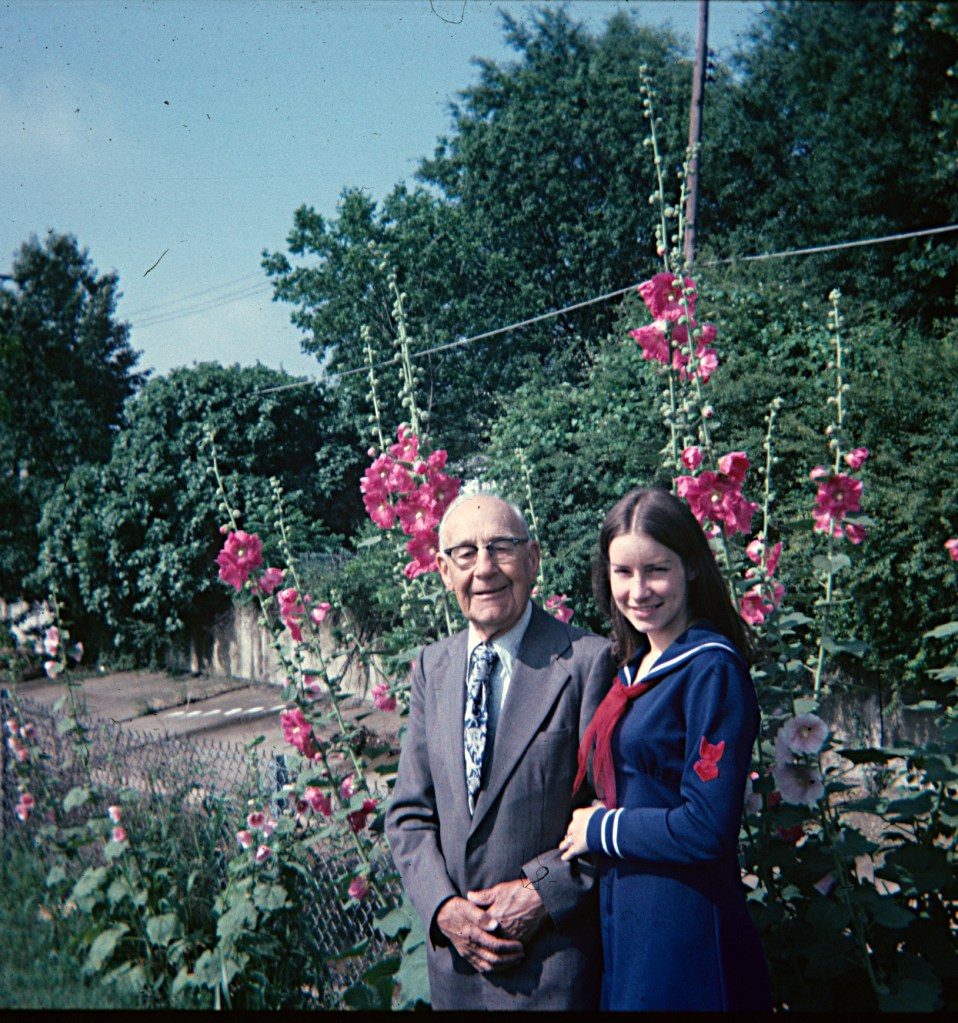
Without that, I return to an earthly example. I see Jesus in the eyes of my Grandpa Peterson. His gentle, kind eyes model for me what it feels like to come to Jesus as a little child and feel warmth and unconditional love.
In the news this week: the head of a national Christian organization falls from grace after preaching about moral failure. I’ve been thinking about how preachers (okay, I’ll make it personal—how I) tend to protest too much or preach the loudest about the very thing I struggle with.
This reminds me of the time Scott and I were staying at a hotel in North Carolina when the fire alarm screamed in the middle of the night. Scott took his time getting out the door. He wanted to get dressed first, go to the bathroom, and find his wallet. He said he saw no smoke and felt no heat, so he wasn’t worried.
I, on the other hand, panicked and urged him to flee immediately. I had visions of us perishing in the fire together if I waited for him, thus leaving our children to fend for themselves as orphans. It was a double-bind: follow my husband’s lead and die together or follow my instincts and run? My choice was to leave without him and let him come at his leisure. But as I descended the third flight of stairs, guilt set in that I had abandoned him, and I slowed my pace. Why wasn’t he catching up to me? Did he have a heart attack? Did his bad knees give way? Did he need my assistance?
What I didn’t know was that we had each chosen a different stairway to descend. In the end, we both got to safety—even though there was no danger from a fire. It was a false alarm.
If I had to do it over again, I think I’d wait for Scott. In fact, the next time it happened, this time in Chattanooga, we took our time and went down together (yup, another false alarm).
So how does this story relate to the fallen preacher? We all need transparency and accountability in our struggles. We’re safer when we do life together.
A 2025 Update. As I read back over this entry, I admit I’m not sure about my conclusion in this double bind. Was I really safer waiting for Scott? I don’t know, but I do know it felt less stressful to stay together.










 In the Pursuit of Peace