Galatians 5:19-21 lists “acts of the flesh” as “immorality, impurity, sensuality, idolatry, sorcery, enmities, strife, jealousy, outbursts of anger, disputes, dissensions, factions, envying, drunkenness, carousing, and things like these.”
I’m not too worried about drunkenness, orgies, sorcery, and idolatry. But what of selfishness? Or outbursts of anger? Or envy? Are we not all guilty of these at some point?
This is more than a list. It’s an admonition for self-examination. And so my prayer today, Lord, is for You to reveal and expose any area in my life that does not exhibit a fruit of the Spirit.
Later. That’s the quickest answer to prayer I’ve ever had! Yesterday was an emotionally draining day. It will forever be known in my mind as “Meltdown Day.”
Probably ten years ago, I got ticked off with a friend over an issue that affected me. She promised to take care of it, but she never did. Year after year, I stewed inside, waiting for her to fulfill her promise. Up to now, she’d always put up a brick wall when I brought up the subject.
Well, yesterday, the subject came up again, and I was surprised when she said she’d handle it. Now, it appeared that a little door had opened in her wall, and it felt safe to walk through it.
Wrong. She got triggered and slammed that door in my face. The why is her story, her issue. But my response was so out of character and out of line that I knew it tapped into something deep inside. I had been working through a grief issue just before this incident, and it was not finished yet. This seemed to blow it wide open.
I grabbed some Kleenex, hopped onto my bicycle, and rode to our local playground. I cried for over an hour before I started to process my anger, envy, and grief. It took another couple hours to talk it out with my friend.
Deep wounds take a long time to heal and release, I think. But why are they there in the first place? Perhaps because of our own sin. Perhaps because of other people’s sin against us. Or maybe it’s just lies we believe. Guilty. I raise my hand. Guilty.
I have been struggling, fighting, working at getting some uninterrupted quiet time first thing in the morning. Not happening. This time is so precious to me, and when I have to give it up for whatever reason, it leaves me irritated. Why? What’s going on here, Lord? I know spiritual warfare is part of it.
I woke this morning with this childhood song in my heart: Jesus is the joy of living. But it doesn’t feel true today.
When, on this earth, will I quit struggling to keep Jesus as my joy? I get annoyed, upset, angry, peeved, frustrated, ticked off at so many stupid little things. I’m tired of it! Why can’t I just have a “poof pill”? POOF! And the anger is gone. Actually, giving up anger is the only way to make this happen, but it’s a lot of work getting to that place of peace. I’m a slow learner.
I know irritations in life are inescapable, but how I respond to them is up to me. Lord, give me peace.
A 2025 Update. I am in a different season of my life now and have more control over my schedule. Finding alone time is no longer an issue. Maybe that’s why my heart easily agrees that Jesus is the joy of living.
Burnout is a dead campfire. No spark, no heat, just cold ashes. No life left to warm others. No energy to cook. Useless. It needs an outside source to reignite the wood. And rain further diminishes any chance of catching a spark. Cool and damp, I retreat to my tent.
AI-generated
I remember my experience in Grade 6 at Camp Barakel.* One night we were scheduled to camp outdoors, but for some reason our counselor decided to forgo setting up tents. In the middle of the night, rain sent us dashing to our cabins—clothing, hair, and sleeping bags soaked. Shivering and shaking, I wrapped myself in my one dry towel for the rest of the miserable night.
I don’t know how to release the bone-chilling shivers in this memory. It reminds me of the day my dad, my brother, and I got caught in a downpour on our motorcycle on an African footpath. As soon as we reached home, Mom stoked the fire in the wood stove to heat up some water, stripped off my clothes, and plopped me into the tin bathtub. I think I’ve hated being cold ever since.
As I sit with the memories and release my anger and blame, I notice my campfire has a single flame, fed by a wick where oil flows steadily beneath it—God’s eternal supply. I venture out of my tent and savor the warmth. Perhaps I’ll have enough strength now to face tomorrow.
Simplicity or minimalism is better than clutter. Because it’s easier to clean around. Because I spend more time on what’s really important in life. Because it streamlines my work.
Things are to be used. If you’re not using them, why keep them?
We get emotionally attached to things. Childhood bonds to things may be the strongest. (e.g. my Funny Monkey). What’s important to me may not be important to you because we don’t have the same bonds.
It’s easy for me to throw away what I’m not attached to.
Things are temporal, of the earth. They bind us, tie us up, hang us—unless we can let them go.
There can be too much of a good thing. There can also be too little.
I can think of no possession I have that I wouldn’t be willing to part with—except my journals, because they’re irreplaceable. But if having them gets in the way of my love for God and service to Him, then I’d gladly give them up. Even pictures, as precious and irreplaceable as they may be, what’s in the heart is what counts in life. I’d prefer to not be tested in this, though. But God knows my heart.
“Funny Monkey” still has my name tag on it from boarding school.
A 2025 Update. I’ll never get my husband to read The Gentle Art of Swedish Death Cleaning – How to Free Yourself and Your Family from a Lifetime of Clutter by Margareta Magnusson. Living with a clutter-bug who feels more secure with his things crowded around him, I laughed when I saw this sign at the paint store. Apparently, my Swedish roots are showing.
Barkono is a Hausa word meaning “pepper.” After losing all taste and smell for a full year after COVID-19, I decided to celebrate its 50-75% return by indulging in the joy of once more tasting spicy flavors.
I started by searching for ethnic restaurants in Murfreesboro. Not surprisingly, Chinese, Thai, and Mexican were the most prolific. And then I researched available varieties in Nashville—much more cosmopolitan of course.
Nigerian
In January, when Scott and I drove to Nashville for an appointment, we stopped on the way to visit our daughter Sharon who teaches ESL at Legacy Mission Village, a school for refugees. Though the culinary choices in that neighborhood were numerous, I opted for the only Nigerian restaurant in the city. We followed our GPS to Nico’s Restaurant and Bar. The large room was dark and empty except for one man sitting at a corner booth. He greeted these turawa (white people) and motioned us to a tiny, sliding glass window at the back of the restaurant.
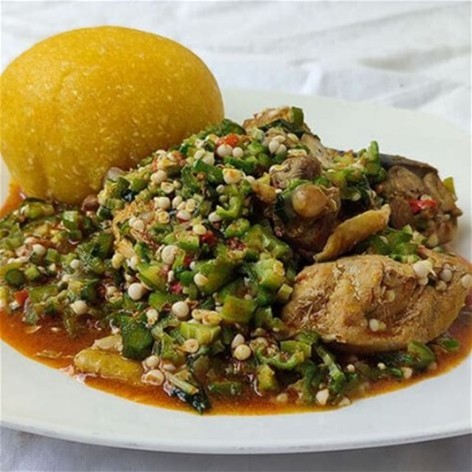
I asked the owner if she had any tuwo da miya (my favorite northern Nigeria dish). Sadly, she said she was from the South and only served fufu and pounded yam. I asked for the spiciest dish on the menu, and she recommended the okra soup.
Scott cannot handle anything spicy (yes, opposites do attract), and he cannot tolerate this African American eating any food with my fingers, so I ordered take out and reheated the dish when I got home that evening. Deliciously satisfying!
In September, My sister Grace arrived from California to join my brother and me for a sibling reunion in Georgia. On the way home from the airport, stopping at the Nico restaurant was a must. Two large, boiled chicken legs filled her bowl of okra soup. Not her favorite she said. I was happy to polish it off.
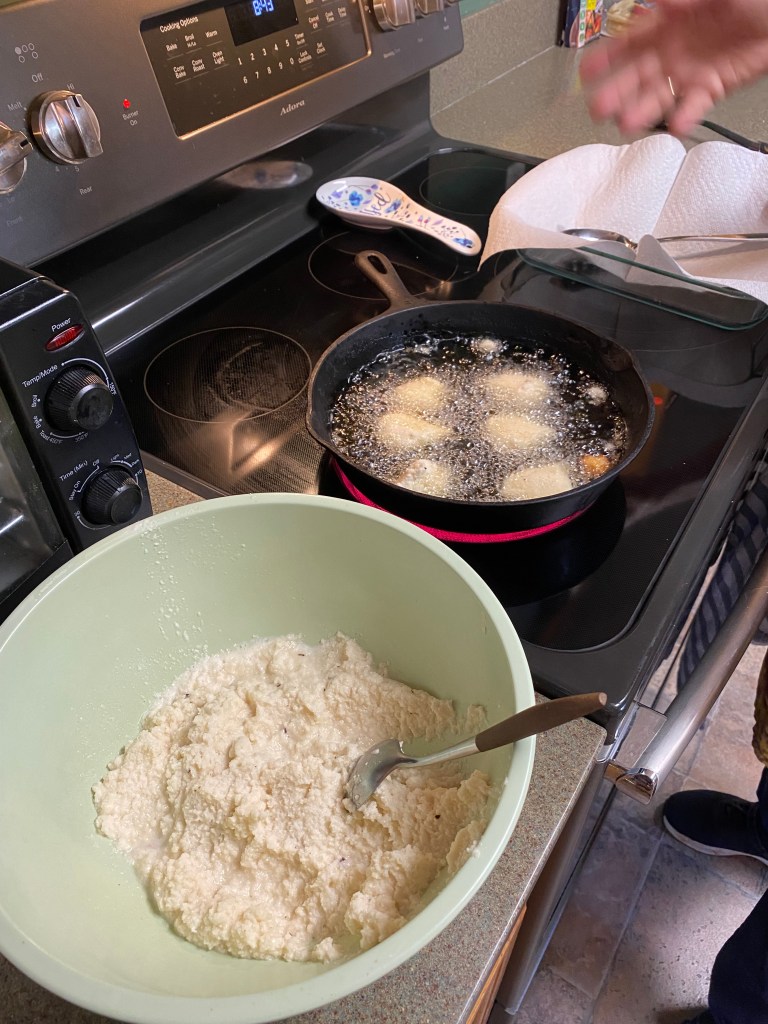
And then Grace asked me to make some kose (deep-fat-fried, black-eyed-pea beancakes). Much to Scott’s chagrin, it took a week to get the musty odor out of our house. I think the peanut oil was too old.
Korean
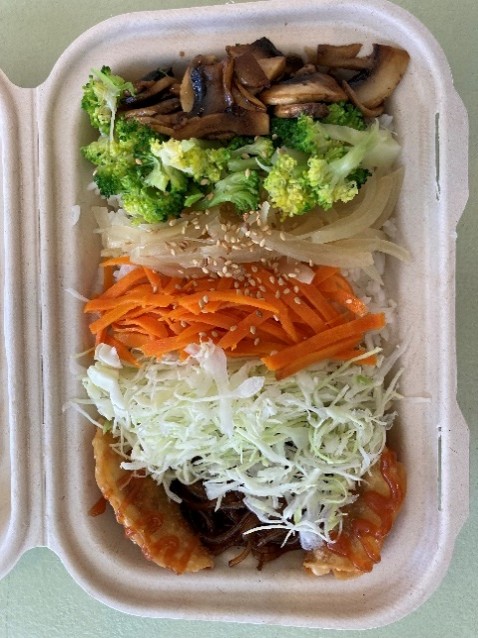
February’s wet, gloomy weather drove me to try Cup Pop Korean Restaurant, across the street from MTSU. Two ladies, chattering away in Korean (I presume) lent authenticity to the atmosphere of this little hole-in-the-wall eatery. I opted for vegetarian and spice level 2. (Next time I’ll bump it up to 3). Instructions were prominently posted on how to eat this delicacy: Pour your sauce cup over the rice/meat/veggies, stir, and enjoy. “But don’t pour over the dumpling,” the cashier admonished. Oh … my … goodness! I thought I only had enough room for half a serving, but I couldn’t stop myself from consuming the whole thing. Amazing! I brought home the remainder of my sauce, planning to toss it over my next bland meal.
Italian
Once a week, Scott and I order online a large, one-topping pizza (half pepperoni for him and half jalapeño peppers for me) from our nearby Papa Johns. I’m on a first-name basis now with Seth who greets me as I walk through the door. A home movie and a pizza. Can’t get much better than that!
Indian
One day while waiting for a friend to get out of surgery, I was delighted to discover the hospital cafeteria that day was serving Indian butter chicken with cauliflower, sweet potatoes, and chickpeas over a bed of rice. Warmed my heart! I felt sorry for my friend’s pain, but this delicious meal made my wait tolerable.
Mexican
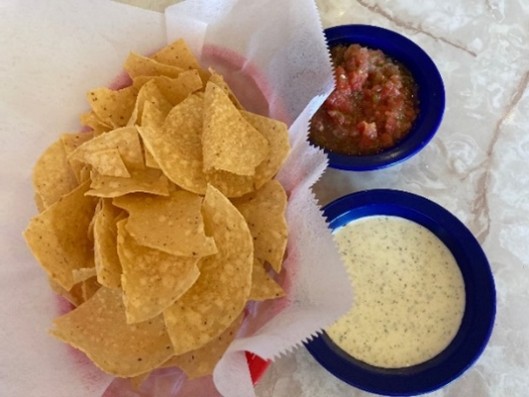
In March I indulged my craving for Chuys Mexican Restaurant’s creamy jalapeño dip and chicken tortilla soup. I always bring home leftovers.
And since I was out of town for Mothers’ Day, Scott surprised me later with a trip to Mi Patria, a new Mexican restaurant in town. I tried their fish tacos. Quite tasty, but the only spice came in the salsa dip for the chips. Since Scott does not care for Mexican, and spice does not fare well with his system, this was truly a sacrifice for him. He had steak and fries.
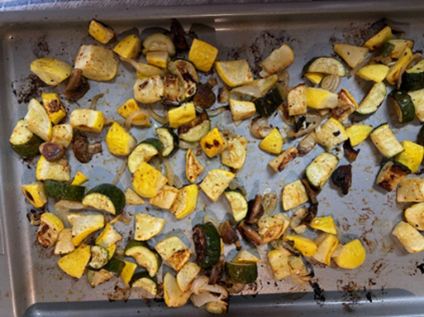
This summer, A friend gave me some home-grown summer squash (which I oven roasted with zucchini, mushrooms, and onions) and another friend gave me some tajin spice (chili peppers, sea salt, and dehydrated lime juice). Put the two together, and the result was indescribably delicious. I wonder what tajin would taste like on popcorn.
Thai
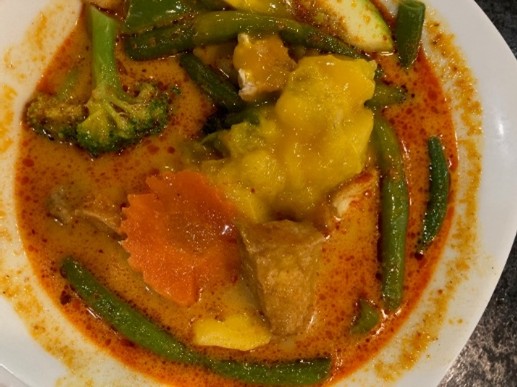
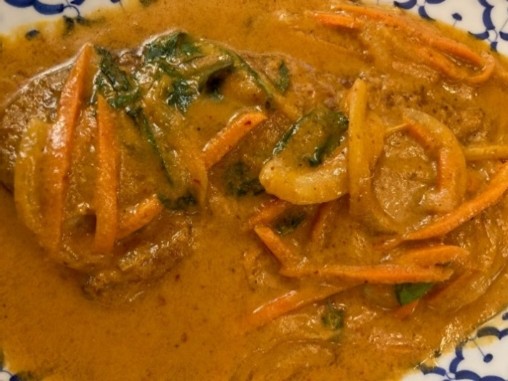
In April, my birthday month, friends treated me to two Thai restaurants. At Thai Pattaya, I ordered coconut curry with tofu and veggies (spice level 2) and at Bangkok Thai, red curry with fish (spice level 3).
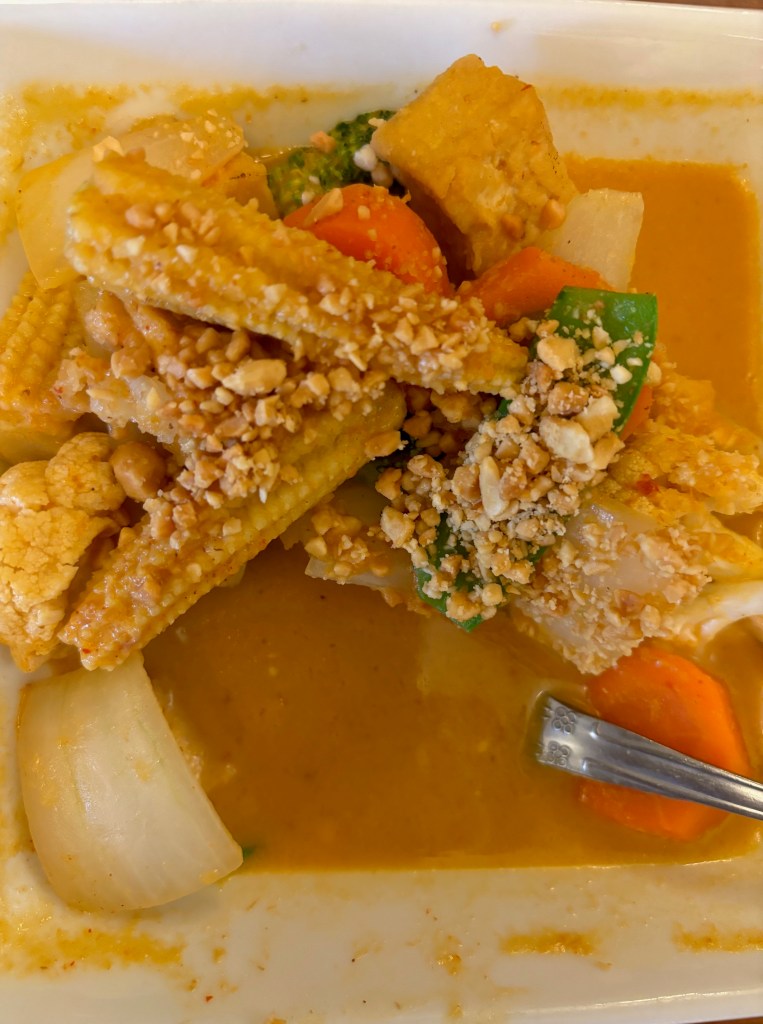
In October, Scott and I returned to Bangkok Thai with a gift certificate for our anniversary, and I ordered the massaman curry dish with tofu. Though delicious, it was too mild and soupy. We were surprised when the bill came to $6 higher than the menu stated. Apparently, we had neglected to notice the $3-each extra charge for brown rice. But I guess I must have enjoyed it, because I consumed it all instead of taking home leftovers!
Ethiopian
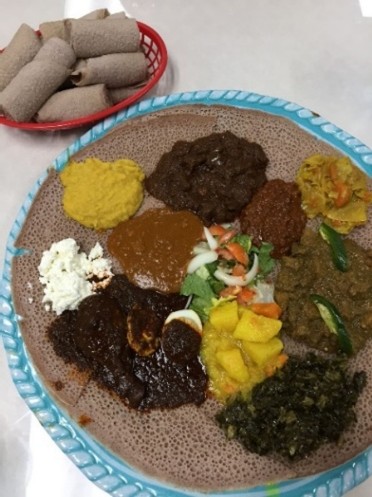
My Life Group at church meets for a potluck every other Sunday, and the theme one week was international food. Since I was already in Nashville to attend the open house for Legacy Village Mission, I stopped by Rehobth Ethiopian Café, a take-out- only establishment that still had the remnants of COVID-19 restrictions. Undeterred, I ducked under the plexiglass partition in the doorway to place my order. Though Minna, my ministry partner from Ethiopia, raved about the food, I felt disappointed. Apparently this restaurant matches the poor man’s injera that she grew up with, and I am more familiar with the upper-class variety (pictured here). Though I craved the spicy meat dish option (30 minutes to prepare), I chose the vegan combo (10 minutes) since I would have had to sit in my car in the 97-degree heat to wait for my order. I also missed the experience of sitting around the community dish with my friends, with no utensils but the three fingers on my right hand to snuggle tasty morsels in the delicious bread.
Mediterranean
This next story begins in 1970.
When Cheryl (my other ministry partner and boarding school classmate) had reconstruction knee surgery in June, her home health care provider, Jan, arrived and announced she was not the person originally scheduled to come. The ensuing conversation went something like this.
Cheryl: I just got back from an MK (Missionary Kid) boarding school class reunion.
Jan: I’m an MK too! Where did your parents serve?
Cheryl: Nigeria.
Jan: Me too!
Cheryl: What school did you attend?
Jan: Hillcrest.
Cheryl: My ministry partner went to Hillcrest!
Cheryl (texting me): Guess who’s in my home? A lady who went to Hillcrest.
Karen: What’s her maiden name and year of graduation?
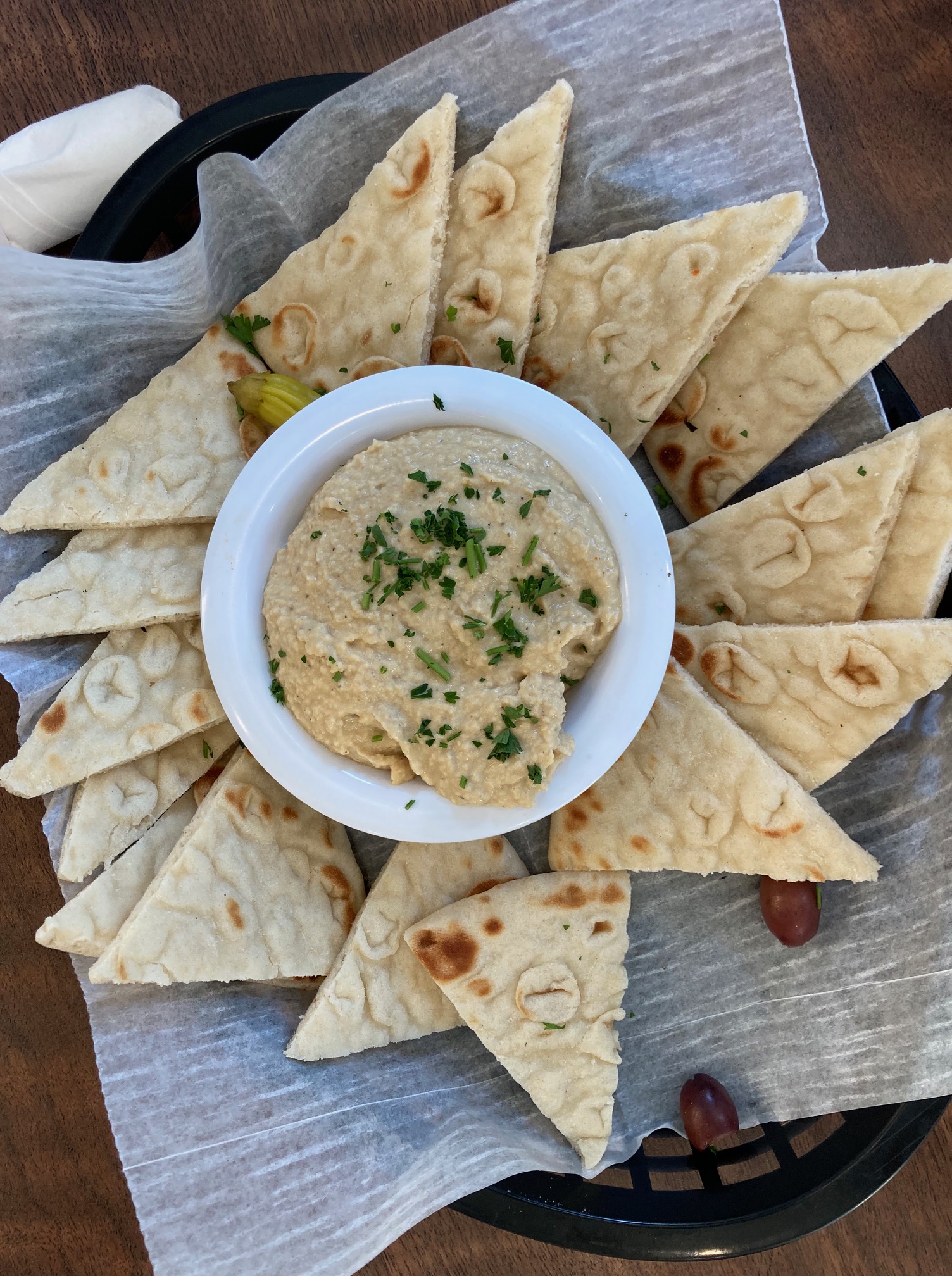
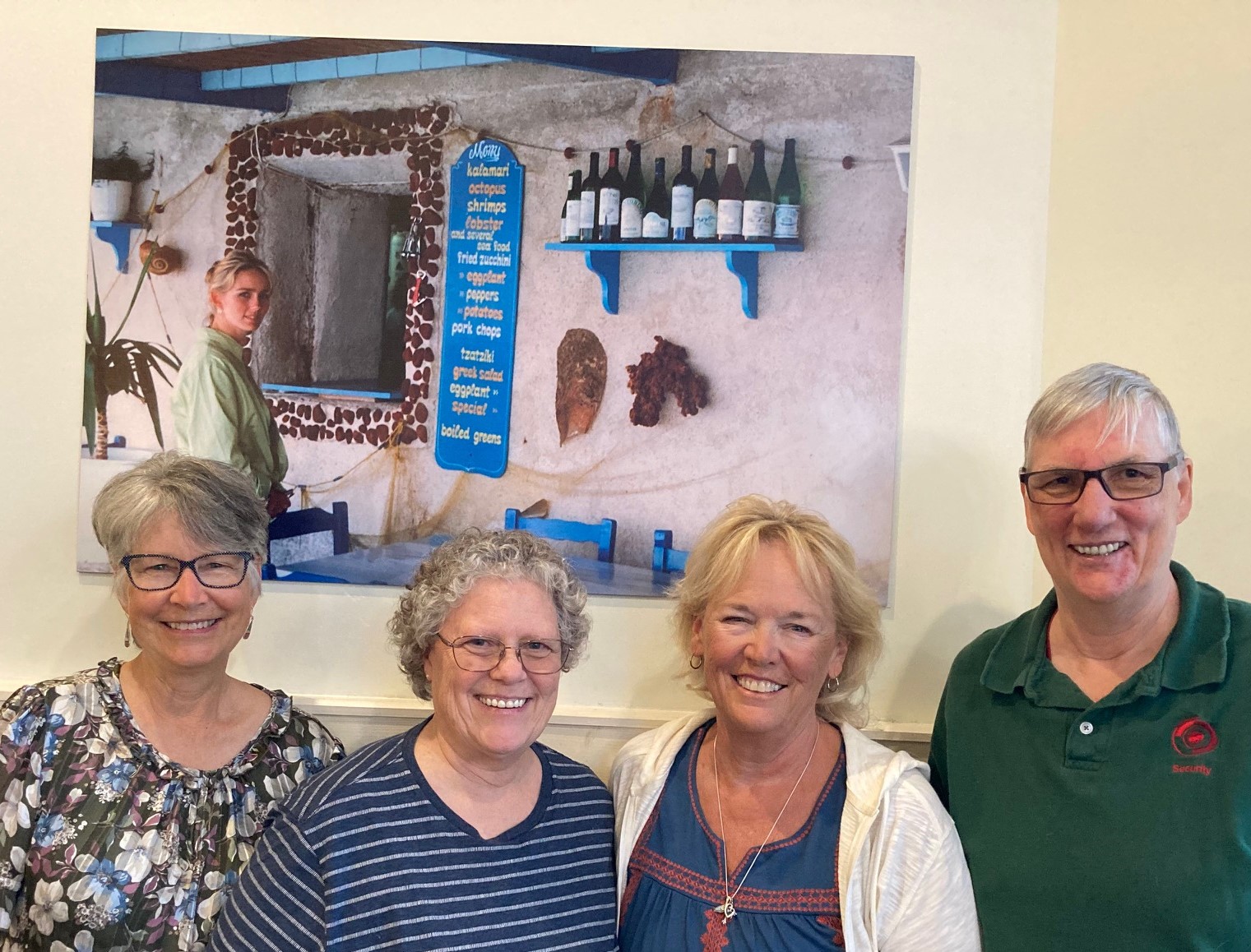
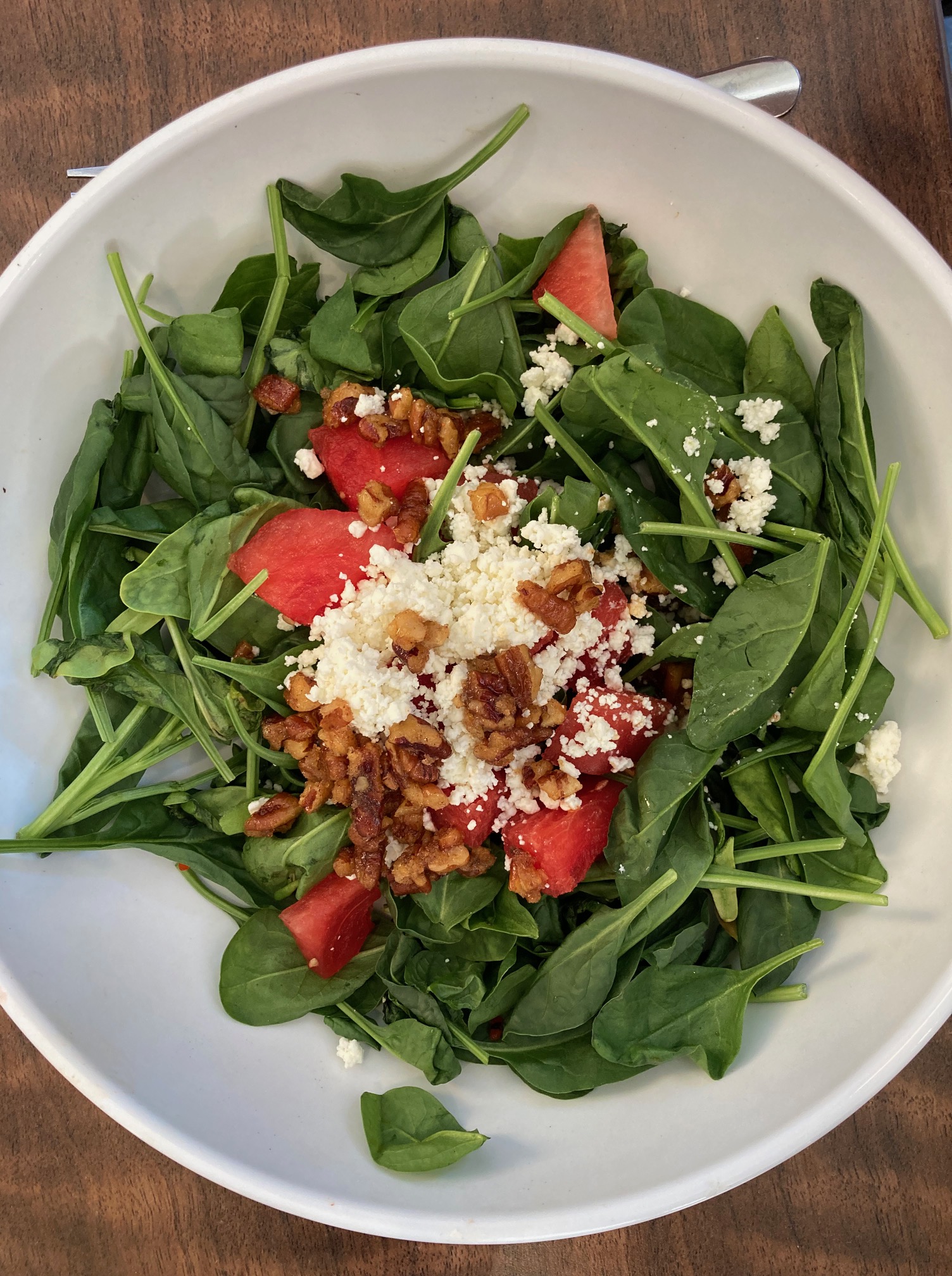
Thus, Jan (a classmate I had not seen in 52 years), Minna, Cheryl, and I met at Taziki’s Mediterranean Cafe. We shared some hummus, and I ordered an amazing watermelon, spinach, feta cheese, and candied pecans salad. Very refreshing on a hot summer day.
Venezuelan
One day my daughter Sharon wanted me to meet a sweet Venezuelan couple from her ESL class who had recently moved to our town. For a taste of home, they recommended Brasas Grill. Thus my friend Carol and I agreed to meet for lunch in August (“As long as the food is not spicy,” she said. It wasn’t.) We ordered chicken-filled empanadas and sweet, caramelized plantains topped with delicious cheese. Tasty and filling, but one visit was enough.
Cuban
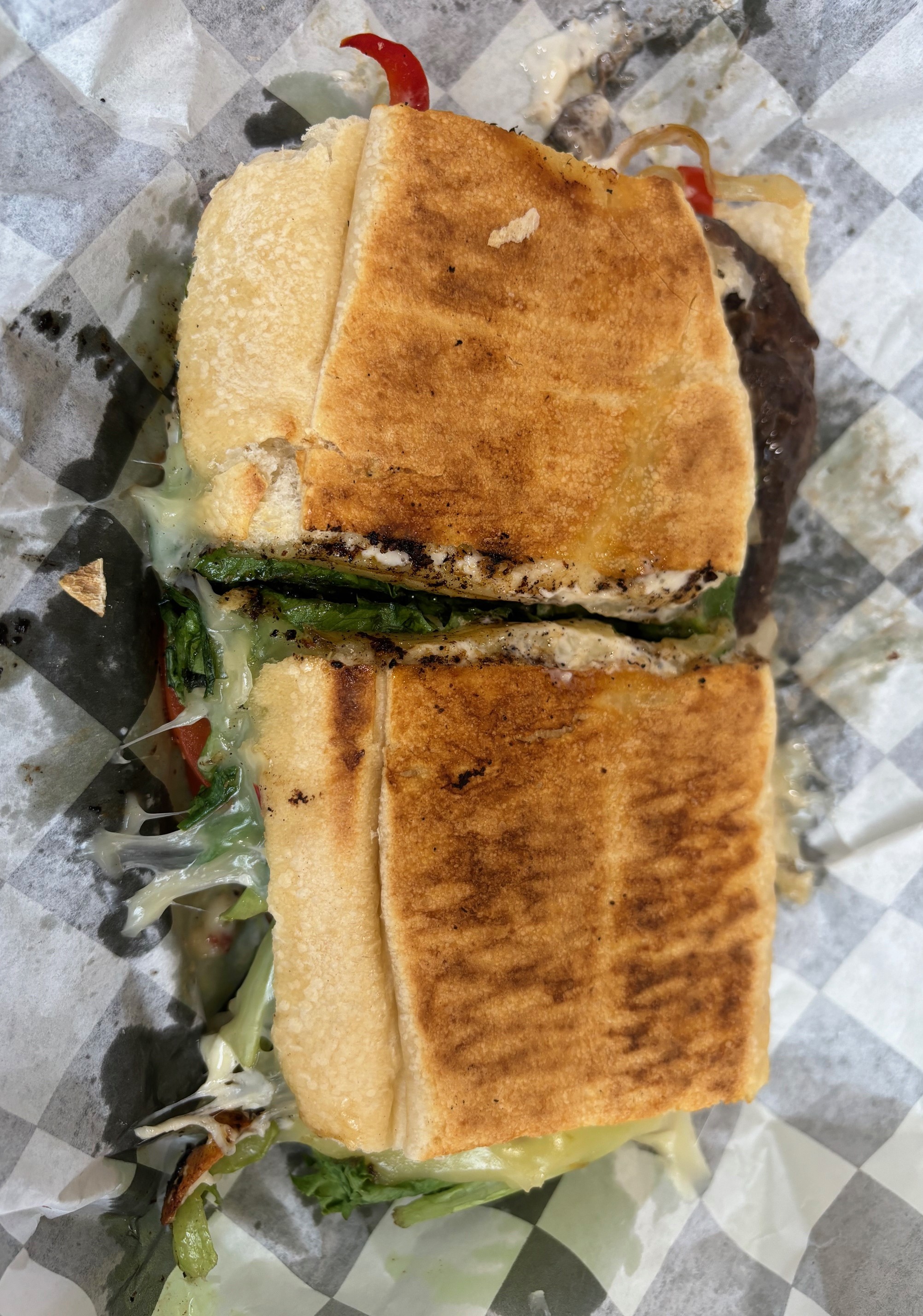
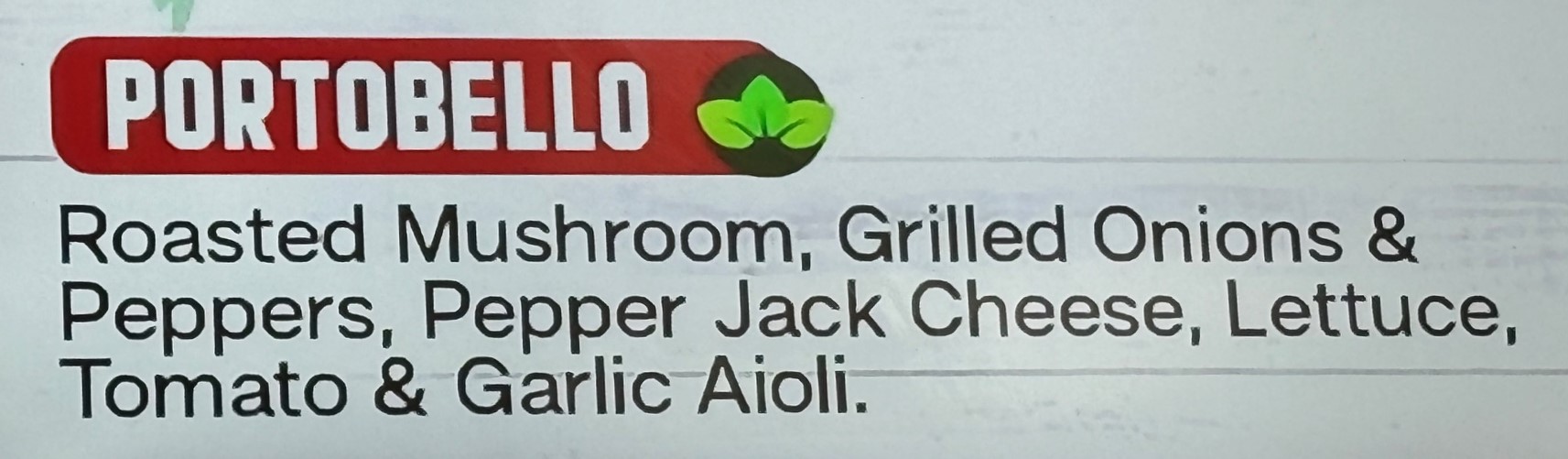
In October, I tagged along with Scott to Chattanooga where he participated in WMBW’s Share-on-thon. Going to the Hamilton Place Mall food court was an easy way to satisfy both our palates. I tried a portobello mushroom sandwich. Though not spicy enough to provide the flavor I was seeking, I enjoyed the crustiness of the toasted bread.
Laotian? Vietnamese?
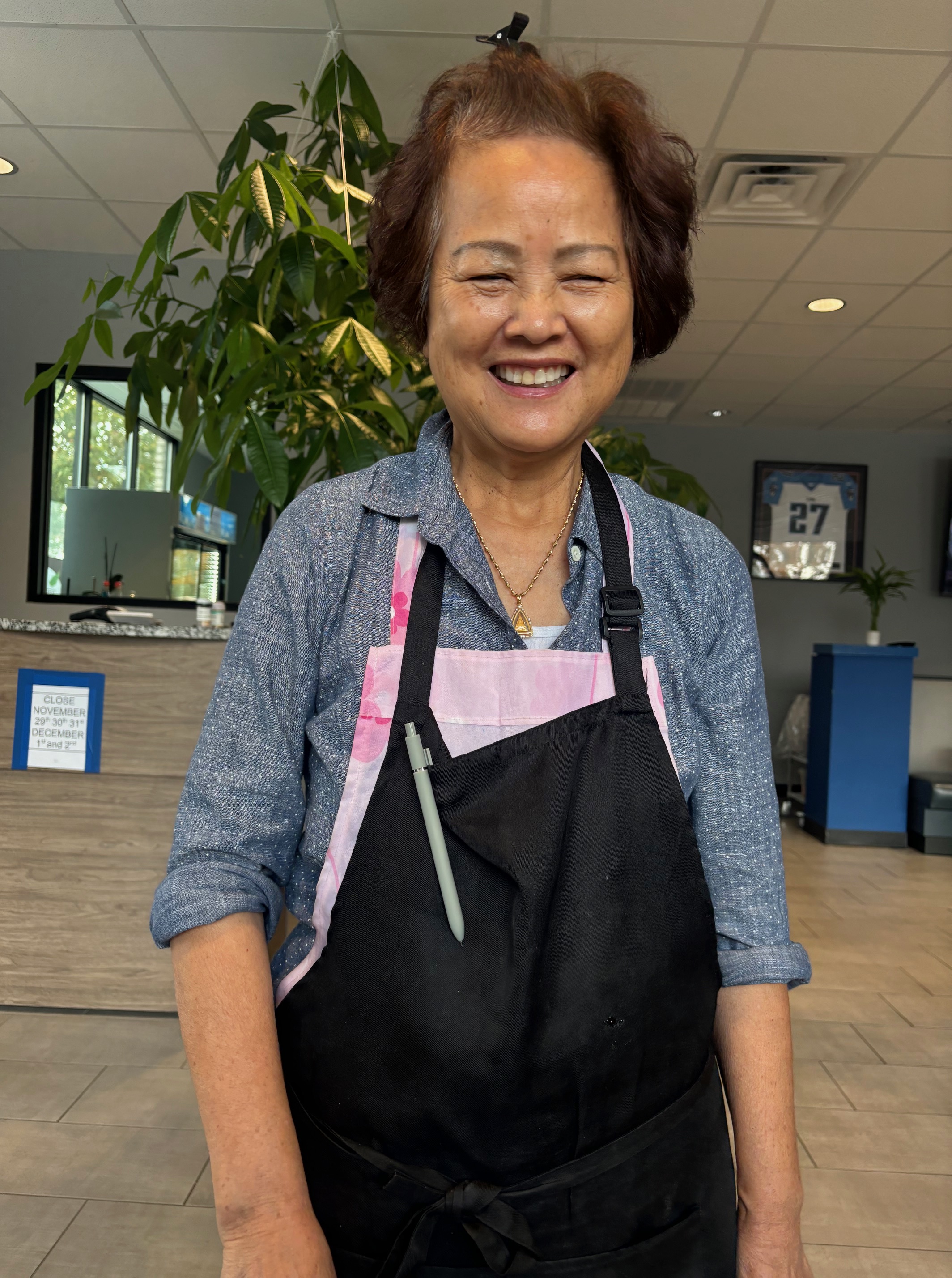
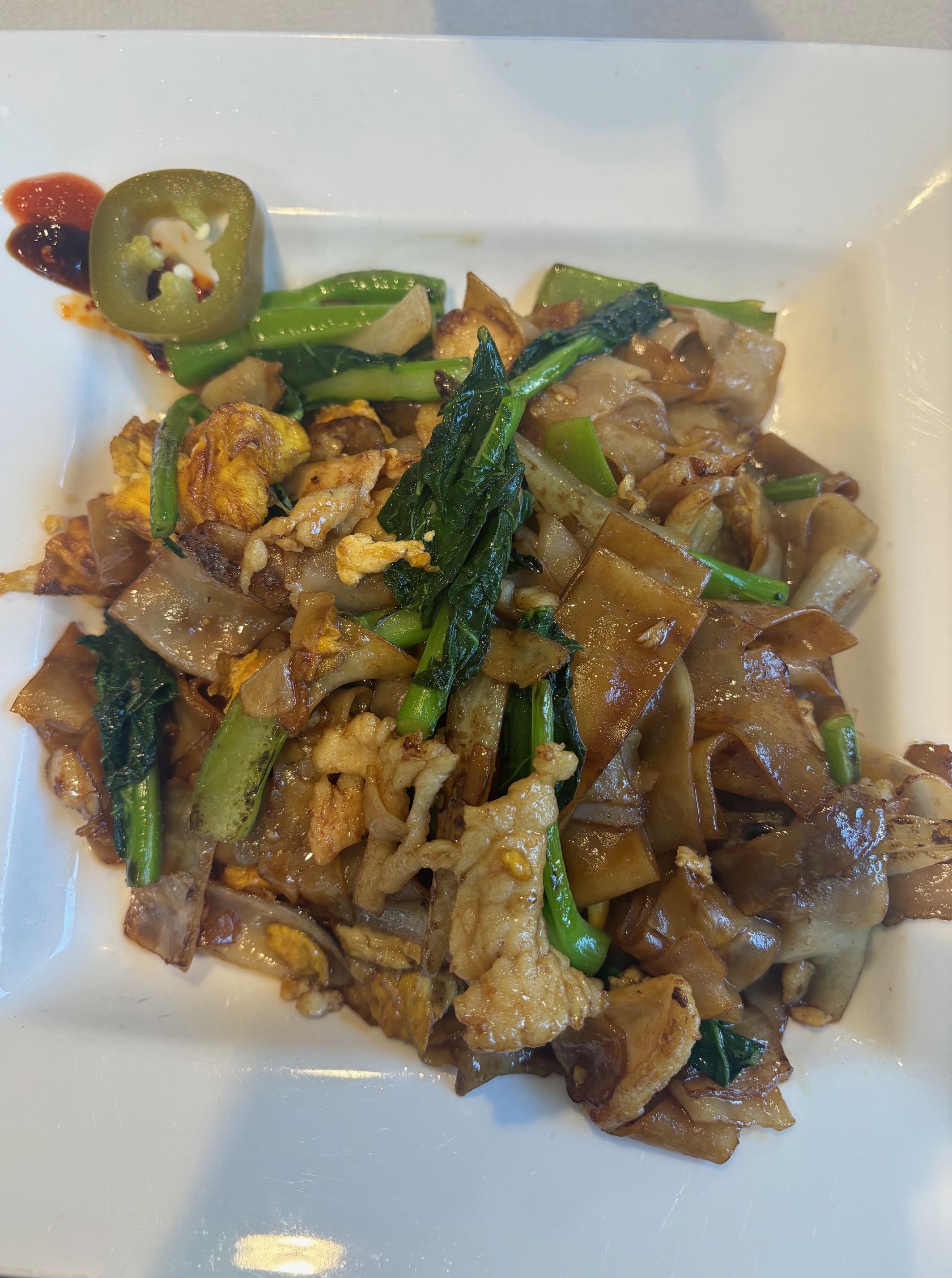
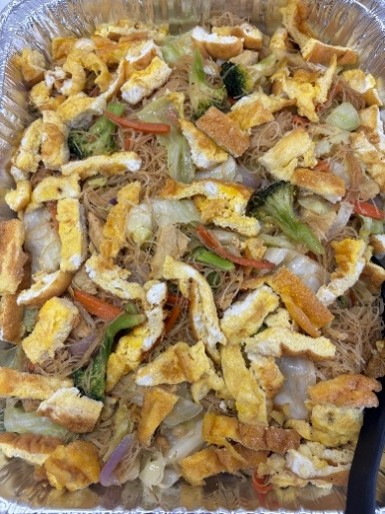
Quite by accident, I discovered an 18-month-old restaurant listed online as Laotian but supposedly Vietnamese just a few minutes from my church. Though near some run-down establishments, inside I found clean, bright booths and tables and a friendly face. Lin (not sure how she spells her name) greeted me enthusiastically and seated me with a one-page menu. Many of the items looked like Chinese or Thai, so I asked for her recommendation for a typical Laotian dish. “My favorite is Pad See Ew,” she said, “with wide rice noodles, Chinese (!) broccoli, and egg—but I don’t recommend you include the carrots.” I took her advice and ordered it with chicken.
This dish originates in Thailand, “so what makes it different?” I asked. “We like our food HOT,” she said. And she proceeded to fuss over the arrangement of condiments on the table, mixing Hoisin Sauce and Sriracha Chili Sauce on the side of my plate, topped with a jalapeño pepper. She then hovered nearby to see how I liked it. “Delicious!” I declared, and she grinned, satisfied. By the end of my meal, we’d exchanged names, I knew she was my age (70) and had lived in the USA for 43 years. Her two kids live out of state, and she works at the restaurant a couple hours a week to get out of the house. What a happy extrovert! To complete my experience, I wandered through the international grocery store next door and drooled over the guava and mango nectars.
International Potluck
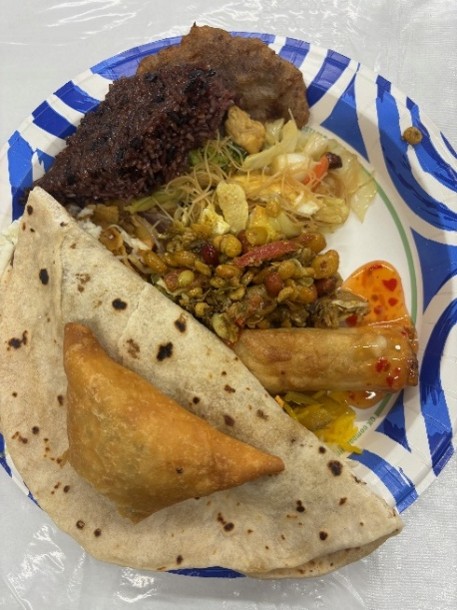
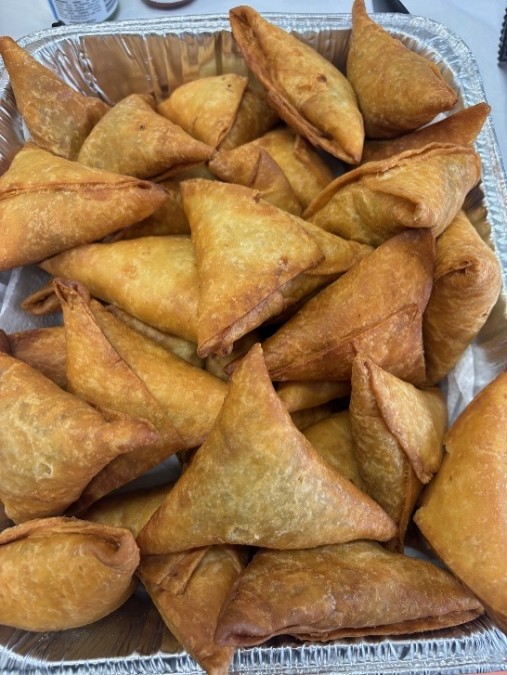
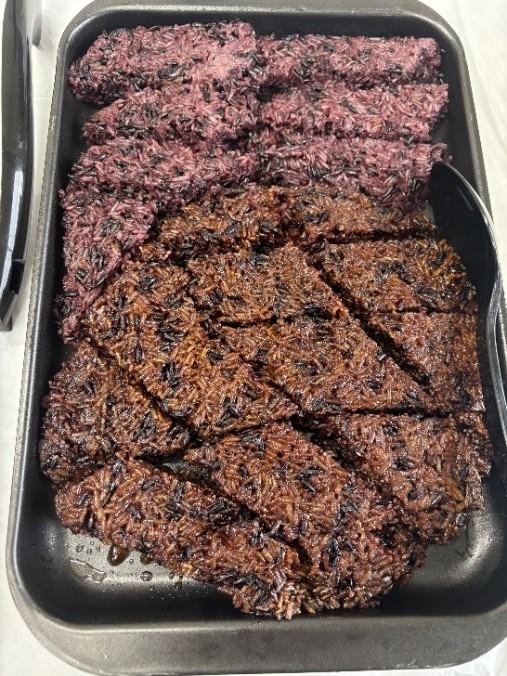
For my last hurrah, I shamelessly invited myself to one of Sharon’s many Christmas parties at Legacy Village, for I knew I’d find a variety of dishes from other countries, including Kurdish, Burmese, and Mexican. Sadly, though all the dishes were tasty, this year not a single one was spicy. To make up for it, I added hot sauces, gifts from friends this year: Cowboy Candy and The General’s Hot Sauce Hooah Jalapeño.
In Conclusion
If you’ve read this far, I suspect the first question you will ask is, “What was your favorite?” Ethiopian and Nigerian topped my list for the best flavor (no surprise there), and Korean for the most unusual. My most fun experience was meeting Lin at Ladna 88. In the end, I enjoyed any dish with barkono.
Thank you to my friends who joined me on this adventure or contributed toward it with your gifts. And thank you to my husband who tolerates my cravings for international cuisine—as long as I don’t eat with my fingers or cook it in my house.
If anyone cares to join or invite me, I’m feeling lickerish* as I search for my next tasty culinary experience.
*Lickerish (adj.) [archaic]: eager to consume delicious foods
It had been an intensive week with a D.I.D. (dissociative identity disorder) client. At the end of the week she stated, “I feel so broken and shattered. What good am I? What’s the point of my life, anyhow? How can God ever use me?”
His answer came to her in a visual. “I’m going to use all your broken parts to create a beautiful mosaic.”
I may not dissociate, but like all of humanity, my life is broken in some way. The parts of my heart lie scattered on a table in a jumbled mess. I give up trying to find all the pieces of this puzzle. I need someone with more creativity, skill, and a mastermind to figure it all out. I hold just one piece in my hand right now. I don’t have the time, talent, or energy to pick up more than one piece at a time. Show me, Lord, what to do with this one piece. Keep me from cutting myself on the edges as I work with it.
I see myself wedged in sideways into the mosaic. I can only influence what I can reach—my little corner of the world. But I can see in all directions—the needs of the world. And I can pray and cheer on the other pieces. And God is making something beautiful out of my life.
There’s a debate swirling around these days about the role of the Holy Spirit. Some claim that only through study of the Scriptures can we know truth; others say we experience the Holy Spirit whispering truth in our ears. I say it’s both/and. We must know the Scriptures in order to test the spirit’s voice. The Holy Spirit’s words will never violate the written Word.
Some people argue, “You can’t trust your experiences,” but I retort, “That’s all we have! Everything that has ever happened to us is our experience, and we live our lives accordingly.” My experience will be different from yours, and this is okay. The goal is to get rid of the lies we believe in those experiences.
Some would admonish us, “Don’t seek an experience,” and I think they may be right. If one person experiences a spiritual high of some sort, I don’t have to go chasing after it to duplicate it. God will give me the experiences I need. My goal is to continually seek Him, pursue Him, and look for the treasures in His Word.
A spiritual experience can come from the outside—such as a visitation by an angel. This is not something I can manipulate or orchestrate. It’s God’s doing. But experiencing God on the inside, in my mind, happens because I choose to open myself up to Him—when I choose to obey, to let go of bitterness, anger, and unforgiveness. It comes when I fill my mind with good things and not evil ones. It happens when I guard my heart against the lies and wiles of the devil. It happens most often when I spend quiet, alone time in God’s presence, just being still. It’s the place of meditation. It’s where Jesus is. It’s where God’s Spirit speaks to my human spirit.
My college graduation following my senior speech recital
Journal 2006
My college professors for my oral interpretation major taught me to critique other students’ work. And as a speech and drama teacher, I had to give my students constructive feedback. Sometimes, however, the students felt more criticism than critique. How can I tell the difference?
Often driven by mean-spirited emotion, the purpose of criticism is to put another person down in order to lift myself up. The tone is one of superiority. Criticism reveals my trigger points and devalues the other person.
The purpose of a critique is to evaluate and analyze. It originates in the mind. Its tone is one of equality. It desires improvement and suggests cooperation.
I am far too critical and vocal about other people’s faults. It is wrong for me to air another person’s dirty laundry in front of others. It takes away the person’s dignity. Why do I believe my way is superior? Why am I impatient with others’ choices? Who died and made me queen?! It’s time to confess my sin of arrogance and criticism.
A 2024 Update. I’ve learned that feelings of inferiority and insecurity lay behind my pride and criticism. I pray that my students can forgive me for my less than stellar attitude and actions. Though I’m no longer in a teaching role, my critiquing skills help me ask questions of my clients to help them discover areas where they overcompensate.
Why is it sometimes easier to absorb negative comments than positive ones?
When someone says something negative to me, I tend to accept the curse of their words, allow the knife’s edge to pierce my heart, and begin to believe the lie that their words are true. And then I protectively shroud my heart. But when I agree to let go of my protective cover and feel the hurt, God heals the wound, and the curse of the words dissolves. Once the curse is broken, someone may repeat those same ugly words, but this time they’ll be deflected by the shield of truth.
When someone says something positive to me, however, it’s sometimes harder for the blessing to sink in. For example, you might tell me I’m beautiful. But if I believe I’m ugly, I will deny your blessing, and it will bounce off my head and never absorb into my heart. It’s all about lies I believe.
James 3:10 (NIV) says, “Out of the same mouth come praise and cursing. My brothers and sisters, this should not be.” I am responsible for what comes out of my mouth, and I am responsible for processing what’s in my heart when it comes out of yours.
For further reflection, here are some examples of blessings and curses in the Bible.
God spoke a blessing after He created the earth. “This is good!” He declared. (Genesis 1:24)
God cursed the ground after The Fall (Genesis 3). To live under a curse is a terrible thing. Heaven will be a lifting of the curse and a return to beauty and perfection.
God cursed Cain as a punishment for murder (Genesis 4:11). Yet, even in the curse, God placed a mark on Cain as a way of escape. Mercy.
Abraham understood the power of blessings and curses. God said to him, “I will bless you … You will be a blessing … I will bless those who bless you, and I will curse him who curses you … In you shall the families and kindred of the earth be blessed, and by you they shall bless themselves” (Genesis 12:1-3).
Jacob wrestled with the angel and would not let him go until the angel was willing to “declare a blessing on him” (Genesis 32). What does this mean anyway?
Pagan Laban said to godly Eliezer, “You are blessed of the Lord” (Genesis 24:31). He spoke true words even if he didn’t understand them.
The Lord blessed Potifar’s house “for Joseph’s sake; and the Lord’s blessing was on all that he had in the house and in the field” (Genesis 39:5).
Jesus became a curse for us. “Cursed is everyone who hangs on a tree” (Deuteronomy 21:23). If just ONE curse on our heads brings wounding, my imagination isn’t great enough to fathom the curse of the world on His shoulders. He felt all my sin, all the curses I’ve ever spoken. The world itself—that He made with His own hands—rejected Him, thrusting a giant sword through His heart. In one agonizing, painful moment He knew—He could identify with soul wounds. He never believed a lie, but He felt the curse. A terrible moment in time. But He broke the curse!
“Anyone who does not carry his cross and follow Me cannot be my disciple” (Luke 14:27).
What does following mean exactly?
It’s walking behind Someone on a footpath. When you come to a fork in the road—a crisis like death or illness or disaster—you continue to stay behind the Leader, not stray off the path or choose another fork. It’s trusting that the One you follow knows the way through the wilderness.
John 12:26 says, “If any of you wants to serve Me, then follow Me.”
What does it mean to serve? Is that the same as following?
When Jesus washed the disciples’ feet, He said, “What I’ve done, you do.” Did He mean that we should have foot-washing ceremonies? I serve my family by cooking for them, cleaning the house, running the household. But it’s more than that. Serving others is a heart attitude.
When I serve others, I’m following Jesus. When I follow Him, I will serve others.
A 2024 Update. When I first began meeting with clients for inner healing prayer, I was appalled to learn that some of them believed that serving others meant self-abasement, self-neglect, or laying themselves down as a rug to be trampled. But lying on the pathway renders them incapable of following the Leader. Fortunately, God is patient. He will allow us to stay there until we cry out to Him for help. Once we can stand, we can follow Him.




















 In the Pursuit of Peace