We don’t fit right because we were shaped for something else.
“Compassion fatigue” occurs when we become less willing to help—because the recipients of your help fail to improve.
We must differentiate between:
Relief (crisis from natural disaster)
Rehab (restoration to positive elements before crisis)
Development (process of ongoing change that moves all the people involved—both “helpers” and “the helped”—closer to being in right relationship with God, self, others, and creation.)
Don’t apply relief when development is needed!
Avoid paternalism—doing things for people that they can do for themselves.
We are not bringing Christ to poor communities. He has been active in these communities since the creation of the world, sustaining them by the power of His word (Heb. 1:3). Hence, a significant part of working in poor communities involves discovering and appreciating what God has been doing there for a long time!
Change begins when something triggers an individual or group to reflect upon their current situation and to think about a possible future situation that they would prefer.
Three common triggers:
A recent crisis
The burden of the status quo becoming so overwhelming that they want to pursue change
The introduction of a new way of doing or seeing things that can improve their lives.
“Never waste a crisis!”
Has anyone else had experience with this topic? In what context?
My parents’ home in Zambuk, Nigeria, as it looks today
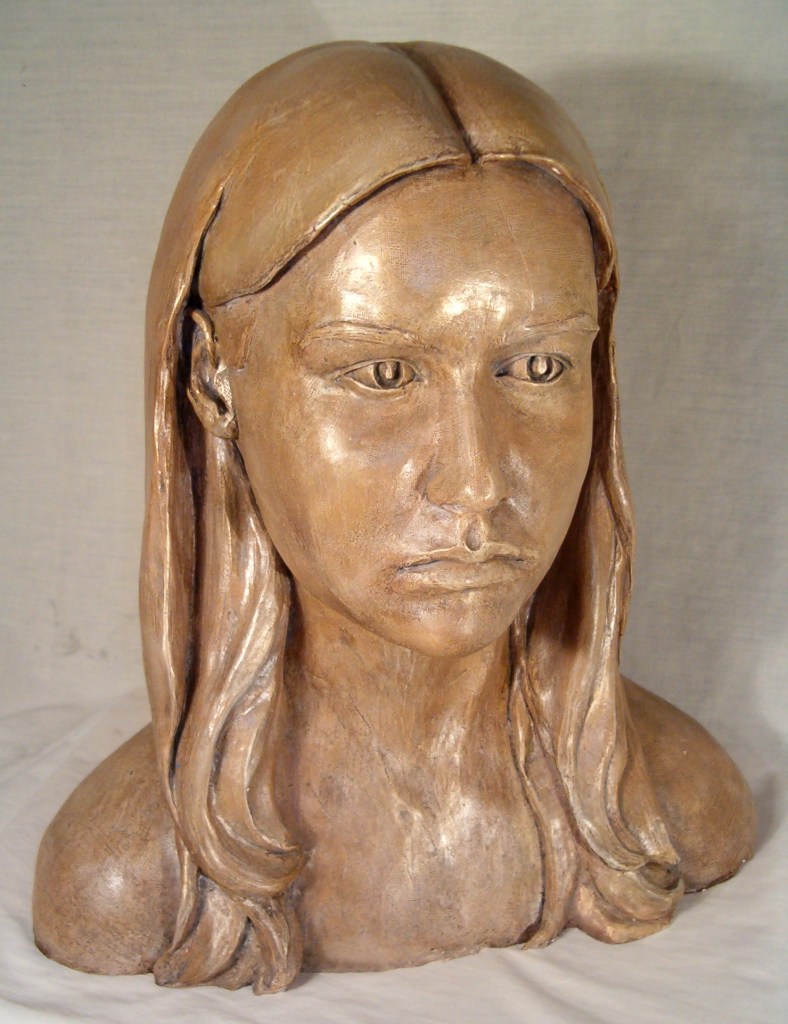
From my 2012 Journal. We tend to focus on different things at different seasons of our lives. For example, when our daughter Cindy took a course in human anatomy for her degree in sculpture, she couldn’t help but notice the shapes of different people’s noses, eyes, and hairlines. As a young mom now, I suspect she’s focusing more on toddler behavior.
Cynthia’s self-bust
I, on the other hand, learned to critique a speaker’s vocal quality and body language for my oral interpretation degree. Perhaps that’s what kicked into high gear last night when I attended an evening church service. I found myself distracted by what I observed on stage. The words to a song splashed onto the screen, the worship leaders stepped up to the front in unison, each dressed to perfection—except that I think one is too perfect—I wonder what that rigidity looks like in her daily life?One dresses fashionably, I muse, but the fashion doesn’t suit her. Another is not petite enough. (What?! I just critiqued “the perfect one” as being too petite!) Arrggh! What’s wrong with my mind? I’m noticing the outward appearance, but inwardly, I’m critiquing: too perfect, too immodest, wounded, relaxed, etc.
I’m not God, and I can’t see into another person’s heart, so where do I come off having the right to judge and critique someone else’s inner soul? Yes, the externals give clues to the internals and, because of my counselor’s training, I’m getting better at noticing. But I don’t like the consequences. It’s distracting to my focus on worship. I’m not these people’s judge . . . or have I become one? When did I take on this role, and how do I stop it? It’s one thing to notice; it’s another to critique and then to judge.
So why do I do it? I think to myself, This person needs fixing! Yikes! What an ugly thought! That’s God’s job, not mine.
What if I focused on creativity and beauty instead of flaws? What if I celebrated our differences and our choices instead of our motives? Celebrated the colors on stage. Observed the style of clothing from a designer’s eye, appreciating the variety of shapes and sizes and textures rather than as a critique of a person’s character. I need to separate the physical from the internal.
So when does assessment turn into judgmentalism? Or pride? Or contempt? Or pity? Or concern? Or compassion? Have I created a standard in my mind for right and wrong that is different from God’s standard? God’s measuring stick is absolute (don’t lie, hate, lust, covet). My standard is a moving target based on cultural norms, a person’s age, historical time periods, etc.
And so I begin by stating an observation regarding externals:
She’s large-boned / He’s shorter than average
She wears high necklines / she has a plunging neckline
She has 4 visible tattoos / he has none
She wears tight-fitting jeans / he wears saggy pants
He has shoulder-length hair / she has short, spiky hair
It becomes an assessment when I draw plausible conclusions based on past experience or training. The assessment is not wrong IF I acknowledge that it is an educated guess: it could be that . . . I wonder if . . . most people like this are. . . . But concluding (without knowledge) what’s in a person’s heart is presumptuous. For example:
She’s too skinny / plump because she’s on weight-gaining drugs, she was abused as a child, she has no self-discipline, she has a food disorder, etc.
She shows cleavage because she wants to attract men’s attention, she has a “wardrobe malfunction,” she grew up in an Africa village where it’s culturally acceptable, etc.
She has tattoos because she wants to fit in with her peers, because she wants to permanently remember an event, because she’s rebelling against parental restrictions, etc.
And so on and so forth.
This exercise of the mind morphs into sinful pride (The Elder Brother syndrome) when I begin to compare myself to another person and indulge in feelings of superiority: I would never do that. . . I’m better than he/she. How sick is that!
I think about Zacchaeus the tax collector. How would I have judged him I wonder . . . a short, fat, greedy, mean, traitorous man? But Jesus sees into his repentant, hurting heart and begins a love relationship with him.
Visual: I see mobs of people milling around. Some are blind, others are crippled, and many are wearing arms in slings. Others hide behind facial masks, believing they’re safer that way; but their restricted vision prevents them from seeing the truth. They’re all dressed in filthy rags, covering painful sores. A pitiful lot.
And then I watch as a drop of Living Water falls gently onto one person. Like a drop of soap in a dishpan with oil, the ripples spread out and a path of clean is created. And more drops fall, and the people turn their faces skyward. Blinded eyes see, slings fall off, and crippled legs are straightened. But some are frightened by the foreign matter, and they run from the moisture . . . because water and dirt create mud streaks on their face, and they feel self-conscious.
And so I begin to let go of my judgmentalism. I now see their fear instead of their sin; their timidity instead of their stubbornness.
The rain is gentle and soothing and inviting. I allow myself to be bathed in it, cleansed, forgiven. I sense the sweet wooing of the Savior. And now instead of judgment, I feel sorrow for those who struggle, for I am one of them.
Suddenly the focus of my prayers change. I don’t pray for the person to have a change of heart; I pray for God’s mercy to let a drop of His Spirit fall on him/her. I appeal to God to pour out His love and woo the stubborn, judgmental heart—starting with mine.
Man looks on the outward appearance, but God looks on the heart (I Samuel 16:7).
The shrewd man saw trouble and took cover; the simple kept going and paid the penalty (Proverbs 22:3).
From my 2012 Journal. I’ve often thought about how the Psalmist David fled from King Saul; but the 3 young captives Shadrach, Meshach, and Abednego stayed put and refused to bow before an idol at the king’s mandate. Corrie ten Boom hid Jews in Holland during Hitler’s regime, while others refused to harbor fugitives. What’s the right thing to do? Flee from harm’s way or stand your ground and take the consequences? What about Mary and Joseph? God could have simply put a miraculous, sword-proof shield around the holy family or made them invisible to the soldiers’ eyes. But God chose to remove them from the situation. He told them to flee to Egypt.
What would have happened if David had stood his ground and confronted Saul instead of running? Or if the Jews hadn’t gone into hiding? Or if Shad, Mesh, and Abed had fled the country?
When the Israelites were besieged by the Babylonian army, God instructed them not to resist—just surrender and go into captivity. Instead, the leaders and the people fought back, tried to escape, and hid—and many lost their lives as a result. Later, God told the remnant to do the opposite: stay put and not flee to Egypt. The key, I think, is obedience to the Spirit of God who knows what’s best.
I can’t say I’ve ever been in this situation, so it’s hard to predict what I might do. But I think about it. Have you ever experienced this dilemma? How did you choose and why?
If you refrain from rescuing those taken off to death—those condemned to slaughter—If you say, “we knew nothing of it,” surely he who fathoms hearts will discern [the truth]. He who watches over your life will know it. And he will pay each man as he deserves (Proverbs 24:11).
From my 2012 Journal. A study of two men (II Kings 5)
Jordan River today
The story: A little girl is taken captive from Israel and placed in the service of a lady whose respected husband Naaman is a commander of the Syrian army. One day Naaman is diagnosed with leprosy and the servant girl tells her mistress that healing is possible back in her home country. By a circuitous route, Naaman winds up at the prophet Elisha’s doorstep. Elisha sends his servant Gehazi out the door to instruct Naaman to dip 7 times in the Jordan River. Naaman is ticked off (the dialogue is quite comical) and stomps away. But in the end, he obeys and gets healed.
Next, Naaman returns to Elisha’s house to reward him for this healing gift, but Elisha refuses to accept anything, and Naaman drives away in his chariot. The servant Gehazi, meanwhile, runs after Naaman, tells a fib, and walks away with some loot and hides it in his house. For this indiscretion, God inflicts leprosy on him. Talk about irony!
Naaman’s issue? Pride. He believed that God could heal him, but he expected God to perform in a certain way. When God didn’t meet his expectations, he got angry, but he eventually humbled himself. He made the right choice in the end.
Gehazi’s issue? Greed. But his one indiscretion left his life in ruins. (I wonder if he attempted a 7-dip trick in the Jordan to get rid of HIS leprosy!?)
So here’s a foreigner who gets a gift from God and an Israelite who gets punished. Why?
Lesson: It’s really about what’s in the heart. Actions matter—we live with the consequences of our decisions. But if we guard our hearts, we suffer fewer consequences for poor choices.
Lesson: It’s not who you’re living close to that determines your character. Naaman lived in a position of power under an ungodly, idol-worshipping king. Gehazi lived in a position of servitude to a godly prophet.
From my 2012 Journal. I think I have a skewed attitude toward time. My dad was extremely punctual—which was a little comical to watch in the context of a remote African village in the 50s where time was ordered around the seasons of harvest or full moons. Our lives growing up were regimented and predictable—breakfast and dinner at 6 o’clock sharp. Lunch at noon. Family devotions before breakfast and after dinner—without fail. Work hard in between. (I identified with the hymn, “Work for the Night Is Coming.”) And don’t get me started on the regimen of boarding school bells and sirens . . . !
But I loved it! I actually thrive on routine and schedules. There was a long season in my life when, no kidding, I planned and regimented every minute of my day. As a result, I was extremely efficient and productive. It did not leave room, however, for relationship-building. Marriage and children knocked me off that routine, and I slowly began to adapt to fluidity in my schedule. But I still don’t like wasting time.
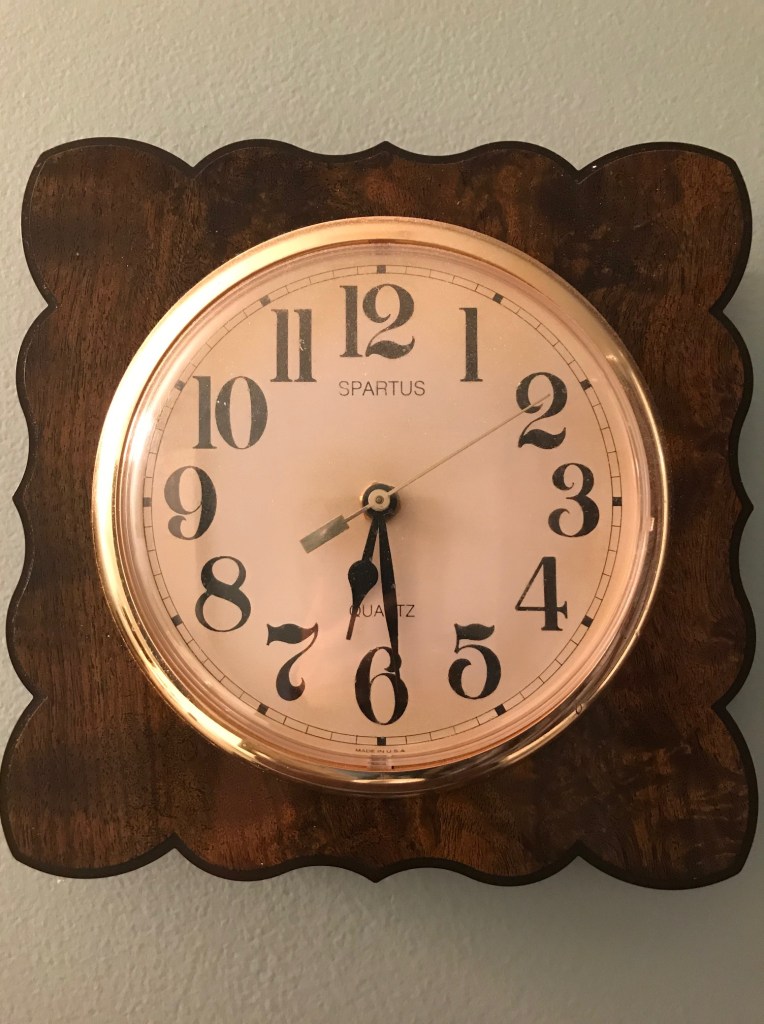
We have a clock in every room of our house, and I even wear a timepiece on my wrist to make sure I keep to specified deadlines. I’m a task-oriented person. If I don’t have a running list of goals to accomplish, I feel at loose ends, unproductive, lazy . . . like I’m wasting time. Vacations for personal pleasure and decadence feel wasteful of . . . time.
How about the word “busy”? What does that mean? If someone calls me on the phone and asks, “Are you busy?” I never know how to answer that. I’m always doing something—even if it’s resting: I’m busy resting or reading or cleaning my house or praying with someone. I’m not sitting on the couch staring off into space, catatonic. A better question might be, “May I interrupt what you’re doing?”
So what does wasting time mean, exactly? Is use the opposite of waste? If I waste food, it means I don’t use it up. But what if I have an excessive amount of it? Do I share it? Freeze it? Or throw it in the garbage? How do I waste water? I suppose that depends on my region. If I live in an arid climate, the definition might be quite different if I lived in a rain forest. How about wasted opportunities? That’s a harder concept. Sometimes we’re limited by our resources or our emotional state or our internal drives.
When does “relaxing” morph into “wasting”? And where in all this discussion does balance come in?
Okay, I’m done with the rambling in my head. Anyone want to weigh in?
When Jesus saw him lying there and learned that he had been in this condition for a long time, he asked him, “Do you want to get well?” (John 5:6 NIV).
From my 2012 Journal. The story of Jesus healing the disabled man at the Pool of Bethesda intrigues me. This place was a hotbed of sick folks. Did Jesus heal anyone else there that day, or did He single this man out? The Scripture doesn’t say if Jesus approached him first or if the man spoke first, but it says that Jesus SAW him there and LEARNED that he’d been in this condition for years.
Astonishingly, Jesus asks him, “Do you want to get well?” What if the man had said, “No”? How foolish we would have thought him. Of course he wanted to be well—that’s why he was at the healing pool in the first place. Yet, the question isn’t quite so odd as one might think. It’s human nature not to like change—even if it’s good for us. We do a lot of “choice” work in our ministry: Are you willing to let go of your anger? Are you willing to feel the pain? Are you willing to explore why you’re medicating with alcohol?
I don’t recall any record of Jesus asking anyone else this same question, Do you want to get well? Normally the hurting person initiates the request for healing (remember blind Bartimaeus?). A client is in my office because she’s made the choice to seek healing. I rarely approach a stranger and ask if she wants to get rid of her pain. Sometimes I’ve tested a person’s sincerity by asking, “If there was a way for you to get healed, would you want to know how?”
The crippled man’s answer is also astonishing. Instead of replying yes or no, he jumps to the defense. “Sir,” the invalid replied, “I have no one to help me into the pool when the water is stirred. While I am trying to get in, someone else goes down ahead of me” (v. 7). (Implied: Duh, of course I do, but I don’t know how.) The Healer is in his presence, but the paralytic is looking to another source for pain removal. (“And how’s that working for you?” we sometimes ask a client.)
People go to counselors and doctors and friends and give their excuses and complaints about feeling bad, when all along The Master Healer is waiting for them to turn to the Him–the only one who has the power to heal.
Do you want to get well? What’s your excuse for not pursuing the Healer?
From my 2012 Journal. I don’t know why it took me so long to figure this out, but once I did, following these protocols for making a decision has saved me a bucket load of embarrassment and regret.
When faced with a double-bind, work through your feelings about each side individually, one at a time. Once you feel at peace no matter which side you choose, your solution will be much clearer to your rational mind. Emotions cloud your ability to choose wisely. (If you need help working through your feelings, give me a call!)
Example: If I choose Option A (accept a new job offer), I’ll feel some fear. If I choose Option B (stay with my present job), I’ll feel some regret.
Want to know God’s will? Make no decision to move forward until you’re at peace about it first. Then you’ll be able to hear God’s voice more clearly.
Example: A classmate of mine in college felt great angst about his passion to become a missionary pilot. Somewhere he’d bought into the lie that God would never give him the desires of his heart; he was afraid that God was just testing him. It seemed obvious to me that it was God who had given him the passion in the first place, and I told him so, but I didn’t know then how to help him work through his emotions.
Never confront someone, write a letter, or send an email or text while you’re triggered. You’ll say stupid things you’ll regret, and the cleanup from the mess you create will be harder and take longer. Always come to peace in your heart first, and then say what you have to say. (I’m speaking from experience here, folks.)
Example: I doubt if you need one. We’ve all done it!
For the rich men of the city are full of violence [of every kind]; Her inhabitants speak lies and their tongue is deceitful in their mouth (Micah 6:12 AMP).
From my 2009 Journal. Because I grew up in a loving home, sheltered from violence and hatred and evil, it was hard for me to conceive of men willfully choosing murder, crime, and destruction. And then I began working with SRA (Satanic Ritual Abuse) victims, and I listened for hours to unspeakable stories of raw evil and witnessed the results of perpetrators’ horrible deeds. When I read this verse, I can now begin to imagine the horror of an entire nation involved in wicked choices. No wonder God was upset with Israel!
I think there are two kinds of people: wounded (that’s most of us) and evil. A frightened and vulnerable teenage girl who aborts her baby is in a different category from someone in the occult who rips a child from his mother’s arms and places him on Satan’s altar (See 2 Chronicles 28:3). Worshipping a false god can be done out of pain or ignorance; but once a person witnesses evidence of God’s power and still chooses the fake way, that’s foolishness. Someone who chooses the violence of human sacrifice, however, has crossed over into the enemy’s camp. God’s judgment is severe for evil men.
The second half of this verse reveals the source of evil choices: lies and deception (coming from The Father of Lies). Most of our emotional suffering is a result of believing lies. Bad things that happen to us can be painful in the moment, but the lies we believe about the event keep the pain alive. And where there’s unresolved pain, there’s often destructive behavior.
Victims of extreme abuse can go either way: become perpetrators themselves or reject all things evil and run to God. What a joy to watch the latter find healing from their trauma. These overcomers have a special place in God’s kingdom. They are my heroes.
Evil in the open is but evil from within that has been let out. (The Life of Pi, by Yann Martel)
To read more about child sacrifice, check out https://www.worldvision.org/author/caleb_wilde, 5 things you need to know about child sacrifice in Uganda. (Unfortunately, the USA is also guilty.)
From my 2009 Journal. While reading through the book of Habakkuk, I notice the prophet’s anguished struggle with God’s inaction.
How long, LORD, must I call for help, but you do not listen? Or cry out to you, “Violence!” but you do not save? (1:2 NIV).
Why do you make me look at injustice? Why do you tolerate wrongdoing? (1:3).
Your eyes are too pure to look on evil; you cannot tolerate wrongdoing. Why then do you tolerate the treacherous? Why are you silent while the wicked swallow up those more righteous than themselves? (1:13).
Humans have wrestled with God’s choices from the beginning of time. We try to reconcile our theology of a good and caring God with our perception of His actions or inaction. Why is it so hard to just accept God and His will and His way? I think it’s because we have a built-in need for fairness and justice, and we want control of our world.
What makes you struggle with God?
2020 Update. Our world is a mess right now, but is it really any different from Habakkuk’s day: violence, injustice, wrongdoing, wickedness. My struggle is not really about what’s going on in the world, but rather what’s going on in my heart. When I ask why questions, I don’t really want an intellectual answer. I want God to fix the pain in my heart so I can be at peace. But it’s a struggle to let go of my own agenda.
From my 2009 Journal. Miracle stories in the Bible like Noah and the ark, Israelites crossing the Red Sea, Jericho’s walls, and Jonah’s fish survival occurred at specific times in history, often far apart. I wonder how many thousands of God-stories never get recorded? Miracles happen daily around the world, but they’re not written down for all eternity in a best-seller book. These Bible stories feel larger than life (Elijah and the prophets of Baal, David and Goliath). Is that because they’re the stories of my childhood? They’re like bright spotlights in a dark place. They stand out starkly against the ordinary, the mundane.
I think of Daniel who lived a long life, day in and day out fulfilling his duties, but he has some defining moments, some spotlight experiences, where his character passed the test. Thousands of us live ordinary, daily lives in the kingdom. It’s important what I do today, in the mundane, choosing righteousness, so that when I am tried for my faith, I’ll continue to be who I am in the daily times.
2020 Update. Today I choose to love you even when you judge me for wearing a mask or not. Today I will remain joyful when toilet paper is scarce. Today I refuse to speak ill of your political candidate because I have not walked in his shoes or yours. Today I will remain calm and peaceful when my city’s citizens riot in the streets. Today I will love my husband and take food to a hurting neighbor and pray with a friend. Today I get to choose my attitude and responses when I’m isolated or in a crowd.
What are you going to do today to prepare for tomorrow’s God story?










 In the Pursuit of Peace