My schedule today is full, and I can feel the familiar and uncomfortable pressure in my stomach and tight shoulders. My head knows I have the exact number of minutes in a day required to accomplish God’s work, but part of me goes into panic, rushing, planning mode in order to keep on top of things—which, in the end, is quite counterproductive!
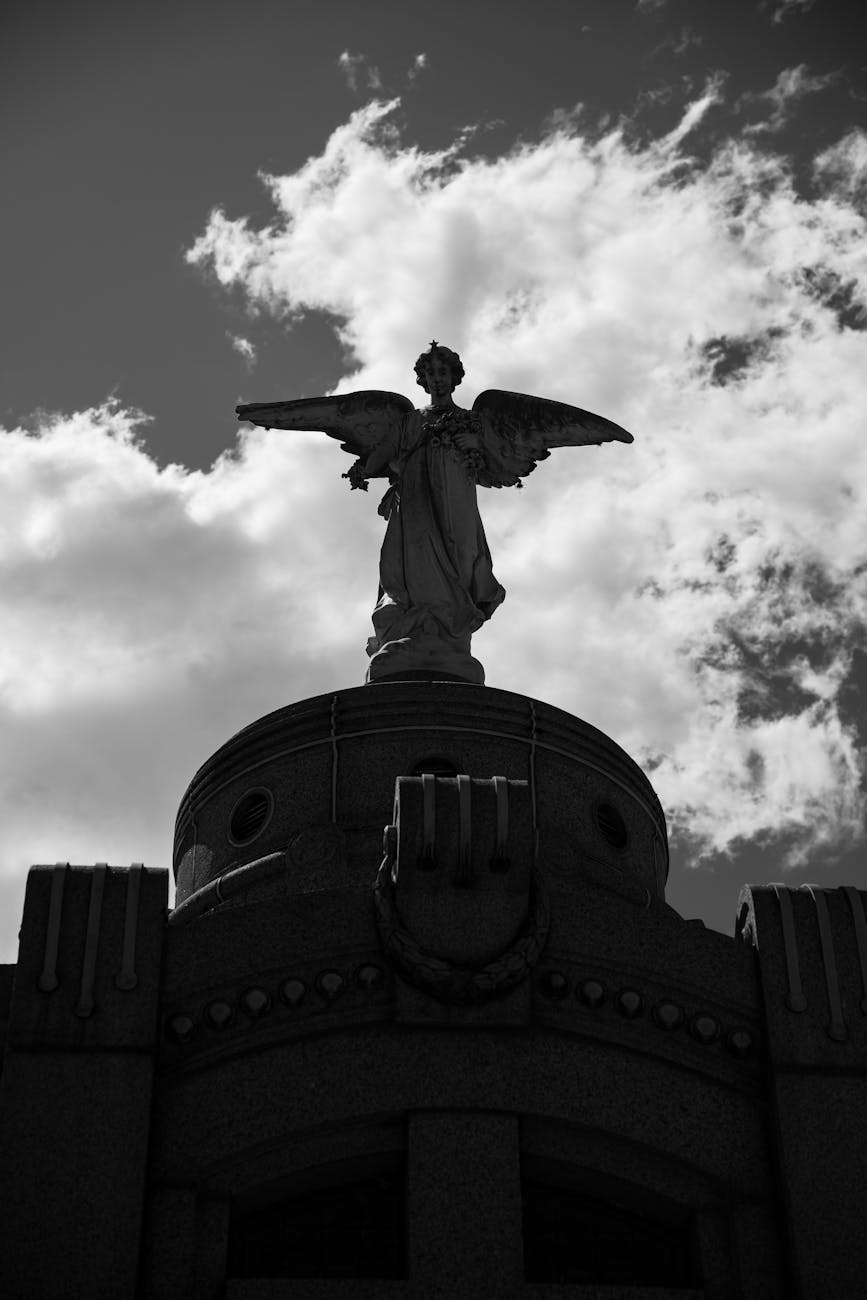
VISUAL: I have a Panic Guardian who’s sitting on the apex of my heart cathedral roof. “I have to stay on top of things!” he says.
How comical! No matter what logic I try to reason with him, he’s not budging. There’s a party going on below, inside where it’s cozy and warm, but no, he wants to stay up here where he can stay vigilant and survey the lay of the land. He doesn’t want to miss anything.
“Can you trust Me to watch out for you?” says Jesus. “What if I set an angel up here to keep guard?”
The Guardian ponders a moment. After all, angels have superpowers and can see farther and deeper than I can and know better the dangers out there. That thought seems to relax him a bit. “But be sure to come and get me, the moment you sense trouble!” he admonishes the guardian angel.
Angel just smiles. “That’s my job,” he replies, “and I don’t get as tired as you trying to balance on the narrow edge of a rooftop!”
My Panic Guardian goes inside the castle and surveys the feast and festivities, but he’s still on alert for any sign of trouble overhead. He can’t fully relax and participate. That’s his job, after all. I need an internal signal, he thinks. Something to alert me—like an alarm bell that will get my attention over the noise of the revelry.
And so Jesus hands him a special alarm—one that vibrates, noiseless, in his chest. How clever!
“Let’s test it!” he says to Jesus, who agrees and gives a signal to the angel to set off the alarm. Guardian flies up to the roof. “Where’s the danger?” he asks.
“There is none,” the angel replies. “You just asked to test it.”
“Oh, right.” With a quick glance around him, Guardian returns to the party, confident that he’ll be alerted when it’s time, but resting when all is calm.
The pressure dissipates, my shoulders relax, and I go on with my day in peace.
Tornadoes in Nashville and Chattanooga (too close to home)
Tribal killings near Jos, Nigeria (where I was born)
Locust swarms in East Africa that may affect my Compassion kids
A friend in the hospital
I don’t know how to pray for these overwhelming needs. I serve a big God, and I’m in His hands, and I cannot take on His job.
VISUAL: I see a large metal bowl with all the world’s problems swirling together in a vast, soupy mess. God’s enormous hands hold the bowl steady while the contents are shaken.
And where am I? I’m not inside the glop … yet. I’m a little ant clinging to the rim of the bowl trying to be faithful to the few tasks God entrusts to me. Things could get jostled enough that I fall in, but until then, I’m safe. If I do fall, I’ll have to deal with that. Meanwhile, “He’s got the whole world in His hands.”
The picture is clearer now—it’s like when I make kosai, and all the hulls of the black-eyed peas rise to the top when I swirl the bowl. (I guess you have to have lived in northern Nigeria to understand this one.)
Instead of praying for the swirling to stop, how about I pray that I cooperate with God’s plan for the world. I see things rising to the top of the bowl—the scum that needs to be scooped and poured off, while the good stuff settles to the bottom. God is purifying His church. It’s all good.
Today I begin with a 2025 Update. As we joyfully gather around the feast table with all our family this year, I pause to remember the angst of the pandemic. We survived it, and life went on, some of us changed forever due to circumstances beyond our control. For me, personally, I learned to embrace the change. As retirees, my husband and I had plenty to eat, a shelter over our heads, and no children underfoot to juggle school and job security. I had more time to read, do jigsaw puzzles, and hike solo on the Greenway. What’s not to like for an introvert!
Journal 2020
With the country on lockdown from COVID-19, I find I have a more open schedule, unsure how to plan my day. As a task-oriented person, I don’t know what I’m feeling . . .
Visual: I’m walking through a misty cloud, uncertain which path I’m supposed to take. I can hear the crunch of gravel under my feet, affirming I’m heading in the right direction, and in the small circle of light, I can see Jesus’ feet directly in front of me. Just keep following and trusting my senses, I tell myself.
Suddenly I find I’m blindfolded. Oh no! Now I’m dependent on following His footsteps, but they’re hard to hear over the crunching of my feet. Pause. Listen. Step toward the sound. What if He gets too far ahead of me? That’s silly, I think. He won’t leave me behind. Just listen . . .
I hear some sticks breaking off to the right. Is that Him? Is He leading me into the forest? Is it a distraction? An animal? All is still and quiet. I don’t dare move.
And then I hear a soft “mooo.” Whew! But it’s taken my focus off the footsteps in front of me.
“I’m here,” says Jesus quietly.
Relief. Ready for the next step, I feel His hand reaching back to take mine. “We’re about to cross a stream,” He says. “I need you to hold onto Me so I can guide you across.”
“Blindfolded still?” I ask.
“You may take it off,” He replies. “But it won’t help much. The fog is too thick, and you’ll try to rely on your eyes instead of the pressure of My hand guiding you.”
I trust Him. I leave the bandana on and begin my forward movement into the icy cold water. In my mind’s eye I can see the rocks as my feet try to get a grip on their slippery surface.
“I’ve got you,” Jesus reassures me. “Right foot next.” And so we continue across. My feet are cold, but the water is shallow. We are in no danger.
Jesus removes my blindfold, and I see a little spark and then a bonfire ahead of us. He wraps a blanket around my shivering shoulders, my feet toward the fire, and soon I feel drowsy. “Rest, Little One,” He says. “Rest, for the journey is long, and you’ll need your strength for the mountain up ahead. But don’t worry. The sun is rising, the mist will dry up, and soon you’ll be wishing for the cool water. We’ll fill our containers before we leave here to remember the days when you walked by faith and not by sight. For now, just rest and enjoy the quiet.”
And now I know what I was feeling—like I had to keep to a schedule, accomplish a to-do list, keep on track, use my time wisely. What if I allow myself to be lazy today and just do what I feel like doing in the moment, without an agenda. No “have-tos” just “get-tos.” What if today is a vacation day?
Today I feel like I’m juggling too many Ping-Pong balls. As they fly helter-skelter out of my hands, I stop, herd them into a four-sided tray, and hand them to Jesus. When I ask Him which ball He wants me to pick first, He hands me a different one—large, crystal-clear and sparkling like a diamond. Though scared to touch it, I reach out and find it is weightless, made of pure light. And He? He places it deep into my heart so that my hands are free. I carry it safely tucked inside my body, but its light spills from my pores for all to see—His light.
“But what about all those Ping-Pong balls I gave You?” I ask.
“No problem,” He says. “I’m a Master Juggler.” And He begins to toss the stars and the planets in a spectacular, brilliant light show.
“How does He keep from dropping all of them?” I wonder. And then I see the strings attached. He’s bonded to each one—each star, each orb—and, yes, to each Ping-Pong ball. Chords of love and ownership and responsibility.
“Just carry the heart ball today,” He says, “and I’ll help you juggle the rest.”
Words cannot describe the love I feel for Jesus, the third member of the Trinity. He’s beside me, ever present, watching me, protecting me, surrounding me, providing companionship, leading me, following me to see where my own footsteps take me. A friend—but not casual. A perfect friend—one who loves me just the way I am, but who loves me too much to leave me just the way I am. My Friend is so enamored with me (I haven’t figured out why yet) that He saved my life. Perhaps it’s because He made me. (In a small way I understand because of the way I fiercely love my own children because they’re flesh of my flesh, and in a sense I “created” them, and they were born perfect in my eyes.)
I was falling over a cliff, and Jesus grabbed me and pulled me to safety. But in the process, He had to go over the edge Himself—willingly He did this. And when He hit the bottom, His life blood was splattered. And I remained safely at the top of the cliff, trembling for my near miss with death. And grieving for the loss of my Friend and wishing I could die instead because it was my own foolishness that put Christ in that position to have to rescue me. But in the end, I see it’s better Him than me who went over the edge, because that would have been the end of me—kerplatz, splat! And then Jesus would have been left at the top, friendless.
Okay, never mind that there are millions of others around Him—but hey—they did the same thing I did—they foolishly got too close to the edge as well, but somehow He became the safety net for all mankind, forever, all at once, and permanently too, so when they fall off, they land safely in the net, and Jesus’ shepherd’s crook gently fishes them out. And trust me, there’s not one person who ever lived who didn’t get too close to the edge and lose his step and tumble over—except of course for the babies who were too young to crawl to the edge. (They were safe in their playpens.) Oh, by the way, some who went over the edge didn’t really believe the safety net was there, and they fell right on through. Ouch.
But back to the kerplatz on the canyon floor. If that had been ME down there? Like I said, it would have been all over but the shoutin’. But not Jesus. He had the power to do what no one else could—gather up the broken pieces, mend HIMSELF, grab His spirit and put it back into His body—except that somehow, He morphed that broken, bruised flesh into something permanent and new with new powers. Now He could fly and leap over tall buildings in a single bound. And coming back up to the top of the ledge, He told me I’d never fall over the edge again.
“How come?” I asked.
“Watch,” He said. And then He flattened the terrain with a single word. No more cliff! So we began to walk arm in arm, sometimes hand in hand; and occasionally, like a gentleman, He carried me over the rough spots and the puddles. And sometimes I let go of His hand to explore something nearby that looked more interesting than what was on the path He was leading us down. But invariably, it was fools’ gold I discovered. Sigh. Better to stay on the path with my Friend, my Savior.
He’s got a big machete and can swipe away all the snakes we encounter along the way. He’s got good eyes. He always sees them first. Sometimes He points them out to me so I can sidestep and avoid them. Sometimes He warns me, but my mind is elsewhere, and I get bitten. Yikes! But He carries an antidote with Him. One drop of His precious blood from the vial neutralizes the poison.
Sometimes I see a huge mountain or obstacle in the way, blocking our path, and I get frustrated or scared or uncertain. But my Companion just laughs. “I’ve been here before,” He says. “Come, I’ll show you the path around the mountain.” Or sometimes He surprises me and says we need to climb over or through the mountain. And He shows me the hidden entrance.
And He never leaves my side. As long as I hold onto Him, His energy flows into me to keep climbing, keep trudging, feet steady. He keeps reminding me of the beautiful valley of Sonshine on the other side. Sometimes on these treks, especially through the mountain, the way gets pitch black, and I lose my orientation. But He says all I have to do is ask, and He starts to glow with His own internal light. And He lets me see the myriad points of light—angels guarding the footpath, some up ahead, and some behind. And I step forward in confidence.
My Friend is very patient with me. He doesn’t ridicule me for my doubt or my ignorance or my stupidity. I wish I could be just as good a friend to Him. “But then, you’re not God, are you?” He smiles. “So quit looking at you, and keep your eyes on Me. I know what’s best for both of us. I’ve been to the other side, and I know the journey is worth it. Come on; let’s keep walking. One step at a time.”
There are no words to describe this Friend of mine. I love Him, and He loves me. And that is enough.
Someone challenged me to “look Jesus in the eyes.” I don’t know how to do this. I don’t see pictures in my head like an artist does. So when I “see” Jesus, it’s an indistinct outline of the form of a man. How then can I possibly look into His eyes?
AI-generated
When I ask Jesus to reveal Himself to me, all I see in my visual is a distorted, grotesquely shaped mask that covers His face. Am I afraid to see Him in all his glowing, white-hot, pure light, like when Moses had to wear a veil? I don’t think my human eyes could tolerate seeing Him in His glorified form. And yet He wasn’t glowing when He appeared to the disciples in His resurrected body. Why can’t I experience that as well?
“Do you want the mask off?” Jesus asks.
Well, why wouldn’t I? Who put it there in the first place?
My Heart Guardian steps up. “I’ll do it,” he says. And when he rips the mask off, I see the misshapen, disfigured face like the Phantom of the Opera. And Isaiah’s words leap at me: “There is no comeliness . . .” (referring to the cross). He was bruised . . .”
I once saw an artist’s rendition of Jesus. It wasn’t ugly . . . just plain and uncomely. And I didn’t want to continue looking. I want my Jesus to look handsome, majestic, chiseled and rugged and buff with gorgeous features that would make me fall in love with Him and His form. I felt disappointed . . . like this can’t truly be Jesus. I want Him to look perfect. But then I see Akiane’s drawing of Jesus and I like it. Or Jechoon Choi’s Joyful Jesus.
We all have distortions of reality. We have no photograph of Jesus hidden in the archives. No one living today has seen Him in the flesh or walked with Him. And even a drawing doesn’t produce the same result as being in someone’s presence. I can’t wait to see Him face to face.
In the beginning stages of a human love relationship, there’s an emotional high, an excitement, a drive to spend as much time together as possible. Then life happens, and you struggle to work through disappointments that the fairytale doesn’t exist. The same can happen when you begin a love relationship with God. The initial joy of finding a perfect partner in life gets buried under disillusionment and painful circumstances. You find He’s not what you first expected.
Yes, I know Jesus loved me enough to die for me, and that knowledge is all good, but it doesn’t impact me emotionally. I’ve heard it for 65 years in thousands of sermons, and somehow now I’m obligated to serve Him whether I like it or not. I’m in this marriage now because I said “I do” when I was five years old, but it’s not an equal partnership. He is everything, and I am nothing. And maybe I hold back or cringe if I sense Him coming on too strong—like He wants something from me, and I may as well give in, whether I like it or not because He’s going to get His own way in the end anyway. “Thy will be done” might mean there’s suffering to follow, and what if I prefer to stay in my comfort zone, guarding my heart and trying to shield myself from pain?
And somewhere, somehow, a part of my heart holds out, self-sufficient, anticipating harsh judgment from the God of the Old Testament, surprised at His betrayal, and believing He expects absolute perfection, surrender, and obedience to His will.
Through time, as I work through my painful childhood memories, my relationship with my husband begins to heal and grow and deepen, and I find my intimacy with my creator begins to change as well. I learn more of His compassionate heart, never condemning me or forcing my will. He is the embodiment of I Corinthians 13 love. In the end, when I allow my guard to stand down, and I embrace what is to follow, there’s sweet fellowship and excitement at renewed intimacy and a deepening passion that feels safe. I’m returning to my first love.
Why is it okay for me to feel something negative while I judge you for losing it? What about my own ungodly reactions? How hypocritical can I be? You have to endure me, too, when I get angry and say things I shouldn’t. Don’t I want you to love me anyway and give me grace? Of course! But I get weary of your ungodly choices. I expect you to be farther along in your healing, so why don’t I expect the same of me? Why do I hold you to a different standard? It’s such a battle for the mind.
So why does your trigger affect me? Maybe it has to do with expectations. I expect to live in a perfect world. I expect to have a perfect day. I expect a birthday to be all about me. I expect Christmas to be full of joy and peace. I expect to not have my boundaries trampled. I expect you to have the emotional maturity of your physical age. I expect to have good health till the day I die, and my clothes to always fit, and the roof to never leak. I expect my mango to be sweet and my new car to never get dented. I want to live in a state of perfect harmony and peace, and your reactions allow a foul wind to blow. And when my expectations aren’t met, I’m sad, angry, and disappointed.
When that happens, do I pout? Clam up? Put on a happy face? Steel myself mentally or physically for your responses and reactions? Give up all expectations or just expect the worst?
When I erect a steel-plate armor to protect myself, I’m encased in a jail cell. My heart grows cold, and I distance myself from my Heavenly Father (the source of love) and from a compassionate heart.
I repent of my self-protection and preservation. I give permission to Jesus to drill and unscrew and remove my steel plate so I can step out, free of bondage. Without my armor, however, I am weak, pale, starved, and thirsty for connection. Jesus gently ministers to my shrunken frame, murmuring, “I’ll be your protection. I love you. I will never leave you or forsake you. You are Mine.”
In my visual, Jesus leads me up to the roof of the Castle of My Heart, where we sit in rocking chairs, enjoying the sunshine together. He doesn’t say much, but I’m suddenly aware that even this perfect state could be disrupted at any time. Off to our left, a messenger arrives bearing a white envelope on a silver platter. A letter for me? It’s so pretty and pure. A love letter, I hope. But I’m expecting the worst. I’m reluctant to open it. Will I find gray ashes inside?
Now I can see the metaphor clearly. I want the missive to be a love letter, a perfect day, my desired Christmas gift, a friend who never criticizes my choices, a carefree marriage, and always-obedient children. My expectations are founded on gray ashes.
“Open it,” Jesus commands, and when I do, I’m startled when a pure white dove flutters out and flies away. I peek inside to find a ruby red heart. I’m puzzled.
“Your heart is what determines your destiny,” He says. “Your perfect day cannot be spoiled by someone else’s choices if your heart is pure.” And with that, He places the heart inside my chest. “Your heart is protected and surrounded by my love and care, and nothing can touch it there except your own willful choices to use your own self-protection or to refuse to release your pain.”
Father, I invite you and implore You to protect my heart where I’m vulnerable and weak, so that I don’t fall prey to the enemy’s lies and deception.
The story of Jesus in the temple at age 12 (Luke 2:41-52) has always left me feeling uneasy with more questions than answers. Where did Jesus sleep each night for five nights? Did someone invite Him home with them after dark? How did He get food? Did He even eat? Did He have enough money in His pocket? Where did the crowds go without any port-a-potties?
How did Mary and Joseph feel? One day to travel toward home, one day back, search for three days. Not only had they missed out on five days’ worth of work back home, but they’d misplaced the Son of God! This mother’s heart would have vacillated between fear and anger, between trusting God that He would take care of His Son, and relief that He was safe. And if Jesus weren’t considered a man, she’d be tempted to give Him His first whipping for being so uncaring, irresponsible, and self-centered. “How could you do this to us?” she cried.
I wonder if Mary’s faith grew ten times that day, or if she became triggered every time Jesus wandered too far from the back door after they returned home.
And then I look at it from Jesus’ viewpoint. Did He even realize His parents had left? Was He so engrossed in being “in the zone,” where He felt closest to Home that He was unaware of what day it was? He wasn’t being disobedient, for His parents never said, “Come, Son, it’s time to go,” and He didn’t respond with a whine, “Do I have to?” Was He just being a boy, acting like a boy/almost man, not to think about how this would affect His family? Or was He unconcerned, for He knew He was safe, and He knew they would be okay. He’s not responsible for their emotional well-being. No codependency there!
How did Jesus respond to His mom’s accusation? He was actually surprised they’d been searching for Him. He knew where He was; why didn’t they? He didn’t apologize or self-defend. He put it back on her. “Didn’t you know . . .?” Was Jesus being inconsiderate? Unkind? (I don’t think so, for as the Son of God, I believe He could do no wrong.)
How was Jesus at age 12 a reflection of the Father’s heart? Here was an opportunity to spend time with His real dad. Here was a chance to listen to and receive instruction from the seat of power and authority and instruction in His dad’s holy Scriptures. THE WORD was hearing about the Word as a growing, learning, almost-teen-age human.
Relationship and truth with God are more important than even human relationships. “I MUST be about my Father’s business; I MUST be in My Father’s house; the Son of Man must suffer; the Gospel MUST first be proclaimed to the Jews; I MUST preach the Kingdom of God to other cities; The Son of Man MUST be delivered into the hands of sinful men and be crucified, and the third day rise again; all things MUST be fulfilled; you MUST be born again; so MUST the Son of Man be lifted up; we MUST worship Him in spirit and in truth; I MUST work the works of Him that sent Me; other sheep I MUST bring in.”
“Must” feels like a divine appointment that Jesus kept, but I still feel the story through His mother’s eyes.
I was having a glorious time—perfect spring day with everything in blossom, enjoying a walk, sitting on the deck, delighting in sunshine and a soft breeze on my skin. Feeling genuine joy, contentment, and happiness . . . when spoken words, negative in content and tinged with anger, dashed my sunshine with cold water. I lost my joy, and my inner anger flared.
Why do some people carry around buckets of cold water, ready to douse the first bit of joy they sense in others? I know it’s their protection to cover their pain, but please pour the water over your own head and cool yourself off before you enter my space!
I use my own anger to try to bring some warmth back to my cold body, but it’s a warmth that is self-induced and unproductive. I willingly hand my anger to Jesus, and in my visual I step into a warm shower. Now I feel the sadness and disappointment of a ruined moment, a stolen joy.
“I am your source of joy,” Jesus says. “My presence is what brings you pleasure, and nothing can separate us . . . not man, not beast, not any evil spirit or Satan himself. I am the Light, your warmth, your provider, shield, and protector.”