At some point in His ministry, Jesus sent out the twelve disciples and gave them power
to drive out demons
to cure diseases
to heal the sick, and
to preach the kingdom of God. (Luke 9:1; Mark 6:7)
The twelve? That means that He gave those powers and gifts to Judas as well—the one He chose by the will of the Father, knowing he would betray Him. The one whose love of money was never cured though he spent three years at the Master’s feet.
Jesus sent them out two by two. Who got stuck with Judas? Was he so wicked at this time? Perhaps not. Perhaps he only had a “little sin” in his heart. But all the disciples struggled with unbelief and fear and pride. What was so different about Judas?
They were to take no food (what if they had a blood sugar problem?), no money (or credit cards for that matter), no change of clothes (ewww … would you want two sweaty, smelly men in your home?), and they were to preach repentance. Apparently Judas failed to heed his own warning.
Judas never asked Jesus to drive out his own demons. He never got to see the fruits of his labor. He missed the blessings and didn’t endure to the end of God’s plan, to the resurrection. He tried to avoid the pain in his heart and took his own life.
And yet … God’s plan could not be thwarted. His plan triumphed in the end. He used Judas’ poor choice to bring salvation to the whole world.
A 2024 Update. A couple students in our community took their own lives last month. I understand that when pain is overwhelming, a person can believe there is no alternative, but the premature end of a life feels like such a waste, a missed opportunity to bless others. I wonder how God will redeem these events in the lives of those who are left behind to pick up the pieces.
There are rare few days when I wake totally at peace in my heart. Usually, I have to work through a disturbing dream or some upset emotion from the day before.
I have spent a lifetime pursuing inner peace. Even as a preschooler, I felt a restlessness that I labeled as guilt. Accepting Jesus, the Prince of Peace, as my Savior helped relieve any fear of retribution, but I continued to wrestle with negative emotions. I remember in Grade 6 doing my first Scripture word study. I looked up every verse in the Bible that contained the word peace, but that information only made me long to find more answers.
Now that I’ve finally figured out how to reach a state of peace through inner healing prayer, I wonder how peace differs from joy or happiness. Supposedly, “happy” is related to circumstances, but I’m told no one can steal my joy. Happy is an emotion. Isn’t joy an emotion too? If not, what is it? Perhaps the English language is inadequate to define these three words.
I understand peace. I’m not sure I experience as much joy or happiness. The closest I come is when I witness people hear from God and see them come to peace. That gives me great joy—but that’s also “happy” to me.
An MK (Missionary Kid) I know died yesterday. His family, surely, is not happy, but I can see them experiencing peace in the midst of the pain. Can they experience joy as well in this circumstance, as they picture him in heaven?
A 2024 Update. I am in a very different place in life since I penned those thoughts in 2006. Today I rarely wake up feeling unpeaceful. I’ve come to believe that peace and joy are the same thing—they just manifest in different energy levels. I’m generally a low-energy person emotionally, so you won’t see me wildly reacting when I’m delighted, but inside, my heart may be leaping. And happy? That’s gazing at the beauty of the sky, hearing pounding rain on a hot tin roof, tasting Ethiopian injera ba wat or savoring Lindor’s dark chocolate.
I was self-assured in my childhood about my clothing choices until someone remarked negatively about an outfit. Then self-consciousness set in, not unlike Adam and Eve who were content until the serpent catapulted them into self-awareness—and then they felt shame.
I was coerced recently into watching an Oprah show where interviewers accosted ladies on the street and told them how awful their bras were and how terrible their clothing styles were. Made-for-TV drama. I could have socked the accosters who freely handled and lifted the strangers’ bosoms. Why would anyone get a thrill out of changing a person’s bra size?
Now, I’m not against looking nice, but the danger was that I suddenly became self-aware and others-aware. I sat in our ladies’ small-group Bible study last night and found myself looking around the room at cup sizes and positions and bra fits. And value and judgment suddenly rested on who did it “right.”
I also noticed a friend’s clothes yesterday. The style went against everything Oprah said she should wear, and I considered saying something to her. Really?! Where does Oprah get her clout? Why do the people on her show get to establish the standard for my friend?
What we wear often reflects what those in our circle are wearing. When tapered jeans were “in,” my daughters pled with me to get rid of my straight-legged ones. How uncouth, gauche, and unsightly! Well, guess what? Now I’m not only fashionable in my wide jeans, but we’re told they are better for the figure because they make the hips look smaller! So tapered jeans are now definitely “out.”
Years ago “over-sized” was in. Today, it’s the tighter the better. (Personally, I prefer the big—it hides a multitude of bulges!)
Another skewed value in America is the drive to look younger and thinner. In some other cultures, value is assigned by age or wisdom, and wealth is determined by plumpness—meaning you have enough food to eat. Maybe I’m living in the wrong culture.
All this attention to outward appearances makes me tired. The focus is all wrong. What I wear and how I wear it begins to determine my value in my circle—be it home or church or at the grocery store. How do I return to unselfconscious and dress according to my personal preferences? How do I quit judging, sizing up, assigning value to someone based on their outward appearance? I want to be confident enough in myself to dress in a way that self disappears. Self-conscious means I think more about I instead of you. And I instead of God.
The missing ingredient here is relationship. I think the reason we ladies were aghast at the behavior of the accosters on the show was because they violated strangers’ personal space. If a friend had spinach in her teeth, I would tell her. I would want her to do the same for me. And if a trusted friend kindly pointed out that my dress was frumpy, I’d take it to heart. But if I’m criticized for my shoes, and my choice is based on comfort for arthritic feet, no matter what your opinion is, the ability to walk supersedes style for me. But it still makes me sad that I’m being judged for not keeping up with fashion.
I suspect when someone cares how I look, it’s more a reflection on how it makes THEM feel. Maybe I should feel sad for the critiquer because she is driven by something unfulfilled in her own soul.
2024 Update. It’s interesting to look back at my younger self and see what triggers made me obsess. I may still notice today what other ladies are wearing, but I can do so without judgment. I’m comfortable with my choices now. As my sister says, “I’m too old to worry about that anymore.”
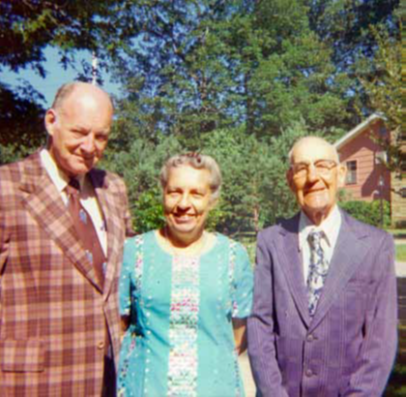
My sweet parents and Grandpa Peterson My early fashion role models!
I think I absorb more of the pain from the world than I realize. So, just for today I want to lay each request, each burden, at God’s feet rather than carry them myself.
I visualize each person or organization I pray for as a domino on God’s tray. Some stand straight, some lie on their sides, and others lean over the edge. But all are in God’s hands. And like a butler balancing an assortment of goodies on a tray, so God carries the world—His world—in His capable hand. And I, the child heir, can skip along beside Him, knowing that He has all things under His care and control. I’m free to watch Him or join Him in His work, or I’m free to run off and play. And sometimes I do one and sometimes I do the other. But it’s no longer my responsibility. It seems silly for the child to point out mishaps and misdemeanors to the butler. He’s well aware of them, and it’s His job to wipe up the spills.
So, what is prayer? Prayer is tugging on the butler’s hand. When He leans down, I whisper in his ear: “I’m scared. Did you see that? Can You help me with my homework? Can You help my friend Susie who fell and scraped her knee?” And He smiles and nods and comes to the rescue. I’m too little to do a grown-up’s job.
If I were to choose a recurring theme for my greatest struggle in life, it would be over the subject of money. I have been imbalanced for so long that it’s hard for me to get to the center. It’s like being on a wobbly merry-go-round with one side higher than the other, and all I can do is tightly grip the edges.
When I was single and my decisions only affected myself, I felt at peace. I could be as imbalanced as I chose, and it only affected me. But when you add a spouse and children to the mix, it becomes complicated—especially if there’s a difference in philosophy, upbringing, goals, and values. Trust is at the core of the relationship. Will I ever come to grips with this topic?
The bottom line for me, I guess, is learning to trust the God of the universe that He will take care of me and supply all my needs. The wise financial planner saves for the future; the foolish spends it all on pleasure now. The miser hoards it all and has no pleasure. Somewhere there’s a balance, and I want to be at peace no matter what circumstance I find myself in. I can’t hold onto my false security handles anymore. I have to leap into the loving arms of Jesus and trust Him to sustain me and not let me fall. He owns the cattle on a thousand hills, and I know that He will care for me. But the perspective has to change. Not only does He own them, but I do too. I’m heir to the kingdom.
Later. I fretted and fretted over missing the deadline for our daughter to apply for the Presidential Scholarship at Berry College. But we got an invitation in the mail for the scholarship weekend anyway. My faith factor just bumped up a notch, and I let go of my tight grip when she won the contest.
A 2024 Update. My heart finally began to relax at last when, a few years ago, I found myself worrying about how I’d manage financially if I became a widow. God’s gentle voice whispered in my ear, “I will be a husband to you. I will care for your needs.”
. . . His Spirit in your inner self [indwelling your innermost being and personality] (Ephesians 3:16 Amplified)
Since my innermost being is home to the Holy Spirit, I want to make Him feel as at home and comfortable as I possibly can. I know how icky it feels in my earthly home when there’s tension and discord and fighting and self-centeredness. How at home does the Holy Spirit feel when I’m angry, peevish, sulky, self-centered, lonely* or at worst—when I sin, leaving dirty smudges on the windows of His house, keeping others from seeing His light shine through?
[*“Why are you lonely? Aren’t I here?” says the Holy Spirit]
Guilt is like walking on a sandy beach, leaving footprints for all to see. And when shame tries to smooth over the prints, I create more footprints in my retreat.
Forgiveness is God sending His wind (the Holy Spirit) to blow across the sand, erasing all the prints. And even if I fail again, the wind continues to blow.
How much better to scramble onto a rock, where no footprints can be made, and no guilt and shame exist.
With a satisfying morning behind me, as I entered the room with a smile on my face, I immediately sensed a shift in the atmosphere. This person’s bad mood challenged my response.
I see a dark cloud swirling above her head. Since she’s cold and damp and miserable, no wonder she grumbles and complains. (Or does she relish the attention she gets from her drama?) Anyway—what is that to me? The problem is, I can’t get near her, or I’ll get drenched too—or worse, get zapped by the lightning coming out of her cloud. I confess I prefer to avoid prickly people, but if I do, I forfeit relationship and I can’t help them.
As I pray about my dilemma, the Lord says, “Wherever you are, rest in the eye of the storm, and the swirling wind about you will push her rain away so that you can draw near. You don’t have to be affected by her weather patterns.”
The tug of my human heart says I have the same temptation toward pride, the same bent, as Satan himself. I want to be like God. I want the universe to revolve around me. I want glory. Like the Apostle Paul, I want to shout, “O wretched man that I am; who shall deliver me from the body of this death [idolatrous desire]?” (Romans 7:24).
My visual is that I’m at the center of a circle, craving the world’s honor and praise. Though I want to experience significance, I don’t want this idolatry of self. I want to echo John the Baptist’s words: “He must increase; I must decrease.”
Paul viewed himself as a slave of God (the Master of the Mansion, a perfect gentleman who looks after and cares for His servants and who gives good gifts according to their service for Him.) Kitchen maid or head chef, butler or chimney sweep—we all have our jobs to do. If we do it with a complaining spirit, we shift the focus to the idolatry of self. If we serve with gratitude and love, our load feels lighter. We’re driven to excellence. We want the Master of the Mansion to look good. Shining the gold on the newel of the banister becomes an act of worship. Fetching His slippers is a privilege. We adore Him. Why? Because He makes each one of His servants feel significant. He catches our eye. He notices. “Nice job on the newel, Charlie. Thank you for remembering to feed my dogs, Susan. I love you, Karen.”
But there are other metaphors: “No longer do I call you My servants, but My friends (John 15:15). You are My bride (Isaiah 54:10). I bought you with a price (I Corinthians 7:23). You were sold for nothing, and you shall be redeemed without money” (Isaiah 52:3).
And we remember who we were and from whence we came. And we gladly, gratefully, joyfully enter into a love relationship with our Rescuer.
But then that niggling question comes—how did we get into the slave marketplace? How did we end up in the prostitute’s parlor? And we blame God. He created us, didn’t He? It’s His fault for bringing us into existence in the first place. And we face that universal question, “Why was I born?” Just so He could have more slaves? How bitter is that?
But no. He wants relationship. “He satisfies the longing soul and fills the hungry soul with goodness” (Psalm 107:9).
“Will you be My bride?” asks Jesus. I have searched for you, I have found you, I have courted you. Will you say yes? I will exchange your dirty garments for clean, bright white ones. I will give you a crown worthy of a queen.”
And in humility, all pride gone, I bow prostrate at His feet. I am unworthy. He deserves all the glory, the honor, the praise.
Coronation Day is coming. Preparations are in the works. I want my heart to be ready. I want to complete the tasks He’s given me to do in preparation of the wedding day and His coronation ceremony.
Regret is like being covered in mud—easily washed off with some divine truth. But if my actions cause others to suffer (whether intentional or not), and they end up with mud in their eye, saying sorry doesn’t reverse the consequences.
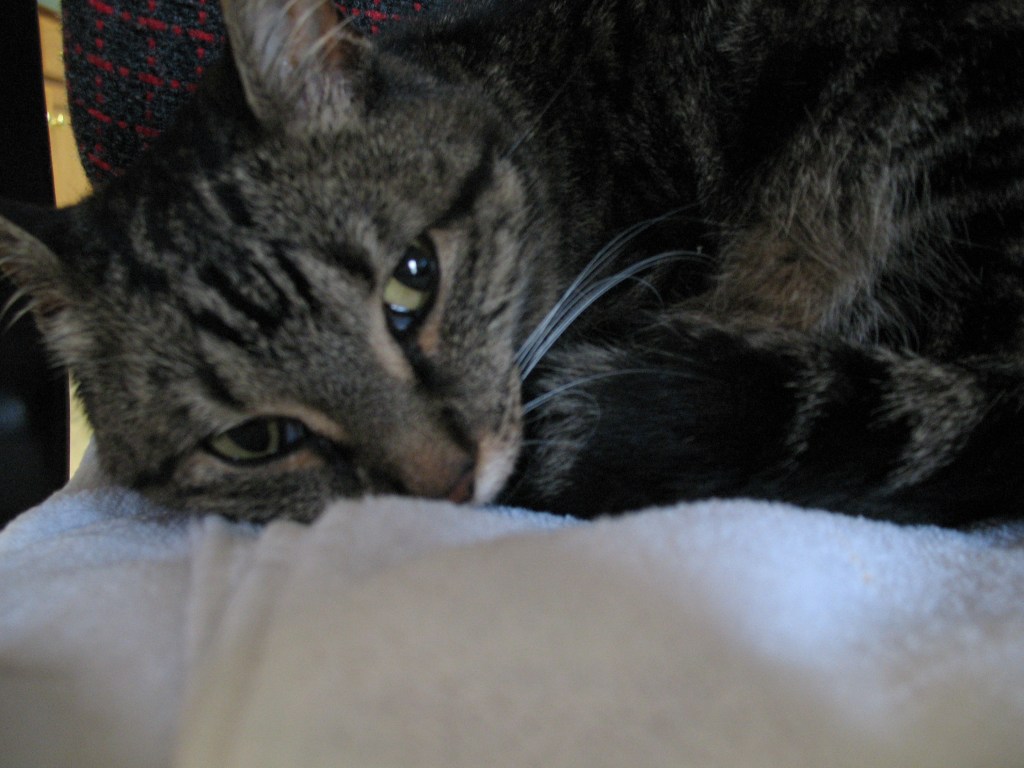
One time, I accidentally ran over a cat that darted in front of me. Out of the house flew a lady screaming, “You murdered my Fluffy!” I was terribly sorry it happened; I duly apologized and offered to assist her, but she refused my help. I had to leave her sobbing in the street, dead kitty in her arms, with the pain of her loss in her heart.
I am no murderer. Involuntary kitty-slaughterer, yes, but it was an accident. I felt sorry for the cat and for the lady, but there was absolutely nothing I could do to resurrect that animal or ease the woman’s pain. I prayed for them both.
I had metaphorically kicked sand in her eyes. I can apologize and offer to help wash it out. At the point of her refusal, however, my obligation is done. It is her choice to tolerate the sand and not wash it out herself. All I can do is walk away—or sit on a log and watch—and if she starts to stumble, to catch her because she can’t see the logs under her feet. But if she refuses my help or rejects me, I’m wasting my time staying with her on the beach.
Addendum: the cat lady’s neighbor put my mind at ease when she came out to see the commotion. “Don’t worry,” she said, “I’m not surprised. It was just a matter of time before that dumb cat would get hit, for it kept crossing the street.”









 In the Pursuit of Peace