Journal 2010. Practicing the presence of Jesus is a worthy goal, but I don’t believe it means my mind must be focused 100% on Him every second of the day. I begin my day with Jesus, followed by the day’s activities where my awareness and conversation with Him ebbs and flows. Today I came to the end of a project in which I was totally focused and absorbed and then suddenly, abruptly, refocused on God. It made me think about relationships and a playground.
Watch a parent take a child to the playground. Some children let go of the parent’s hand quite readily and run off to play, totally oblivious to any potential danger—because they are keenly aware that the parent is nearby. But often throughout the morning, the child will run back to the parent for a snack, for a drink, with a skinned knee, for comfort, for delight (“Look at me! See what I can do”), for rest, for conversation.
The parent knows there is danger outside the perimeters. The child is aware of boundaries and off limits as instructed by the parent, but he has total freedom within the boundaries to choose which piece of equipment, which child to play with, how often and how long to play with each. Freedom within the boundaries. The child is conscious of the parent’s presence, even if he is not interacting with him every second.
And so I go about my day, resting, working, playing, interacting with others, but always aware of the presence of my Father. I never have to ask permission to play on a certain piece of equipment. It’s all permissible. But if I want to leave the premises, I better get His permission first, and I know He’ll accompany me if I do. My Father will always be there. And if I run away, He’ll pursue me. He loves me!
My boarding school playground in Nigeria, supervised by “Aunties” and “Uncles”
Journal 2010. I learned the conventions of prayer at my daddy’s knee. Family devotions looked like this: 6 a.m. and 6 p.m. Bible reading and prayer, no skipping for any reason. Starting with the youngest, everyone read a daily portion of the Scripture (Genesis to Revelation and back again)—just a verse when we were very young and learning to read; more when we were older. Next, each person in the family took a turn praying, beginning with the youngest (me). If we ever reversed the order from oldest to youngest, I’d have to be prompted on my turn because my mind had long ago checked out.
My parents’ prayers were like droning bees to my young ears—same tone and inflexion every time, same topics. Mom always began, “Our loving, heavenly Father” and ended with the sing-song, all in one breath, “In-Jesus’-name-amen” as if it were one word. Dad mumbled so much we couldn’t hear or understand him too well, and when he read, he skipped words or mispronounced them, but his heart was pure, and that’s what mattered. Our childish prayers always began with “Dear Jesus,” followed by “thank you for–” and “God bless–” or Dad would prompt me to say, “Help me, Lord, not to fight with Paul and Grace Anne . . .” (Not sure God answered that one till after we grew up!)
Last night I met with a group to dedicate a new church building. The prayers were specific but global—e.g. asking God’s direction and safety, peace upon “all those who come into these rooms” or “we pray for all those who are struggling with [whatever].” I left feeling a little dissatisfied. Global prayers don’t have anything to attach to visually. They don’t negate the prayer, but a picture would help me.
Does one prayer at one time cover all the bases from now till the Lord comes or the building collapses? God knows our heart and intent, and if our words don’t come out all polished and smooth, He can figure out what we mean. But choice of words is important.
In regular conversation, we try not to interrupt someone’s conversation until it’s an appropriate moment, but we might jump in on each other’s words to agree, disagree, or question. We wouldn’t do that when someone else is praying. We’re too polite. Group praying, for me, can be distracting, boring, or uplifting. It takes discipline to stay focused and listen. Some people are good conversationalists, and I can stay engaged. Others I check out mentally when they open their mouth. Wonder if others do that when I pray? Another issue I have is doing two things at once. If I’m listening, I can be agreeing, putting my “amen and so be it” onto their words. But when it comes time for me to pray aloud, I have to form my thoughts before I open my mouth, and so I end up not listening to the one praying.
When a woman is in labor, Lamaze teaches her to find a focal point to help her manage the pain. God is my focal point when I’m laboring in prayer. What if last night we’d prayed, “May Your glory fill these rooms; may Your presence here be felt by all who enter”—focusing more on Him than on us. What if I changed the focus and attention of my prayers away from the people and the need and drew my focus and attention onto God instead? What if instead of asking for money, we asked God to receive glory and honor by our godly choices and responses? Or invite Him to display His power. Instead of demanding that He heal every ache and pain, we could ask how He wants to proceed and ask for courage to get in line with His will so the nations will be drawn to Him.
Your thoughts?
2009. My sister Grace and I in front of a church that faithfully supported our parents
Journal 2010. One Sunday at church, I could feel something in my heart jabbing—scornful, critical, and judgmental—toward the man worshipping in front of me. Convicted, I closed my eyes and watched a visual unfold in my mind as I tried to refocus on the singing.
I saw myself walking down the central aisle in a heavenly church, dressed in a spotless bridal gown. As I reached the platform where God sat on His throne, His “train that filled the temple” enveloped me. Then He gently turned me around to face a great throng of worshippers, all dressed in similar white garb. I was no more special than anyone else in the audience. The man I had judged was just as pure, forgiven, and covered by the blood as I was. We were fellow travelers, fellow strugglers.
The lights dimmed low, but a spotlight picked out this man moving toward me. He extended his right hand of fellowship and reconciliation, and then he reached for Jesus, and they exchanged words of intimacy. I realized then that God had used him in a special way—unique to him, and I heard God say, “Let each esteem others better than themselves.” My self-righteous, critical spirit toward this man dissipated.
Why am I so taken aback when someone I hardly know comments, “You are so critical!” What words are coming out of my mouth that are hurtful, analytical, cutting, or nit-picky? Is this how others see me? Really? Ouch! Lord, change me!
I have never taken kindly to criticism. We “perfect,” one-on-the-enneagram people like to think we never do anything wrong. We aren’t rebellious, vindictive, or cruel on purpose. We want to please and placate and follow and do right all the time. “Miss Goody Two Shoes” is our nickname*.
Being a critic, however, can be both a blessing and a curse. The gift is I can quickly discover what’s wrong and try to correct it. Some children throw a party if they get 99% on a test, but not me. I focus on the one I missed and want to know the correct answer, so I can get it right next time. The “curse” is that it leaves no room for grace or for seeing the good in people. Is that behavior temperament-driven or woundedness—something inside that craves attention, achieving goals, or pleasing a professor? I don’t know where the roots are.
Unfortunately, this habit translates into observing character flaws in my loved ones. I was a cheerleader when my girls were learning to walk but became their worst critic when they didn’t perform at school according to my expectations. I hear God’s Spirit gently whispering to me: “Room for growth.” Instead of looking at a person as a complete, finished, having-arrived performer, celebrate how far he or she has come. And instead of seeing how far short they are of the bar of perfection, the paradigm shift is to see how much room they have to grow.
I’m not sure this takes care of every critical thought, but it’s one piece. Perhaps it will give me space to be less than perfect. I have room to grow.
If we could see ourselves as other see us . . .
If we could see others as Jesus sees them . . .
*Being called Miss Goody Two-Shoes was originally a compliment, not a derogatory term. “Goody” was the little girl’s name in the story, not a description of her behavior.
A 2021 Update. I’ve worked diligently over the past few years on curbing my inner critic. I hope and pray I am a kinder, gentler person both toward myself and toward others. And if I am the recipient of criticism, I am quicker to forgive and not put up a shield of defense. I can only hope and pray that those I’ve hurt have found healing for their own souls. I’m truly repentant.
Journal 2010. Sickness is tiring! And somewhat boring. I’m intrigued that I feel a sense of entitlement: Since I’m sick, I shouldn’t have to do dishes, cook supper, or clean house; and I should get to watch what I want on TV. But why should sickness entitle me to selfishness and self-centeredness?
When I don’t feel well, it’s very hard to be cheerful. It takes all my energy just to concentrate on performing simple tasks. I admire hurting friends who just keep on smiling in the midst of their pain. When I hurt, I want the world to know it.
I feel closest to the Lord when I feel the best physically—because I can concentrate on reading the Word and communing with Him. How can I do this with a headache or a stuffed-up nose, or I’m in so much pain I can’t focus?
I hesitate to pray for a deeper walk with God, for I fear it means affliction and trials and even illness. It’s like asking God for more patience when you know trials are what produce patience and endurance. It’s like hugging a warm coat tightly around me. I don’t want to open my coat to expose my skin to the elements just so I can learn to be tough. But God says if I remove the coat, I’ll draw closer to the fireplace of His warmth.
Another thought—what if I’m nowhere near a fire and a blizzard comes (circumstances beyond my control). It doesn’t make sense for me to take off my coat. I’ll wrap it even tighter around me. God says He can provide an extra blanket so I can weather it through.
Is it possible to experience more intimacy with God without going through trials? Can I trust Him to bring into my path that which will bring about my needed growth? I don’t want to stagnate, rot, mold, or wither. I want to grow, blossom, produce fruit and seed, and reproduce.
So . . . I don’t have to dread or fear trials, but I don’t have to ask for them either. God knows exactly what I need to increase my trust and dependence on Him. Just be a Mary, He says, and sit at His feet.
Journal 2010. Charlie was a proud and bitter man. When he was a little boy, his big brother told him God always answers prayer. So one night, Charlie knelt by his bed and asked for some candy—but none appeared. That was the day he lost all faith in a god who would withhold good things from him.
As I studied John 16 this week, I thought about Charlie.
Jesus is explaining to his disciples what is about to happen. He’ll be going away for a while, and then they’ll see Him again after the resurrection. When Jesus senses that they want to ask Him [questions] about this, He explains a little more plainly. And then He says, “In that day [after the resurrection and when the Comforter comes] you will no longer ask Me anything.” (He did not say, “ask Me for anything.” He meant ask Me any questions you have.)
“And besides,” He says, “I won’t be here anymore. Instead, you’ll ask [questions] in My name and the Father will give it to you. Until now you have not asked for [about?] anything in My name.” (Before Jesus ascended, the disciples could ask Him any question face to face, but after His ascension, they could speak directly to the Father, through Jesus.)
“Ask and you’ll receive [answers] and your joy will be complete,” He says. “I’m not saying that I will ask the Father on your behalf. No, the Father Himself loves you” (vv. 25-28).
The disciples respond: “Now we see that You know all things and that You do not need to have anyone ask You [questions]. (The rabbinic method of teaching was to ask questions, and Jesus’ teacher was the Father.) This makes us believe that You came from God.”
Jesus says, “You believe at last!”
Instead of “ask Jesus for anything” (as I’ve always been taught), this passage (context, context) is all about asking Jesus questions. Jesus said, “Ask what you will. . . .” He didn’t say ask for things or prayer requests.
If I’m reading this passage right, it would change a lot of theology, misunderstandings, and disillusionment when we ask Him to do something, and He doesn’t do it. Perhaps Charlie would have grown up a different man had he understood this concept.
Journal 2010. My third grade Sunday school lesson for this week was on David and Saul. I began by asking the children to look at each other’s eyes and tell me their color. We had five children with brown eyes, and three who had blue. Next, I told them that I had a special gift for each of the blue-eyed children: a one-dollar gift certificate to McDonalds. I instructed the brown eyes to clap and applaud for them. And then I paused, observing their response. I asked the brown-eyes how they felt. One said she felt “left out.” Another said, “sad,” and another “unfair.” They all admitted to feeling jealous.
And then it happened. Little blue-eyed Ethan stood up and walked over to brown-eyed Holly (who had made a decision just this week to follow Jesus) and gave her his gift certificate. I praised him and then immediately handed him a replacement.
I then launched into the story of David (handsome shepherd boy, beautiful-eyed, strong, courageous, musically gifted) being anointed king (not because of his outward appearance, but because of his heart for God), his brothers’ jealousy, his slaying of Goliath, and Saul’s subsequent love and admiration for him. And then how the women sang, “Saul has killed his thousands, but David his tens of thousands” and how Saul’s admiration turned to jealousy, to hatred, and then to attempted murder.
We discussed what things made 3rd graders jealous (toys, talents, privileges), and how jealousy can lead to bad things. We talked about how God gives each of us gifts—not for the purpose of self-glory, but to be used for Him and given away.
In conclusion, I instructed the blue-eyes to hand their gifts to the brown-eyes. Not fair? Oh no! Because when we give our gifts away to minister to others, God blesses us in return. And I handed each of the brown eyes a replacement. Now everyone had a gift certificate.
I told the children the gift was theirs to use as they wished. They could spend it on themselves, or they could give it away to bless someone else. It was their choice.
Brown-eyed Chandler said he was going to give his to his brother. Blue-eyed Ethan said, “I wish I could rip mine in half so both my brother and I could use it!” Melina observed that he’d given his away twice, and she tried to hand her coupon to him, but he declined. “It’s okay. You keep it,” he said. And then: “I know! I’ll spend it on ice cream, and I can share it with my brother that way!”
I think the children taught me as much as I tried to teach them that day!
As I read Acts 5:16-6:15, I note a progression of violence, stemming from the Pharisees’ sin of unbelief, jealousy, and hard hearts. And the apostles’ responses are astonishing.
The apostles are imprisoned.
An angel frees them, and they return to preaching.
Peter and John are brought before the Sanhedrin, beaten and let go.
They continue preaching.
Stephen is arrested, preaches to his audience, and is stoned.
His last words are, “Lord, do not hold this sin against them.”
Obviously, I wasn’t in their shoes, driven by God’s command and with the Holy Spirit propelling me forward, but . . . if I were in their situation, my first response would most likely have been fear, hiding, and kowtowing to the Pharisees’ bullying to avoid further pain. Flogging can be rather incapacitating, don’t you think! I wonder if God healed them instantly? Or did they go through a month of recovery with no antibiotics and their wounds miraculously not becoming infected?
In the flesh, I would have struggled for being unjustly treated. I would have cried unfair and prayed for justice, a staying of the abusers’ hands, a change to my circumstances . . .
Instead, they rejoiced! Extremely counter-intuitive!
I could claim I, too, would have responded in a godly way, but I’ve never been put to the test like this. God prepared the Apostles for this hour. I can trust God to prepare me as well for anything I must endure.
P.S. In Acts 7, Stephen boldly told the Sanhedrin to their faces that they were stiff-necked, stubborn murderers. When is it appropriate to call someone out for their sin? Obviously, the Holy Spirit guided his words, but I cannot even begin to imagine talking that way—to anyone! It’s not my temperament or personality. I’d be asking them all, “What are you feeling? How does it feel to hear me preaching? Why are you jealous?” I guess that’s why God didn’t call me to be a prophet!
I need a fresh start with prayer. I’m beginning to do the grocery list thing again. I’m glad God can focus on more than one thing at a time. I can’t. My mind wanders. And God understands because He made my brain this way. But I know I have to do my part and have a little self-discipline. Journaling slows my brain down and helps me focus, but even while I’m writing out my prayer, my mind skitters off onto a tangent. Sigh. What if I quit using the word pray and start using talk instead? “God, I want to talk to You about . . . .”
. . .
My perspective on intercessory prayer has shifted from “ought to” or “spiritual discipline” to “ministry opportunity.” Prayer is as much kingdom work as teaching Sunday School or taking a meal to someone who’s sick. The key is the word ministry I think. I love “doing ministry.” It appeals to my task-oriented mind. Intercessory prayer is different from gratitude or praise or confession. I feel like I’m such a beginner in this.
. . .
Come into His presence, said King David. That was fine for him to say, because God’s presence was located in a place. There’s something missing in this statement for me. How can I “come into” when I’m always there?
I sat down to have my Quiet Time this morning and immediately began to intercede for someone—no preliminary formula of ACTS (Adoration, Confession, Thanksgiving, Supplication). I hear some preacher’s voice in my head admonishing me, and it occurs to me that God is not on a timetable of morning, noon, and night. Maybe I thanked him last night, confessed at noon two days ago, and now I’m ready to intercede. I understand the mindset of focusing my attention on Him and quieting my heart, and some days I have to do that. But if His presence is there for me at all times, there’s nothing wrong with galloping into requests on others’ behalf. I think God can handle that!
. . .
I heard on the Barna report that the average person prays only 8 minutes a day. They compared that person to someone who was living in a dangerous community who prays continually. Well . . . yes . . . that makes sense. But it felt like shame and condemnation for lack of prayer on the part of those who live in peaceful places. But how does one quantify prayer? If one is continually in God’s presence, one’s very breath is prayer. Am I more spiritual because I say 50 words in prayer instead of 5—and that takes longer? Strange that we should equate time (minutes) with relationship. But I suppose there is some truth to that in the earthly realm.
Prayer is also listening. How do you quantify that? I listen all day long. Why is it so hard to let go of the rules and focus on relationship? Peter struggled with it when he went to visit Paul in Antioch and quit eating with the Gentiles. Not all rules are bad. We need them. But they are bumper guards in a child’s bowling game—helpful at first, but unnecessary when you get the hang of living the Christian life. You get into the groove of right living and obedience and you find the sweet spot of love for the game. Of course there’re always adjustments and self-corrections to be made.
. . .
I find that my prayers are directly tied to my emotions. Words flow when I’m feeling sentimental. I pray most deeply and earnestly when my emotions run deep and more cerebral when feeling flat. But my emotions are not what create results. It’s not the words I say, but rather, I believe, God reads the heart and the motive. I can invoke His name in a loud cry or a soft whisper. The power is in His name, not in my poor attempts to get His attention.
For 11 days I sat by Scott’s bedside at St. Thomas Hospital while he recovered from knee surgery. I watched a team of workers ministering to the patients. In one shift, a doctor, a PA, a nurse, a tech, a food deliverer, a cook, a housekeeper, a student nurse, a supervisor, and a case worker all contributed to the healing process. Only the surgeon or only the cook wouldn’t have been sufficient. Pain med management was no more important than the one who emptied the urinal. It was a well-oiled machine where everyone had to do his or her part, what he or she was skilled and trained for.
Somewhere I was taught that in God’s kingdom we should all exercise all the spiritual gifts (teaching, helps, hospitality), even if they aren’t my gifting or calling. I cut my baby teeth on “Bringing in the Sheaves” and the primacy of evangelism, but It has been a very long time since I’ve shared my faith openly with a nonbeliever. I have made a gradual yet complete shift away from evangelism to discipleship, from making converts to helping to heal the body of Christ. It has become my calling, and it’s intentional. But is it okay?
The housekeeper should never attempt surgery, and it would be a waste of his training if the surgeon gave up his job to do janitorial work. Acts 6 records the scenario where the apostles maintain their calling and giftedness—prayer and ministry of the Word. But the ones responsible for distribution of the widows’ food are no less godly or gifted. In fact, they’re specially chosen and commissioned by laying on of hands. It wasn’t the gift or the type of work that qualified them, but their character. We tend to put huge accolades on the public speaker, but every team member behind the scenes has a spotlight on him too.
What’s my point? I would never be able to stand in front of 50,000 people like Angus Buchan and proclaim the Gospel unless God called and equipped me for it. I have become more and more convinced that life is about celebrating our various roles in the kingdom . . . though I guess I’d like the fun sometime of reeling in the fish, not just putting worms on the hook.
The issue I’m wrestling with is the bold declaration in public that Jesus is the Christ. What inside me makes me shrink? I could speak to a believing crowd because we’re on the same side of the fence . . . teammates.
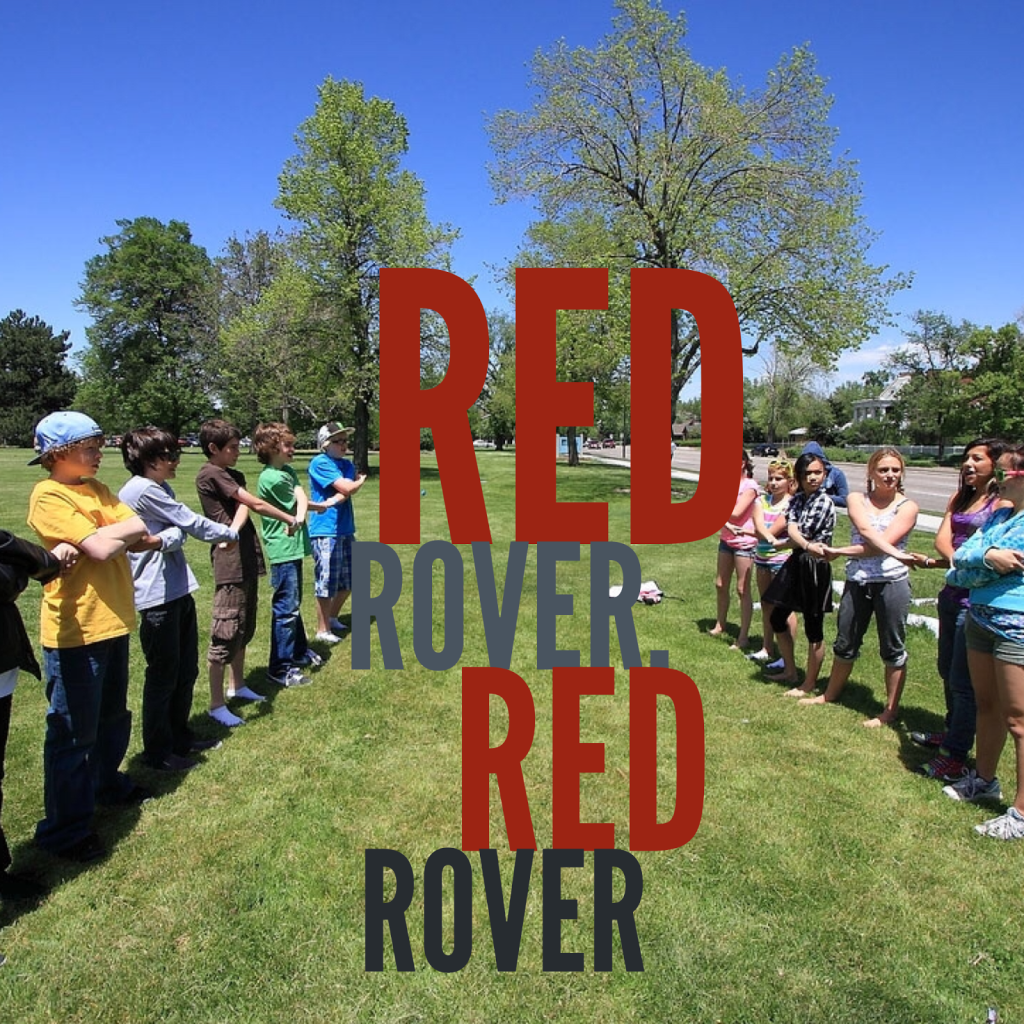
And there’s my visual. At first, I saw a tug-o-war, digging in my heels in total opposition to the other side. Instead, God showed me “Red Rover.” Evangelism is an invitation to join our side. My spirit relaxes with that.
So . . . I can tell someone on the opposing team, “Drop what you’re doing. Let go of the hand next to you. Come test our side. Experience the strength of the God side. Come join forces with us.” Our team breaks apart where there’s sin and idolatry and strongholds, and the enemy captures one of our members. But our team will prevail. Our God is stronger than your gods!
After struggling with this issue for years, I lay to rest the notion/teaching that I’m missing something because I don’t have certain spiritual gifts such as speaking in tongues, raising people from the dead, healing sickness and disease by a touch, or handling snakes without getting poisoned.
Crowds gathered also from the towns around Jerusalem, bringing their sick and those tormented by impure spirits [to Peter], and all of them were healed (Acts 5: 12-16, NIV).
After Jesus’ ascension, Peter, the man who denied Jesus three times, begins to perform miracles of healing and casting out demons. Peter didn’t ask for this gift. It was conferred upon him—according to God’s design and purpose. I don’t have the gift of healing, but I have seen clients delivered of evil cosmic beings because, and only because, the person willed it to be so and because Christ’s death defeated demonic forces. I have no power in myself to do diddly-squat! It’s by God’s very will and choice that I draw breath and move and have my being.
I’ve been standing around with my palms up, asking and ready to receive whatever God has for me. Instead, He says, “Just get to work! Quit standing around waiting. When and if I hand you something, open your hand or reach for it in obedience.” If I refuse a gift, then I’m being rude or disobedient. It’s not so polite to extend my hand to demand that someone give me a gift!
The next verse says, Then the high priest and all his associates who were members of the party of the Sadducees were filled with jealousy.
“And don’t be jealous,” God says, “if I give one gift to someone else that you think you want or deserve. I know exactly what gift(s) you need—best for you and best for Me. Now get to work and enjoy what I’ve given you!”