Bagfuls of Prayers

In the same way, the Spirit helps us in our weakness. We do not know what we ought to pray for, but the Spirit himself intercedes for us through wordless groans. (Romans 8:26 NIV).

From my 2013 Journal. As I pray a bullet list of requests for God to grant, He hands me a fistful of bags, heavy as gold but light as fairy dust, in which to carry the requests. First, I hand one to Alan for his trip. He accepts it and thanks me for it.

Next, I hand a bag to Betty. She shows me the needy children she cares for. I don’t have to drum up compassion. I have to walk the path God put me on and follow His leading in humble obedience. He will show me who I am to care for, and Betty will care for the ones in her care.

After that, I give one to Cherie. She drops it in her pocket, but I urge her to carry it next to her heart where the holes are.

Deidre comes next, but she wrinkles her nose, holds it at arms’ length and drops it. God instructs me to empty the contents over her head. Pretty sparkles of light and flower petals rain down.

I hand one to Edith, who cries with gratitude and eats it for strength, absorbing the nutrition for her mind, soul, and body.

Fran asks for one, too, but she’s too weak to hold the container. I empty the contents onto her reclining body and gently massage it into her skin—a healing balm. The prayer covers her like a mud bath to remove all the impurities and draw out the shame and inadequacies and fears. Next, she must choose to dip into the Salt Sea. My prayers cannot force her to do it. But in the spirit of adventure, I know she will leap in and be cleansed. Just don’t wait too long, dear one, or the mud will dry, and you’ll feel itchy and ugly. Go wash and be clean!

Gina begs for a double-triple portion—afraid that only one bag won’t be enough. I laugh and assure her that God’s power is immeasurable and His grace sufficient. Like Peter, she begs to be washed all over. But I’m instructed to squeeze only one drop from her bag onto her index finger. I don’t understand why, but I obey. She’s curious too. What to do with it? Jesus tells her to rub the ointment into her eyes so she can see clearly!

These bags of prayers (all alike I thought) from my lips change into different forms and substances, according to the needs of the receiver. How amazing is that!

Who’s next? I have so many bags left. I want to distribute them all, but they seem to be multiplying like the loaves and the fishes. I hurry over to offer one to Helen. She thanks me, smiles, and says good for me for handing them out and then carefully places it on her shelf, next to her idols. Sigh. Maybe her idols will topple over in the presence of the Holy One like the Philistine god Dagon.

One for Ira, who gladly accepts it and carries it around with him wherever he travels. He’s grateful for it and recognizes its power—ready for use at a moment’s notice.

Next I offer one to Janine. She thanks me, declares it smells good, and tosses it into the back of her car. I decide that’s not good enough, so I secretly toss a bagful, like fairy dust, over top of her house. Curiously, the particles dry up and dissipate before they touch her roof. I try a second time, and it happens again. What gives? There seems to be an impenetrable shield over her house that deflects my prayers. And now I know why. Instead of a believer’s bag, I need to hand her the red one—the one that contains the blood of Jesus. Sprinkle that one . . . no . . . use a hose! Cover, saturate, flood that home! It’ll force her to exit and look up. I happily spray her with it as well. She laughs. She tastes it on her lips. She wants more. She wants to drink it, dance in it, twirl like a little girl before she first got hurt. Jesus says, “Just hold the hose, Karen, just hold the hose.” Then she grabs it from me and sprays her neighbors who have come out to see what the commotion is all about. More laughter.

I box up two bags with extra padding and send them off to China. Though I don’t know their addresses, God safely delivers them to the doors of Kang-Chun and Liang-Lee, two persecuted pastors. There’s healing ointment in the one, I see, along with some bandages. I can’t tell what’s in the other box. The pastor isn’t home. Oh, there’s bread and wine and cheese and rice (of course!) for the starving wife and children. Like the widow’s oil, it keeps replenishing itself. Splendid!

I set down the rest of the bags. M through Z will have to wait for another day.

And now, Lord, I need one for myself. It’s in pill form, easy to swallow. I don’t need to know what’s in it. God’s work/word is unseen as it nourishes my body, gives life to my brain, feeds my arms and my legs, my liver and my heart. Nothing gets wasted or eliminated. “Drink,” He instructs me. “Drink deeply of Me, of My presence, My Spirit, My love. Let it cleanse your every pore. Let it wash through you and make you clean . . . strength for today and always. Breathe deeply. I’ve given you the breath of life itself. It’s My breath. I breathed into you to make you a living soul. Your very being is a testament to My power and creativity.”

Photo by monicore on Pexels.com

Sabbath Rest

From my 2016 Journal. Every Sunday, my missionary parents practiced Sabbath rules according to their own definition. We did not enter a restaurant or store, travel, cook, play table games, or indulge in handwork on that day. I began to question this logic when I discovered that Jewish Sabbath occurred from sundown to sundown Friday to Saturday, and never mind that we didn’t keep the rest of the Levitical laws.

Mosaic Law gave general rules for Sabbath (Shabbat) observance: no lighting fires in your house or cooking (Exodus 35:3) and limited traveling (Joshua 3:4-5). The ancient Pharisees interpreted and refined Sabbath rules according to their own parameters, and today their legalism extends to not pushing elevator buttons, turning on electric lights, or using any device-driven means of transportation.*

Jewish law prohibits work on Shabbat, but while resting is implied, the word Shabbat literally means “to cease” or “to sit.” God didn’t need rest after creating for six days. He simply ceased.

Reform Judaism says, “One should avoid one’s normal occupation or profession on Shabbat whenever possible and engage only in those types of activities that enhance the joy, rest, and holiness of the day.”

With this in mind, if I were trying to “keep the Sabbath” I would avoid housework, computer work, and the business end of my ministry. It would not preclude ministry itself according to Jesus’ example. He preached and healed all week long. You’d think He’d refrain on the seventh day and take this day off, but apparently His work wasn’t classified as labor.

I may not be Jewish, and yes, Jesus is my Sabbath rest, but I do need to “cease.” I need the change of pace, the chance to recoup, refresh, and recharge my body, mind, and soul.

So . . . once a week, I often turn off my computer, refrain from cleaning house, and occupy myself with things I enjoy doing—guilt-free, such as reading, doing a puzzle, or golfing with my husband (after church of course!)

What does your Shabbat look like?

*How far am I allowed to walk on Shabbat? – Shabbat (chabad.org)

*Laws of Shabbat for Beginners (aish.com)

Heavenly Worship

(1950s) Dad building our church out of mud brick and a tin roof. What remains in 2014 after storm damage.

From my 2013 Journal.

My first memories of church included sitting for hours on a backless mud bench, singing mostly American hymns translated into Hausa, accompanied by my missionary mother playing the accordion. Dad’s preaching would lull me to sleep if Mom didn’t occupy me with crackers. Women sat on one side of the church, men on the other, and nearly-naked children squished shoulder to shoulder on the floor or front pews. In later years, local pastors and women playing indigenous musical instruments led the joyful service.

This week, when one of my African-American neighbors died, his dear wife invited three of us white folks over to meet some of her friends who had arrived to provide comfort. They all circled up, holding hands, singing and praying—loud, long, repetitive, simultaneously. We three stood quietly apart, singing softly, joining in with our hearts. Later, at the funeral, the preacher’s sermon included thunderous shouting, huffing with each sentence, accompanied by organ crescendos and a robed choir.

I thought back to an Easter service at the Eastern Orthodox Church where I visited with a Jordanian friend. Worship included quiet a capella music and chanting, solemn contemplative rituals, and a brief homily. Beautiful icons, candles and incense completed the sensory experience.

At my contemporary interdenominational church, the congregational singing predictably goes from loud hand-clapping, hand-raising, drum-beating musical numbers with guitars and electronic keyboard accompaniment led by a group of performers followed by one quiet song before the conversational-style, 30-minute sermon.

Worship cultures . . . each with their own traditions, expectations, idiosyncrasies. There’s no right or wrong way—unless the heart and mind aren’t engaged.

And my preference? I’m somewhere in the middle—neither monkishly contemplative nor exuberantly outward in expression. Quiet suits me best as an introvert. And call me a heretic, but give me an intimate dialogue or deep conversation any day over a sermon lecture. Yet I still choose to attend churches that might not suit my personal preferences. I need the variety of the body.

What will heaven’s worship be like? In the book of Revelation, John records moments of loud and times of silence. Somehow all nations, tribes, and tongues will be unified in their worship and will enjoy Him together. I can’t wait!

Be Prepared!

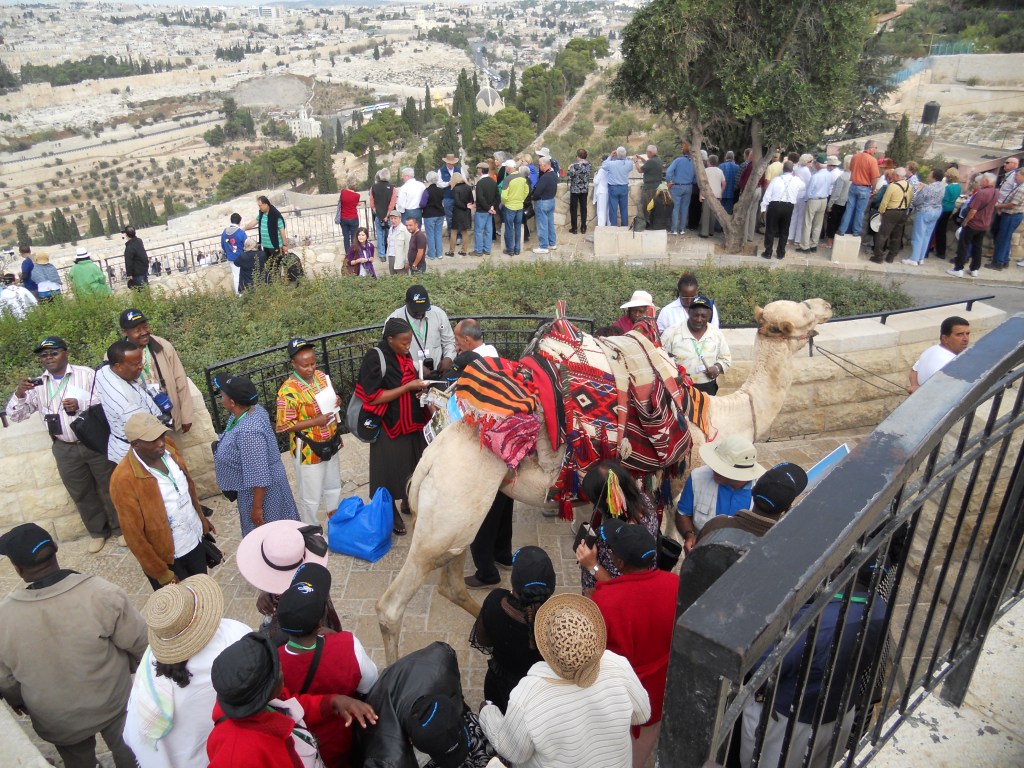
From my 2014 Journal. For our tour in Israel, our leader, Charlie Dyer, supplied each of us with headphone devices so he could speak to us in crowded places. Each time we arrived at a site, we’d leave our personal belongings on the bus and carry only minimal necessities—camera, notebook and pen, and of course the headphones. Because of their weight, I opted to leave behind the provided spare batteries.

When we arrived in Jerusalem, the climax of our journey, the bus driver dropped us off on the top of the Mount of Olives. It was crucial to have our listening devices with us if we didn’t want to lose our way among the elbow-to-elbow crowds.

To my chagrin, my headphone batteries died just as we began to descend the mountain. I felt like one of the virgins in the wedding parable who had neglected to bring extra oil for her lamp. I learned a powerful and humbling experiential lesson!

But all turned out well. Someone in our group graciously let me borrow his extra batteries. The God of second chances!

Unripe Fruit

From my 2013 Journal.

Recently, I broached a subject with a friend about an issue I’d noticed in her life. Her steely hard, plant-the-feet-in-the-ground, defensive posture, and irrational response all told me this subject was a trigger, and I needed to back off. She’s obviously not ready to receive my input, and so I have to let it go.

I know her heart desires truth, but she’s not ready to face her pain. And that’s okay. It’s God’s job to gently woo her to Himself and prepare her heart to be willing.

Don’t pick unripe fruit!

Keeping a Dream Alive

From my 2013 Journal.

Reading a biography or memoir may be interesting, entertaining, or even inspiring—but rarely life-changing, unless it intersects with my own—when I identify with the character in some way.

This morning I read Caleb, the spy’s story in Joshua 14. At age 40, he saw a piece of property he wanted in the land of Canaan, but because of the Israelites’ rebellion, he had to wander with them for 40 years in the desert. At age 85, he asked leader Joshua for that same territory, determined to rout the inhabitants with God’s help. Talk about keeping a dream alive!

Caleb’s faith sharply contrasts with the descendants of Joseph who complained they didn’t have enough land for their families. Joshua said to them, “Go clear the forest and you’ll have enough” (Joshua 17:17-18).

“But they have iron chariots!” they whined.

I can see Joshua rolling his eyes. “You’re numerous and powerful; you can do it.”

So I try to connect with this story. What dream have I held onto? Some dreams, I know, I must grieve and let go. But if God-directed, what excuses do I use not to fulfill it? Sometimes I need patience, endurance, and perseverance to wait.

What dream have you kept alive?

Overwhelmed

From my 2015 Journal.

If I let it, the news this week could leave me feeling overwhelmed:

  • Earthquake in Nepal
  • Flooding and tornadoes in Texas
  • Riots in Baltimore
  • Beheadings in Syria
  • Shootings on campuses
  • Starvation in India

Meanwhile, I go about my sheltered, stress-free, cushy life. Catastrophes in other parts of the world don’t affect my daily life and decisions. If they did, I’d be the one in crisis and I couldn’t function. If I don’t feel pain when you’re in pain, that’s a good thing. I don’t want a doctor operating on me when he has a broken arm. I need him to be healthy and well.

For two full days this week I listened to three abuse victims’ agonizing sobs. They weren’t in any physical danger, but they believed they could not go on living. Was I compassionate? Yes, of course. But I did not absorb their pain. It’s not healthy or productive for me to do so. That’s Jesus’ job.

Whose pain have you taken on that doesn’t belong to you?

Not My Calling

From my 2013 Journal.

I sat ho-humming through yet another yearly “revival” sermon on The Great Commission (Go/going, baptize, make disciples) ending with the usual admonishment that every believer was required to “go and do thou likewise,” when I stopped to take notice of the text. Were this Baptist preacher’s carefully crafted words meant to be taken literally? Though he’d be delighted if I witnessed to my neighbor, I’m sure his face would turn ashen if I, as a woman, volunteered to baptize a convert!

And how would he handle I Corinthians 1:17 where the Apostle Paul says, “God did not send me to baptize, but to preach the Gospel”? Would this preacher berate Paul for not following orders? Or the Apostles who declared, God has called us to preach, not to wait on tables? Can you tell I was feeling triggered!

God has called me to something specific, and if I focus on that, I will fulfill His great commission for my life. Why do I keep questioning this? Because of the voices from outside. As I sat quietly listening to God’s voice, I sensed Him saying, “Read the rest of the passage.”

. . . as the Lord has assigned to each his task. (I Cor.3:5-9)

I have an assigned task. I can quit worrying about whether I should be doing other tasks. Just do the one God assigned me to!

Each one should retain the place in life that the Lord assigned to him and to which God has called him. (I Cor. 7:17)

This verse refers to our position at the time of conversion:  whether slave/free, circumcised/uncircumcised. But the wording implies that God is the One Who places us in our position. I want to be faithful and content in the place God has assigned me and, call me a heretic, but I don’t think that includes a literal fulfilment of the three parts of The Great Commission.

Big Pants, Small Heart

From my 2013 Journal.

As I passed near the men’s clothing aisle of a new Goodwill store in town, I noticed a large woman, weight mostly distributed around her waist and thighs, holding up an enormous pair of pants that would have fit someone one-and-a-half times her size. “Can you believe this?” she exclaimed. “I’ve never seen pants so big! I’ve never seen anyone who could actually fit these! Wow! These are huge! Look at this!” she reiterated to her shopping companion.

Several thoughts raced through my mind:

  1. Why did she disbelieve that someone could actually fit them? I’ve seen people this large in person and on TV.
  2. She, herself, was (ahem) larger than average.
  3. Why was she making such a big deal about it—loudly—in public?
  4. Did comparing her large frame with someone larger make her feel better about herself?
  5. I felt more compassion for the large-pants man and less compassion for the lady. Why?

And then it hit me. I recognize myself in her. I do the same thing (sigh)—I make the biggest fuss about what triggers me the most. When I roll my eyes at someone else’s words or deeds, I recognize some unfinished business in my heart—some lack of compassion, some unresolved hurt, or some judgmentalism. The woman’s words simply revealed what was already in her heart. I don’t judge this woman—because I am too much like her. Perhaps I need to practice more grace . . . toward myself!

For out of the overflow of his heart he [a person] speaks. Matt. 7:15-23; Luke 6:43-45

How Much Evidence Do I Need?

From my 2016 Journal.

Jesus’ death left pain in its wake, and His followers stubbornly refused to believe the women who reported seeing Him after He had risen (Mark 16:14). I wonder what lie the disciples believed that kept denial in place?

  • Too good to be true.
  • I can’t let myself feel hope for fear I’ll be disappointed.
  • You can’t trust a woman’s word.

Jesus doesn’t need to dig around in their psyches to help them discover why they’re being stubborn. (That’s what I would have done.) He knows their hearts and rebukes them for their refusal to believe. God is patient with our struggles and fears and doubts, but He’s not so patient with stubborn disbelief. How many times did He say, “O ye of little faith?” There’s no pointing fingers here. I’m plenty guilty myself.

The women at the tomb believed as soon as the angels spoke truth to them. The men, however, continued to doubt when presented with the evidence (others’ testimony and an empty tomb). The disciples on the road to Emmaus couldn’t seem to grasp the truth, and Jesus rebuked them. Even when the disciples saw Jesus in the room where they gathered, and the joy center of their brain activated, they had a hard time believing.

We know that the brain is a complex organ—different parts are responsible for different functions: the occipital for eyes, the amygdala for emotion, the frontal cortex for logic and reasoning, and memory in a different part. Since God created the human brain, He knows what part gets activated during fear (like Peter sinking in the sea of Galilee). He knows that the frontal cortex shuts down during a fight/flight/freeze situation. Yet He seems impatient: Why do you doubt, Peter? Why do you have so little faith? Why don’t you men believe when the evidence is in front of you that I’m alive? Stop doubting!

What makes us doubt? Is the emotion center too strong? Are there lies imbedded in that emotion? Those with D.I.D. (Dissociative Identity Disorder) maintain strong denial parts, for if they believe trauma happened, then they’d have to admit it was real. Once truth enters the brain, however, and they experience an encounter with the living Lord Jesus, doubt and fear flee. Jesus knows all this, so is He really impatient . . . or is He challenging His disciples to accept HIM, the way, the truth, and the life?

Sometimes it’s hard to believe someone else’s testimony, but everyone (including Mary, the ten disciples, and eventually Thomas) believed when they saw the resurrected Jesus with their own eyes. Why? Because they experienced it for themselves. Truth experienced in the right brain translates into left-brain belief.

When evidence stares me in the face, what makes me dig in my heels and refuse to see truth? [2021 update: I’m not talking about political opinions on whether or not to wear masks!]