To Whom should we pray?

From my 2009 Journal. I listened to a radio pastor yesterday who stated: we are to pray to the Father, through Jesus, by (I think he said) the Holy Spirit.

Always? Is it wrong to pray to Jesus? To the Holy Spirit? And are not all three God—equal, unified? Is it merely semantics? Or is it indeed the biblical model? When Jesus was on earth, He never told the disciples to “pray to Me.” Or did He? He said, “Ask Me what you will and I will grant it.” I know my prayers change in tone and in request depending on the One to whom I focus in prayer.

The Trinity is spatial to me. I visualize The Father high up, above, beyond the earth’s atmosphere, ruling the universe, sitting on His throne, judging, overseeing, in charge of the atoms, big, big, big. Jesus, on the other hand, is here, beside me, friend, intimate, sitting with me on the bed, at the table when I eat, watching over my shoulder while I’m at the computer, walking beside me at the grocery store. I see the Father watching over me; the Son is beside me. But the Holy Spirit is in me. He permeates every cell of my body and brain and heart, convicting, whispering truth into my innermost being, comforting, enlightening, revealing, opening my eyes, teaching.

Three separate Beings? Yes—and no. They are one—there is only one God, no longer separated now that Jesus is home again. They’re not “apart.” Just as I am made up of three separate (but unified) parts—I have a body, soul, and spirit. I can no more separate one from the other than God can divide Himself. I suspect it’s not as big an issue as we make it. Father, Son, and Holy Spirit are one after all!

I still have my earthly body, and my spirit/soul are finite/limited, but I am made in the image of God. I cannot pray to one “part” of God without praying to all parts. I suppose you could say that I could speak to my body, or I could talk to my “self” (my soul/mind), or I could converse with my spirit, but each part is aware of the other parts.

Just for fun, listen to people when they pray and note whom they address. What do you think this reveals?

Shame Lifter

We all need connection, but the universal thing that keeps us from it is SHAME and FEAR. (The Power of Vulnerability, Ted Talk by Brene Brown)

From my 2009 Journal. I just finished reading Shame Lifter by Marilyn Hontz, my former pastor’s wife. She says shame was the undercurrent for all things she did or felt in life.

I, too, admit to feeling an undercurrent in my heart—the shame of inadequacy—a restlessness in my spirit that I’m hiding. It happens when I feel my mind slipping away from me—when I can no longer remember a name or recall a common word or someone tells me they had dinner at my house and I’m surprised because I’ve forgotten, or I’m asked to speak in front of a group. I feel so out of the culture, out of sync, unintelligent, afraid I’ll say something dumb.

The roots go all the way back to my Grade 6 furlough when I had to ask a friend what a word meant—a common English word that was never used in my boarding school in Africa. And even after her explanation, I misunderstood. Here’s how it went:

Someone had scrawled some words on the blackboard of the teacher next door: “Mr. Hart cut a fart.” I found Billie Bean, an African-American classmate, pulled her aside under the fire escape stairs, and asked her what a fart was.

First, I felt her hesitation and embarrassment at having to explain this bodily function. There were inadequate synonyms in sixth grade to explain, and so she pointed to her derriere and said, “It’s what comes out of there.” Okay, now I got the picture: someone was suggesting that Mr. Hart had taken a knife and cut in half a piece of excrement. Why in the world would Mr. Hart do that? And what would possess a student to scrawl that on the blackboard?

When Billie discovered my misunderstanding of this American idiom, I do not remember how she corrected it, but I believe that’s where the shame of inadequacy became planted. I believed the “should”—I should have understood—but even more I could sense her discomfort and the subject felt dirty.

Jesus is my shame-lifter. Being culturally ignorant was not my fault, and I didn’t have to take on Billie’s embarrassment. Perhaps I became the more intelligent one since I now knew that word in two languages!

How Big Is God?

From my 2009 Journal. Isaiah’s imagination wasn’t big enough to give us perspective on God’s vastness, so he put it in human terms: compared to God we’re just tiny insects crawling around our little world.

God sits enthroned above the circle of the earth, and its people are like grasshoppers. He stretches out the heavens like a canopy, and spreads them out like a tent to live in (Isaiah 40:22 NIV).

I think of the song “He’s got the whole world in His hands.” If the world fits in His hands, how big is the rest of Him? I can picture a standing giant who flings a handful of dust into the air and each speck begins to sparkle with a gazillion twinkling lights and the universe is born. According to verse 26, each star is numbered and named! Not one is missing or lacks anything. But those stars only come up to His middle while His head and torso tower above them.

Here I am on earth trying to understand this huge Being and all I can see is a shadow coming toward me. The little grasshopper has no perspective at all—everything is too immense. Perspective comes when you look at it from the giant’s viewpoint. And that’s what Isaiah was trying to convey I think.

This passage makes me think of a doll house: everything is miniature to me, but from a grasshopper’s perspective it feels spacious. The miniature logs in the dollhouse fireplace aren’t enough to give me warmth. The tiny loaf of bread on the dining room table would not begin to satisfy my hunger.

Another perspective of God’s bigness was captured  in the song “The Love of God,” by Frederick M. Lehman,  The third verse of the hymn, Lehman said, “had been found penciled on the wall of a patient’s room in an insane asylum after he had been carried to his grave.”

Could we with ink the ocean fill,
And were the skies of parchment made,
Were every stalk on earth a quill,
And every man a scribe by trade;
To write the love of God above
Would drain the ocean dry;
Nor could the scroll contain the whole,
Though stretched from sky to sky.

How big is your God?

Universe pexels-photo

What Makes Your Heart Leap?

From my 2009 Journal. What makes your heart go thump? Your first crush? Seeing an old friend after 20 years? A perfect gift? A healed heart? A sunrise?

Here is my servant, whom I uphold, my chosen one in whom I delight (Isa. 42:1 NIV).

God the Father delights in His Son. His heart leaps with joy in relationship! I want God to leap with joy at the thought of relationship with me. I want my heart and soul to sing when I think of Him. But it feels rather one-sided. He is everything. I am nothing but a dog licking my Master’s boots. I will serve Him faithfully, but I am dependent on Him for food and water and air and training and discipline. He is a kind and benevolent Master who loves me, and somehow I manage to bring Him delight as well. I am not an equal. We are different species, aliens by comparison. He is everything; I am nothing. But He chose me, picked me out of the dog pound to serve Him and be His companion. My heart leaps when I think of that.

Dogb pexels-photo-1174081

Why Have You Forsaken Me?

cross

Around three o’clock, Jesus cried out with a loud voice, “Eloi, Eloi, lema sabachthani?” which means, “My God, my God, why have you forsaken me?” Mark 15:34 (NET)

From my 2016 Journal. A victim often asks the question, “Where were You, God, when the abuse happened?” In my experience, God seldom answers the “why” question immediately. Generally, there’s an emotion (often anger) standing in the way, behind the “why” that needs to be addressed first.

I believe it was Jesus’ humanity speaking when He asked, “Why have You, Abba Father, forsaken Me?” In my opinion, contrary to many preachers and songs that claim that the Father turned His back on His Son, God had NOT forsaken Him. Never! But in this moment of extreme physical torture, head throbbing from thirst, body in tatters, fighting to breathe, bruised and battered, His back on fire as it rubbed against the wood, three hours felt like an eternity. One minute would be more than the average man could handle. Minute by minute agony, waiting for the end to come. Wishing it to just be over.

Jesus had intimate communion with His Papa all along. He’d wrestled with His own will just twelve hours earlier and submitted to His Father’s plan. But in one’s pain, it’s hard to focus, to think, to use logic. The focus is all on the removal of pain.

“Where are You, Father? I can’t feel You near. I can’t see You or hear You.”

The abused take it a step further: “You could have chosen to stop it and You didn’t; what kind of a cruel God are You, anyway?”

Jesus’ anguished cry could not include sin or blasphemy or lies. “Why have You forsaken Me? It FEELS like You have.”

Jesus is quoting Psalm 22. The words, “My God, my God, why have you abandoned me?” are only the first few words of verse one. The rest says, “I groan in prayer, but help seems far away.” (Note the word seems.)

Verse 19 declares, “But you, O LORD, do not remain far away! You are my source of strength! Hurry and help me!”

Jesus knew the whole Messianic Psalm by heart. It’s a Psalm of agony and truth, but it ends in triumph. Jesus knew this had to be His lot in order to fulfill prophecy.  He did not have the physical strength to quote the entire Psalm, but He could begin it, and those Jews who heard it would immediately recognize its source and be able to fill in the rest.

The abuse victim cries out, “Where were You, God? Why did You forsake me?”

And the Father gently replies, “I was there all along.”

Who Am I Displeasing?

DispleasureFrom my 2015 Journal. I grew up in a boarding school where we had nightly devotions together as a group in the girls’ dorm. One particular spinster Auntie (as we called our dorm mothers) got frustrated one night with our continuing chatter and instructed us to all be silent. She began to lead us in a chorus, and I leaned over to the girl next to me and whispered, “Listen.” I wanted her to hear me sing the counter melody.

My punishment for this one-word infraction was to forgo afternoon playtime for a week in order to write out by hand 1,000 (yes, one thousand) times:  “I displease the Lord when I am not quiet in devotions.” You see—I remember the exact words all these years later! The repetition, or perhaps the injustice I felt, kept my anger alive until one day I chose to forgive her.

And then I laughed out loud when Jesus replaced those words to reflect His truth: “I displease Auntie when I am not quiet in devotions, and Jesus loves me even when I’m not quiet in devotions.”

But there’s more to the story. God graciously allowed me as a grownup to reconnect with this Auntie, and I was able to hear her life story and listen to her heart. And, no, I did not recount this incident to her since I felt no malice toward her anymore. That is the power of forgiveness.


Happy face

Enough Is Enough

His loyal love towers over His faithful followers. (Ps. 103:11b NET)

From my 2016 Journal. There’s a part of me that is unable (unwilling?) to receive/believe God’s love for me. Why? What in me cannot accept it?

EnoughThe word enough comes to mind—I’m always trying to earn God’s love. Where is this insidious lie buried in my heart? Somewhere in childhood perhaps. It was the culture of my boarding school to always strive for perfection. Getting anything less than 100 was unacceptable. But I discover it’s not from the teacher; it’s coming from within. Why? What do I believe about myself if I fall short? That I didn’t try enough, study enough, work hard enough? When I make “less than” I feel . . .

Memory:  A fourth-grade spelling test when I drew a blank over the word earnest. I knew it, I had studied it, but for some reason, my brain shut down when the teacher called out the word. I feel a little angst that the teacher will think less of me when she sees my paper. But so what? Because I will think less of me?

Jesus says, “Look into My eyes.” I imagine I see disappointment, judgment, and condemnation. He kneels beside my desk and asks, “Karen, why are you scared?”

“I want to be at the top.”

“Why?”

“The view at the top is more spectacular than the climb up the mountain.”

“It’s exhilarating to be at the top,” He affirms, “but the effort to get there can be fun too. You’re not going to fall. You’re roped in, anchored to Me. And to the mountain.”

“But what if I make a mistake?” I counter. “What if my pitons don’t hold? What if . . . ?”

And suddenly my visual flips to its side. The mountain is an illusion. I’m not climbing UP; I’m moving FORWARD on a flat plane. There are bumps and small hills on the path for sure, but it’s safe. And Jesus walks beside me.

“Do You really love me?” I query.

“I really do.”

“Then why do I doubt?”

“Why indeed?” Nothing can separate me from His love . . . neither height, nor depth . . .

“Enough” is Satan’s word: you haven’t prayed enough, you don’t love enough, you don’t serve enough, you are not enough.

Jesus is enough. “Enough” was nailed to the cross. “Enough” has been filled and fulfilled.

The question is not, “Have I done enough?” The question is, “Am I connected to Jesus?” While in His presence, “enough” is satisfied.

There’s a song we used to sing: “I want my Lord to be satisfied with me.” I understand the sentiment, but I think the wording is faulty. I don’t have to do anything to satisfy Him. I can simply open all the doors to my heart, release all the guilt and shame and hiding, and let Him in. But I can never do enough to satisfy Him. A child doesn’t need to satisfy a parent. A child simply trusts and obeys.

Jesus paid the price, and the Father is satisfied with Jesus. And that is enough.

Nikki’s Story

From my 2016 Journal. Twenty-five years ago, I volunteered to substitute-teach in a 4th grade girls’ Sunday school class at our church in Holland, Michigan. One girl in particular was rather recalcitrant, and I didn’t know how to handle her. So I was surprised at the end of class when she asked me to explain what salvation meant. I did not know at the time that she was a visitor.

I don’t remember what all I said, but I do recall reaching into my purse and retrieving a quarter. I held it in the palm of my hand and explained that salvation is a free gift that Jesus offers to us, just like I was offering her this quarter. She stared at it, puzzled. “It’s a free gift,” I repeated. “It’s yours.” Suddenly the light bulb went on, and she reached out and took it. “That,” I explained, “is what salvation is. All we have to do is receive it.” That day, Nikki accepted Jesus into her heart, and she taped the quarter into her Bible as a reminder of her decision. The following week her mother sought me out to thank me and to inform me that Nikki had radically changed since making this important decision.

Nikki continued to attend the church on up through high school, and one day her mother asked me for a favor. Her daughter was going to participate in a Chrysalis Retreat*—a time of intense spiritual growth—and she needed to gather letters from various people to encourage her on her journey. Of course I agreed to participate. Shortly thereafter, we moved to Tennessee, and we lost track of each other.

Imagine my delight and surprise this month when I got a message on my answering machine from a Nicole who said she was looking for a Karen who had written a letter for her Chrysalis bag. She said God was doing great things in her life, and she wanted to share it with me. She’d Googled my name, found my home phone number, and sent a friend request on Facebook. I was clueless as to who this person was until I called her back, and she relayed the story of the quarter. Then it all came back. Nicole—or Nikki as I knew her then—had recently watched the movie War Room and was in the process of creating her own prayer closet. She’d unearthed her bag and determined to contact each person who’d written her a letter to thank them for speaking truth into her life. What a joyful time of fellowship we had as we caught up on each other’s lives!

*chrysalis.upperroom.org/about

butterfly

Lessons from the Shingles

From my May 2016 Journal. Shingles, Day 9. When I came down with the shingles*, I had no idea what was in store for me in the days to come. But I determined right from the beginning that #1) I would have a positive attitude and #2) I would do my best to learn something from the experience.

With horrible nausea, I made two trips across town to the doctor, throwing up four to five times that day. Even with anti-nausea meds, I was barely functional. Finally the doc switched me to Phenergan. With one dose my life became bearable. I could tolerate the rash, the nonstop headache, the eye pain, and the loss of appetite. I thought of chemo patients and wondered how they tolerated such an assault to their bodies.

A book I read recently on healing mentioned that our perception of pain is related to the highest point of discomfort along with the final outcome of the ordeal (whether negative or positive). During the nausea, I thought I’d die. But as soon as it was under control, I suddenly thought, “Well, that wasn’t so bad!” How interesting is that!

As for lessons learned, so far the only thing I’ve come up with is this:

Before this all started, I heard a question posed on the radio: Who are you? My super-spiritual answer was “a daughter of the King.” But that’s not what my honest answer was. My initial response was related to what I DO: I’m an inner healing prayer minister.

In this last nine days of inactivity, I pondered the question again. I was perfectly content at this point with not being capable of praying with people. My identity this week had nothing to do with ministry. I felt no loss as to who I was. I was too sick to care. Would I have responded, “I’m a sick person”? Is that my identity or my condition?

I am loved. That is enough.

And so I’m grateful:

  • For a husband who’s taken excellent care of me.
  • For the little kindnesses from friends—a meal, a card, a run to the pharmacy, a visit.
  • That my pain has been very manageable.
  • For doctors and nurses and pharmacists and medicine, and a country where such is readily available.
  • For flexibility to cancel appointments without loss of job security.
  • For a comfortable couch, soft pillow, warm blanket, and a kitty for company.
  • That I only have a mild case of the shingles (I’ve heard horror stories).

Day 19, A few observations:

  • Schedules and to-do lists have become irrelevant.
  • Pain management easily takes front and center.
  • Time takes on a different dimension. I’m nearing three weeks of time standing still. One day is like every other—bed to couch, to attempt to do something, to couch. If something gets done, that’s good. If not, oh well!
  • I’m grateful for beauty—the moon, the roses, the trees and grass that I can see through my window, and the sunshine on my face when I sit on the deck for a few minutes.
  • It does no good to try to rush the healing process. You’ll just relapse.
  • Going down is quick. Getting back up takes effort and time.
  • Sleep is necessary.
  • Spiritual disciplines decline in direct proportion to how sick one is. I can gauge my recovery process according to how much I focus on prayer.
  • You can’t teach another person the lessons you’re learning. It will just be information to them until they experience it for themselves. (This is true for everything in life I think.)
  • It’s okay to just be—sometimes that’s all you can do. But it feels quite unproductive—which is my inner default drive—to do, do, do, produce, manage my goals, serve others. It’s hard to serve others when you’re self-focused.
  • Multitasking is no longer an option.

Observation after 5 weeks: I don’t like to talk about illness once I’m through the worst of it. Leave it alone please; let’s move on to something else. You have it far worse than I do. I don’t want to be the center of your focus and attention. Why? Where is that emotion coming from I wonder?

After 7 weeks: Following the shingles, I had laryngitis for four days followed by a full-blown cold, and then I lost a crown while out of town. I’ve had to fight to stay positive, but occasionally I leak! When it’s obvious I don’t feel well and I can’t hide it, people will ask and comment. But when it’s not obvious, I don’t like drawing attention to myself. But expressing it somehow helps me feel better. I watch my friends who have chronic pain who can be matter-of-fact about it—especially if asked—and others who verbalize it constantly, all the while declaring, “. . . but I won’t complain.” When does declaring facts morph into complaint? It starts, I think, in the heart.

So I have to check my attitude periodically. It is easy to get discouraged when the endpoint is unclear. What helps is to refocus, go to the castle of my heart, if even for a moment. It’s like a reset button. I cannot begin to imagine what it’s like to fight against cancer or to come to the end of one’s life with no hope of recovery from illness or aging. No wonder people turn crotchety!

So, Lord, help me to pass this test and learn my lessons.

*Shingles: an acute, painful inflammation of the nerve ganglia, with a skin eruption, caused by the same virus as chickenpox. Mine attacked the right side of my temple in the trigeminal nerve and my right eye (where I’ve battled with flare-ups ever since). I’m so thankful for an excellent ophthalmologist.
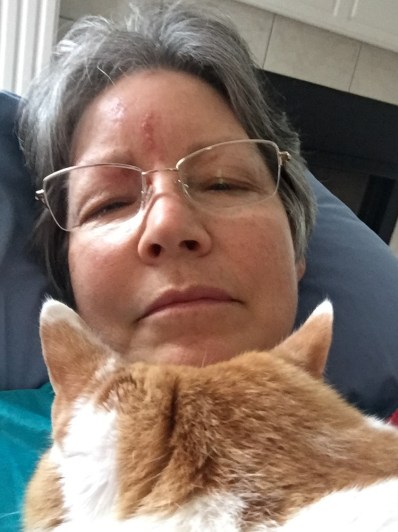
Shingles 2

Peaches keeping me company

I’m a Recovering Pharisee

You will never understand the heart of a Pharisee unless you realize that he sees the plank in his eye as belonging to others (Erwin Lutzer in Who Are You to Judge?)

eye plank

From my 2016 Journal. I am a recovering Pharisee. I identify more with the law than with grace, with Martha more than Mary, with the big brother rather than the prodigal son, with self-righteousness over God’s righteousness. Had I been at the synagogue the day Jesus healed the crippled woman (Luke 13), I would have been the Pharisee condemning Jesus for working on the Sabbath. Self-righteousness is my continual default. I cringe when I read this verse:

 To some who were confident of their own righteousness and looked down on everyone else, Jesus told this parable: (Luke 18:9 NIV)

Thankfully, I’ve come a long, long way in shedding my Pharisaical robes, but I’m not there yet—and won’t be until I get to heaven. Whenever I think that I’m “better than” I’ve crossed the line into self-righteousness.

So, I explore this thought:  If I choose the God path, does that make me superior to those who choose to resist God? My inner Pharisee says yes. But I know that is arrogance.

I am responsible for my own faith, my own choices, my own reactions and responses. I don’t know another person’s heart—not really. We are each accountable to our own master—be it God or Satan or money or pain. Since I’ve chosen God as my master, then I only answer to Him. It is not my job to judge another person’s choices or motives. I might know and recognize that they’ve chosen a poor master, and I can urge them to reconsider their choice, but they may be bound in chains and may not know that freedom is available to them. Why get upset and rage at them for not opening their eyes—when they are truly blinded by the god of this world and cannot see until the God of Heaven opens their eyes.

Lord, remove all stubbornness, pride, arrogance, self-righteousness, and feelings of superiority from my heart. Give me the heart of the sinner who beat his breast and begged God for mercy.