Navigating Body Needs

Journal 2017

“Sometimes you aren’t listening to your body because you’re listening to everybody else’s expectations.” AnnVoskamp.com

I’m reading a book entitled Plant Paradox that challenges much of what I’ve been taught. Who can I believe? Who has the answers? Opinions and research shift from one decade to the next. Eat potato skins, they say—that’s where the nutrients live; don’t eat the skins, others say, because that’s where the toxins stay. Egg yolks are bad for cholesterol; yolks and whites are best if eaten together. Don’t eat real butter—it has bad fat; don’t eat fake butter—it has too many chemicals. Aaackkk!

I just know that something has to give. I feel more tired and achy as the summer wears on—usually my most healthy season. Where is this inflammation coming from? How do I know what’s good for me and what’s not? Everyone has his or her pet opinion. And how do I balance buying organic vs. watching my budget? Or market-fresh vs. grocery stores vs. my shopping time? What’s most important to me? To God?

I eat pizza and pancakes every Saturday. And for company tonight I’m fixing a high-sugar dessert. How can I say no to that! My naturopath says to stay away from wheat and corn. The rheumatologist suggests avoiding nightshade veggies (tomatoes, peppers, eggplant)—all of which I just bought. Sigh.

I feel old when I’m tired and hurting and compare myself to an elderly couple at my church doing at their age what I don’t have the energy to do now at mine.

VISUAL: From the sidelines, I watch see this couple busily digging a ditch, while Jesus stands to one side observing us both. He hasn’t asked me to dig with these spry octogenarians, but somehow, I feel guilty.

“Look down at your feet,” He says.

I see water.

I don’t understand the significance. At first, I think, I need to bail this liquid out of my ditch. But then I realize the couple is digging for water, and I’ve already found mine. This is no reflection on them, no judgment—just an observation in the visual.

So, what’s next? I’m standing ankle-deep in clear, running water. It feels good on my sore feet. I’m allowed to stay here if I like . . . though I think, maybe I should help the couple dig for their water. Why should I stay here when others need me? So, I offer my services, but they wave me off.

“We love what we do!” they say. “If you like digging, you’re welcome to join us, but we don’t need your help. We’ve found our joy.”

Okay, I can live with that.

So, I stay here in the cool, refreshing water till something flows down my gully that requires attention. I’m grateful for those who answer the call to do. Today I am content to just be, a soft breeze caressing my cheek as I sit here on the patio of Starbucks, watching the cars go by, smelling coffee and perfume and fried food. It’s been a glorious day.

A 2024 Update. My inflammation is under control now and, fortunately, I don’t battle any allergies, or I might have a different opinion. I’ve settled on my mother’s philosophy and wisdom: eat what you want but in moderation. And eat lots of veggies.
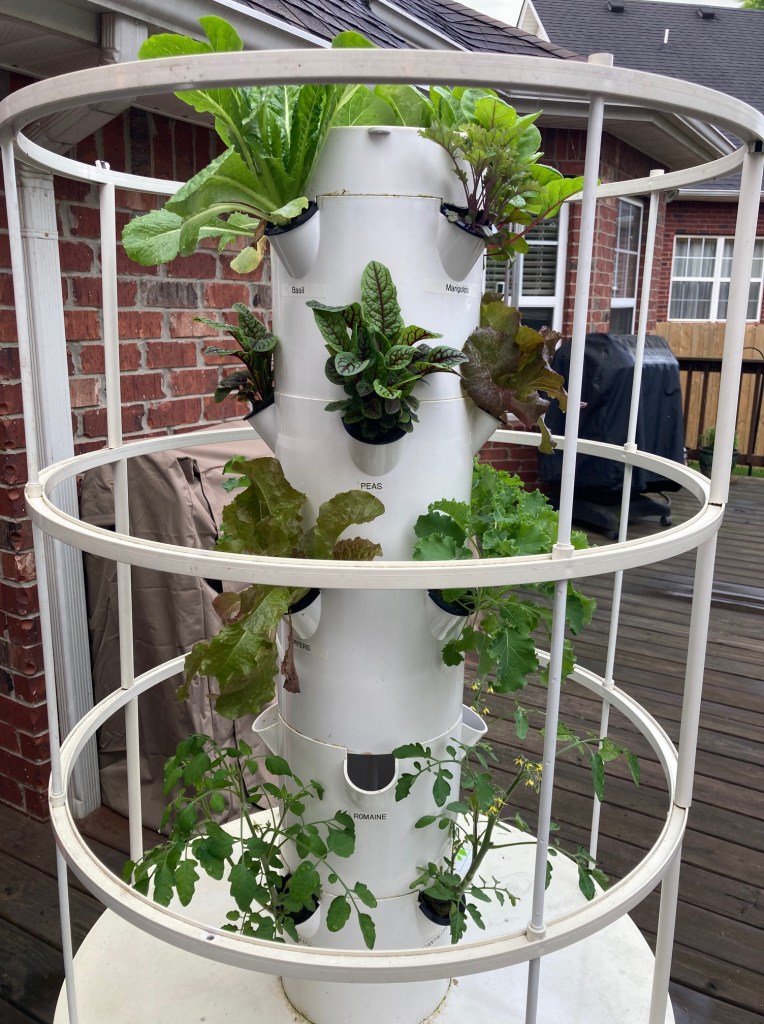
Starting my Tower Garden

The Banquet

“But I’m not . . . special,” Bailey says. “Not the way they are. I’m not anyone important.” (Erin Morgenstern in The Night Circus)

My mind won’t stay still enough to focus on the Word or prayer this morning. When this happens, writing helps slow my brain. There’s something about the physical act that’s connected to my mental thoughts. Yet even as my hand puts thought to paper, my mind flies in another dimension—a dissociation of sorts. Why does my mind go on tangents, cover the days’ schedule, rehearse conflicts, recall history, and plan for future goals, instead of staying present with the Living Lord Jesus?

I see a Gatekeeper Guardian silhouetted in a doorway with heaven’s brilliant bright light behind her. Why won’t she let me get past her?

“Because your heart is not ready or prepared yet,” I hear her say. Apparently, she can read my mind. (Oh, wait, she is my mind!)

“So how do I get ready?” I ask.

“You just did,” she says, smiling and pointing inside. My eyes try to adjust to the blinding light. I can hear laughter and the clinking of glasses and utensils. It seems there’s a party going on.

“Come on in!” I hear a voice calling out.

I step forward, groping, uncertain. An angel appears by my side, takes my elbow, and guides me to a bench. I find myself seated at a lengthy table and join the revelers. I don’t know who these beings are. Angelic hosts? Parts of my heart? Or those loved ones who have gone before? I can only see the table area directly in front of me.

Suddenly, I see God the Father “up front” wherever we are in this banquet hall. He’s introducing His Son. The hall erupts in cheers and hoots and hollers and wild clapping. I stand to join them and clap politely, but I don’t know yet what we’re celebrating. When the noise subsides, He approaches the podium.

“Thank you all for coming to my banquet,” He begins.

My mind starts to wander as I look around, my eyes adjusting to the light, able now to take in more of the scene. There are rows and rows of these banquet tables, but I still can’t make out the attendees or why we’re here.

And then I spy them—different Parts of my heart are all gathered together for a great feast. I decide I better refocus on Jesus.

“And so in conclusion . . .,” He says.

I’m chagrined. I’ve missed the whole speech!

People start clapping and I do, too, till He descends the platform, takes my hand, and leads me to the front. Uh-oh. Am I in trouble?

“Everyone, thank Grandma today for coming. She’s led you well.” Jesus has a twinkle in His eye. He knows good and well I’m here because of Him. He chose me from the foundation of the world. He wooed me and kept me and pursued me. I wouldn’t be here except for Him.

“Don’t be so modest,” He responds. “I didn’t force you to come. You chose well. You have a hard time accepting praise.”

“Because I don’t deserve it,” I think. I know my heart and its potential for pride and arrogance.

“I want you to see yourself as I see you, Karen. Are you willing to do that? That’s not pride. That’s honesty.”

And so I agree. Of course I agree. How can I oppose God? “Ok, Lord, fire away.”

Canons of confetti pop and spill their contents into the air, and the crowd cheers and roars.

“That’s my girl!” Jesus exclaims. “I love her so much. She doesn’t know how much. I’m so proud of her.”

I’m blushing bright pink. I throw my arms around Him and sob. Why tears? Why now? He may have chosen me, but I chose Him!

I see the scene in Secondhand Lions when the character Walter chooses to leave his irresponsible mom to go live with two eccentric old uncles. He’s found love, acceptance, and stability. There’s no pride in his choice. It’s a response to love.

“You bet I choose Jesus!” I shout. “He loves me! He died for me! Why would I choose the unloving, unfaithful, self-centered, wounded parent (the world, the flesh, and the devil) when I can have the real thing? I’ll choose love every time.”

“Come here, Children!” I cry, and the whole room rushes toward me for an embrace.

“Thank you for choosing Jesus!” they call out. There’s laughter, love, and delight. Dancing breaks out and raucous music surrounds us. Some return to quiet conversation over their wine.

One shy little girl approaches me, and I bend toward her. “Yes, Little One?”

She stretches on her tiptoes and whispers in my ear, “I love you.” I’m not sure of her identity, but she’s a pretty little thing, a cutie. And off she skips to play.

I glance over at Jesus.

“Aren’t you glad you came to the party?” He asks.

“Yes!” I shout to the skies. “Yes!” I’m grateful for the invitation. And we join the dancing and the merriment. It’s pure joy.

It’s time for me to start my earth day with its food preparation, exercise, emails, housework, and praying with people, but I have an open door in my heart now where I can see a party going on, and I can join in anytime I want to.

That afternoon when I gave a gift to a friend, she said, “I don’t deserve it.” Ouch! Didn’t I just say that to Jesus?

When Helping Hurts

From my 2012 Journal. Here are my takeaway quotes and statements from a thought-provoking book entitled When Helping Hurts–How to Alleviate Poverty Without Hurting the Poor . . . And Yourself. According to the authors, Steve Corbett and Brian Fikkert, every human being is suffering from some kind of poverty:

  • a poverty of spiritual intimacy
  • a poverty of being
  • a poverty of community
  • a poverty of stewardship.

We don’t fit right because we were shaped for something else.

“Compassion fatigue” occurs when we become less willing to help—because the recipients of your help fail to improve.

We must differentiate between:

  • Relief (crisis from natural disaster)
  • Rehab (restoration to positive elements before crisis)
  • Development (process of ongoing change that moves all the people involved—both “helpers” and “the helped”—closer to being in right relationship with God, self, others, and creation.)

Don’t apply relief when development is needed!

Avoid paternalism—doing things for people that they can do for themselves.

We are not bringing Christ to poor communities. He has been active in these communities since the creation of the world, sustaining them by the power of His word (Heb. 1:3). Hence, a significant part of working in poor communities involves discovering and appreciating what God has been doing there for a long time!

Change begins when something triggers an individual or group to reflect upon their current situation and to think about a possible future situation that they would prefer.

Three common triggers:

  1. A recent crisis
  2. The burden of the status quo becoming so overwhelming that they want to pursue change
  3. The introduction of a new way of doing or seeing things that can improve their lives.

“Never waste a crisis!”

Has anyone else had experience with this topic? In what context?

My parents’ home in Zambuk, Nigeria, as it looks today

Why Do I Care What Others Think?

From my 2013 Journal. I sprained my pinkie finger this week and had to tape it to the next finger to keep it stable and from feeling shooting pain anytime I bumped it. As I stood in church yesterday during a clapping song, I was conscious of how I had to restrict my hand motions in order to compensate.

All I could think about was what people would think if I just stood there and didn’t participate. Later I began to reflect:

#1 Why do I even think people are looking at me?

#2 If they are looking, are they judging me?

#3 Do they even care? Do I?

First of all, I suspect most people are doing the same thing I am—thinking more about themselves and what others are thinking of them if they act a certain way. And, yes, I think they’re judging—because I do it—judge people for their actions, that is. But so what if they judge or not? If they care or not?

More than feeling self-conscious, however, I think about my motive to set a good example. If I don’t clap, am I giving someone else permission not to participate in group worship? Do I hear a “should” in there somewhere? I want people to know why I’m not clapping. I can’t just stand there and not do it! Why not?

Claire Fontaine in Have Mother, Will Travel says,

Those who matter don’t mind, and those who mind, don’t matter.

How profound! It’s past time to let this one go. My worship must be God-centered rather than others-focused.

God Loves Me!

 “God created man . . . and God fell in love . . .” (Wes Stafford in Just a Minute)

From my 2012 Journal. That’s a stunning statement. In my head I’ve always known “God is love” and that God loves me. After all, we grew up singing, “Jesus loves me” and quoting John 3:16 “For God so loved the world . . . ” But were those just words, a fact, a piece of information, a truth with no questions asked, or a head knowledge only?

To say someone “fell in love” implies emotion and deep affection. There’s a difference between saying, “I know Scott loves me,” and “He fell in love with me.” I know about God’s agape love (sacrificial love; doing-the-right-and-moral-thing kind of love). But what do I know about His emotional love? Is it similar to what I feel for my girls or for my grandsons? I delighted in watching their every move as they turned over, took their first steps, spoke their first words. Is this how God feels toward me?

Somehow the thought that I’m a sinner stands in the way of accepting God’s emotional love for me. It’s time to take the label off.

I may be a corrupted or scratched-up CD, but I’m not a corrupted file. I’m fixable! (The world at the time of Noah—now that was a corrupted file!)

God loves the song that I sing. I’m his favorite album—scratches and all. He doesn’t get irate when I fail to perform at my best. He’s the originator, the creator of the CD, and He has a scratch-less copy on His hard drive. He made a perfect copy, and then Satan’s tools and my pride, stubbornness, and rebellion corrupted the music. Someday He’ll make another copy of me—back to perfect, good as new, and I won’t need the medium anymore. The music will play in the air, crystal clear, scratch-less.

God fell in love with me—my music—because He’s the songwriter, and He loves His creation. I came out of His heart. “Yes, Jesus loves me.”

2021 Update: After reading the book Imagine Heaven by John Burke, I have a new appreciation and understanding of God’s all-encompassing, unconditional, healing, gentle love. The thought makes my heart sing.

People, We Need People

What most people call trials and tribulations, I call class time.

(Degenhardt in Surviving Death)

From my 2012 Journal. Can I be honest? It’s so much more pleasant being around people who aren’t uptight, negative, or angry all the time. But it’s those very people who help me grow! Yes, I’ve had my share of losses and grief and experiences that have taught me life lessons, but it’s people—with all their flaws and triggers and woundings that hurt and jab and poke and bump into me that have given me the most fodder for growth opportunities. The continual sandpaper has removed some of my rough edges.

A 2020 update. Something I’ve observed during this COVID year: As an introvert, I’ve not minded the slower pace and the forced distancing from people. I feel more at peace when I’m in my own little bubble typing on the computer, doing a jigsaw puzzle, going for a hike, or reading a book. Isolation makes me feel content, but it doesn’t make me grow. I suspect it’s the opposite for extroverts who are happiest interacting with people. Isolation forces them to face their inner landscape—and that becomes their opportunity to grow.

Lean into the uncomfortable and watch God work.

Violence and Lies

For the rich men of the city are full of violence [of every kind]; Her inhabitants speak lies and their tongue is deceitful in their mouth (Micah 6:12 AMP).

From my 2009 Journal. Because I grew up in a loving home, sheltered from violence and hatred and evil, it was hard for me to conceive of men willfully choosing murder, crime, and destruction. And then I began working with SRA (Satanic Ritual Abuse) victims, and I listened for hours to unspeakable stories of raw evil and witnessed the results of perpetrators’ horrible deeds. When I read this verse, I can now begin to imagine the horror of an entire nation involved in wicked choices. No wonder God was upset with Israel!

I think there are two kinds of people: wounded (that’s most of us) and evil. A frightened and vulnerable teenage girl who aborts her baby is in a different category from someone in the occult who rips a child from his mother’s arms and places him on Satan’s altar (See 2 Chronicles 28:3). Worshipping a false god can be done out of pain or ignorance; but once a person witnesses evidence of God’s power and still chooses the fake way, that’s foolishness. Someone who chooses the violence of human sacrifice, however, has crossed over into the enemy’s camp. God’s judgment is severe for evil men.

The second half of this verse reveals the source of evil choices: lies and deception (coming from The Father of Lies). Most of our emotional suffering is a result of believing lies. Bad things that happen to us can be painful in the moment, but the lies we believe about the event keep the pain alive. And where there’s unresolved pain, there’s often destructive behavior.

Victims of extreme abuse can go either way: become perpetrators themselves or reject all things evil and run to God. What a joy to watch the latter find healing from their trauma. These overcomers have a special place in God’s kingdom. They are my heroes.

Evil in the open is but evil from within that has been let out. (The Life of Pi, by Yann Martel)

To read more about child sacrifice, check out https://www.worldvision.org/author/caleb_wilde, 5 things you need to know about child sacrifice in Uganda. (Unfortunately, the USA is also guilty.)

2020 Vision

The key to healthy memory functioning at ANY age is attention (p. 20).

 From my 2009 Journal. When my eyes began to change around age 40, I decided to get progressive lenses so I would never have to search for a pair of reading glasses. But now I’m losing my mind. Sigh.

I just read the book Where Did I Leave My Glasses? (The What, When, and Why of Normal Memory Loss) by Martha Weinman Lear.

glasses

 Conclusion: I’m normal! Yay! Here are some of my takeaways from the book.

  • I can’t change or improve memory loss, but I can improve my ability to cope with it (the author gives some compensatory strategies).
  • Do you need to make introductions and you’ve forgotten names? Try “Do you two know each other?” and hope they introduce each other!
  • Multitasking ability actually does decrease with age (but since I was poor at it in my youth, I’m doomed!)
  • Tip: Focus on one thing at a time. Deliberately block out a time for one task, no interruptions. (Good luck with that!)
  • “I never said that” and “I always knew it” are ego protection statements. “The need to feel right is a huge factor in how we remember and how we forget” (p. 110).
  • “Just because it looks like a duck and walks like a duck and quacks like a duck, make no assumptions. Not when the subject is memory” (p. 115).

Now, what was I saying . . . ?

The Blue Parakeet

Blue parakeetFrom my 2009 Journal. I just finished reading a thought-provoking book The Blue Parakeet—Rethinking How You Study the Bible by Scot McKnight. The author sets up two traditional ways of interpreting the Bible. The first is what he terms the “return and retrieve” approach: we return to what is literally taught in the context of the history in which it was written, and we try to obey it. This puts me in mind of another book I just finished—The Year of Living Biblically in which A. J. Jacobs humorously attempts to adhere legalistically to every command in the Law. The second approach is to “fossilize past interpretations into traditionalism.”
Why the title? Parakeets make wonderful pets, so we tame them, cage them, or clip their wings to keep them where we want them. McKnight contends that many of us attempt to do the same thing with the Bible. Instead, he proposes three better ways to read the Bible: Story, Listening, and Discerning.

With Story he suggests that we read the Bible like peering at Magic Eye photos  (take the flat, two-dimensional words off the page and see its three-dimensional depth) or like stepping into a picture on the wall and entering into it as an alive scene. He then suggests that we often try to do this with five ineffective shortcuts.

  • Morsels of Law (the dos and don’ts of Scripture). i.e. legalism—which results in our own superiority, being more concerned with being right than being good, and becoming judgmental. [I’m relating big time to this one.]
  • Morsels of blessings and promises (e.g. daily promise calendars). Dividing the Bible into chapters and verses contributes to this. “These people become optimistic and upbeat and wear big smiles . . . until something bad happens . . .” (p. 47).
  • Mirrors and inkblots. “Reading the Bible as an inkblot is projecting onto the Bible our ideas and our desires . . . it’s finding our story in the Bible instead of finding the Bible’s story to be our story” (p. 49).
  • Puzzling together the pieces to map God’s mind (systematic theology).
  • Maestros—following one “master” whether it be Moses, Jesus, or Paul. “One-chapter Bible readers develop one-chapter Christian lives.”

If we frame our relationship to God or the Bible as “authority,” then our response is going to be “submission.” But if we frame it as “love,” then our response is one of “love.” We’ve spent a lifetime being told to obey God—a term we use for a child (obey Mommy). But when we mature, our relationship to a parent grows to one of friendship, mutual respect, appreciation and love. I had to learn to obey my heavenly Father and to trust Him that He only wanted the best for me; and once I learned that, I could enter into the delights of getting to know Him better. He’s done everything for me, so relationally, I respond back to Him. I crave His attention; I crave spending time with Him—not just being subservient to Him.

If we read the Scriptures as a dialogue, a story, each author weighing in on a conversation, we get the bigger picture. For example, Paul says justification is by faith whereas James emphasizes works. This shows us that “James is in conversation with Paul or someone like Paul, or with someone who is distorting Paul.” Let’s say we had four theologians sitting around my dining room table chatting about their favorite subject. There would be banter back and forth between them, some saying one thing, another one correcting or honing in or asking questions. If we took just one statement off the table and wrote it down, out of the context of the conversation, all we’d have is a quote. We’d miss the larger picture, and we certainly wouldn’t experience the relationship that produced this quote. So . . . what’s our relationship to the Word? Love THE Word. I remember being jolted awake when I first heard the term “idolatry of the Bible”—where we worship God’s words instead of Himself.

McKnight says, “Words on a page are not just little squiggles of information on paper. Written words are personal exchanges, personal deposits of a person. Our words come from the depth of our heart and soul, and they extend who we are. That is why we care what others think of what we say . . . If you are doing good works, you are reading the Bible alright. If you are not doing good works, you are not reading the Bible alright” (p. 112). If you’re in the first group, keep it up; if you’re in the second group, make some changes!

And further: “We don’t follow Jesus literally; we  . . . pick and choose what we want to apply to our lives today, and I want to know what methods, ideas, and principles are at work among us for picking what we pick and choosing what we choose” (p. 122). The answer? Discernment.

If I were in a book club, I’d recommend this book for a conversation starter.

On Losing Weight

From my 2009 Journal. This Sunday I watched a particularly well-padded lady at church who loves to move to the music. I’m fascinated to watch human flesh respond this way in motion. Why does this mesmerize me? I feel sorry for the lady, but in truth I feel sorry for me. Here she is, obviously enjoying the joy of the Lord and (seemingly) oblivious to the fact that the people around her are watching. I feel like slapping myself for my rudeness in staring.

Here’s what I’m thinking: “If she only knew what she looked like . . .” Is that what people say when they watch me? If I don’t like what I see in the mirror, why should others?

I confess my fascination, my rudeness. Why am I not very tolerant of obesity? Why so critical? Is this self-righteousness? There’s always someone who is heavier than I am, and I’m envious of those who are thinner. I don’t like the numbers I read on the scale. I want to lose some weight, but why? To fit my clothes better? To feel better physically? To feel better about my looks?

The one I want to explore is Reason #3. Is this vanity? Where am I getting the belief that thin is beautiful, that I’ll look better in the eyes of others if my underarms don’t jiggle or my stomach is flat?

Though I’d not say I am obese, I do know I’m not at an ideal weight at the moment. What would motivate me to give up one thing in order to gain something else? My strongest drive, and the only one I think, that would work to help me lose weight, is to believe that it would please my Savior. But is that true? He loves me no more, no less, if I’m fat or thin.

What I do know is that obesity is often a symptom of a heart need. It’s just that an obese person’s issues are visible, whereas the issues of a thin person may not be. When I’m judgmental of people who are overweight, I fail to address my own hidden hurts.

Ok, now that the issue is out on the table, what do I do with it?

I’m currently reading Bill Thrasher’s book A Journey Into Victorious Praying. He states, “God wins His greatest victories in the midst of apparent defeat” and “God uses the needy moments in life to prepare us for His work.” And when anticipating temptation, “think ahead and ask God to give you a prayer burden to pray each time you are tempted to go back to your previous lifestyle . . . Make it a prayer that will damage Satan’s kingdom as God answers it” (pp. 33-35).

Suddenly I realize that I haven’t talked to God yet about my desire to lose weight. Oops.

As I pray, I hear Jesus say, “Step into the light. The mirror and the camera don’t lie.” First I have to come out of denial, acknowledge the truth, and confess my vanity. And then I ask God to reveal to me what’s really in my heart. I am willing to stop filling the empty place with food and I ask Him to fill it with something of Himself instead.

I can now see the church lady in all her beauty, loving God in full abandon. God knows her heart. It’s no longer about me.

Chocolate