WORD FOR THE YEAR 2019 – REST

The problem is when labor becomes the only thing that defines who we are. When we come to see things like rest as a negative space defined by the absence of work. When we fail to recognize the value of rest for building our sense of self.

(Alex Pang WordPress Hurry Slowly)

All of my life I’ve set goals for the year, for the month, for the day. I’m a task-oriented person driven to make to-do lists. In college, my schedule was so tight I kept a minute-by-minute chart (no kidding!) for each day’s goals and activities. The advantage of this discipline is great productivity; the disadvantage is that flexibility cannot dwell in your vocabulary.

Marriage, and especially children, tended to upset my neat calendar rows, and I began to relinquish my grip on defining productivity as success. Some days just keeping a child fed, dry and safe was my goal for the day.

I’m in a lovely season of adulthood right now where I get to choose how I manage my time—no school bells, no appointments unless I make them. I have no imposed time frames from outside sources. If I were not so goal-oriented, I could imagine myself sitting all day long in a comfy chair with a book on my lap. But I don’t—there is work to be done, things I want to accomplish, ministry to attend to, and relationships to maintain.

Growth and maturity and balance, for me, have come from watching people-oriented people. I’ve attempted to embrace the fact that people are more important than schedules and “being with” is just as important as “ministering to.” But I cannot change my basic temperament, and I continue to set goals for accomplishment.

After the previous year’s marathon goal of stretching myself once a month, immediately I knew my word for 2019 would be REST. But what would that look like? Did it mean I would cancel all my prayer ministry clients? Put editing Simroots on hold for a year? Hire a housekeeper? No, it meant I would cease from self-imposed goal-setting for self-improvement. I could relinquish my “have-tos” and begin to relax. Just for a year.

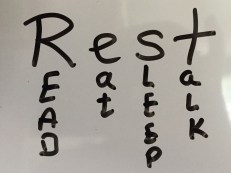
RESTWhen I put the word Rest on my kitchen whiteboard, my friend Cheryl wrote more words vertically under each letter. Pretty clever and spot on I thought. I also came up with the acronym REST G (Releasing Every Situation To God).

What I learned this year: Resting is sometimes harder for me to do than doing! Jesus is my Sabbath rest.

What was your Word for the Year? How did that go?

Click on the links below to see some of my previous years.

Word for the Year 2012 – Adventure

Word for the Year 2013 – Word

Word for the Year 2014 – Food

Word for the Year 2015 – Hike

Word for the Year 2016 – Unplugged

Word for the Year 2017 – Neighborhood

Word for the Year 2018 – Stretch

Heavenly Thoughts

From my 2009 Journal. I’m at the SIM Sebring Retirement Center. These godly old missionary saints in Florida just keep giving and giving. Some give gifts of time, others of service, some of tangible gifts. Some exude gifts of beauty and grace while others serve with gusto.

I think that whatever gifts God gives us here on earth will continue to be used in heaven to serve others. What do I have to offer though? People will have perfect knowledge and won’t need me to sit and listen for hours and pray with them. Maybe I’ll get to organize the angel wardrobes or help check in the new arrivals on the heavenly database list!

What language will we speak? The same as Adam and Eve? Will we get to meet all the people we ministered to unawares? Will we go around apologizing for all the dumb things we did and said to each other here on earth? Will we grow in knowledge? I do know that we will have the full truth that answers the need of our pain. Will we experience emotion in heaven? Will we all be smart? Wear different colors or all be dressed in white?

God’s kingdom as described in Isaiah 11 and 12 sounds perfect, glorious, fair, peaceful, delightful, comfort-filled, right, and true. I long for that kingdom now. But we must wait for it with patience. My daddy longed for it. He set his eyes on heaven in the last years of his life and didn’t want to stay here any longer. Mom, on the other hand, kept her feet firmly planted on earth and refused to look heavenward till it was time. Somewhere there’s a balance. I want to live on both planes at the same time. Yes, I long for heaven, but I must be content where I am now. The Apostle Paul felt this same conflict in his soul: Heaven is far better, but for your sakes I must stay here.

The physical world of the heavenly kingdom sounds glorious. But I can experience a taste of the spiritual realm (grace, mercy, love, peace) now, carried around like a jewel inside my heart. Heaven’s treasures and resources funnel into my heart here on earth, and I can draw on that strength any time I desire or need it.

What will it be like to meet Jesus for the first time? John the Baptist experienced Him on a physical plane—he touched Him, saw Him with his eyes, observed His works, was present for the declaration of the Father’s affirmation “This is My beloved Son; hear ye Him.” John said he wasn’t worthy to unloose Jesus’ shoelaces. We tend to brag about whom we’ve touched—people like a President, the Queen of England, famous actors or singers. What would it be like to revere someone so much that it would be an honor to touch his foot?

I feel intimate with Jesus, but on a spiritual plane, not physical. How will I respond when I see Him “in the flesh”? I have no precedent on which to base my future experience. I used to think that the second you died, you were ushered immediately into the presence of Jesus. “Absent from the body; present with the Lord” after all. Now I tend to imagine there’s a process you must go through first.

Here’s how I picture it: the angels who have been assigned to you accompany your spirit to the heavenly realm. There they offer you a drink of Living Water and give you an opportunity to bathe away your earthly impurities before they outfit you in your new pure white robes—just like Joseph had to bathe and receive clean clothes and be prepared before he could see Pharaoh. And then you’re told when your appointment is, and you’re debriefed in protocol for approaching royalty. Perhaps you’re even given a tour of your new quarters and a little view of the royal city. Perhaps you’ve even gotten to spend time with your loved ones who excitedly try to prepare you for what’s to come—your first meeting with your risen Lord. The excitement is running high. You can scarcely contain yourself.

And then the moment I’ve been waiting for—the “welcome home.” And I’m way too overwhelmed and shy to approach Him—I would not dare think of reaching out to touch His royal person. I’m flat on my face like a Nigerian villager before his chief.

But then something happens. He reaches out to me; He lifts me to my feet (“The lifter of our heads”) and embraces me, and I feel His enormous, infinite love and acceptance, and I realize in an instant how many times I failed Him on earth, how many times I responded in anger or unforgiveness or self-righteousness, and lost opportunities to serve Him. And I find myself asking for the privilege of serving Him—in any capacity—just so I get to be near Him and see Him and drink in His beauty. After all, there are millions of us up here, from every tribe and nation, and we all feel the same way—we’re all falling over each other to be near this Presence.

But He asks, “Are you willing to serve Me in the royal kitchen? In the royal nursery? As a chauffeur or greeter for newcomers? As a gardener in the kingdom? As an overseer of the mansion complex? And of course you say yes—anything for You, Jesus, and with pleasure. And the work we’re given to do will be “right down our alley.” I doubt I’ll be gardening, but I might be organizing things!

How do you picture heaven?
How Big Is God?

From my 2009 Journal. Isaiah’s imagination wasn’t big enough to give us perspective on God’s vastness, so he put it in human terms: compared to God we’re just tiny insects crawling around our little world.

God sits enthroned above the circle of the earth, and its people are like grasshoppers. He stretches out the heavens like a canopy, and spreads them out like a tent to live in (Isaiah 40:22 NIV).

I think of the song “He’s got the whole world in His hands.” If the world fits in His hands, how big is the rest of Him? I can picture a standing giant who flings a handful of dust into the air and each speck begins to sparkle with a gazillion twinkling lights and the universe is born. According to verse 26, each star is numbered and named! Not one is missing or lacks anything. But those stars only come up to His middle while His head and torso tower above them.

Here I am on earth trying to understand this huge Being and all I can see is a shadow coming toward me. The little grasshopper has no perspective at all—everything is too immense. Perspective comes when you look at it from the giant’s viewpoint. And that’s what Isaiah was trying to convey I think.

This passage makes me think of a doll house: everything is miniature to me, but from a grasshopper’s perspective it feels spacious. The miniature logs in the dollhouse fireplace aren’t enough to give me warmth. The tiny loaf of bread on the dining room table would not begin to satisfy my hunger.

Another perspective of God’s bigness was captured  in the song “The Love of God,” by Frederick M. Lehman,  The third verse of the hymn, Lehman said, “had been found penciled on the wall of a patient’s room in an insane asylum after he had been carried to his grave.”

Could we with ink the ocean fill,
And were the skies of parchment made,
Were every stalk on earth a quill,
And every man a scribe by trade;
To write the love of God above
Would drain the ocean dry;
Nor could the scroll contain the whole,
Though stretched from sky to sky.

How big is your God?

Universe pexels-photo

What Makes Your Heart Leap?

From my 2009 Journal. What makes your heart go thump? Your first crush? Seeing an old friend after 20 years? A perfect gift? A healed heart? A sunrise?

Here is my servant, whom I uphold, my chosen one in whom I delight (Isa. 42:1 NIV).

God the Father delights in His Son. His heart leaps with joy in relationship! I want God to leap with joy at the thought of relationship with me. I want my heart and soul to sing when I think of Him. But it feels rather one-sided. He is everything. I am nothing but a dog licking my Master’s boots. I will serve Him faithfully, but I am dependent on Him for food and water and air and training and discipline. He is a kind and benevolent Master who loves me, and somehow I manage to bring Him delight as well. I am not an equal. We are different species, aliens by comparison. He is everything; I am nothing. But He chose me, picked me out of the dog pound to serve Him and be His companion. My heart leaps when I think of that.

Dogb pexels-photo-1174081

Should I or Shouldn’t I?

Teach us to consider our mortality, so that we might live wisely. Ps. 90:12

From my 2016 Journal. I hear of causes, movements, meetings and appeals for help that I could join. But I have limited resources, time, dollars, and energy. Each money appeal, request or event that crosses my path has to be filtered through these considerations. And I must check in with the Commander-in-Chief before I move on it—even if it’s a good and worthy cause.

A friend recently sent out an appeal on Facebook to gather items to be donated to a local charity. The words I heard in my head were “I should do that in order to fulfill God’s heart for serving the poor and needy.” It makes no logical sense to admit I feel guilty for not doing it, so I know it’s trigger-based.

Guilt and shame and “enough” are nailed to the cross, so what is in my heart that wants to hold onto this “should”?

VISUAL: Shoulds are a heavy burden to carry—like an unwieldy, large sack of potatoes. If I don’t carry it, I think, who will? Since the potatoes are my responsibility, I can’t hand them over to Jesus. For example, He can’t diet or exercise for me or walk a casserole dish over to my sick next-door neighbor. That job is mine to carry out.

“True,” Jesus says. “There are certain things you were created to carry, not Me. So here’s what you can do. Put the sack down and empty all the potatoes out onto a tarp and let’s sort them together. First, throw away the bad ones (the lies). Now sort the rest into types, colors, sizes, or any way that makes sense to you.”

So first I sort them by kind—russets, red, fingerlings, etc. Seeing different colors and sizes is easier from there.

“Today we’re going to make a stew,” He says. “We don’t need a whole sack full of potatoes. Nor do we need every kind. Only pick up what you need for right now this morning. This afternoon you’ll need a different kind.”

Whew! This feels much more manageable now.

After seeing this visual, I was able to slow my thought processes down. I cleaned house thoroughly, ran to the grocery store, got the car washed, and filled up the gas tank—all with a feeling of peace. Next I drove almost three hours through heavy traffic to attend a funeral and drove home at night. Only in the last half hour did I begin to feel tired. Thank You, Lord, for teaching me to set down my potato sack! Maybe tomorrow I’ll find time to go through my closet for gently-used clothing to donate to the homeless shelter.

potatoes-vegetables-erdfrucht-bio-162673


I’m a Recovering Pharisee

You will never understand the heart of a Pharisee unless you realize that he sees the plank in his eye as belonging to others (Erwin Lutzer in Who Are You to Judge?)

eye plank

From my 2016 Journal. I am a recovering Pharisee. I identify more with the law than with grace, with Martha more than Mary, with the big brother rather than the prodigal son, with self-righteousness over God’s righteousness. Had I been at the synagogue the day Jesus healed the crippled woman (Luke 13), I would have been the Pharisee condemning Jesus for working on the Sabbath. Self-righteousness is my continual default. I cringe when I read this verse:

 To some who were confident of their own righteousness and looked down on everyone else, Jesus told this parable: (Luke 18:9 NIV)

Thankfully, I’ve come a long, long way in shedding my Pharisaical robes, but I’m not there yet—and won’t be until I get to heaven. Whenever I think that I’m “better than” I’ve crossed the line into self-righteousness.

So, I explore this thought:  If I choose the God path, does that make me superior to those who choose to resist God? My inner Pharisee says yes. But I know that is arrogance.

I am responsible for my own faith, my own choices, my own reactions and responses. I don’t know another person’s heart—not really. We are each accountable to our own master—be it God or Satan or money or pain. Since I’ve chosen God as my master, then I only answer to Him. It is not my job to judge another person’s choices or motives. I might know and recognize that they’ve chosen a poor master, and I can urge them to reconsider their choice, but they may be bound in chains and may not know that freedom is available to them. Why get upset and rage at them for not opening their eyes—when they are truly blinded by the god of this world and cannot see until the God of Heaven opens their eyes.

Lord, remove all stubbornness, pride, arrogance, self-righteousness, and feelings of superiority from my heart. Give me the heart of the sinner who beat his breast and begged God for mercy.


Where two or three aren’t gathered

For where two or three are gathered together in my name, there am I in the midst of them (Matt. 18:20 KJV).

From my 2011 Journal. Every Monday morning I meet with a small group of ladies for Bible study and prayer. And every Sunday I join hands with my Momentum team, and we bring our requests before the throne of God. And many times I’ve begun a prayer session by quoting Matthew 18:20, reminding God of His promise to join us.

We’re all guilty of it—quoting and applying Scripture out of context—but it startles me when I discover I’m the guilty one! The actual context of this verse is regarding confronting a person who has wronged you and forgiving them and getting witnesses and declaring he’s wrong. It really has nothing to do with a prayer meeting!

Is it still true that God is “there” when two or three are gathered together? Of course! But He’s just as much “there” when there’s only ONE of us in one place! I just don’t think I should use this verse as a proof text for something it isn’t.

What verses have you been guilty of taking out of context?

clasped-hands-comfort-hands-people-45842

THOUGHTS, WORDS, DEEDS

Your life is a printout of your thoughts.

From my 2011 Journal. Since childhood, I’ve been taught that deeds are important—whether good or bad. Remember that little chorus, “O be careful little hands what you do”? Within the last 10 years, as I’ve been listening to people’s memories, I’ve begun to understand how much our words might have an even greater impact. (See Derek Prince’s book Blessing or Curse—You Can Choose.)

But after reading Surviving Death by Scott Degenhardt, I became convicted about how much our thoughts can impact the universe as well. For one thing, if you think something, it has the potential to turn into words, which often morph into deeds. (Ever notice how you can think about doing something, and then you decide to ignore it, and then all of a sudden you find yourself getting up and doing that very thing?) I marvel that a thought has that much power over my body.

I could quote the verse “as [a man] thinketh in his heart, so is he” (Prov. 23:7 KJV), but somehow I’d come to believe that as long as I didn’t SAY something or DO something, it was okay. But here’s where I got convicted. I have found myself critiquing and then criticizing people’s choices in my head. I would never dare say something out loud, but I indulged the thought. What if we all had the ability to read everyone else’s thoughts? Would our thought life change?

Here’s the thing . . . thoughts are not really private. The God of the universe knows my mind. And sometimes my thoughts get expressed in my triggered emotional responses.

I am He Who searches minds—the thoughts, feelings and purposes—and the [inmost] hearts.  Rev. 2:23

God, by Jesus Christ, will judge men in regard to the things which they conceal—their hidden thoughts. Rom. 2:16

How does one confess a lifetime of guilt in one’s thought life? Sigh.

Thoughts pexels-photo-1485657

I Have a Question

From my 2011 Journal. My husband says he’s going to inscribe on my tombstone my favorite question: How does this make you feel?! My skill as a counselor is often based on how effective my questions are, so I’ve started taking note of some of God’s questions in the Bible, for He is a master “questioner”! Obviously He didn’t ask them because He didn’t know the answer, but rather so His clients would examine themselves and face whatever they were feeling or believing, or trying to avoid or hide.

To Adam:

            Where are you?

            Who told you that you were naked?

            Have you eaten of the tree?

To Eve:

            What have you done?

To Cain:

            Why are you angry?

            Why are you sad and dejected?

            If you do well, won’t you be accepted?

            Where is your brother?

            What have you done?

To the disciples on the road to Emmaus:

            What is this discussion you’re exchanging between you as you walk along?

To the disciples after the resurrection:

            Why are you disturbed and troubled?

            Why do such doubts and questions arise in your hearts?

To Mary at the tomb:

            Why are you crying?

To Peter on the shore of the Sea of Galilee:

            Peter, do you love Me?

What question is Jesus asking me today?

Question mark

Permanently Public

Dad's letterFrom my 2015 Journal. My father was a prolific letter writer, and I followed his example for many years, handwriting weekly missives to all my friends. On more than one occasion, someone has kept a letter I’ve sent and, long after I’d forgotten about it, shared it with me. It’s scary to think that something I said 40 to 50 years ago impacted someone so much that they kept it on file. Technology, meanwhile, has opened up a venue for exposing us like no other medium I know. I’m often surprised to see copies of letters or documents that were kept, photocopied, and posted online for the entire world to see. These become permanent records somewhere “out there” for future generations to mine through and discover.

Back in New Testament times, letters were carefully preserved and copied by hand, shared with several churches, and passed down through the generations. John the evangelist wrote a personal letter to “the elect lady” in II John and told her not to allow certain people into her home and not to give them encouragement or Godspeed. Typically, in the past, I’ve read the Scriptures as if every word were written to me. Thus, when I’d read this passage, I would try to figure out who in the world I shouldn’t “allow into my home.” That is an unhealthy exercise in futility! Since no husband is mentioned in this book, I assume John was giving her some advice about protecting herself and her faith.

The Word of God is inspired, and the Holy Spirit moved in men’s hearts, but sometimes men wrote out of their triggers, and most certainly out of their personalities. When I read the epistles as letters to a specific person or persons at a specific point in time, it feels like I’m peeking into someone’s private mailbag. I’m not sure I’d want some of my Facebook posts, letters, emails, or texts broadcast all over the world, published, and reprinted for future generations!

And then there’s that slanderous reference to Diotrephes.

I wrote something to the church, but Diotrephes, who loves to be first among them, does not acknowledge us (III John 1:9 NET).

Yikes! How I would blush to see my name referred to like this in a public letter! Perhaps Diotrephes was too full of pride to care. But I wonder at the time if John had any inkling how permanent his words were to become.

I once wrote an angry letter to an organization with whom I still have a relationship. I regret that now. Did my letter get permanently filed under “Difficult People”? I have since learned my lesson: never respond in writing while I’m feeling triggered. Work through my emotions first and my tone will change.

How would my communication change if I knew my words were permanent?