Musing on Judas

From my 2016 Journal.

Jesus sent out the twelve disciples and gave them power to drive out demons, to cure diseases, to heal the sick, and to preach the kingdom of God. (Luke 9:1; Mark 6:7)

The twelve? That means that He gave those powers and gifts to Judas as well—the one He chose by the will of the Father, knowing he would betray Him. The one whose love of money was never cured though he spent three years at the Master’s feet.

Jesus sent them out two by two. Who got stuck with Judas? Was he so wicked at this time? Perhaps not. Perhaps he only had a “little sin” in his heart. All the disciples struggled with unbelief and fear and pride. What was so different about Judas?

They were to take no food (what if they had a blood sugar problem?), no money (or credit cards for that matter), no change of clothes (ewww . . . would you invite two sweaty, smelly men in your home?), and they were to preach repentance. Apparently, Judas failed to heed his own preaching.

Whom do we trust with our money? The person we think will do a good job, who’ll keep good accounts. But it’s a man of great strength of character who can be trusted with money—especially other people’s. It’s our own choice if we want to squander our own money. But it’s unconscionable to steal and squander and hoard that which belongs to someone else. We are all weak men—thus we need accountability.

Judas, on the outside, looked so squeaky clean that his closest friends never suspected. (Makes me think of the perpetrator at boarding school—so deceptive that his co-workers to this day are astonished when they find out.) Satan is the master deceiver.

But then, I’m the one I fool the most—denying what’s in my own heart—until I’m confronted.

Random Thoughts on Prayer

From my 2013 Journal.

I need a fresh start with prayer. I’m beginning to do the grocery list thing again. I’m glad God can focus on more than one thing at a time. I can’t. My mind wanders. And God understands because He made my brain this way. But I know I have to do my part and have a little self-discipline. Journaling slows my brain down and helps me focus, but even while I’m writing out my prayer, my mind skitters off onto a tangent. Sigh. What if I quit using the word pray and start using talk instead? “God, I want to talk to You about . . . .”

. . .

My perspective on intercessory prayer has shifted from “ought to” or “spiritual discipline” to “ministry opportunity.” Prayer is as much kingdom work as teaching Sunday School or taking a meal to someone who’s sick. The key is the word ministry I think. I love “doing ministry.” It appeals to my task-oriented mind. Intercessory prayer is different from gratitude or praise or confession. I feel like I’m such a beginner in this.

. . .

Come into His presence, said King David. That was fine for him to say, because God’s presence was located in a place. There’s something missing in this statement for me. How can I “come into” when I’m always there?

I sat down to have my Quiet Time this morning and immediately began to intercede for someone—no preliminary formula of ACTS (Adoration, Confession, Thanksgiving, Supplication). I hear some preacher’s voice in my head admonishing me, and it occurs to me that God is not on a timetable of morning, noon, and night. Maybe I thanked him last night, confessed at noon two days ago, and now I’m ready to intercede. I understand the mindset of focusing my attention on Him and quieting my heart, and some days I have to do that. But if His presence is there for me at all times, there’s nothing wrong with galloping into requests on others’ behalf. I think God can handle that!

. . .

I heard on the Barna report that the average person prays only 8 minutes a day. They compared that person to someone who was living in a dangerous community who prays continually. Well . . . yes . . . that makes sense. But it felt like shame and condemnation for lack of prayer on the part of those who live in peaceful places. But how does one quantify prayer? If one is continually in God’s presence, one’s very breath is prayer. Am I more spiritual because I say 50 words in prayer instead of 5—and that takes longer? Strange that we should equate time (minutes) with relationship. But I suppose there is some truth to that in the earthly realm.

Prayer is also listening. How do you quantify that? I listen all day long. Why is it so hard to let go of the rules and focus on relationship? Peter struggled with it when he went to visit Paul in Antioch and quit eating with the Gentiles. Not all rules are bad. We need them. But they are bumper guards in a child’s bowling game—helpful at first, but unnecessary when you get the hang of living the Christian life. You get into the groove of right living and obedience and you find the sweet spot of love for the game. Of course there’re always adjustments and self-corrections to be made.

. . .

I find that my prayers are directly tied to my emotions. Words flow when I’m feeling sentimental. I pray most deeply and earnestly when my emotions run deep and more cerebral when feeling flat. But my emotions are not what create results. It’s not the words I say, but rather, I believe, God reads the heart and the motive. I can invoke His name in a loud cry or a soft whisper. The power is in His name, not in my poor attempts to get His attention.

Red Rover, Red Rover

From my 2013 Journal.

For 11 days I sat by Scott’s bedside at St. Thomas Hospital while he recovered from knee surgery. I watched a team of workers ministering to the patients. In one shift, a doctor, a PA, a nurse, a tech, a food deliverer, a cook, a housekeeper, a student nurse, a supervisor, and a case worker all contributed to the healing process. Only the surgeon or only the cook wouldn’t have been sufficient. Pain med management was no more important than the one who emptied the urinal. It was a well-oiled machine where everyone had to do his or her part, what he or she was skilled and trained for.

Somewhere I was taught that in God’s kingdom we should all exercise all the spiritual gifts (teaching, helps, hospitality), even if they aren’t my gifting or calling. I cut my baby teeth on “Bringing in the Sheaves” and the primacy of evangelism, but It has been a very long time since I’ve shared my faith openly with a nonbeliever. I have made a gradual yet complete shift away from evangelism to discipleship, from making converts to helping to heal the body of Christ. It has become my calling, and it’s intentional. But is it okay?

The housekeeper should never attempt surgery, and it would be a waste of his training if the surgeon gave up his job to do janitorial work. Acts 6 records the scenario where the apostles maintain their calling and giftedness—prayer and ministry of the Word. But the ones responsible for distribution of the widows’ food are no less godly or gifted. In fact, they’re specially chosen and commissioned by laying on of hands. It wasn’t the gift or the type of work that qualified them, but their character. We tend to put huge accolades on the public speaker, but every team member behind the scenes has a spotlight on him too.

What’s my point? I would never be able to stand in front of 50,000 people like Angus Buchan and proclaim the Gospel unless God called and equipped me for it. I have become more and more convinced that life is about celebrating our various roles in the kingdom . . . though I guess I’d like the fun sometime of reeling in the fish, not just putting worms on the hook.

The issue I’m wrestling with is the bold declaration in public that Jesus is the Christ. What inside me makes me shrink? I could speak to a believing crowd because we’re on the same side of the fence . . . teammates.

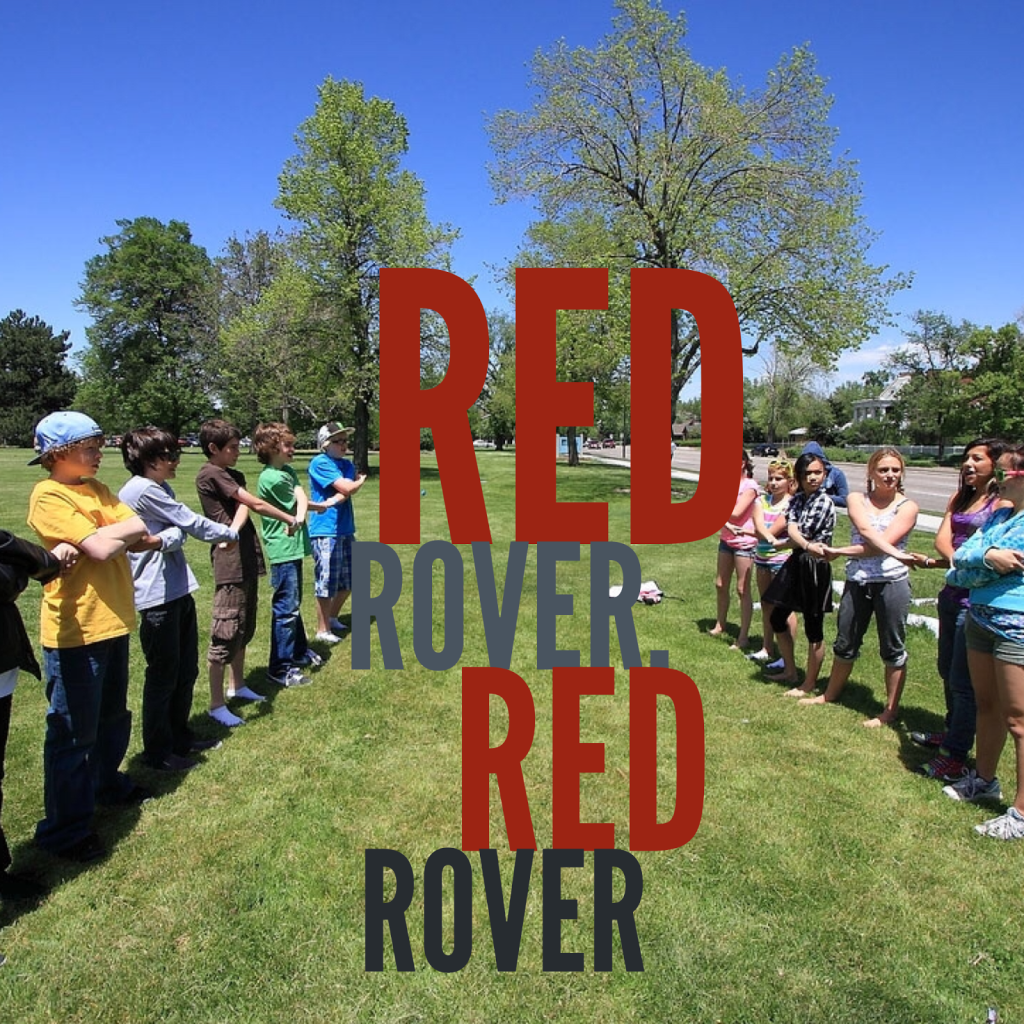
And there’s my visual. At first, I saw a tug-o-war, digging in my heels in total opposition to the other side. Instead, God showed me “Red Rover.” Evangelism is an invitation to join our side. My spirit relaxes with that.

So . . . I can tell someone on the opposing team, “Drop what you’re doing. Let go of the hand next to you. Come test our side. Experience the strength of the God side. Come join forces with us.” Our team breaks apart where there’s sin and idolatry and strongholds, and the enemy captures one of our members. But our team will prevail. Our God is stronger than your gods!

Seek God, not an experience.

From my 2016 Journal.

After struggling with this issue for years, I lay to rest the notion/teaching that I’m missing something because I don’t have certain spiritual gifts such as speaking in tongues, raising people from the dead, healing sickness and disease by a touch, or handling snakes without getting poisoned.

Crowds gathered also from the towns around Jerusalem, bringing their sick and those tormented by impure spirits [to Peter], and all of them were healed (Acts 5: 12-16, NIV).

After Jesus’ ascension, Peter, the man who denied Jesus three times, begins to perform miracles of healing and casting out demons. Peter didn’t ask for this gift. It was conferred upon him—according to God’s design and purpose. I don’t have the gift of healing, but I have seen clients delivered of evil cosmic beings because, and only because, the person willed it to be so and because Christ’s death defeated demonic forces. I have no power in myself to do diddly-squat! It’s by God’s very will and choice that I draw breath and move and have my being.

I’ve been standing around with my palms up, asking and ready to receive whatever God has for me. Instead, He says, “Just get to work! Quit standing around waiting. When and if I hand you something, open your hand or reach for it in obedience.” If I refuse a gift, then I’m being rude or disobedient. It’s not so polite to extend my hand to demand that someone give me a gift!

The next verse says, Then the high priest and all his associates who were members of the party of the Sadducees were filled with jealousy.

“And don’t be jealous,” God says, “if I give one gift to someone else that you think you want or deserve. I know exactly what gift(s) you need—best for you and best for Me. Now get to work and enjoy what I’ve given you!”

Seek God, not an experience.

Bagfuls of Prayers

In the same way, the Spirit helps us in our weakness. We do not know what we ought to pray for, but the Spirit himself intercedes for us through wordless groans. (Romans 8:26 NIV).

From my 2013 Journal. As I pray a bullet list of requests for God to grant, He hands me a fistful of bags, heavy as gold but light as fairy dust, in which to carry the requests. First, I hand one to Alan for his trip. He accepts it and thanks me for it.

Next, I hand a bag to Betty. She shows me the needy children she cares for. I don’t have to drum up compassion. I have to walk the path God put me on and follow His leading in humble obedience. He will show me who I am to care for, and Betty will care for the ones in her care.

After that, I give one to Cherie. She drops it in her pocket, but I urge her to carry it next to her heart where the holes are.

Deidre comes next, but she wrinkles her nose, holds it at arms’ length and drops it. God instructs me to empty the contents over her head. Pretty sparkles of light and flower petals rain down.

I hand one to Edith, who cries with gratitude and eats it for strength, absorbing the nutrition for her mind, soul, and body.

Fran asks for one, too, but she’s too weak to hold the container. I empty the contents onto her reclining body and gently massage it into her skin—a healing balm. The prayer covers her like a mud bath to remove all the impurities and draw out the shame and inadequacies and fears. Next, she must choose to dip into the Salt Sea. My prayers cannot force her to do it. But in the spirit of adventure, I know she will leap in and be cleansed. Just don’t wait too long, dear one, or the mud will dry, and you’ll feel itchy and ugly. Go wash and be clean!

Gina begs for a double-triple portion—afraid that only one bag won’t be enough. I laugh and assure her that God’s power is immeasurable and His grace sufficient. Like Peter, she begs to be washed all over. But I’m instructed to squeeze only one drop from her bag onto her index finger. I don’t understand why, but I obey. She’s curious too. What to do with it? Jesus tells her to rub the ointment into her eyes so she can see clearly!

These bags of prayers (all alike I thought) from my lips change into different forms and substances, according to the needs of the receiver. How amazing is that!

Who’s next? I have so many bags left. I want to distribute them all, but they seem to be multiplying like the loaves and the fishes. I hurry over to offer one to Helen. She thanks me, smiles, and says good for me for handing them out and then carefully places it on her shelf, next to her idols. Sigh. Maybe her idols will topple over in the presence of the Holy One like the Philistine god Dagon.

One for Ira, who gladly accepts it and carries it around with him wherever he travels. He’s grateful for it and recognizes its power—ready for use at a moment’s notice.

Next I offer one to Janine. She thanks me, declares it smells good, and tosses it into the back of her car. I decide that’s not good enough, so I secretly toss a bagful, like fairy dust, over top of her house. Curiously, the particles dry up and dissipate before they touch her roof. I try a second time, and it happens again. What gives? There seems to be an impenetrable shield over her house that deflects my prayers. And now I know why. Instead of a believer’s bag, I need to hand her the red one—the one that contains the blood of Jesus. Sprinkle that one . . . no . . . use a hose! Cover, saturate, flood that home! It’ll force her to exit and look up. I happily spray her with it as well. She laughs. She tastes it on her lips. She wants more. She wants to drink it, dance in it, twirl like a little girl before she first got hurt. Jesus says, “Just hold the hose, Karen, just hold the hose.” Then she grabs it from me and sprays her neighbors who have come out to see what the commotion is all about. More laughter.

I box up two bags with extra padding and send them off to China. Though I don’t know their addresses, God safely delivers them to the doors of Kang-Chun and Liang-Lee, two persecuted pastors. There’s healing ointment in the one, I see, along with some bandages. I can’t tell what’s in the other box. The pastor isn’t home. Oh, there’s bread and wine and cheese and rice (of course!) for the starving wife and children. Like the widow’s oil, it keeps replenishing itself. Splendid!

I set down the rest of the bags. M through Z will have to wait for another day.

And now, Lord, I need one for myself. It’s in pill form, easy to swallow. I don’t need to know what’s in it. God’s work/word is unseen as it nourishes my body, gives life to my brain, feeds my arms and my legs, my liver and my heart. Nothing gets wasted or eliminated. “Drink,” He instructs me. “Drink deeply of Me, of My presence, My Spirit, My love. Let it cleanse your every pore. Let it wash through you and make you clean . . . strength for today and always. Breathe deeply. I’ve given you the breath of life itself. It’s My breath. I breathed into you to make you a living soul. Your very being is a testament to My power and creativity.”

Photo by monicore on Pexels.com

Sabbath Rest

From my 2016 Journal. Every Sunday, my missionary parents practiced Sabbath rules according to their own definition. We did not enter a restaurant or store, travel, cook, play table games, or indulge in handwork on that day. I began to question this logic when I discovered that Jewish Sabbath occurred from sundown to sundown Friday to Saturday, and never mind that we didn’t keep the rest of the Levitical laws.

Mosaic Law gave general rules for Sabbath (Shabbat) observance: no lighting fires in your house or cooking (Exodus 35:3) and limited traveling (Joshua 3:4-5). The ancient Pharisees interpreted and refined Sabbath rules according to their own parameters, and today their legalism extends to not pushing elevator buttons, turning on electric lights, or using any device-driven means of transportation.*

Jewish law prohibits work on Shabbat, but while resting is implied, the word Shabbat literally means “to cease” or “to sit.” God didn’t need rest after creating for six days. He simply ceased.

Reform Judaism says, “One should avoid one’s normal occupation or profession on Shabbat whenever possible and engage only in those types of activities that enhance the joy, rest, and holiness of the day.”

With this in mind, if I were trying to “keep the Sabbath” I would avoid housework, computer work, and the business end of my ministry. It would not preclude ministry itself according to Jesus’ example. He preached and healed all week long. You’d think He’d refrain on the seventh day and take this day off, but apparently His work wasn’t classified as labor.

I may not be Jewish, and yes, Jesus is my Sabbath rest, but I do need to “cease.” I need the change of pace, the chance to recoup, refresh, and recharge my body, mind, and soul.

So . . . once a week, I often turn off my computer, refrain from cleaning house, and occupy myself with things I enjoy doing—guilt-free, such as reading, doing a puzzle, or golfing with my husband (after church of course!)

What does your Shabbat look like?

*How far am I allowed to walk on Shabbat? – Shabbat (chabad.org)

*Laws of Shabbat for Beginners (aish.com)

Prejudgment

From my 2013 Journal.

I stood in line at the Wal-Mart return counter behind a beautiful, young black lady linked arm-in-arm with a white man. From my view of their backs, it appeared to be an unlikely pairing. His head tilted a little to the left as if in affection. In my right periphery, another strange couple appeared—a white man with a very obese woman. Though there were two employees behind the counter, we all lined up single file so we could approach whichever clerk became available next.

I tsked under my breath when the couple to my right inched their way forward and nudged into line beside me. Though inwardly indignant, I remained outwardly gracious. If they wanted to be rude and ignore protocol, that was their problem.

The couple in front of me advanced to the counter, and I stepped forward to take their spot. At that moment, the couple on the right pushed past me to get in line directly behind the first couple. Astonished at their brazenness, I turned to the lady behind me to observe her reaction and mirrored her surprise. I shrugged and rolled my eyes as if to say, “Some people! Whatever!”

When the first couple finished their transaction, both couples turned and exited the room together. That’s when realization dawned. These were two special-needs people with their caretakers. The second couple was simply trying to stay close to their group. I felt duly ashamed of myself for my prejudgment. God forgive me!

Heavenly Worship

(1950s) Dad building our church out of mud brick and a tin roof. What remains in 2014 after storm damage.

From my 2013 Journal.

My first memories of church included sitting for hours on a backless mud bench, singing mostly American hymns translated into Hausa, accompanied by my missionary mother playing the accordion. Dad’s preaching would lull me to sleep if Mom didn’t occupy me with crackers. Women sat on one side of the church, men on the other, and nearly-naked children squished shoulder to shoulder on the floor or front pews. In later years, local pastors and women playing indigenous musical instruments led the joyful service.

This week, when one of my African-American neighbors died, his dear wife invited three of us white folks over to meet some of her friends who had arrived to provide comfort. They all circled up, holding hands, singing and praying—loud, long, repetitive, simultaneously. We three stood quietly apart, singing softly, joining in with our hearts. Later, at the funeral, the preacher’s sermon included thunderous shouting, huffing with each sentence, accompanied by organ crescendos and a robed choir.

I thought back to an Easter service at the Eastern Orthodox Church where I visited with a Jordanian friend. Worship included quiet a capella music and chanting, solemn contemplative rituals, and a brief homily. Beautiful icons, candles and incense completed the sensory experience.

At my contemporary interdenominational church, the congregational singing predictably goes from loud hand-clapping, hand-raising, drum-beating musical numbers with guitars and electronic keyboard accompaniment led by a group of performers followed by one quiet song before the conversational-style, 30-minute sermon.

Worship cultures . . . each with their own traditions, expectations, idiosyncrasies. There’s no right or wrong way—unless the heart and mind aren’t engaged.

And my preference? I’m somewhere in the middle—neither monkishly contemplative nor exuberantly outward in expression. Quiet suits me best as an introvert. And call me a heretic, but give me an intimate dialogue or deep conversation any day over a sermon lecture. Yet I still choose to attend churches that might not suit my personal preferences. I need the variety of the body.

What will heaven’s worship be like? In the book of Revelation, John records moments of loud and times of silence. Somehow all nations, tribes, and tongues will be unified in their worship and will enjoy Him together. I can’t wait!

Be Prepared!

From my 2014 Journal. For our tour in Israel, our leader, Charlie Dyer, supplied each of us with headphone devices so he could speak to us in crowded places. Each time we arrived at a site, we’d leave our personal belongings on the bus and carry only minimal necessities—camera, notebook and pen, and of course the headphones. Because of their weight, I opted to leave behind the provided spare batteries.

When we arrived in Jerusalem, the climax of our journey, the bus driver dropped us off on the top of the Mount of Olives. It was crucial to have our listening devices with us if we didn’t want to lose our way among the elbow-to-elbow crowds.

To my chagrin, my headphone batteries died just as we began to descend the mountain. I felt like one of the virgins in the wedding parable who had neglected to bring extra oil for her lamp. I learned a powerful and humbling experiential lesson!

But all turned out well. Someone in our group graciously let me borrow his extra batteries. The God of second chances!

How Can I Help You?

What’s in your hand?

From my 2013 Journal.

When someone shares a problem with me, Miss Fix-it here tends to jump in with a solution. I’ve learned, however, it’s better to find out what the person wants or expects first, or I may get a rebuttal. Sometimes people don’t want a solution; they just want a listening ear.

The prophet Elisha asked the prophet’s widow, How can I help you? What do you have in your house?

God asked Moses, What do you have in your hand?

And Jesus asked the disciples, How much bread do you have?

We need to start with what we have and work from there. This is a principle I learned from the book When Helping Hurts by Corbett and Fikkert regarding poverty—start where a person is, using the resources they already have. Don’t just jump in to fix it. Let them be part of their own solution.

A 2021 Update. I’m reading The Power of Moments by Chip Heath. In section II, the author suggests a better question for a health professional to ask than “What’s the matter with you?” is “What matters to you?”

Sometimes the solution lies in asking the right question.

Need help?