I’m feeling peevish today—I need a week to work uninterrupted. As an introvert, I thrive on solitude, but for the last month, I’ve had to be “on” with people—either needy ones or as company in someone else’s home. It’s not that I don’t enjoy my life, but I just need a break from it. When others around me are struggling, it affects my mood. I feel like I keep giving and giving without getting replenished.
In the River of Life, I would prefer to float on my back and watch the sky. Instead, I’m back-paddling at the top of a waterfall.
When I finally stop rowing, I fly over the waterfall with a God-given parachute. But at the bottom, my boat spins in an eddy, and I white-knuckle my grip to keep from capsizing or slamming into the rocks. I’m in survival mode and must remain vigilant for more rapids ahead. This wild ride is no longer exhilarating or fun. I’m cold and wet and want to get out and dry by a fire.
Endurance. Perseverance. Steadfastness.
I feel the weight of people’s woes and my responsibility to meet their needs. I feel the burden of maintaining friendships and working to contribute toward our family’s finances. I could spend all day at the feet of Jesus, but the house won’t clean itself, and the food doesn’t cook itself, and I have to think about my health, prayer obligations, books to read, goals to accomplish, and, and, and.
Balance. Rest. Pleasure.
I’m a linear thinker who knocks off my to-do list one item at a time, but relationships, interrupting phone calls, and the messiness of life get in the way.
I think it’s about losing control. I used to have control over my own life, but now I live at the mercy of other people’s choices. It makes me feel lost at sea without my oars.
Jesus asks my permission to handle the oars. All I have to do is sit and watch and wait, He says. When He commands, “There’s a fish; let down your net,” I obey. And when He says, “It’s time to rest,” I can lie down on the cushions and sleep, knowing He is in charge. And sometimes He hands me a Karen-sized oar and says, “Now paddle hard!” because we’re about to go over some rapids.
A 2025 Update. Reading this entry makes me tired! I am in such a different place now emotionally. I am at peace, unhurried, at rest. Perhaps my circumstances have changed, but I suspect I’m simply at a different place in my healing journey as a recovering co-dependent.
Whenever I ask people to define faith, they glibly quote Hebrews 11:1.
Now faith is the substance of things hoped for, the evidence of things not seen.
But to me, this sentence is just meaningless words on a page. It wasn’t until I heard the following sermon that it finally clicked. Here’s what pastor said.
Faith is when you hear what God says, and you do it.
It’s defined by what God says. (For every entry in Hebrews 11, they heard a command from God.)
It’s determined by how you respond. (Check out the verbs in this chapter.)
It’s deepened by the challenges you face, your experiences.
It’s directed to the rewards He promised.
Faith is NOT simply belief. For example, I can believe that if I step off the edge of a cliff, I won’t fall. That’s stupidity, not faith.
Faith is acting on a command or a promise from God. Faith is standing on the edge of a cliff, and if GOD TELLS ME to step off the edge, I do it in obedience and trust. If I plummet to my death, so be it. He will take care of the results. Or He may have prepared an invisible bridge to the other side (like in Indiana Jones and Last Crusade)—but I wouldn’t have known it was there if I hadn’t taken the first step.
Daniel’s friends, Shadrach, Meshach, and Abednego (Daniel 3:16-28) obeyed God—in faith—and their attitude was, “Even if we die, God will take care of it.” But God chose to spare their lives for a greater purpose. Others, like Jim Elliott and his four fellow missionaries, obeyed and became martyrs—they stepped into faith and obedience and stepped right into the arms of Jesus.
A 2025 Update. I’d like to add that the object of my faith is of prime importance for the outcome. I can always trust God to do what’s best.
The Dilemma: Shechem, the son of Hamor the Hivite, defiles Dinah, the daughter of the Patriarch Jacob. (Genesis 34)
Man’s Solution: Simeon and Levi (Dinah’s brothers) decide to avenge the wrong. They deceive Shechem and the leaders in the city, kill all the males, and along with Jacob’s other sons, seize all the plunder, including women and children. (As an aside, I find it interesting that it’s Levi, the future priestly line, who avenges. A strong sense of justice and fairness becomes imbalanced.)
It seems that God allowed for vengeance in the Old Testament (an eye for an eye), even though the Mosaic Law had not been given yet. Yet murder is not an equal retribution for rape. If only the brothers had asked God what to do, He could have brought judgment on Shechem, and his blood wouldn’t have fallen on the brothers’ heads.
God’s Solution: Jacob is now scared of retribution, and God answers that fear. He instructs Jacob to move to Bethel (where he first met God at the ladder to heaven) and to build an altar. (Genesis 35:1).
Man’s Response: The Scripture doesn’t say God instructed Jacob to get rid of idols. Maybe He did say it, or maybe Jacob is taking the final step of obedience and loyalty to His God. Remember that Rachel (Jacob’s favorite wife) had taken her father’s idols when they fled Paddan Aram. I also suspect the women and children whom the brothers captured from Shechem’s town also brought idols with them. Nonetheless, Jacob instructs all his household to give him all their idolatrous paraphernalia (which he buries) and to purify themselves and put on fresh garments—outward symbols of an inward change of heart.
God’s Response: When Jacob obeys, God protects. “The terror of God fell on the towns all around them so that no one pursued them” (Genesis 35:5 NIV).
My Response: When I’ve been wronged, it’s easy to believe that taking vengeance into my own hands will make me feel better. But “Vengeance is mine,” says the Lord (Deuteronomy 32:35). His retribution is fair and just and better than anything I can dream up.* Best to let those feelings go and face my pain.
I may take many detours in life, responding with poor choices, but I’m safest in the place where God dwells, in obedience, and in purity.
*I’ll never forget the day I was working with a D.I.D. client. When Jesus asked one of her Little Ones if she’d let HIM punish her perpetrator instead, her eyes got big. “He be in big trouble!” she exclaimed.
Has the potter no right over the clay, to make out of the same mass (lump) one vessel for beauty and distinction and honorable use, and another for menial or ignoble and dishonorable use? (Romans 9:21 AMPL)
The correct response to this question is yes, of course, the potter (in this context, God) has this right. But if you’re like me, you might struggle with accepting it. If I have given God the right to my life, am I willing to be a Ming vase with all its beauty and value? A cooking vessel that takes a lot of heat? Or a serviceable, smelly chamber pot?
And so, I ponder what kind of pottery He created me to be. I think He’s chosen me to be a water vessel—a practical, no frills, serviceable carrier of Living Water to those who are thirsty. Sometimes it’s a heavy load to bear—until I realize I’m not the one who’s supposed to transport it. My shape and size are created for the task He’s given me. All I need to do is be faithful. Daily. Hourly. And if He chooses to form my sister into a Ming vase or my friend into a chamber pot, that is His business. He knows what every person should be—all for His glory and purpose.
What kind of vessel do you think He made you? Are you at peace with His choice?
I’m too busy. Important details are slipping through my fingers. I’m worried over finances (first the washing machine died, then the compressor on the upstairs air conditioning unit quit, and now the car needs a new muffler). I’m worried over my daughters’ needs, over my health, sleep, and eating habits, over other people’s health, over ministry needs.
I haven’t been at peace for a while. When circumstances go awry or when things spin out of control, is my response always a trigger from the past? Or can it be a new situation? It’s a tangled mess right now. Where to begin to lay it on the altar?
Sometimes it’s simply a choice. And today my choice it to hand God my worry.
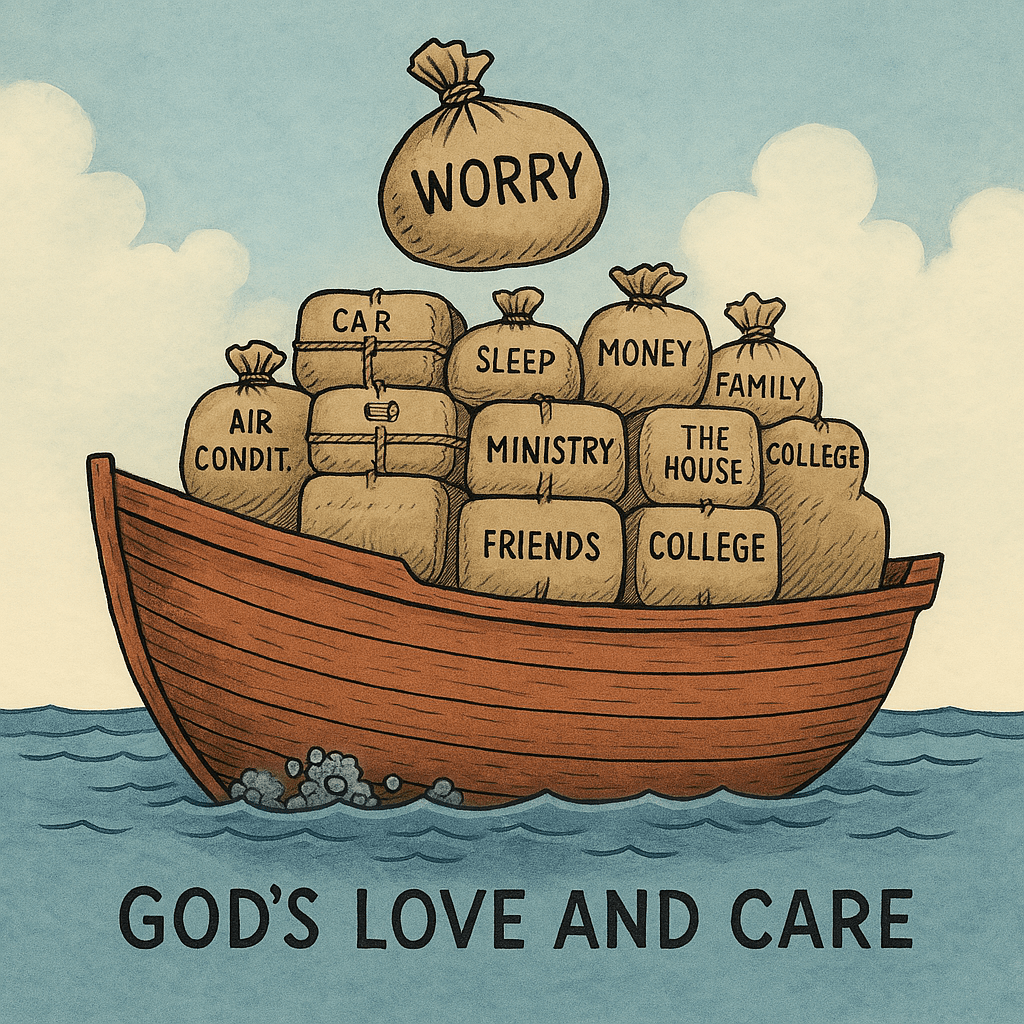
My ship floats in a sea of God’s love and care, but in my ship dwell all my cares and concerns. When life comes at me one bundle at a time, I can deal with each in turn and move on. But when the bundles continue to compile, my stress elevates, and my ship sinks deeper into the water. There aren’t too many choices: throw some of the bundles overboard, climb to the top and enjoy the view, or sink with the ship. This could be akin to burnout, and I don’t want to go there.
This weekend was the last bundle to pile on top. Was it from God to test me or simply an opportunity to minister to one of God’s children?
My husband’s name is listed in the phone book under clergy, and we get periodic pleas for help from random strangers. One time I was able to pray with a lady for an hour. Usually, I refer them to the church office. This time it was Saturday, church office closed, when I got a call from Gerry, a 62-year-old homeless Christian widow who was stranded near us and afraid to get on the highway with her car leaking fluid. I invited her to spend the night. It broke my heart not to be able to help her more, but I couldn’t take on one more thing. If I’m feeling this much stress, I cannot even begin to fathom what she goes through on a daily basis to survive.
Was I foolish to take her in? Was she merely working the system to get what she wants? I gave her what I could—a bed and meals, laundry, a hot shower, and a phone card. But I wanted to give her more. I wanted to pray with her intensively to heal a few hurts, but I don’t think she was ready for that yet. I listened, I didn’t judge her, I held her, and I prayed for her. What more did You want from me, Lord? She was a bundle I had to gently place overboard and trust her to God’s care.
Gerry told me a Catholic Father, responsible for his flock, went to bed each night praying, “God take care of Your sheep; I’m going to sleep.” That’s profound. God, take care of my friend Gerry. I need to take care of my family now.
When do you come to the place where you say no to someone’s plea for help? I have control over who I schedule to pray with. It’s a steady stream, usually not too much, but right now, it’s too much. With two graduations, a senior show, and a reception to prepare for, I feel swamped. I feel like climbing out of the boat and swimming in God’s love for a while. I need a spiritual bath.
Now I see barnacles of pride and sin and anger cemented to the bottom of my boat. I must chip them off, break the bonds that hold them in place, and let them float away.
Next day. My boat has suddenly sprung a leak. It appears that our house guest stole my credit card. I called to cancel the card and filed a police report. I feel sad for Gerry. I was taken advantage of. I gave her dollars I could ill afford to give her, and she stole from me. I could be angry, bitter, hateful, revengeful. Instead, I feel sorrow for her. Would I do the same were I in her shoes? Perhaps. Lord, take care of my friend Gerry. I believe she’s Your child. She believes You’re punishing her for her divorce.
That night. Shame-faced, I found my credit card in the pocket of my housecoat—right where I put it yesterday. Lord, help me. Were you protecting me from some future fraud through this incident? What’s going on here? What lesson are You trying to teach me? You’ve just restored my faith in human beings. God, forgive me. I falsely accused an innocent person. Lord, please protect her from false arrest.
Why does money drive everything here on earth? A homeless person struggles for daily bread and survival next to the millionaire who lives in luxury. Money can mean survival or demise. Why do we hang onto it so tightly? Or let it go so easily? What happened to the trusting nature of my childhood? Have I seen too much now of how the other half lives? Is it because I don’t feel in control of what I do have? I’m living in a very stable condition now, but life is so uncertain. You can build a business for a lifetime and then lose it in one disaster. What exactly am I afraid of? What are my worries? How do I let go?
A 2025 Update. Shortly after this, we removed Scott’s title “Reverend” from our phone listing, and the calls stopped. Was that a good decision?
I don’t remember how I processed through this visual, but I realize now that the more bundles I carried, the deeper I sank into God’s love, and that’s not a bad thing. I may not have been in control of the bundles of life’s circumstances, but what didn’t belong and what made it worse was the weight of my worry and the unholy barnacles. I also learned through this incident that I cannot rescue everyone. I am not meant to do God’s job.
Religious heart-preparation rituals didn’t figure too highly in my Baptist upbringing. We didn’t make much of high holy days and certainly not Advent, Lent, Ash Wednesday, Passover, Maundy-Thursday, or even Good Friday. So, it’s not in my background and training to make much of one day over another. Perhaps we followed the Scripture passage about not observing one day above another. In any case, I believe every day is a heart-preparation day.
Heart-preparation for the Lord’s Supper is also a bit of an enigma to me. We partake in community, but we spend it in solitude—reflecting inwardly. I find it very difficult to meld the two. I’m too aware of my surroundings. Too aware of the ritual and the people around me, and no place to write (my best vehicle for concentration). And certainly not long enough to focus and concentrate inwardly to deal with any sins I’ve committed. For me, that heart preparation must come before I ever sit in the pew. “Remembering His death” comes closest to what the ritual does for me. And that indeed, I think, is its primary purpose.
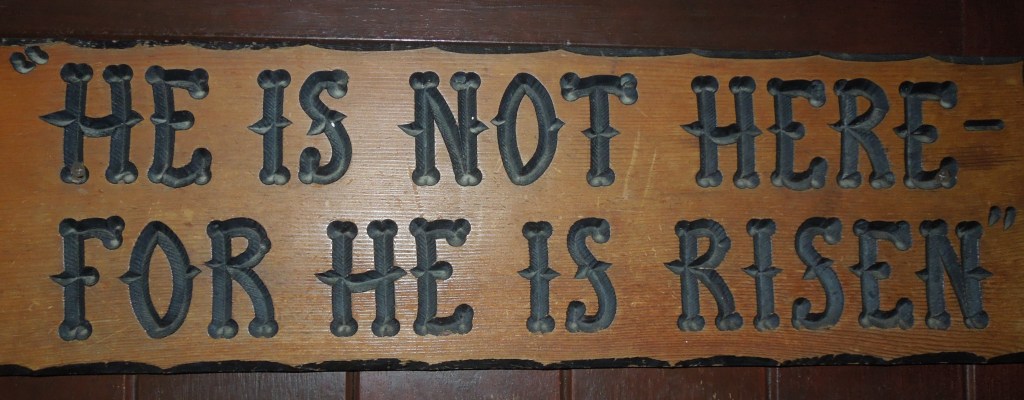
So, today I remember, give thanks, pray, and prepare my heart for the joyous celebration of Resurrection Sunday.
God created man in His own image, in the image and likeness of God He created him: male and female He created them. (Genesis 1:27 AMP)
What, exactly, is God’s “image”? I know what the theologians say, but the word trips me up. By definition, image implies something visible. Yet God is not visible—or is He? God is a spirit, yet Jesus now has a glorified body. Could it be possible for God the Father or His Son to have an essence that resembles Adam? What form did He have before the reincarnation? Is it possible that God possessed shape and form (like a man) only on a grand scale (like we’re miniatures in comparison) but that His spirit was as large as (or larger than) the universe. Maybe His spirit is His aura or His energy field.
And isn’t it interesting that God created two people rather than three? God is three in one, and in a sense, so is man (body/soul/spirit). Yet it takes two (male and female) to procreate. God doesn’t procreate Himself, but He has both male and female characteristics. What a mystery!
Donald Miller inBlue Like Jazz suggests that if we change our metaphor, we change our attitude. For example, he says we use war metaphors when we refer to cancer: we battle cancer; we fight cancer. What if we changed the metaphor?* Would our perspective change?
Miller says we use economics when we talk of relationships: we value people, invest in them, think of them as priceless, and relationships can be bankrupt. Love is not a commodity, but we use it like money. If somebody does something for us or offers us something, like gifts, time, or popularity, we feel they have value, we feel they are worth something to us. We withhold affirmation from the people who do not agree with us, but we lavishly finance the ones who do.
I accused someone yesterday of having an issue with economics. She didn’t want to fellowship with someone because she felt the person was beneath her. Before I put on my judge’s hat, however, I realize that perhaps I, too, am guilty. What are my perceptions and values? It’s almost the reverse for me. I’ll fellowship with anyone “below” me but feel uncomfortable with those “above.” Isn’t it interesting our metaphor for viewing someone with or without money as “above” or “below” us? I need a new metaphor.
And it’s not just wealth. How about intelligence? Talents? Usefulness in society? I think of Princess Diana and Mother Theresa dying at the same time. Which person was worshipped, caught the most media attention? What about the rich man and Lazarus? Stark contrasts in wealth and poverty. Yet, which were the richer?
What other metaphors do I need to rethink?
*A 2025 Update. I just watched the movie The Healer, in which a fun and feisty girl with cancer calls her disease her “marshmallow,” thus removing all the negativity associated with that scary word.
Yesterday was a test of endurance. Three people called to unload their woes on me. Then last night I didn’t know that our middle daughter was coming home to spend the night, and I could hear her rattling around the house till 2:30 a.m. At 4:30 a.m. I heard a terrific cat fight. Since K-C is an indoor cat, I didn’t think much of it, but the noise fully woke me, and I got up because I was hot. That’s when I discovered the back door was ajar and the porch light was on. The neighbor cat shot out the door leaving his sprayed male scent and fur on the floor and a terrorized K-C. For the next seven hours I tried to return to sleep without success. I was burned out from the night before, trying to get ready to teach my first class.
K-C did not last long at our house!
I think I handled the first interruption okay, worse with the second, but by the third, I just gave up and gave in. I had to quit thinking and start preparing for the class and wing it with what was left in me.
I need a Sabbath day of rest! One month with family, holidays, company, starting a new job, and driving our youngest to college leaves me with no downtime. I want to be a little bird, soaring on the wind, or a duck peacefully floating on a warm pond with the breeze ruffling my feathers. I want to be a cat, content to curl up in my mistress’s lap and go to sleep, knowing my needs will be met. I want to jump onto the highest counter to escape the world and survey the humans below. But when I do, I see the mess the world is in. Too much pain, heartache, and stress, and my world has been crazily spinning out of control, off on tangents instead of staying on its axis.
Peaches, our current feline
Am I crazy to take on a teaching job again? What was I thinking? But the offer dropped in my lap after I asked God to supply our needs. He’ll have to help me juggle my time. I’m through worrying about it. Meanwhile, how to get my body rested and my mind to relax … I’ve been on a treadmill for too long, and I need to get off. I’ll have to WORK at resting!
I need balance. Demands or requests for my time from other people collide with my to-do list. Are interruptions always about God’s timing? Are they sometimes Satan’s interference? How does one discern which it is? I know that people need to come before things in my priorities, but what if the “thing” is a service for someone?
When someone calls, for example, wanting prayer, do I stop what I’m doing to minister to them? Sometimes yes, sometimes no. If I’m on my way to a meeting at church and I get a phone call, do I forgo my small group time or, like last night my commitment to nursery duty, to process with this person? No, I can say a quick prayer for them and urge them to make an appointment. It’s okay to manage my time.
On the other hand, like today, I was at home preparing for my class when I got three phone calls that interrupted me—each needing a listening ear. One I gave my full attention to; the second only half-heartedly, and the third I put off till later. Should I have done that? I burned out by the end of the day. Had I rested long enough from my work to minister and pray, I might have gotten more work done.
A 2025 Update. I learned better balance from my days of imbalance. I learned that your crisis is not my emergency. I learned to listen to my body and, most of all, my emotions that drove that imbalance. It’s better to be at peace than to have to pick up the pieces.
After Moses finally agreed to obey God, return to Egypt, and ask Pharaoh to let God’s people go, Pharaoh refused and made things worse for the Israelites. And Moses began to whine to God:
WHY have You dealt evil to this people?
WHY did You ever send me?
YOU haven’t delivered your people at all.
If God commands, and I obey, and things get worse before they get better, this is normal. Perseverance, endurance, and overcoming all require faith—especially when it gets darker.
When I’m in pain or distress, it’s hard to hear the Lord’s voice. Often my first response is to blame God for my predicament. After all, He’s the King of the Universe, capable of stopping it. But when I’m angry or belligerent, God rarely answers the question “Why?” Instead, He defends His character. “You are ignorant, O foolish man. I am the all-knowing. You don’t know what you’re talking about.”
I pray that in my hour of trial I will be an overcomer and remain faithful and not accuse Him of withholding His love. I feel so weak. It’s easy to trust God when there’s food on the table and my health is good.
Moses’ Anger
I wonder what ticked off Moses. Was he taking on the burdens of the people he was supposed to free? Was he mad that Pharoah wouldn’t heed his warning or obey his bidding? God doesn’t tell Moses His whole plan. He only reveals one plague at a time, and each time Moses probably thinks, “Okay. NOW he’ll let us go.” Did Moses take on the responsibility of making Pharoah budge? And when he wouldn’t, did it make him mad? I can sure identify with that! I’d like to see a few people budge!
So how do I respond when I don’t get my way? Can I trust that God has the situation under control? That He can move in the hearts of men to accomplish His will?
Moses’ Worry
God gave Moses a huge responsibility: lead a million people through a desert with no water, no food, and only armed with a memory full of miracle experiences. Everyone who had a problem came to him for a solution. What a heavy burden! Did God give him daily advice? Or did He only speak at the big crunch times?
Where do I turn when the tough times come? I can work hard to build my resources and slip backward. I can sit back and not work yet move forward. I could lose my health, my home, or my livelihood without warning. Is God on the throne if a tornado wipes us out? If the breadwinner dies?
When it happens to someone else, it’s just a story. When it happens to me . . .
Worry is a large, tangled ball of string with fear at its core. How do I get through that energy field of worry, through the tightly woven string ball to face my fear and replace it with peace?







 In the Pursuit of Peace