The Organized Mind

Journal 2018

My mind is fighting itself this morning as I try to study the Word. This summer is so jam packed with travel, ministry, company, goals, and family events, it’s hard to stay present. I wake up with to-do lists in my head, with plans, ideas, and needs taking up more prefrontal cortex space than I care to give it. Feeling a little overwhelmed, my foot starts jiggling again.

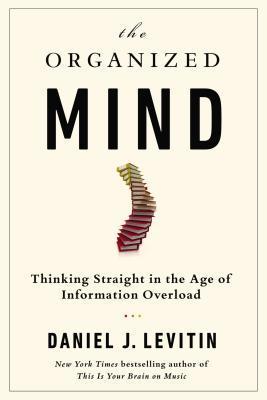
I’m currently listening to a fascinating book on brain research: The Organized Mind: Thinking Straight in the Age of Information Overload, by Daniel J. Levitin. The author addresses the neurological importance of proper sleep, the inability of the brain to focus on more than one thing at a time, how multitasking actually reduces effectiveness, and the role of memory. I just wish I could retain all this information. (Click here for a summary video of the book.)

I already practice many of the principles the author suggests, but I struggle sometimes getting into the flow (as he terms it). This is when our left brain stands still and we go into right-brain mode to write, paint, or create music. When I have a lot on my mind, it’s harder to stay there.

One of my takeaways from the book is that mindless daydreaming mode is actually very purposeful. We need it. It’s almost like REM sleep where our brain sorts and searches and organizes information. We need time to daydream and not fill our minds 100% with stimuli and entertainment. What is screen time doing to my brain if I don’t ever give it a rest? If it’s not the computer, it’s the phone. If it’s not the phone, it’s the TV or iPad. So, when I wake in the morning, it’s hard to stay focused on God. My mind is going crazy trying to keep up with my schedule.

Visual: I’m balancing on the top rung of a floor-to-ceiling library ladder, randomly grabbing books off the shelves. I want to read them all, but which book do I start next? Where should I focus? How do I cram a lifetime of goals into what’s left of my short life span? I need a system, a plan. I can’t possibly read them all, and I don’t want to waste my time. I want to organize my life in an overcrowded library.

Balance

Yesterday was one of those days when I’d stretched to my limit of emotional and psychological endurance. When I get unbalanced (people versus alone time, leisure versus work), I must make adjustments to return to equilibrium. There’s my part and there’s God’s part. When I bleed over into trying to do God’s job, I take on burdens that harm me. The battle may be the Lord’s, but I must do my part and take care of my body, feed myself spiritually, and make wise decisions.

I need to leave the library for a while and stop rushing, relax, and gain some perspective. I need to be okay with not meeting a goal or a deadline. So today I think I’ll skip some of my scheduled activities, go for a walk, clean up my e-mail inbox, and organize a closet. The library books will still be there when I return.

One-Track Mind

Journal 2006

I have a one-track mind that struggles to manage multiple, simultaneous crises. At one time I aspired to become a medical doctor until I realized I didn’t have the multi-tasking skills needed for that profession. The positive side to this super-power is I can focus on a task to completion. Unfortunately, I get frustrated at interruptions, finding it hard to pull my mind away from the zone.

As I’m concentrating on a task, I’m not thinking about God. When I’m worshiping God, I find it distracting to be around people. And while I’m with people, I can’t center on my inner needs. How do I balance these areas of focus and release my feelings of worry and guilt that I’m “less than”?

So here’s my visual: With my heart in the middle, my feet perform a task, my arms reach out to minister, and my head looks up to God. When I look within, I focus on self—adjusting and changing, making goals, and removing triggers. When I look outward, I focus on relationships and the needs of others.

So, in my visual, it’s okay to be seated (feet still, no task) while I reach out to minister to others. The body is still there, whether my mind is focusing on it or not. When I watch my feet, my senses can still be alert, aware of changes in the environment that will warn me of danger. The parts are all inter-related, still in existence even if my eyes are focusing on one part only. The rest of me doesn’t go away.

So how do I find balance? Should I tithe my time? (That would mean focusing solely on God 2.4 hours in a 24-hour period or 1.6 hours if I only count waking hours). How much time should I allot to self-examination? (As much as necessary, I think, to become emotionally healthy.) If my arms are always engaged in ministry, my feet (tasks) don’t get done. If my head always faces the sky, my feet will trip. Each part must take turns. The trick is to maintain an equilibrium between the parts.

But I must not become too compartmentalized. I can focus on each in rapid succession. Micro-seconds of looking up while engaging my hands or feet will give me orientation. Checking my attitude while ministering to others is necessary. I might not be able to stop for self-care in the moment, but I certainly can take note of it and deal with it at my first opportunity.

A 2025 Update. Over time, I worked through the anger I felt at my tasks being interrupted. I find I can more quickly redirect my attention to others or return to the zone and refocus on my task without anxiety or shame. Being one-track-minded is not a character flaw.

Schedule Conflicts

Journal 2017

I feel conflicted about my schedule. I have not built in enough margin, enough down time, enough me time. My fault, I know. It feels overwhelming to think about all my relationships, responsibilities, commitments, and projects. There has to be a balance somehow. Life is messy and moves from day to day whether or not I plan or organize or prioritize. And I can make all the plans and goals I like, but they get interrupted on a daily basis.

My heart relaxes with this visual: All the parts of my day and my life are pieces on a spinning pie chart. But if God is in the center, there’s stability and peace.

Six Tributaries

Journal 2005

Lynda Graybeal, administrator of Renovare (www.renovare.org) suggests we need a “balanced vision” of 6 streams or dimensions of the Christian life (Conversations, Vol 3:1, p. 52). Though I was reared in one particular stream, I have dipped my toes in each of these tributaries and found grace in each of them. All make up the body of Christ. All have partial truth. All can learn from the others.

Contemplative – The prayer-filled life

Holiness – The virtuous life

Charismatic – The Spirit-empowered life

Social Justice – The compassionate life

Evangelical – The Word-centered life

Incarnational – The sacramental life

Which stream refreshes you the most? Which one challenges you?

Small Bites


As I read the Scriptures, I find I can only chew on one small portion at a time. When I’m studying faith in Hebrews 11, it’s hard to focus on I Corinthians 13 and love. When I’m reading the Psalms, I’m focused on praise and thanksgiving. I have to trust that whatever bite I’m chewing on at the time is what my soul needs.

Sometimes my soul needs water because I’m thirsty (“as the deer panteth for the water”). Sometimes it enjoys dessert (the mountaintop experiences in life). But other times, a sip of bitter coffee (admitting I’m wrong) offsets the sweetness of forgiveness. Meat and starch for energy. I need it all . . . but I can only take (and enjoy) one bite at a time.

And so I lay aside the guilt that says I’m not praising enough, or I’m lingering too long over the coffee. I need balance. And I can trust God to bring into my life whatever He has planned for me to help me grow in my walk with Him.

What are you chewing on today?

Small bites 2