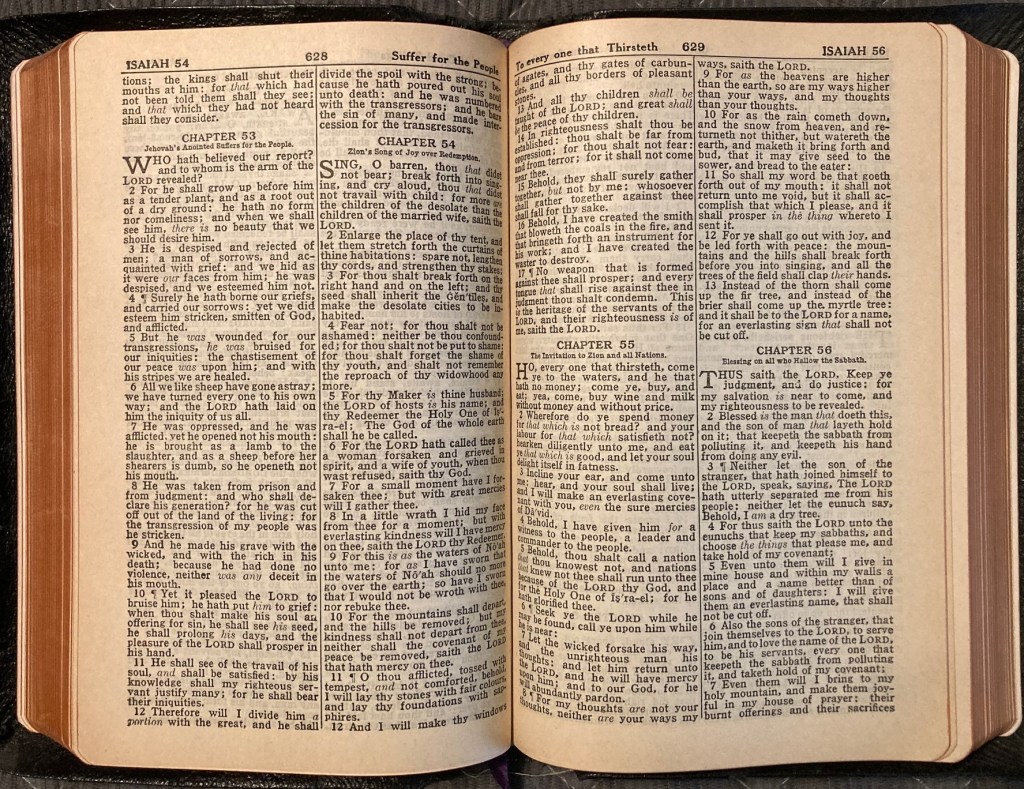
Experiencing The Holy Spirit

Journal 2006

There’s a debate swirling around these days about the role of the Holy Spirit. Some claim that only through study of the Scriptures can we know truth; others say we experience the Holy Spirit whispering truth in our ears. I say it’s both/and. We must know the Scriptures in order to test the spirit’s voice. The Holy Spirit’s words will never violate the written Word.

Some people argue, “You can’t trust your experiences,” but I retort, “That’s all we have! Everything that has ever happened to us is our experience, and we live our lives accordingly.” My experience will be different from yours, and this is okay. The goal is to get rid of the lies we believe in those experiences.

Some would admonish us, “Don’t seek an experience,” and I think they may be right. If one person experiences a spiritual high of some sort, I don’t have to go chasing after it to duplicate it. God will give me the experiences I need. My goal is to continually seek Him, pursue Him, and look for the treasures in His Word.

A spiritual experience can come from the outside—such as a visitation by an angel. This is not something I can manipulate or orchestrate. It’s God’s doing. But experiencing God on the inside, in my mind, happens because I choose to open myself up to Him—when I choose to obey, to let go of bitterness, anger, and unforgiveness. It comes when I fill my mind with good things and not evil ones. It happens when I guard my heart against the lies and wiles of the devil. It happens most often when I spend quiet, alone time in God’s presence, just being still. It’s the place of meditation. It’s where Jesus is. It’s where God’s Spirit speaks to my human spirit.

God’s Word

Journal 2009.

Jeremiah 32. God’s Word can be trusted.

Jeremiah predicted doom and gloom to all of Israel, and it made the king mad, and he shut Jeremiah up in the court. Jeremiah must have been having some doubts, so the Lord told him ahead of time his cousin would come to him and sell him a field. When it happened, just as God said, God then told Jeremiah to have the deed buried in a safe place. And just as God accurately predicted the scenario with his cousin, He would assuredly fulfill His promise to bring Israel back to the land and prosperity.

When Jeremiah still struggled with the prophecy, God said this famous quote: I am the Lord, the God of all flesh; is there anything too hard for Me?

A rhetorical question: No!

Jeremiah 33. God’s Word gives hope.

God sees the big picture; He knows the end from the beginning. Our sight is limited and finite, and the amount we know is miniscule, according to the will and desire of the Creator.

I fear I think like an American—individualist instead of tribal. What good did it do Jeremiah to learn that God would restore Israel and he’d never live to see it? Who cares how many descendants David’s throne would have when he was hurting, mocked, and imprisoned? The future won’t affect him personally!

But there’s that thing called “hope.” This earth, this life, isn’t all there is. There’s a bigger picture. I’m just one speck in the Grand Plan. My part is miniscule, but important, in God’s eyes. It’s not all about me and only me. God was showing Jeremiah that his life was not in vain. That His calling on his life was important for the greater good.

We have a future and a hope. Hallelujah!

Jeremiah 36-38. God’s Word is to be obeyed.

I am in awe of Jeremiah’s dogged persistence and obedience to the Lord. He was asked to do some pretty bizarre things, and he was given the very unpleasant task of telling bad news and warning people and no one listened—at least not the kings. His life was threatened. He was persecuted. But he continued to trust.

“Obey the Lord and it will go well with you” (38:20) was a promise to the king, but it has application for today. We cannot conclude, however, that God will always spare our lives if we obey Him. But we do know disobedience reaps consequences.

There are certain commands in Scripture we know we are to obey (love your neighbor, don’t lie or steal) and when we’re given a direct nudge from the Holy Spirit. There are consequences to our disobedience and blessings when we obey.

Sweet Words

Journal 2009.

“Your words were found and I ate them, and Your Word was to me a joy and the rejoicing of my heart; for I am called by Your name, O Lord, God of Hosts.” (Jeremiah15:16)

Thought #1. What did Jeremiah mean by eating God’s words? I think about the word biblio-idolatry (the worship of the Bible). This is the person who studies every word, shade of meaning, and explanation but never falls in love with the author (The Word Himself). It’s the person who can’t let go of the literal to read in context. Or the one who boasts in the ability to find any verse, quote any passage. They’ve fallen in love with the beauty of the language, or they use verses to beat people over the head.

That was not the case with Jeremiah. He had a relationship with the author of the words, and therefore the words were sweet to him. When my husband says to me, “I love you,” I cherish his words. If an acquaintance says, “I love you” because I happened to be kind to her, the words do not hold the same impact as someone I deeply cherish. I can thank her politely and then flick them away. I don’t “eat her words and enjoy their sweetness” like I do when Scott says them.

Thought #2. What does it mean “I am called by Your Name”? My maiden name was assigned by default from my father, and I inherited my last name by marriage. My given middle name, however, belongs to my paternal grandmother. I am “called by my grandmother’s name” means I’m associated with her. And though I never knew her, I want to “do her proud,” as Grandpa would say. But to be called by GOD’S name? Wow! Here’s the relationship as I see it:

He is King                   I am a Princess

Lord                            Indentured servant

Messiah                       Saved one

Shepherd                     Sheep

Truth-giver                  Truth-receiver

Creator                        Created

Redeemer                    Redeemed one

Master                         Slave

Comforter                   Comforted one

Counselor                    Counselee

Father                          Daughter

Prince of Peace           Peace-receiver

Holy One                    Purified one

Savior                          Saved

Vine                            Branches

Door                            Protected one

Way                             Traveler

Word vs. Spirit

Journal 2005

As I study the passages in the Word about the Holy Spirit, I wonder where the balance is between study and experience. My Bible training was all academic: interpretation, dissection, exegesis. If I only have the written Word and no Holy Spirit inside to interpret them, I simply have a collection of symbols on a page, lifeless and meaningless. But if I didn’t have the written Word, how would I know what my experience meant? But Jesus IS the Word—the Living Word. He brings the symbols to life and gives them meaning. I need both.

I wonder why God chose to use words to communicate with us. Why not comic-book pictures? Or is the world itself and its experience a visual? A picture would not be reproducible in certain countries or eras. But words endure, can be passed down through the generations. Can be heard. But for those who are visual . . .  I guess God gives each of us the visuals in our minds that meet our needs the best. But then, so do words.

A 2023 Update. After praying with people for the past 22 years, I’ve come to realize how important both words and visuals are. Clients will say, “I know the truth in my head, but I don’t feel it in my heart.” What they are describing is left-brain (words, logic) vs. right-brain (pictures, emotion). Our experience comes first, followed by interpretation of the event. When I read Scripture, I’m engaging my left brain. When the Holy Spirit speaks directly to my heart (emotions), I experience the truth and it gets correctly interpreted.

The Word and the Spirit

Journal 2005

Sometimes I learn more truth through other people’s processing than I do through my own. Yesterday, while praying with a client over the phone, God answered a question for her that answered a question for me: If we have the Holy Spirit, why do we need the Bible? And if we have the Bible, why do we need the Holy Spirit?

Now, I could have given her a plausible explanation that would have satisfied me. However, it made the most sense to her when she visualized a classroom. We need both the Teacher and the textbook. A student gets information from the text—facts, history, stories, and even poetry, but she has a relationship with the Teacher. The Teacher asks and answers questions about the text; He explains, expands, and embellishes it. And how does He know so much about the textbook? He’s the author!