Jesus, Aged 12

Journal 2020

The story of Jesus in the temple at age 12 (Luke 2:41-52) has always left me feeling uneasy with more questions than answers. Where did Jesus sleep each night for five nights? Did someone invite Him home with them after dark? How did He get food? Did He even eat? Did He have enough money in His pocket? Where did the crowds go without any port-a-potties?

How did Mary and Joseph feel? One day to travel toward home, one day back, search for three days. Not only had they missed out on five days’ worth of work back home, but they’d misplaced the Son of God! This mother’s heart would have vacillated between fear and anger, between trusting God that He would take care of His Son, and relief that He was safe. And if Jesus weren’t considered a man, she’d be tempted to give Him His first whipping for being so uncaring, irresponsible, and self-centered. “How could you do this to us?” she cried.

I wonder if Mary’s faith grew ten times that day, or if she became triggered every time Jesus wandered too far from the back door after they returned home.

And then I look at it from Jesus’ viewpoint. Did He even realize His parents had left? Was He so engrossed in being “in the zone,” where He felt closest to Home that He was unaware of what day it was? He wasn’t being disobedient, for His parents never said, “Come, Son, it’s time to go,” and He didn’t respond with a whine, “Do I have to?” Was He just being a boy, acting like a boy/almost man, not to think about how this would affect His family?  Or was He unconcerned, for He knew He was safe, and He knew they would be okay. He’s not responsible for their emotional well-being. No codependency there!

How did Jesus respond to His mom’s accusation? He was actually surprised they’d been searching for Him. He knew where He was; why didn’t they? He didn’t apologize or self-defend. He put it back on her. “Didn’t you know . . .?” Was Jesus being inconsiderate? Unkind? (I don’t think so, for as the Son of God, I believe He could do no wrong.)

How was Jesus at age 12 a reflection of the Father’s heart? Here was an opportunity to spend time with His real dad. Here was a chance to listen to and receive instruction from the seat of power and authority and instruction in His dad’s holy Scriptures. THE WORD was hearing about the Word as a growing, learning, almost-teen-age human.

Relationship and truth with God are more important than even human relationships. “I MUST be about my Father’s business; I MUST be in My Father’s house; the Son of Man must suffer; the Gospel MUST first be proclaimed to the Jews; I MUST preach the Kingdom of God to other cities; The Son of Man MUST be delivered into the hands of sinful men and be crucified, and the third day rise again; all things MUST be fulfilled; you MUST be born again; so MUST the Son of Man be lifted up; we MUST worship Him in spirit and in truth; I MUST work the works of Him that sent Me; other sheep I MUST bring in.”

“Must” feels like a divine appointment that Jesus kept, but I still feel the story through His mother’s eyes.
Prayer Burdens

Journal 2018

My heart is heavy this morning with the news that a friend is nearing the end of her life, and another is struggling to function with a disease. Perhaps God put the heaviness there so that I will pray for my friends. Perhaps I’m believing a lie. Or maybe it’s tapping into something unresolved in my own heart. I see worry lines across my forehead.

In my mind, I lift my dying friend’s wasted skeleton and lay her gently in the lap of Jesus. He smiles. She is in good hands.

I see my other friend limping and leaning heavily on my left shoulder as I try to keep her upright. I’m sad and I don’t know why. My knees buckle under her weight, while Jesus waits for us to reach Him. Why isn’t He stepping forward to help? We sit for a while and rest, and still He tarries. I believe I have the responsibility to get her there, but I can’t. All I can do is sit with her till help comes. And as I relax and encourage her, Jesus sends angels to minister to her. They gently soothe her, but her earthly pain remains. Then I see the angels lift her, chair and all, to His feet. I follow and I watch.

“Are you ready, my child?” He whispers in her ear.

“Not yet,” she replies. And so he instructs the angels to carry her to Sick Bay.

It seems I’m next. “Come here, my child,” He says. “What’s troubling you?”

“It’s that word responsibility again,” I say. I know that whatever “it” is doesn’t belong to me.

“No, But love does. Staying with her and not walking away is what I ask of you.”

“That’s the easy part; I can do that.”

“Then visit her in Sick Bay and let her know she’s not alone in her pain.”

It’s often easier to try to fix another’s pain in order to relieve my own, but prayer is not about telling God what to do. It’s about letting go of my expectations and listening to His instructions.

A Chance Encounter?

Journal 2018

Yesterday I parked at our downtown library and was walking to the City Cafe for lunch when I met a little old lady on the street corner. I smiled and greeted her as I passed by, but she called after me, “Could you give me a ride home?” She lived on such-and-such a street, just .8 miles away, about a 17-minute walk if one was in good health.

“I’m 70 years old,” she declared, “And I’m tired, and people just laugh at me when I ask them, and I need money for my medicine. If you can’t help me, will you pray for me?”

I asked her a few questions. She lives alone, no family in town. Two daughters live up North who don’t speak to her. Her Social Security check doesn’t arrive till Wednesday. She needs her meds for seizures.

Yes, I’d gladly give her a ride. She looked so frail, like a slight breeze would topple her over. I urged her to sit on a nearby park bench while I walked back to the parking garage to get my car. Lunch would have to wait.

On the short drive to her house, she thanked me again and again, prattling, “I just want to tell people what God has done for me. (He’d spared her life after a major health issue.) I put up a homemade flag on my house that reads ‘God loves everybody. Amen.’ But twice people have torn it down and painted over it, and I made a third one. My apartment neighbor doesn’t like me. He won’t like it if you park in his driveway. I like to sing!”

“What’s your favorite song?” I interjected, and she burst into song, strong but wavering, “How great Thou art.” And later, “Because He lives…” And I sang along with her.

Her meds cost $25. I gave her $32, all the cash in my wallet. She burst into tears. “Now I can get my medicine! I think I’ll just sit on my porch and sing,” she said as I helped her out of the car.

“May I take your picture so I can remember to pray for you?” I asked.

With a funny little grin, her hands flew up to her frizzy hair as if to make sure she looked presentable, lifted her chin, and smiled for the camera.

Though I’ve been hoodwinked, scammed, and taken advantage of in the past, I continue to be generous to strangers if God asks me to. Sometimes I’m proactive in my ministry goals. Sometimes God simply guides my feet. I wish I’d prayed with her. I’m praying now that God will supply all her need and continue to give her courage.

A 2025 Update. Now that I’ve passed the 70-year milestone myself, I have to smile at my “little old lady” perception. I never saw her again. I never felt a nudge from the Lord to return to her house, and I sometimes wonder what happened to her.

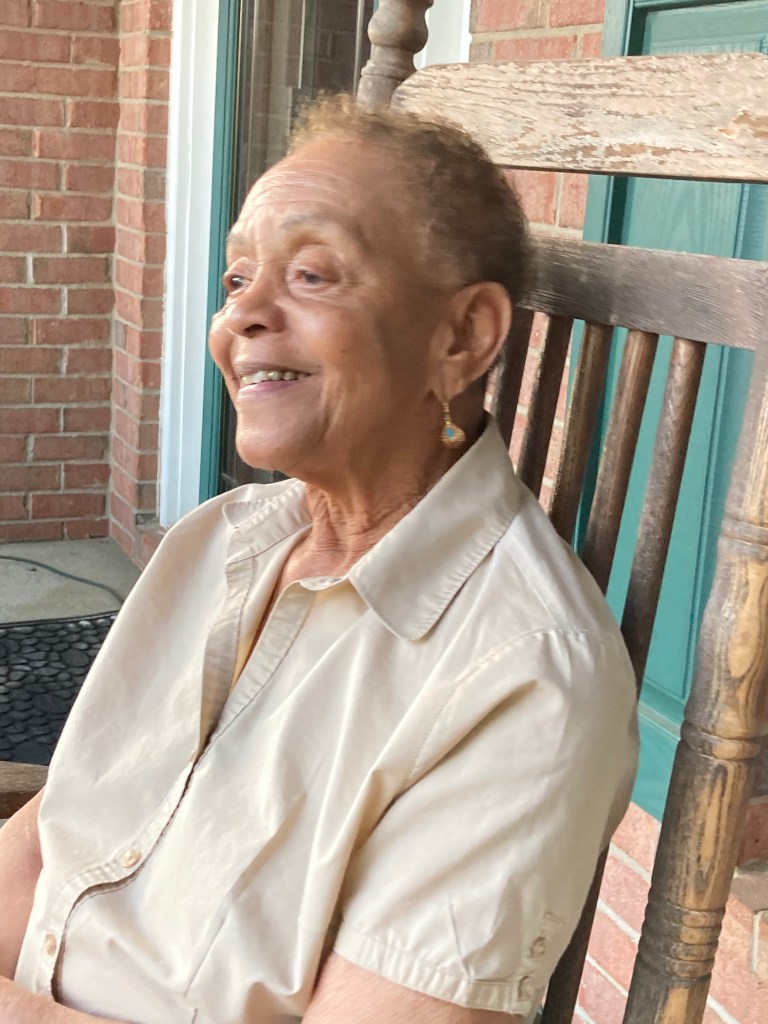
This is my sweet friend, Grandma Vera, not the person I met downtown. But she loves to sit on her porch, and she loves to sing.

What Is Faith?

Journal 2006

Whenever I ask people to define faith, they glibly quote Hebrews 11:1.

Now faith is the substance of things hoped for, the evidence of things not seen.

But to me, this sentence is just meaningless words on a page. It wasn’t until I heard the following sermon that it finally clicked. Here’s what pastor said.

Faith is when you hear what God says, and you do it.

  1. It’s defined by what God says. (For every entry in Hebrews 11, they heard a command from God.)
  2. It’s determined by how you respond. (Check out the verbs in this chapter.)
  3. It’s deepened by the challenges you face, your experiences.
  4. It’s directed to the rewards He promised.

Faith is NOT simply belief. For example, I can believe that if I step off the edge of a cliff, I won’t fall. That’s stupidity, not faith.

Faith is acting on a command or a promise from God. Faith is standing on the edge of a cliff, and if GOD TELLS ME to step off the edge, I do it in obedience and trust. If I plummet to my death, so be it. He will take care of the results. Or He may have prepared an invisible bridge to the other side (like in Indiana Jones and Last Crusade)—but I wouldn’t have known it was there if I hadn’t taken the first step.

Daniel’s friends, Shadrach, Meshach, and Abednego (Daniel 3:16-28) obeyed God—in faith—and their attitude was, “Even if we die, God will take care of it.” But God chose to spare their lives for a greater purpose. Others, like Jim Elliott and his four fellow missionaries, obeyed and became martyrs—they stepped into faith and obedience and stepped right into the arms of Jesus.

A 2025 Update. I’d like to add that the object of my faith is of prime importance for the outcome. I can always trust God to do what’s best.

AI-generated

The Moral Dilemma of Vengeance

Journal 2006

The Dilemma: Shechem, the son of Hamor the Hivite, defiles Dinah, the daughter of the Patriarch Jacob. (Genesis 34)

Man’s Solution: Simeon and Levi (Dinah’s brothers) decide to avenge the wrong. They deceive Shechem and the leaders in the city, kill all the males, and along with Jacob’s other sons, seize all the plunder, including women and children. (As an aside, I find it interesting that it’s Levi, the future priestly line, who avenges. A strong sense of justice and fairness becomes imbalanced.)

It seems that God allowed for vengeance in the Old Testament (an eye for an eye), even though the Mosaic Law had not been given yet. Yet murder is not an equal retribution for rape. If only the brothers had asked God what to do, He could have brought judgment on Shechem, and his blood wouldn’t have fallen on the brothers’ heads.

God’s Solution: Jacob is now scared of retribution, and God answers that fear. He instructs Jacob to move to Bethel (where he first met God at the ladder to heaven) and to build an altar. (Genesis 35:1).

Man’s Response: The Scripture doesn’t say God instructed Jacob to get rid of idols. Maybe He did say it, or maybe Jacob is taking the final step of obedience and loyalty to His God. Remember that Rachel (Jacob’s favorite wife) had taken her father’s idols when they fled Paddan Aram. I also suspect the women and children whom the brothers captured from Shechem’s town also brought idols with them. Nonetheless, Jacob instructs all his household to give him all their idolatrous paraphernalia (which he buries) and to purify themselves and put on fresh garments—outward symbols of an inward change of heart.

God’s Response: When Jacob obeys, God protects. “The terror of God fell on the towns all around them so that no one pursued them” (Genesis 35:5 NIV).

My Response: When I’ve been wronged, it’s easy to believe that taking vengeance into my own hands will make me feel better. But “Vengeance is mine,” says the Lord (Deuteronomy 32:35). His retribution is fair and just and better than anything I can dream up.* Best to let those feelings go and face my pain.

I may take many detours in life, responding with poor choices, but I’m safest in the place where God dwells, in obedience, and in purity.

*I’ll never forget the day I was working with a D.I.D. client. When Jesus asked one of her Little Ones if she’d let HIM punish her perpetrator instead, her eyes got big. “He be in big trouble!” she exclaimed.

AI-generated

Lessons from Moses 2

Journal 2006

In Exodus 4:11 (ESV) God said to Moses:

Who has made man’s mouth?

Who makes him mute?

Or deaf?

Or seeing?

Or blind?

Is it not I, the Lord?

These words startle me. They challenge the popular teaching that God wants everyone healed.

I’m really struggling today with my arthritis. I can tolerate the pain in my hands and feet but find it difficult to cope with the back pain and tightening muscles. I don’t want to be all-consumed with the body, yet it’s the vehicle for the soul to function. Do I just accept what’s happening, or do I seek help? Everybody I talk to has his or her pet remedy or solution. I need a diagnostic tool, but most of all, I need God’s guidance.

Can my infirmity bring more glory to Him than my healing? Is there something He wants to teach me in this situation that I could not learn another way?

AI-generated

A 2025 Update. I’m delighted to report the arthritis is gone! But that’s a story for another day.


God said to Moses, “Now go; I will help you speak and will teach you what to say” (v. 12).

When God tells me to do something, He will give me the tools to accomplish His assigned task.


In another incident, due to his wife Zipporah’s influence, Moses opposed God when he refused to circumcise his son, and God almost killed him. But the fear of losing her husband won over the distaste of the sight of blood, and Zipporah herself performed the surgery!

When God wants something done, He’ll make it happen, but how much better to cooperate with Him the first time He asks! Don’t try to out-manipulate God. He’s smarter and wiser. He’ll always win in the end.

Was Paul Codependent?

Journal 2017

I call God as my witness . . . that it was in order to spare you that I did not return to Corinth. (2 Corinthians 1:23-2:4 NIV)

If the Apostle Paul had shown up in my counseling office, I wonder what I would have said to him? He says he chose not to return to Corinth “in order to spare them.” But it sounds more like he was protecting his heart. He claims he stayed away from the Corinthians out of love for them, but in the same breath he admits: So I made up my mind that I would not make another painful visit to you. For if I grieve you, who is left to make me glad but you whom I have grieved? In psychological jargon, we’d say this was a codependent statement.

This giant in the faith, who faced torture and rejection and beatings and jail time and hardships and the burden of fulfilling God’s call on his life had triggers a-plenty. Why am I surprised? In other passages, he freely admits his short-comings, inadequacies, struggles, and fears.

I’ve been taught that Paul’s writings were inspired (not doubting that) but I think most of my life I’ve also been taught that, as a result, everything he states is truth. But was Paul being true to his own heart? Was he really staying away because he loved the Corinthians . . . or was he protecting his own pain? We don’t know of course. We only know his words.

Now . . . maybe it was wisdom to stay away—why go where he’d be rejected? But that never stopped Paul before. Why does it bother me to think that Paul MIGHT be triggered? Or does it bother me that I’m questioning his heart?

All Scripture is inspired, but not all Scripture is instruction. Sometimes it’s history. II Corinthians is a letter—it records what Paul wrote to a specific group of believers in a specific time period. It was instruction to THEM.

Here’s where discernment is necessary. How do we know what was divine doctrine vs. a reflection on local culture? Who gets to decide? Some sects of Christianity wear hats or head coverings. They want to obey the Scriptures in all things. But others believe wearing a head covering was a cultural issue and doesn’t make one spiritual.

What about instructions to Timothy? Qualifications for a pastor preclude women being in leadership (or do they?) Is that God-ordained or cultural? Who gets to decide? If we release all outward show or behavior as a non-issue and listen only to the heart, does that answer the question: it’s not whether male or female is in charge but where the heart is? [NOTE: check out Bill Rudd’s book Should Women Be Pastors or Leaders in the Church? Very insightful!]

I’ve been taught the New Testament as law and less about heart. Rules to follow instead of relationship. Does that make everyone a law unto themselves? Where do we draw the line between biblical mandate and godly principle?

Apparently the Corinthians were living in sin, full of factions, and accusatory of Paul being boastful, having no authority, and being a burden to them. Much of this letter is self-defense on Paul’s part. He ranges from sarcasm to humility.

We (or I) have placed Paul on a high pedestal of sainthood, like he could do no wrong after his conversion. He’s earned our respect for his position, perseverance, and persecution. But I’ve never heard anyone preach about his character flaws. Paul’s defensive self is in full battle gear in this letter. You can feel the anger and hurt from the Corinthians’ false accusations. Does my respect for Paul slip just a little as I read this letter? Or should I excuse and defend him for what he says?

Should Paul have defended his position as an Apostle? Did he have a right to confront the Corinthians about their sin? Of course. But Paul was not perfect. His choleric nature is showing. I’m curious if his letter convicted them or shamed them or made them dig their heels in even deeper?

What would this letter have sounded like if Paul had dealt with his hurt before responding? Would it have had the same impact on the Corinthians? Self-defense can be idolatry. It is substituting self for God. But does God forgive us? Of course! Our sin is under the blood. But there is a better way—let God be our defense. God can use my hurts and my defenses to accomplish His perfect will. But if I have a choice (and I do), I’d choose His defense over mine and healing of the hurt over carrying the wound around in my heart.

So, here’s a question: if someone wrongs me, should I confront them? Do I need to? Or can I deal with my hurt and overlook the wrong done? If I’m at peace, my motive for the confrontation changes. Then it becomes not about protecting my pain but about what is best for the other person.

It’s really hard to be reasonable when one is triggered. So how does it look to others when MY triggers show? Do they offer me grace? I hope so. And, in turn, may I be gracious when I see others triggered. I guess I can cut Paul some slack if he’s a little codependent.

God’s Instructions

Journal 2009.

When I give someone instructions (a recipe, directions to my house, how to send a file in an email) [yes, this was written a few years ago!] I give clear, precise information. If I don’t, the food may be tasteless; the person will end up at the wrong destination; I won’t be able to open the file.

When God gives instructions, He is the expert. He knows the intended outcome as well as the steps to achieve that goal. His instructions are clear and precise. When God speaks, we better listen . . . and obey to the letter.

God said to Jeremiah (26:2):

  1. Stand in the court of the Lord’s house (where and with what posture).
  2. Speak to all the cities of Judah that come to worship there (what to do and to whom).
  3. Speak all the words that I command you to speak; diminish not a word (what to say—precisely, fully, accurately).

So . . . Jeremiah obeyed. But AFTER he finished speaking, the people, priests, and prophets seized him and threatened death. Obedience does not guarantee comfortable results!

Jeremiah’s response, however, is most interesting and gratifying. He had already grappled with the fear of the results of his actions.

Be assured, however, that if you put me to death, you will bring the guilt of innocent blood on yourselves and on this city and on those who live in it, for in truth the LORD has sent me to you to speak all these words in your hearing.” Jeremiah 26:15 (NIV)

I have learned the hard way that disobedience to God’s clear instructions brings only heartache. I would have saved myself a boatload of angst had I obeyed the first time!

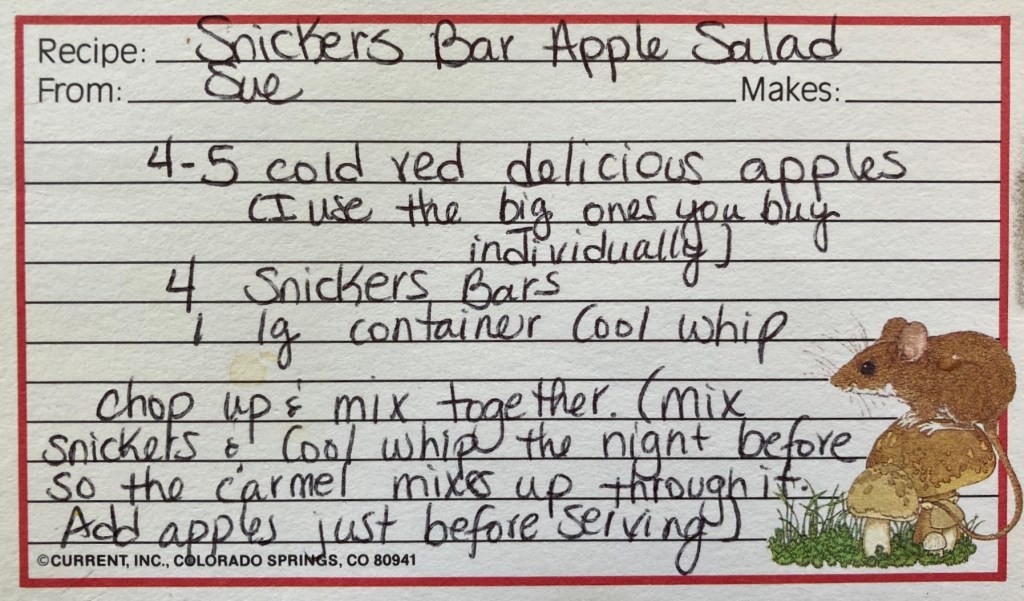
There is on-going debate in our family over whether this is a salad or a dessert.

I Want to Be in Control

From my 2012 Journal. I’ve had a recurring nightmare of being lost and unable to reach my destination. Perhaps my brain is trying to process my unresolved fear of searching for my next classroom in the maze of a two-story American high school after attending a small boarding school in Africa. Or the roots are in my preschool panic when I couldn’t find my dad in the tall grass while hunting guinea fowl together. There is something in all of us that wants to be in control of our lives, and we don’t like the feeling when we’re not.

I have no desire to be in charge of a PTA, a church, or a nation. I didn’t even like being in charge of my own kids when I was parenting. But I do want to be in charge of my own classroom as a teacher, over my own food choices, over my schedule, over my own body, and over my finances. I don’t like it when others violate my will.

So what do I do if I’m under someone else’s jurisdiction (a boss, a parent, a policeman, the law of the land)? I might respond negatively or positively according to whether or not I agree with them or whether the mandate is reasonable or not. If I’m serving a boss who is irritable, unpredictable, overbearing, or unkind, it takes effort and poise and grace and an abundance of God’s Spirit to submit to his or her authority.

But what if I serve under a person whom I highly respect and adore, who is gracious, kind and polite and loves me back? How would my attitude be different? You’d assume I would respond with ease but, sadly, I still fight to be in control.

I serve a perfect Master. What keeps me from responding well to Him when He gives me orders? It’s an on-going struggle for me to submit—until I face my fears of feeling lost or out of control—and that’s when God steps in and brings safety and comfort, just like my dad did when I cried out to him in the jungle grass.

Just Follow the Instructions

From my 2009 Journal. When my three girls were getting ready to live on their own, I gave each of them a homemade cookbook filled with our favorite family recipes. (See below.) What I knew by intuition and experience didn’t always translate onto paper, however. Apparently I did not give precise enough instructions, for I’d frequently get a phone call asking me to clarify an ingredient or procedure.  

In contrast, when God gave instructions to His prophets, He was detailed and precise. One day He spoke the following to Jeremiah:

  1. Stand in the court of the Lord’s house (where and with what posture)
  2. Speak to all the cities of Judah that come to worship there (what to do and to whom)
  3. Speak all the words that I command you to speak; diminish not a word (what to say—precisely, fully, accurately) (26:2)

And so Jeremiah obeyed. But after he finished Step #3, the people, priests, and prophets seized him and threatened to put him to death.

Jeremiah’s response is most interesting and gratifying. He obeyed God out of a peaceful heart because he had already grappled with the fear of the results of his actions.

Be assured, however, that if you put me to death, you will bring the guilt of innocent blood on yourselves and on this city and on those who live in it, for in truth the LORD has sent me to you to speak all these words in your hearing (Jeremiah 26:15 NIV).

My first takeaway is that God’s will was accomplished through Jeremiah’s obedience. Second, obedience does not guarantee comfortable results! (Gulp)

When God gives instructions, He is the expert. He knows the intended outcome as well as the steps to achieving that goal. His instructions are clear and precise. When God speaks, it is in our best interest to listen . . . and obey to the letter.


Intro to Katie’s Cookbook:

Dearest Katie-Bug,

I’ll never forget the day you came into my bedroom early one Saturday morning and announced that pancakes were ready. You were so small, you probably had to stand on a stool to reach all the ingredients. I was astonished. “How did you . . . ?”

“I read the instructions,” you replied.

Up to that time, your classic experiments with ingredients in the kitchen consisted of getting a small mixing bowl, a big spoon, and anything in the cupboard you could find:  a little flour, some sugar, a pinch of various random spices. And when you were satisfied with the results, we would bake the concoction at 350 in a disposable pie tin. Incredibly, sometimes the product was edible! You were so proud of yourself and your creations.

Of my three girls, you were the most interested in what went on in the kitchen—until it came time to clean up, and then you would suddenly declare you had to go to the bathroom; and off you went, conveniently waiting till the task was done. You were most intrigued with the creative part of cooking—like decorating Christmas cookies. Your latest endeavor was decorating a gingerbread house. Remember your attempt at making stroganoff for your dad while I was in California!? But you became a master at turning out perfect macaroni and cheese.

Here are some of our family’s favorite recipes—some yours, some your sisters’ favorites. Keep them safe, for when you get to college, it’ll save you a phone call or two to find out how to make . . . (no, there’s no recipe for making French fries or ice cream!)

May you continue to hone your skills in the kitchen so that you can minister to others, perhaps to your own family some day.

I love you with all my heart,

Mom


Chocolate Chip Scones

1 ¾ cups flour                         1/3 cup butter

3 T sugar                                 1 egg, slightly beaten (reserve some)

2 ½ t baking powder             ½ c chocolate chips

½ t salt                                    4-6 T cream or milk

Combine dry ingredients.

Cut in butter, add egg, choc chips.

Add enough milk so dough leaves sides of bowl.

Knead on floured surface gently 10x

Roll into a circle ½ inch thick

Cut into wedges. Place on ungreased cookie sheet.

Brush with little bit of beaten egg.

400, 10-12 min.