Lessons from Moses 1

Journal 2006

Moses murdered an Egyptian. After the deed, he felt fear—fear of being found out. I wonder how he felt when the words, “Thou shalt not kill” appeared on the tablets of stone. Did he feel guilt? Remorse?

Sometimes I’m more concerned about being discovered than repenting of my sin. Words I’ve said in anger behind someone’s back leave me unrepentant till I’m found out by the one I slandered. Shame at my misdeed leads me to repentance.

I wonder if God’s original plan was for Moses to release the Israelites from bondage while he was still serving in Pharoah’s court. Perhaps the murder incident delayed God’s plan while He worked on Moses’ character.

God’s plan cannot be thwarted by man’s plan, but man can sure mess up God’s best or original plan! God lets us go our way until we see the error of our ways, and then He creatively works “all things for good.”

I wonder what difference it would make to our beliefs if we could see all the choices and various paths we could take in life. Would we believe sooner? Be more cautious of our words? Choose any more wisely? Every choice we make in life—every single step, word, or deed impacts us, the world, and others forever.

For example, if on Tuesday at 9 a.m. I choose to go to the grocery store, and I see a child being verbally abused by his mother, my simple smile could be the moment that freezes kindness and encouragement into that child’s life. And forty years later, God may bring that memory back to him and give him a safe place in his mind to start the healing process. Sound far-fetched? I don’t think so. If God ordained this event from the foundation of the world, and He is the One who prompts me to get groceries at 9 a.m. instead of at 10 a.m., then His plan is fulfilled.

AI-generated

But what if Satan sends a phone call that delays me by two minutes, and I miss this little encounter? Is God’s plan thwarted? I don’t think so. Perhaps He’ll send another person. Perhaps He’ll delay the mother too. Check. Checkmate. God wins!

Another checkmate example. When Moses argues with God that he’s incapable of doing what God asks, Moses gets his way—he doesn’t have to speak before Pharoah. But God gets His way when He chooses an alternate spokesperson: his brother Aaron.

Has my doubt or denial or stubbornness ever thwarted God’s best for me? Yes. But He still gets His will accomplished even though I may lose out on the best plan for me. Why is man’s heart so unbelieving? I piously think, given the circumstances, I would have been a Joshua or a Caleb or a Joseph or a Mary or an Esther. But in reality, I’m probably more like Moses.

Inconvenienced

Journal 2017

My mom had just flopped onto the sofa in the living room when I came to the locked screen door near her and demanded to be let in. She told me to go around to the unlocked kitchen door. I refused. I wanted my own way. I persisted until she gave in, too tired to argue with me or to stand her ground.

The moment she gave in, my seven-year-old self felt something shift inside. I had gained a little power—but at the cost of my self-respect and my mother’s disgust. It didn’t feel good even though I’d gained the victory. I guess I felt guilty.

I repent, first, of my stubborn heart and, second, of my insensitivity toward my mother’s weariness. I recognize that my actions were less than stellar, but I want to thank the Lord for putting such a strong spirit inside me. Mom always said I had a stubborn streak, but if that spirit could be channeled right, it would be a good thing. Thanks, Mom, for believing in me.

So, what is this wanting my own way, not wanting to be inconvenienced, to have to walk a few paces to enter another door. Was I lazy? Self-centered? I think at the time it was driven by tiredness. I think. But, of course, that’s no excuse.

Visual: This stubborn part of my heart looks like Gimli in Lord of the Rings: strong, stout, grumbly, gruff, and tough, but determined to finish his quest. Jesus invites him to chat, but Gimli mutters under his breath. He doesn’t care much about leaving the body (the hurting part of my heart) outside with a sprained ankle. But he comes in and plops down on a chair across from Jesus who is lounging by the fire. (Mom is still sitting on the couch, oblivious to the conversation that’s about to commence.)

“Drop the ‘tude!” I want to shout at Gimli. “You have strength already without it.” (I can see the wheels turning inside his head.)

“This is just who I am,” he says. “Get over it.”

Whew! He’s a tough nut to crack, Jesus. Good luck with this one!

Jesus gets up to tend the fire in the fireplace, and somehow this action begins to melt Gimli’s gruff exterior.

“I’m sorry, Jesus. I’ve been this way for as long as I can remember. I don’t know to be any other way.”

“You’re changing right now . . . “

“Well, yeah, you sorta have that effect on people.”

He smiles. “What’s on your heart, Gimli?”

Gimli looks down toward his chest. He may be a literalist, but he knows what Jesus means.

“I dunno. I just want my own way.”

“Why?”

“Because it feels good. It feels strong. In control.”

“I see.”

“You see what?”

“I see where you’re coming from.”

“You do?”

“Uh huh.”

“Then figure me out!”

“You’re doing fine yourself.”

“Okay, I suspect You’ll ask me next if I’m willing to give up control? And the good feelings . . . “

Jesus nods His head slightly. “Go on.”

“And I need to find a good reason to do that.”

Jesus waits.

“Well, aren’t You supposed to show me something?”

Jesus throws His head back and laughs. He’s enjoying Himself. Apparently He knows that I know that I’m doing it again—maintaining control of the conversation.

“All right, already. I know what I have to do. I’m just not sure if I know how. I trust You. I do know that.”

Chris Tomlin’s song “I lay me down, I’m not my own, I belong to You alone, lay me down . . .” pops into my head.

Comically, this literalist Guardian, who’s as wide as he is tall, climbs out of his chair and lies on his side on the floor.

“You know I’ll have a hard time getting up,” he grumbles.

Again, Jesus laughs out loud. He loves this character.

“Okay, so now what?”

“Now what, what?”

“What do I have to do next?”

“Nothing!”

“What!? I can’t stay like this all day! I’ve got work to do.”

Jesus heads over to the couch, gets a cushion, and places it under Gimli’s head; then He retrieves a blanket and gently drapes it over him. “Rest well, my friend. You’ve earned it.”

In seconds, Gimli is sound asleep, snoring loudly.

Next, Jesus goes to the screen door, unlatches it, picks up the tired and hurting body and carries it into the room. He tends to the ankle first and then invites the body to rest. She knows Jesus will never leave her side.

Gimli opens one eye. “Jesus?”

“She’s okay. Fast asleep on the couch.”

“Okay.” And Gimli drifts back to sleep, dreaming of wars and battles and victories won. But today was his greatest victory of all.

And what of my mom? She’s curled up in her chair, also fast asleep. And through my haze, I can hear Jesus softly humming, “I lay Me down . . .”

Thank You, Lord, for laying Yourself down. You sacrificed Your body, broken and bruised, for me. How can I do any less when You ask me to sacrifice MY body for others who don’t deserve it.

How Much Evidence Do I Need?

From my 2016 Journal.

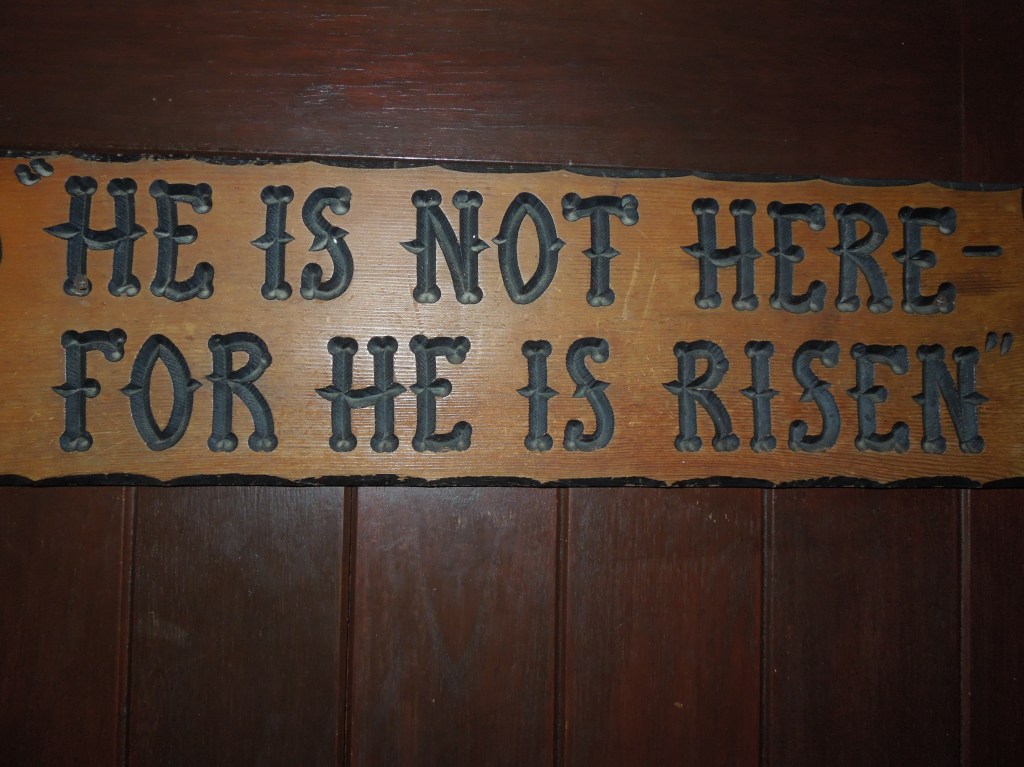
Jesus’ death left pain in its wake, and His followers stubbornly refused to believe the women who reported seeing Him after He had risen (Mark 16:14). I wonder what lie the disciples believed that kept denial in place?

  • Too good to be true.
  • I can’t let myself feel hope for fear I’ll be disappointed.
  • You can’t trust a woman’s word.

Jesus doesn’t need to dig around in their psyches to help them discover why they’re being stubborn. (That’s what I would have done.) He knows their hearts and rebukes them for their refusal to believe. God is patient with our struggles and fears and doubts, but He’s not so patient with stubborn disbelief. How many times did He say, “O ye of little faith?” There’s no pointing fingers here. I’m plenty guilty myself.

The women at the tomb believed as soon as the angels spoke truth to them. The men, however, continued to doubt when presented with the evidence (others’ testimony and an empty tomb). The disciples on the road to Emmaus couldn’t seem to grasp the truth, and Jesus rebuked them. Even when the disciples saw Jesus in the room where they gathered, and the joy center of their brain activated, they had a hard time believing.

We know that the brain is a complex organ—different parts are responsible for different functions: the occipital for eyes, the amygdala for emotion, the frontal cortex for logic and reasoning, and memory in a different part. Since God created the human brain, He knows what part gets activated during fear (like Peter sinking in the sea of Galilee). He knows that the frontal cortex shuts down during a fight/flight/freeze situation. Yet He seems impatient: Why do you doubt, Peter? Why do you have so little faith? Why don’t you men believe when the evidence is in front of you that I’m alive? Stop doubting!

What makes us doubt? Is the emotion center too strong? Are there lies imbedded in that emotion? Those with D.I.D. (Dissociative Identity Disorder) maintain strong denial parts, for if they believe trauma happened, then they’d have to admit it was real. Once truth enters the brain, however, and they experience an encounter with the living Lord Jesus, doubt and fear flee. Jesus knows all this, so is He really impatient . . . or is He challenging His disciples to accept HIM, the way, the truth, and the life?

Sometimes it’s hard to believe someone else’s testimony, but everyone (including Mary, the ten disciples, and eventually Thomas) believed when they saw the resurrected Jesus with their own eyes. Why? Because they experienced it for themselves. Truth experienced in the right brain translates into left-brain belief.

When evidence stares me in the face, what makes me dig in my heels and refuse to see truth? [2021 update: I’m not talking about political opinions on whether or not to wear masks!]