Why do we ask how?

From my 2007 Journal. Why do I question God? When He declares something is true, why do I doubt it? Why do I fret so and try to figure things out for myself? I may think I have the solution for an issue I’m struggling with—but it is very limited. My imagination isn’t big enough to figure out His solutions.

God said to Moses: I will provide meat for the Israelites. Moses asked: HOW? Shall flocks and herds be killed? Collect all the fish in the sea? God said, Is the LORD’s arm too short? Now you will see whether or not what I say will come true for you (Numbers 11:23 NIV). You’d think that Moses, who had witnessed spectacular miracles before his very eyes, would not question God’s ability, power, and creativity. But he wants to know HOW God will provide.

Jesus said to his disciples: Feed the multitudes. The disciples asked: HOW can we do that? We don’t have enough money to go into town and get enough food for this many people. Jesus said, How many loaves do you have?

God says: I will supply all your need according to My riches. I ask: HOW?

DollarI’ve asked for resources for my daughters’ education and for their potential weddings, and then I fret when I think He may not come through, and I brainstorm ways I can get the money to make it happen. Instead, can I not sit back, relax, and watch Him work?

And so, dear Lord, I release to you my worry over where the money is going to come from. I will quit fretting, quit scheming, and simply ask. I ask for faith that will move mountains. I ask for willingness to be obedient when You speak and ask me to do something. I will trust You to guide our paths. I want to unleash Your creativity through faith instead of doubt. Lord, help my unbelief. I am releasing to Your care our checking account, our savings, our retirement funds, the college needs. I will allow You to direct how and when I need to work and how and when I need to be involved in ministry. Guide my footsteps today, Lord Jesus. I don’t know what Your plan is for me today, but I’m open to follow Your lead. Amen.

A 2018 Update. As I reminisce, I’m in awe at how God provided our financial needs. All three girls graduated from college debt-free. And two of our daughters, now married, managed to pull off their weddings within our budget. Now I can say that I, too, have witnessed miracles before my very eyes, and my faith has grown as a result.

Do you think asking HOW is a lack of faith? Why or why not?

Where Is Your Focus?

Focus 3

From My 2009 Journal. Work got canceled, and I had an unexpected, unplanned glorious day to myself to work on the computer and catch up on some work. But one thing after another, my day got interrupted multiple times. I ended up stewing and angry as I headed to the grocery store to pick up some bread, just to discover that the shelves were empty! I’d been trying all day to get rid of my feelings of irritation and hadn’t succeeded too well. Praying for inner peace, I wandered around the store, asking the Lord What was the purpose of all these interruptions to my day?

Just then, I passed a plaque on a shelf that read, “Delight yourself in the Lord.” I laughed out loud. My focus had been all skewed. Thanks, Lord, for putting things into perspective. I chuckled all the way home.

The rest of the verse says, and He will give you the desires of your heart (Psalm 37:4 NASB).

Where is your focus today?

Shoulds and Ought-tos

From My 2009 Journal. I feel a hesitancy inside when I think that God loves and accepts me just the way I am. I’m still caught in the trap of “I need to.” Being a task-oriented person, “doing for God” feels like a “should” or an “ought to.” It’s a continual mind battle to shed the guilt that I’m not doing more for Him. What is that all about?

I hear in my head the voice of some preacher saying, “You ought to knock on doors for evangelism.” I thought I shed that obligation a long time ago. I know I’ve been derogatory toward those who touted knocking on doors, considering them to be a little kooky, driven by fear or guilt (never mind that I used to be one of them. How hypocritical is that!) But I don’t know their hearts—for all I know, they could be more spiritual or passionate than I am about following God.

Hallway with doorsVisual:  I see an endless line of doors that need to be approached. It’s exhausting and the task is never complete. While walking down the hallway, there appears to be a large hand guiding mine, like I’m a child in training. I thought at first it was the preacher’s voice and hand on me, but now I see him standing to the side at a pulpit. The hand that guides me is that of The Father.

I erroneously compare myself to the famous out-front Christians who have great influence over many crowds of people. They’ve been entrusted with ten talents and have been faithful to use them. Bruce Wilkinson comes to mind. Billy Graham is another. Our faithful pastors as well. And then there’s little ol’ me with a very small sphere of influence. I think somehow I’m supposed to do their work.

I know all the right answers: be faithful with what God entrusts to you. I know that God has not created me with the temperament to spend massive amounts of time with people or in front of people—which is what I seem to equate with the highest rank of God-pleasers.

Here’s my bottom-line question: Is God pleased with me and my performance? I’m fully aware that character is far more important. That’s a given, and I work on that constantly. But I still need the question answered—am I doing enough? Enough for what?

I feel uneasy. Like I’m missing something. How do I know how many talents He’s given me? Yes, it’s His work through me. Yes, I must be obedient to His every command and instruction. No, I don’t have to have the big picture or understand everything God’s chosen for me to do. “Rest in Me,” He says, “and I will guide you. I will show you which door to walk through and when.”

HikeAnd the visual changes. “I’ll make the path for your feet,” He says, “and shed light on the stumbling stones. Just keep walking. I’ll tell you when to put down a stone or pick one up. I’ll let you know when it’s time to lend a helping hand to a fellow traveler, when to give away what’s in your hand, and when to keep walking. Sometimes you have to just keep plodding through the forest. The glen or open spaces are yet to come. Sometimes it’s okay to sit on a rock and rest and take a drink or eat. Doing is not always what’s best for you. Self-discipline is good, but listening to Me is better.”

And so, Heavenly Father, I give to You today my path. I trust You to guide me. Help me not to run ahead of You or lag behind. Give me the energy to keep up. I can walk in Your footsteps, unafraid of the dark and the animals nearby.

“Not enough,” “should,” and “ought-to” are not are not quantifiable concepts and don’t belong in God’s vocabulary for me.

Call It What It Is

From My 2009 Journal. I was in a bathroom stall at the Orlando airport on my way home from my mom’s memorial service when I had an epiphany.

Hook

The hook on the back of the door was missing, and my first thought was, How annoying! Where am I supposed to hang my purse?

Now, I didn’t want to be a complainer about insignificant occurrences in my life—a hook on a door compared to death and dying . . . a little thing like that should not have controlled my emotions!

And so I started searching for the right word—because “annoying” or “frustrating” or “irritating” were really too strong to describe what I was actually feeling inside. I wanted a neutral word. That’s when I thought of “inconvenient.”

The circumstance is inconvenient.

How I feel about the circumstance may be annoying, frustrating, irritating.

And so, with the change in vocabulary, there was a shift in my attitude. I would call it what it was and acknowledge that the circumstance was less than ideal, but I didn’t have to have a negative response to it.

What has helped you to “call it what it is”?

I hugged an angel today

From my 2009 Journal, February 16. The floodgates of grief for my mom burst open today. I cried all day at work and then headed for Wal-Mart to pick up some groceries. I was at the checkout line when I met an angel.

Angel girl

Found on Pinterest

In front of me stood a harried mom with her two kids—a boy seated in the cart and a girl (perhaps 3) walking beside him, holding a Barbie doll. I knew the doll wasn’t hers because there was plastic wrap still on the hair—which she proceeded to pull off—and she began walking the doll across the floor. I wondered as I watched her if her mom knew it was in her possession. But what struck me the most—it actually took my breath away—was her stunning beauty. Her facial features were soft, round, angelic; her hair perfectly shaped and combed; and she was dressed in a pure white knit coat.

Meanwhile, her little brother was playing with a toy camera. I wondered if that was his or if it belonged to the store. Twice he dropped it from the cart.

My attention was suddenly drawn to the mom and her words:

   To the cashier:  a comment on how expensive diapers are and that she’d bought the cheaper brand.

   To her daughter: “Don’t sweep the floor with your coat; it’ll get dirty, and pick up the camera for your brother.”

The mom finished paying for her groceries and then turned to her daughter. “I’m not buying that for you; give it to the lady. It doesn’t belong to you,” she demanded. I must confess I felt perturbed at her for allowing the child to carry it with her throughout the store if she had no intention of purchasing it.

At those words, that sweet angelic face shattered into a wail of grief. It was not out of rebellion—I think I can tell the difference. If there had been rebellion in the tears, I would not have responded as I did.

The little family headed for the door and I asked the cashier, “How much is the doll?” Quickly she scanned it. A mere $4—a small amount to me, but perhaps out of reach for a mom buying cheap diapers. “Put it on my bill,” I said and ran after the little girl, leaving behind my cart and my intended purchases. I knelt beside her, put my arms around her and held out the doll. “If it’s okay with your mommy, I’d like to give this to you.”

Mom’s response:  “You don’t need to do that; she has more Barbies at home.” And then, “Thank you.”

Quickly I returned to my cart, aware that I was holding up the line. I was loading the last of my goods onto the conveyor belt when out of the corner of my eye, I saw the little angel barreling toward me, arms outstretched. I knelt; we hugged, tears still on her lashes, tears in my own eyes. I don’t know if she said a word, but I whispered, “I love you.” It was sweet comfort to my grieving soul.

It wasn’t until I was at my car, parked a long way from the door, that I realized I’d forgotten to pick up the $5 rotisserie chicken I’d planned for supper. “Oh well,” I thought, “I’ll stop in at Kroger on the way home, although it’ll be more expensive there ($6 or $7).”

I was still kicking myself over my forgetfulness and the added grocery expense when it occurred to me that if I had made time to go to the chicken aisle at Wal-mart, I would have missed my angel hug. I ran into Kroger, and there on the heating table was one roasted chicken that had been reduced—to $4. I think God was grinning.

Public Tears

From my 2009 Journal. Grief is a very private affair that sometimes turns public. In America we watch mourners at funerals, and if they don’t cry, we say that they are holding up well. I think Middle Easterners and my African friends have a better perspective. They set aside a time to wail and to mourn—publicly. Their cultural norm is to let the emotions out when a loved one passes away. There’s something healthy about this practice. So why do we keep back tears when we are in public? 

Sometimes when you hurt, you want space to cry alone, away from prying eyes. I remember while at boarding school, crying alone or privately was nearly impossible. Someone invariably would insist on asking why you were crying and then try to fix it for you with platitudes: It’ll be all right. God knows best. Romans 8:28, etc. Or worse yet: Don’t cry! Sometimes you just didn’t feel like sharing your hurt with them, but it felt rude to say it was none of their business. All you really needed was for someone to hold you or cry with you.

FireMy Visual: When I am grieving, I have a secret place in my heart where fire is burning and glowing and I need to release that pain. But if someone opens the door of my heart without my permission and snatches that fire, and I don’t know if I can trust him or her or not with my heart,  it feels like a violation.

It is okay to protect your heart. You don’t have to respond rudely if you don’t care to share. Just be honest: I don’t feel like talking about it right now. If they care about you, they’ll respect your space. If they’re pushy, just walk away. But that fire will consume you if you don’t open the door at some point. Grief needs to be released in order to heal a broken heart.

Arise, cry out in the night, as the watches of the night begin; pour out your heart like water in the presence of the Lord . . . (Lamentations 2:19).

How do you handle grief when you are in public and why?

Stay put or run?


Run and hideI Samuel 23:2-3.
I’ve always wondered why David went into hiding from his enemy King Saul? Couldn’t God have protected David if he chose to stay put and not run? Did God tell him to run? Did instinct? Would it have been foolish to stay put when a spear was thrown at his head?

God delivered him every time, but it seems He could have done it without David having to run and hide all the time. Daniel stayed put. And Shadrach and his buddies did too. They didn’t go underground when persecution started. Perhaps, unlike David, they had nowhere to hide. Corrie ten Boom went underground when she chose to hide Jews. Risky no matter what. But when caught, God delivered David, Daniel, and Corrie. But He didn’t deliver martyrs in the early church, and He didn’t deliver Corrie’s sister Betsie from death. (Is that a cop out to say He delivered her from further torture?) When do you go into hiding, and when to the lion’s den?

Two things go through my head: this was part of David’s training to let him experience God’s faithfulness in the hard times as well as learn about this part of his future kingdom. Second, man has freewill and choice. God could have knocked out Saul at the first sign of rebellion, but He continued to give Saul chances to repent. And Saul refused. Obedience to God’s command in the moment is the key, I think.

What’s your opinion?

How Do You Draw Faith?

Bible

The history of the Mission under which I grew up includes a little story about Roland Bingham, one of the founders of the Mission, arriving at the train station with no money in hand, but with faith that God would supply his need. And God did just that. (You can watch a 1968 reenactment of his life here.) So when I heard that story as a child, I began to berate myself that I did not seem to have enough faith. I wasn’t sure I could ever pack my bags and blindly go off somewhere and expect God to meet my needs.

How does one define the word faith? First a little grammar lesson. By definition, a NOUN is a person (man, Mr. Jones), place (home, Iowa), thing (desk, lamp) or idea (love, courage). Concrete nouns like man or desk are easy to visualize or to draw on a piece of paper. Ideas not so much. We do have symbols for some ideas, like a Valentine heart for love or a dove for peace, but how do you draw faith?

Faith became a rather nebulous concept to me. I didn’t know how to visualize it . . . until I read this lovely story in the Bible about Caleb, one of only two spies who believed that the Israelite army could defeat the giants in the land of Canaan.

We pick up the story when the 40 years of wandering in the desert are over, and the leader Joshua is over 100 years old when Caleb approaches him with this request:

Now then, just as the Lord promised, he has kept me alive for forty-five years since the time he said this to Moses, while Israel moved about in the wilderness. So here I am today, eighty-five years old! I am still as strong today as the day Moses sent me out; I’m just as vigorous to go out to battle now as I was then. Now give me this hill country that the Lord promised me that day. You yourself heard then that the Anakites were there and their cities were large and fortified, but, the Lord helping me, I will drive them out just as he said (Joshua 14:10-14 NIV, emphasis added).

My conclusion is that faith is not blindly believing something without evidence or deciding to do something based on what I want to see happen. Faith is believing and acting on what God has already said.

So back to the story of the missionary at the train station.  God had clearly told Mr. Bingham to go to Africa, and so he packed his trunk and headed to the train station to begin his journey. It wasn’t until he took this step of faith that he was handed cash for the ticket. (If you want to read more of the story, click here.)

What does faith look like to you? Can you draw a picture of it on a piece of paper?

What Do You Want to Be When You Grow Up?

Frequently asked questions

I was almost 50 years old before I discovered what I wanted to be when I grew up.

My mother knew in third grade. When she took a hygiene class, she decided then and there to become a nurse. She also knew early on that she wanted to teach others to read. If you had asked me in grade school, “What do you want to be when you grow up?” I would have replied, “a missionary nurse and schoolteacher like my mom.”

In junior high “Uncle” Bill, one of my boarding school teachers, stopped me one day on the sidewalk and challenged me to consider becoming a missionary doctor instead. Because I loved and admired him, I agreed to do so in order to make him happy. The problem was, I neither felt drawn to working with sick people, nor did I have a propensity for the sciences of any kind! But I did know that I fell in love with Miss Pat’s English class.

During my senior year of high school in the USA, I began to panic. What should I do next? My parents were overseas and unable to help me with college decisions. Mrs. Casler, my friend Cindy’s mom, suggested I attend Word of Life Bible Institute, a one-year school of Bible training, before heading to medical school. And so I did.

At the end of that year, I visited a nearby Christian college to check out their pre-med program.  And that’s when it finally hit me—I was pursuing someone else’s dream. With a sense of relief, I gave it up, only to flounder—what do I do now?

Enter Ron, a guy I dated a few times. “Go to TTU,” he suggested. “They’re offering a full tuition scholarship for MKs (Missionary Kids).” And so I applied.

Am I seeing a pattern here?! I didn’t like or know how to make decisions. I just went where others directed me.

I remember sitting in a large classroom when I first arrived on the TTU campus. I was supposed to be filling out forms, including my intended major and class schedule. I didn’t have a clue what to do! The only constant up to this point in my life was that I knew I wanted to become a missionary. I leaned over to the student next to me and said, “I don’t know what I want to major in.”

“Just put down Education,” he replied. “Many students do that. You can always change later.” And so I did.

It was when I took my first education class that I began to back-pedal. A friend who was in the midst of student teaching said she was required to have perfect handwriting and it felt like she was acting all day, and it was exhausting. The thought of teaching frightened me.

Okay, so now what? To become a missionary, I knew I needed to know my Bible, so I switched to a Bible major. Now here was something I was familiar with.

Enter Speech 101 with Dr. Euler. Though the thought of public speaking terrified me, I had enough poise apparently to impress the teacher. “You should consider an oral interpretation speech major as well,” he declared. At first I balked at the idea, but again, a teacher has clout and I listened. The literature appealed to me, and my performances in junior high and high school plays gave me something to build on.

When I got married and didn’t end up on the mission field, I wondered what good my speech and Bible majors did me. I suspect it was my husband Scott who encouraged me to apply for a job teaching English and speech at Berean Academy, a small Christian school. But my four-year teaching experience there exhausted me. It was hard work—mentally, physically, emotionally. I felt intimidated by American teenagers and couldn’t relate to them. I was too young and inexperienced to handle a classroom, but I enjoyed the challenge of trying to keep my students from getting bored. I also enjoyed directing plays and preparing students for speech competition, but again, the work was extremely demanding and I made many embarrassing mistakes. Thankfully, Mrs. Calvert was a sympathetic and supportive supervisor, along with some parents who encouraged me.

Raising three babies and keeping house and moving four times kept me busy by default for the next several years. When we needed the extra money, Scott found out that a local junior college was hiring evening English teachers and urged me to apply. I returned to teaching, but again it was through someone else’s initiative.

It was while we were doing some in-service teacher training that the light bulb finally came on in my mind. We were introduced to the topic of brain studies and were examining how different brains are wired. After taking an assessment test, each teacher was instructed to approach an easel, take a pushpin, and place it in their dominant brain quadrant. I was chagrined to discover that my pin landed on the green square whereas most of the other teachers put theirs in the blue section. Apparently I was working against my natural bent, and it made sense why teaching exhausted me so. And I realized for the first time that all my life I’d been pursuing other people’s directives rather than following my heart.

Shortly after that, we moved to Tennessee, and I had to step down from all responsibilities at church, at school, and in the community.  I was starting over with a new life and many possibilities. One Sunday morning I sat riveted in my seat as Pastor Dean asked the question, “What is your passion?” That sermon, along with its guidelines, became pivotal in my understanding of who I was created to be. At first I didn’t think I liked what I knew about myself. All along I pridefully thought of myself as a professional—someone with status and education. But now I realized that I got far more pleasure out of shuffling papers around than trying to influence and push people to perform a certain way. I had been an introvert in an extrovert profession.

I jotted down in my journal that I loved order, the preciseness of grammar rules and the repetition of data entry.  I also knew I had a passion for reconnecting MKs. I was already meeting those needs as editor of Simroots (a magazine for adult MKs). Life was getting neater and tidier, but I knew I needed more than that to keep me busy while the girls were in school. I just wasn’t sure what.

And then it happened. My world flipped upside down and got messy again. In walked Minna Kayser, a very wounded, suicidal adult MK who landed on my doorstep and stayed. I know now that it was a God-event of epic proportions. (You can read all about it in our book Diamond Fractal.)

I never in my wildest dreams would have thought that working in the counseling field would be a good fit for me. It is far removed from sitting in front of a computer all day and losing myself in organizing script for a magazine. What was God thinking!?

To this day, I’m still not sure what happened. How did I get here? How has a speech and Bible degree and classroom experience and proofreading skills prepared me for this inner healing prayer ministry? How is this related to how my brain works? I’m a visual learner, not an auditory one, and yet what I do requires intense listening. I don’t have the gift or the passion for traditional counseling. I don’t even have the traumatic past that often draws counselors and psychologists into this career. I don’t get it! This calling is so much a God-thing that I am left shaking my head in wonder.

I’m still editing Simroots, and I still enjoy connecting MKs, but my real passion now is watching the light bulbs come on in people’s hearts and minds when God speaks truth to them in a prayer session. What astonishes me is that I got catapulted into this work without the skills or training at first to do it. I got thrown into the deep end before I knew how to swim.

I seem to have lived my whole life in default mode, following instead of leading, listening to others rather than listening to my heart. Was God’s voice in Uncle Bill? The stranger who sat next to me on the first day of school? Did He direct Ron so I’d end up at TTU? Or use Scott to get me into teaching?

Why didn’t God just show me or reveal to me my passions way back when I was a little girl—like He did for my mom? Why did I wander for so many years in areas that didn’t fit me? Am I such a slow learner? Or is that all part of the growth process, the learning progression?

The funny thing is, contrary to my friends’ observations, I don’t feel gifted at all for this ministry. But my mother the nurse, my first role model, claimed she could never do what I do. She didn’t even understand it when I tried to explain it to her. Is this a supernatural, spiritual gift or is it physical—the way my brain is wired to think after all? The fact that God does all the work and I get to watch makes me think that anyone could do this ministry if they just had the training and a willing heart. But I know now that not everyone is called to do what I do. My conclusion? I have learned that when God calls, He equips.

How did you figure out what you wanted to be when you grew up?


On Becoming a Grandparent

From my Journal 2009. I’ve always wondered how a mom’s heart can be totally filled up with love for a child and then still have room for one more. But God gave me a picture of that today. When Sharon was born, my heart filled up with a warm red glow. When Cindy was born, she added sunshine yellow, and the hues in my heart turned orange. When Katie was born, purple enriched it till I had a royal, multi-colored heart. Now if this doesn’t really work on the color chart, that’s okay. Because the Master Artist knows exactly where in the big picture He needs to dab paint on the canvas. He also knows what color of Himself to use to make the colors pop and sparkle and shimmer and glow, dance and come alive. And now little Jackson Morgan has splashed green all over my heart. Beautiful!

On Nov. 19, 2009, Jackson Morgan Wallace, 8 lb, 4 oz. arrived at 8:49 p.m. in Whiteville, NC.

Grandparenting? It’s great!

  • No pain of childbirth (or is it worse watching your daughter go through pain?)
  • No responsibilities for keeping the child alive (but I have even greater responsibilities to pass along to the next generation all the lessons God has been teaching me.)
  • Confidence in the parenting process—been there, done that, got 3 pink t-shirts!

I wish . . .

  • That we lived closer (but I’m very grateful for Skype.)
  • That I didn’t find myself continually saying, “When you were a baby, I . . .” (Yikes! I’ve turned into my mother!)
  • That I had the Internet, like Cindy, to find all the answers (Moms these days don’t need to depend on grandmas any more for their wisdom. Sigh.)

What I did right . . .

  • I told Cindy what my mother told me:  This is your baby. You get to make all the decisions as to how you’re going to feed him, discipline him, and meet his needs. You know your baby better than anyone else on earth. Listen to advice from others (even from me) if you like, but then ignore it all and go with your gut instinct. But most of all, pray, pray, pray.
  • I prayed for Jack before he was born, during the birth process, and continually after that.
  • I laid hands on him and blessed him.
  • I wrote out my first prayer for Jack the day he was born and presented it to his parents.
  • I quit telling Cindy what to do and asked questions instead. I tried to wait for her to ask for advice (hard).

My future grand-parenting plans

  • Tell Jack I love him every chance I get.
  • Tell Jack that Jesus loves him every chance I get.
  • Maintain a good relationship of trust with his parents.
  • Be available. Say yes as often as I can.
  • Begin a college fund in his name.

My best grandparent joke

A lady walked onto an airplane and glanced around for a seat. “Excuse me,” she said to one man. “Do you have any grandchildren?”

“Why yes I do!” he replied. So she walked on.

She came to another seat, and asked the lady sitting in the aisle, “Do you have any grandchildren?”

“Yes,” she replied proudly, “four of them!” So she walked on.

She came to a third person. “Can I ask you a question? Do you have any grandchildren?”

“No . . .” the person answered. “I don’t. . . .why?”

“Oh good!” the lady exclaimed as she sat down next to her. “Let me show you pictures of mine!”

A 2018 update

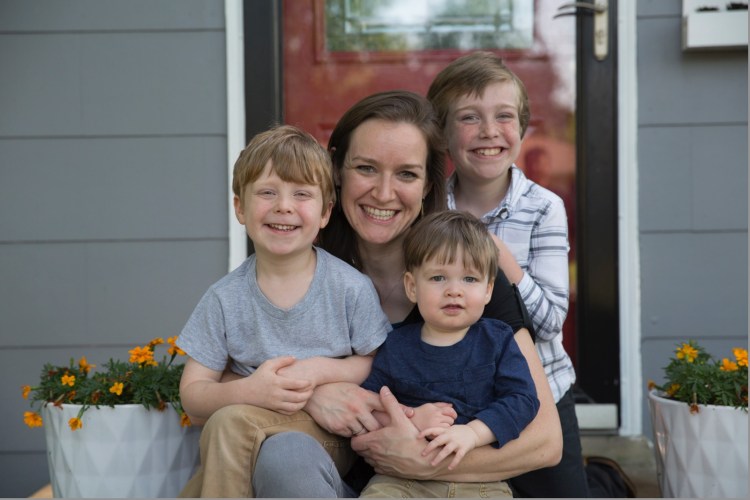
Cindy and Alex moved back to our town in Tennessee and had two more boys. What do you do with boys? I asked. Answer: just love ’em! Oh, and stock the toy box with cars instead of baby dolls please, says Benjamin.

Boys 3

Benjamin (6), Jackson (8), and Noah (almost 2)

So now I give you permission to brag on your grand-kids. And if you don’t have any, be sure to adopt one. Every child needs a grandparent!