Recently, I broached a subject with a friend about an issue I’d noticed in her life. Her steely hard, plant-the-feet-in-the-ground, defensive posture, and irrational response all told me this subject was a trigger, and I needed to back off. She’s obviously not ready to receive my input, and so I have to let it go.
I know her heart desires truth, but she’s not ready to face her pain. And that’s okay. It’s God’s job to gently woo her to Himself and prepare her heart to be willing.
If I let it, the news this week could leave me feeling overwhelmed:
Earthquake in Nepal
Flooding and tornadoes in Texas
Riots in Baltimore
Beheadings in Syria
Shootings on campuses
Starvation in India
Meanwhile, I go about my sheltered, stress-free, cushy life. Catastrophes in other parts of the world don’t affect my daily life and decisions. If they did, I’d be the one in crisis and I couldn’t function. If I don’t feel pain when you’re in pain, that’s a good thing. I don’t want a doctor operating on me when he has a broken arm. I need him to be healthy and well.
For two full days this week I listened to three abuse victims’ agonizing sobs. They weren’t in any physical danger, but they believed they could not go on living. Was I compassionate? Yes, of course. But I did not absorb their pain. It’s not healthy or productive for me to do so. That’s Jesus’ job.
Whose pain have you taken on that doesn’t belong to you?
From my 2015 Journal. I voluntarily spend time around joy killers—people complaining of emotional pain. It’s my calling and my ministry to listen for hours to stories of horrendous abuse and its effects . . . but I’m tired.
And I remember the before . . .
I’m a little girl, twirling with the swirling leaves, shouting delight as wind flings its rain smells, ready to cool the parched earth. Hair tousled, uninhibited, unselfconscious, no to-do list, living in the moment. Exuberant. Carefree.
And then I’m an energized young woman, flinging laughter to the wind, racing down the beach, warm sand between my toes and water lapping at my feet. Collapsing to the ground to watch clouds and birds, sandy-haired, relaxed. Carefree.
I’m a middle-aged woman, slower now. I can’t run and jump as well, but my spirit and soul soar free above the earth. Enjoying the ethereal, shimmering expanse of the ocean. Carefree.
I watch as my body turns sluggish, age spots appear, mind slips away from the present, and my soul settles into tired places. How do I recapture my exuberance when a stale wind hangs thick around me? I can’t sustain the energy of joy. I’m too tired, too distracted, too full of that R word responsibility, heavy weights in my shoes pinning me to the earth.
And I remember I am the one who controls my own joy-killing.
Like young David, I must shed King Saul’s heavy armor and travel light. I detach the weights from my wrists and ankles, kick off my shoes, inhale fresh air, and feel warm sand once more. I’ve been carrying stuff that isn’t mine to bear. Forgive me, Lord.
As I passed near the men’s clothing aisle of a new Goodwill store in town, I noticed a large woman, weight mostly distributed around her waist and thighs, holding up an enormous pair of pants that would have fit someone one-and-a-half times her size. “Can you believe this?” she exclaimed. “I’ve never seen pants so big! I’ve never seen anyone who could actually fit these! Wow! These are huge! Look at this!” she reiterated to her shopping companion.
Several thoughts raced through my mind:
Why did she disbelieve that someone could actually fit them? I’ve seen people this large in person and on TV.
She, herself, was (ahem) larger than average.
Why was she making such a big deal about it—loudly—in public?
Did comparing her large frame with someone larger make her feel better about herself?
I felt more compassion for the large-pants man and less compassion for the lady. Why?
And then it hit me. I recognize myself in her. I do the same thing (sigh)—I make the biggest fuss about what triggers me the most. When I roll my eyes at someone else’s words or deeds, I recognize some unfinished business in my heart—some lack of compassion, some unresolved hurt, or some judgmentalism. The woman’s words simply revealed what was already in her heart. I don’t judge this woman—because I am too much like her. Perhaps I need to practice more grace . . . toward myself!
For out of the overflow of his heart he [a person] speaks. Matt. 7:15-23; Luke 6:43-45
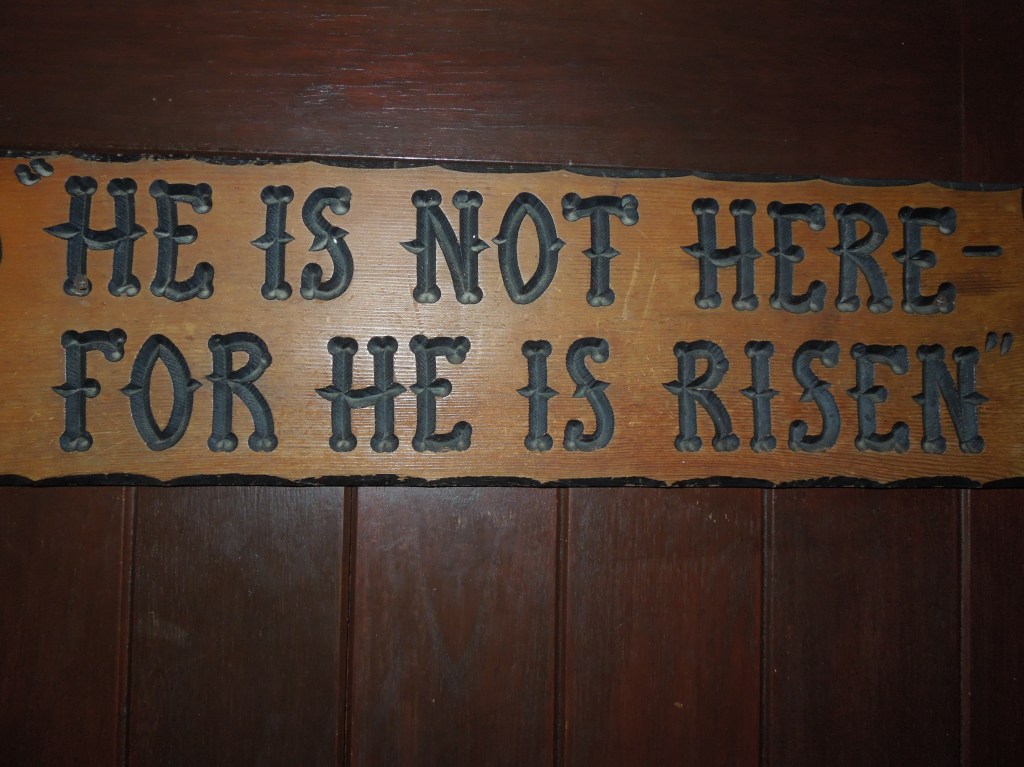
Jesus’ death left pain in its wake, and His followers stubbornly refused to believe the women who reported seeing Him after He had risen (Mark 16:14). I wonder what lie the disciples believed that kept denial in place?
Too good to be true.
I can’t let myself feel hope for fear I’ll be disappointed.
You can’t trust a woman’s word.
Jesus doesn’t need to dig around in their psyches to help them discover why they’re being stubborn. (That’s what I would have done.) He knows their hearts and rebukes them for their refusal to believe. God is patient with our struggles and fears and doubts, but He’s not so patient with stubborn disbelief. How many times did He say, “O ye of little faith?” There’s no pointing fingers here. I’m plenty guilty myself.
The women at the tomb believed as soon as the angels spoke truth to them. The men, however, continued to doubt when presented with the evidence (others’ testimony and an empty tomb). The disciples on the road to Emmaus couldn’t seem to grasp the truth, and Jesus rebuked them. Even when the disciples saw Jesus in the room where they gathered, and the joy center of their brain activated, they had a hard time believing.
We know that the brain is a complex organ—different parts are responsible for different functions: the occipital for eyes, the amygdala for emotion, the frontal cortex for logic and reasoning, and memory in a different part. Since God created the human brain, He knows what part gets activated during fear (like Peter sinking in the sea of Galilee). He knows that the frontal cortex shuts down during a fight/flight/freeze situation. Yet He seems impatient: Why do you doubt, Peter? Why do you have so little faith? Why don’t you men believe when the evidence is in front of you that I’m alive? Stop doubting!
What makes us doubt? Is the emotion center too strong? Are there lies imbedded in that emotion? Those with D.I.D. (Dissociative Identity Disorder) maintain strong denial parts, for if they believe trauma happened, then they’d have to admit it was real. Once truth enters the brain, however, and they experience an encounter with the living Lord Jesus, doubt and fear flee. Jesus knows all this, so is He really impatient . . . or is He challenging His disciples to accept HIM, the way, the truth, and the life?
Sometimes it’s hard to believe someone else’s testimony, but everyone (including Mary, the ten disciples, and eventually Thomas) believed when they saw the resurrected Jesus with their own eyes. Why? Because they experienced it for themselves. Truth experienced in the right brain translates into left-brain belief.
When evidence stares me in the face, what makes me dig in my heels and refuse to see truth? [2021 update: I’m not talking about political opinions on whether or not to wear masks!]
I ran roughshod over a client’s will today in an inner healing prayer session, and God gently rebuked me with the thought: “Sometimes you push toward the goal and miss what’s on the way.”
I admit that I’m a very goal-oriented person, going pell-mell through life, trying to meet deadlines, and I miss the fun in the process. Think road trip. If there’s a time crunch, take the freeway. But the scenic route is more relaxing, candy for the soul. The trade-off, of course, is more hours of traveling, more expense, and potentially missing out on what’s waiting for you on the other end of your trip because you took so long. But the process is part of the adventure.
I understand now how my work with the souls of clients can do more harm than good—that I can inadvertently traumatize them. Yikes! But then I must give myself grace—gaining experience is also part of the process.
I feel like I’m holding the reins of a team of highly charged horses, but Jesus says, “Be still.” How am I supposed to win the race if I calm the horses?
And again I hear, “Sometimes you push toward the goal and miss what’s along the way.”
My inner drive (my horses) need help!
Jesus says to give Him the reins. He lets the horses charge around the track to release their pent-up energy. Then we can begin a more controlled, deliberate walk around the track (or in this case, plow the field—because you don’t need racehorses on a farm!)
The Plan: The family is gone, so I can work all day on editing Simroots, a magazine for AMKs (Adult Missionary Kids).
The Reality (no kidding!) I counted:
21 phone calls
69 texts
64 emails
5 pieces of mail
1 person at the door
6 visits to my office
0 Simroots
By the end of the day, I felt exhausted!
Visual: I’m on a train with my bags packed, briefcase in hand, ready to move toward my destination. But every few feet, the train jerks to a stop. Sometimes people get on and some get off. Sometimes I step off in frustration from the discomfort of the jerking, but I dare not wander too far for fear I’ll not be on the train when it finally breaks free and starts moving again.
By the end of the day, I haven’t even left the station! What to do? I go inside the train station and find an indoor pool (don’t ask) and try to relax and unwind. But I’m still unnerved by the motion of the train. Being a task-oriented person, I prefer a bullet train—fast track, no station stops. I feel agitated, unsettled, irritated . . . certainly not at peace. If I’d known I was on a defective commuter train, I could have adjusted my expectations and been fine with it.
No, this is not the first time I’ve experienced this.
The related Memory: While desperately in need of a nap when my baby was sleeping, the neighbor boy across the street relentlessly pounded away on something in his front yard. I’d just fall asleep when he’d pound again, jerking me awake. Irritated is too soft a word for what I was feeling!
Instead of praying that the boy would stop (I tried that), I could have prayed for supernatural rest. Instead of getting irritated that I wasn’t getting Simroots done, I could have turned my attention fully to the interruptions. And I could have stepped off the train and asked Jesus to tell me when it was time to get back on. Even if the train leaves without me, I can always catch the next one.
A 2021 Update: I have since learned that I’m more productive if I ask the Lord for direction first about what tasks He wants me to accomplish that day and in what order. When my mind is set, I then ask Him to hold the interruptions, except for those that come from Him. Then once a month I climb aboard a bullet train, a scheduled Karen Day with no interruptions allowed.
From my 2012 Journal. I’ve had a recurring nightmare of being lost and unable to reach my destination. Perhaps my brain is trying to process my unresolved fear of searching for my next classroom in the maze of a two-story American high school after attending a small boarding school in Africa. Or the roots are in my preschool panic when I couldn’t find my dad in the tall grass while hunting guinea fowl together. There is something in all of us that wants to be in control of our lives, and we don’t like the feeling when we’re not.
I have no desire to be in charge of a PTA, a church, or a nation. I didn’t even like being in charge of my own kids when I was parenting. But I do want to be in charge of my own classroom as a teacher, over my own food choices, over my schedule, over my own body, and over my finances. I don’t like it when others violate my will.
So what do I do if I’m under someone else’s jurisdiction (a boss, a parent, a policeman, the law of the land)? I might respond negatively or positively according to whether or not I agree with them or whether the mandate is reasonable or not. If I’m serving a boss who is irritable, unpredictable, overbearing, or unkind, it takes effort and poise and grace and an abundance of God’s Spirit to submit to his or her authority.
But what if I serve under a person whom I highly respect and adore, who is gracious, kind and polite and loves me back? How would my attitude be different? You’d assume I would respond with ease but, sadly, I still fight to be in control.
I serve a perfect Master. What keeps me from responding well to Him when He gives me orders? It’s an on-going struggle for me to submit—until I face my fears of feeling lost or out of control—and that’s when God steps in and brings safety and comfort, just like my dad did when I cried out to him in the jungle grass.
From my 2016 Journal. I feel like I’ve been fighting fires for months—rows of houses are ablaze or burned to the ground, and I’m tired of holding the hose, climbing ladders, and rescuing people. I’m weary, and the fires keep spreading. I also see gleeful little gremlins throwing gasoline over the houses.
Lord, I need your help!
A strong wind blows the fire back on itself, and water from the sky douses the flames. But suddenly the scene shifts and my perspective changes. The water is actually coming from a watering can, and the blaze is no bigger than a campfire. I’m just a little ant, so everything looks enormous—unlike from God’s perspective. All my effort and fretting just made me tired.
And so I ask the Lord, “What is my role? Do You want me to hold fire hoses or stand back and watch you work?” I think of Moses who obediently went to Egypt, but it was God who did all the work once he arrived.
I’m tired before going to my next appointment.
“Just show up and obey My instructions,” He says. “And I’ll do the rest.”
From my 2012 Journal. Once I learn a perceived truth, I tend to filter all of life through that grid. For example, when I first learned about the benefits of homeopathic care, I shunned all allopathic doctors—until experience taught me that each has its merits for curing diseases.
One day I had a conversation with a gentleman who declared that the key to a child’s emotional health lies in his relationship with his father. This may be true in some or even in many instances, but not in all. It struck an emotional chord with him, however, and he began to take on some “shoulds.”
I’m currently reading When Helping Hurts by Steve Corbett and Brian Fikkert—a book on the subject of poverty and how not to hurt the poor in the midst of generous attempts to help. What strikes me is the matrix through which the authors view the subject—not that it’s wrong—but that all the verses and arguments are from one premise or topic. For example, the authors pose the question: Why were the Israelites sent into exile? “Idolatry” would be my immediate answer. But the authors concluded: because they didn’t properly care for the poor. Well . . . maybe . . . and that certainly could be part of the answer, but it’s not the only one (See Leviticus 26).
If I were writing a book about idolatry, I’d focus on that topic only and ignore the issue of caring for the poor. Or if I wrote a book on children or women or finances in the Bible, I’d examine all the Scriptures that pertain to just that topic. It’s normal to focus on one topic at a time—it’s all my brain can hold anyway—but I think I may develop tunnel vision in the process.
Grandma grid: My grandsons are the best!
Early in my ministry, TPM (Transformation Prayer Ministry) became my grid for all inner healing needs. While I was reading Boundariesby Cloud and Townsend, I started to view life through that filter. The founders of Temperament Analysis, Arno Profile System see every emotional solution through the grid of temperament needs.
Here are some grids for the topic of addiction.
The theologian calls it sin: stop doing it!
Solomon says it’s unwise: look at the consequences (Proverbs 23:29-35).
The counselor wants to know motive: why are you doing it?
The doctor suggests it’s a chemical imbalance: let’s help you detox.
The family says: you’re hurting me; you need help.
The addict says: I’m not hurting anyone but myself and I’m fine.
Whose grid is correct? The study of psychology, boundaries, codependency, temperament, TPM, or any other system or method (including a set of doctrines)—these are not the authentic answers to human needs.
So here’s where I struggle. Because of my profession and training, my grid tends to be too narrow. The worst part of it is, I’m always thinking, “You could be fixed . . . if only you had the set of keys that I have in my possession. These keys could help unlock the doors on your pain—but either you don’t want to use them, or you don’t know that they exist.” Truthfully, however, my tools are plastic. Jesus is the Master Key; only He can unlock every door. Only God sees the whole picture all at once. He knows every answer, nuance, and issue.
A 2021 Update: I’ve since added HeartSync Ministries to my toolbox. But even this grid is imperfect. Only Jesus has the perfect toolbox.










 In the Pursuit of Peace