If I were to choose a recurring theme for my greatest struggle in life, it would be over the subject of money. I have been imbalanced for so long that it’s hard for me to get to the center. It’s like being on a wobbly merry-go-round with one side higher than the other, and all I can do is tightly grip the edges.
When I was single and my decisions only affected myself, I felt at peace. I could be as imbalanced as I chose, and it only affected me. But when you add a spouse and children to the mix, it becomes complicated—especially if there’s a difference in philosophy, upbringing, goals, and values. Trust is at the core of the relationship. Will I ever come to grips with this topic?
The bottom line for me, I guess, is learning to trust the God of the universe that He will take care of me and supply all my needs. The wise financial planner saves for the future; the foolish spends it all on pleasure now. The miser hoards it all and has no pleasure. Somewhere there’s a balance, and I want to be at peace no matter what circumstance I find myself in. I can’t hold onto my false security handles anymore. I have to leap into the loving arms of Jesus and trust Him to sustain me and not let me fall. He owns the cattle on a thousand hills, and I know that He will care for me. But the perspective has to change. Not only does He own them, but I do too. I’m heir to the kingdom.
Later. I fretted and fretted over missing the deadline for our daughter to apply for the Presidential Scholarship at Berry College. But we got an invitation in the mail for the scholarship weekend anyway. My faith factor just bumped up a notch, and I let go of my tight grip when she won the contest.
A 2024 Update. My heart finally began to relax at last when, a few years ago, I found myself worrying about how I’d manage financially if I became a widow. God’s gentle voice whispered in my ear, “I will be a husband to you. I will care for your needs.”
. . . His Spirit in your inner self [indwelling your innermost being and personality] (Ephesians 3:16 Amplified)
Since my innermost being is home to the Holy Spirit, I want to make Him feel as at home and comfortable as I possibly can. I know how icky it feels in my earthly home when there’s tension and discord and fighting and self-centeredness. How at home does the Holy Spirit feel when I’m angry, peevish, sulky, self-centered, lonely* or at worst—when I sin, leaving dirty smudges on the windows of His house, keeping others from seeing His light shine through?
[*“Why are you lonely? Aren’t I here?” says the Holy Spirit]
Guilt is like walking on a sandy beach, leaving footprints for all to see. And when shame tries to smooth over the prints, I create more footprints in my retreat.
Forgiveness is God sending His wind (the Holy Spirit) to blow across the sand, erasing all the prints. And even if I fail again, the wind continues to blow.
How much better to scramble onto a rock, where no footprints can be made, and no guilt and shame exist.
With a satisfying morning behind me, as I entered the room with a smile on my face, I immediately sensed a shift in the atmosphere. This person’s bad mood challenged my response.
I see a dark cloud swirling above her head. Since she’s cold and damp and miserable, no wonder she grumbles and complains. (Or does she relish the attention she gets from her drama?) Anyway—what is that to me? The problem is, I can’t get near her, or I’ll get drenched too—or worse, get zapped by the lightning coming out of her cloud. I confess I prefer to avoid prickly people, but if I do, I forfeit relationship and I can’t help them.
As I pray about my dilemma, the Lord says, “Wherever you are, rest in the eye of the storm, and the swirling wind about you will push her rain away so that you can draw near. You don’t have to be affected by her weather patterns.”
The tug of my human heart says I have the same temptation toward pride, the same bent, as Satan himself. I want to be like God. I want the universe to revolve around me. I want glory. Like the Apostle Paul, I want to shout, “O wretched man that I am; who shall deliver me from the body of this death [idolatrous desire]?” (Romans 7:24).
My visual is that I’m at the center of a circle, craving the world’s honor and praise. Though I want to experience significance, I don’t want this idolatry of self. I want to echo John the Baptist’s words: “He must increase; I must decrease.”
Paul viewed himself as a slave of God (the Master of the Mansion, a perfect gentleman who looks after and cares for His servants and who gives good gifts according to their service for Him.) Kitchen maid or head chef, butler or chimney sweep—we all have our jobs to do. If we do it with a complaining spirit, we shift the focus to the idolatry of self. If we serve with gratitude and love, our load feels lighter. We’re driven to excellence. We want the Master of the Mansion to look good. Shining the gold on the newel of the banister becomes an act of worship. Fetching His slippers is a privilege. We adore Him. Why? Because He makes each one of His servants feel significant. He catches our eye. He notices. “Nice job on the newel, Charlie. Thank you for remembering to feed my dogs, Susan. I love you, Karen.”
But there are other metaphors: “No longer do I call you My servants, but My friends (John 15:15). You are My bride (Isaiah 54:10). I bought you with a price (I Corinthians 7:23). You were sold for nothing, and you shall be redeemed without money” (Isaiah 52:3).
And we remember who we were and from whence we came. And we gladly, gratefully, joyfully enter into a love relationship with our Rescuer.
But then that niggling question comes—how did we get into the slave marketplace? How did we end up in the prostitute’s parlor? And we blame God. He created us, didn’t He? It’s His fault for bringing us into existence in the first place. And we face that universal question, “Why was I born?” Just so He could have more slaves? How bitter is that?
But no. He wants relationship. “He satisfies the longing soul and fills the hungry soul with goodness” (Psalm 107:9).
“Will you be My bride?” asks Jesus. I have searched for you, I have found you, I have courted you. Will you say yes? I will exchange your dirty garments for clean, bright white ones. I will give you a crown worthy of a queen.”
And in humility, all pride gone, I bow prostrate at His feet. I am unworthy. He deserves all the glory, the honor, the praise.
Coronation Day is coming. Preparations are in the works. I want my heart to be ready. I want to complete the tasks He’s given me to do in preparation of the wedding day and His coronation ceremony.
This was not my favorite day! I had my goals, expectations, and vision of an uninterrupted day to catch up on my work. It started at 4:30 a.m. with the cat waking me up, and it went downhill from there. I spent very little time at my desk, ran errands instead, met others’ needs, and ended the day an emotional wreck. No alone time and thwarted at every turn, I felt off balance, out of kilter.
How do I balance plans with interruptions? Why does it upset my equilibrium when I don’t get my way? I should have known . . . I should have anticipated . . .I should have been others-centered instead of self-centered, runs through my brain.
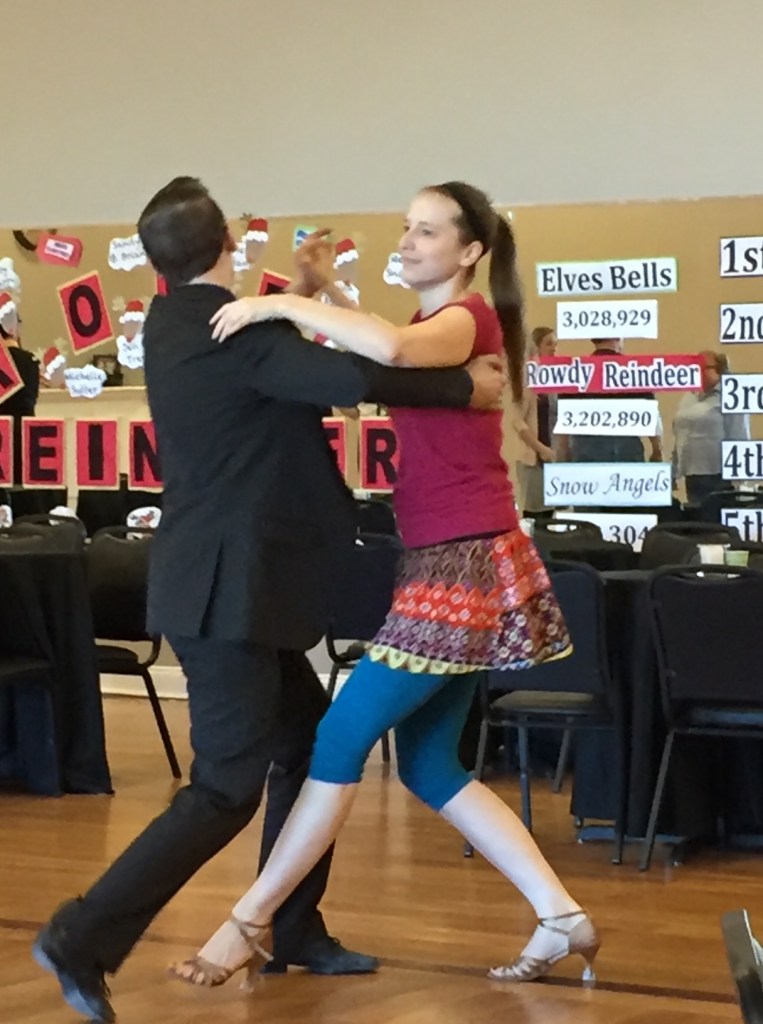
I used to have a tight control over my schedule. I was on the dance floor without a partner. I could sit on the side and play solitaire, get up and get a snack at my leisure, or sway to the music if I wanted to. I affected very few people with my decisions.
And then I got married. Having a dance partner meant I couldn’t sit down as often. Sometimes he served me drinks; sometimes I served him, and at all times we were aware of each other’s presence and needs. If we both were in the mood to dance, we did. If we both wanted to rest, we did. If one did and the other did not, we had to compromise or sacrifice. It was easier sometimes to give in than to fight over it; other times easier to think only about my own needs.
And just as I began to learn that dance, we had children. We adjusted to their varying heights and were less free to move around. I spent far more time fetching drinks for everyone and making trips to the bathroom than keeping time to the music. There was no standing still.
Next, a lot of messy people joined the dance floor asking for help. Some were unseemly characters. Others dressed nicely, but they didn’t know how to dance. Others were too weak and sick to dance. And the world of the dance floor suddenly became more complicated. While I was responding to the needs of the lonely ones on the bench or the thirsty ones in wheelchairs, my husband may have been in the mood to dance. And out of the corner of my eye, I watched one of our girls dancing her own dance with a guy. And my eyes and my heart were torn or divided or distracted or overwhelmed.
Add to that the God-element. In a fifth dimension, unseen to the human eye, the Holy Spirit and the evil one mingled among and through us, stirring us up, catching us when we stumbled, whispering lies or truth in each of our ears as we danced and sat and ate and drank.
I have a restlessness inside. Some days I just wish life would return to the days when I was a solo dancer, in control of my own decisions.
I know I must get away, and so I slip away from my dance partner, away from the tug of the needy ones, away from the vigilance on my children, and head to the balcony to drink in the night air and enjoy the stars. But just as I reach the top step, a noisy group comes spilling out of the room to join me, and the magic of the night is lost.
Instead, I find a quiet bench in the garden. I can still hear the music, and I know I can be interrupted at any time. I just want to go Home (with a capital “H”) where it’s safe, soft, peaceful, quiet. But it’s not time yet.
And so, for now, I slip further into the gardens, hiding behind a tree, hoping not to be found. But my dance partner is lonely and comes seeking me. And I set aside my own needs and return once more to the dance hall.
And the restlessness continues. It has nothing, really, to do with what’s going on around me. It’s not the people, the noise, or the distractions. It’s what’s going on inside my heart–an open door, a furnace burning inside my chest, stoked by anger. And even when I go home (lowercase “h”) the fire remains. Hot. There’s no escaping it.
In the middle of the dance floor, with my permission Jesus reaches out His hand, extinguishes the fire, and says, “Give Me the treasure of your heart.”
I’m willing, but I don’t understand—I don’t know what’s in it. Again, with my permission, He reaches into the door of my heart and retrieves a box. “Where your treasure is, there will your heart be also,” He explains. And I expect Him to take it up to heaven and deposit it under the throne. (Isn’t that what Matthew 6:20-21 teaches? “Lay up for yourselves treasures in heaven . . .”) But, instead, He places my box inside His own heart. “For safe keeping,” He says.
And now it doesn’t matter what goes on around me because I’m following my Treasure. When He says, “Dance,” I dance. When He says, “Rest,” I rest. When He says, “Serve,” I do that.
It’s not about controlling my world but about controlling my mind.
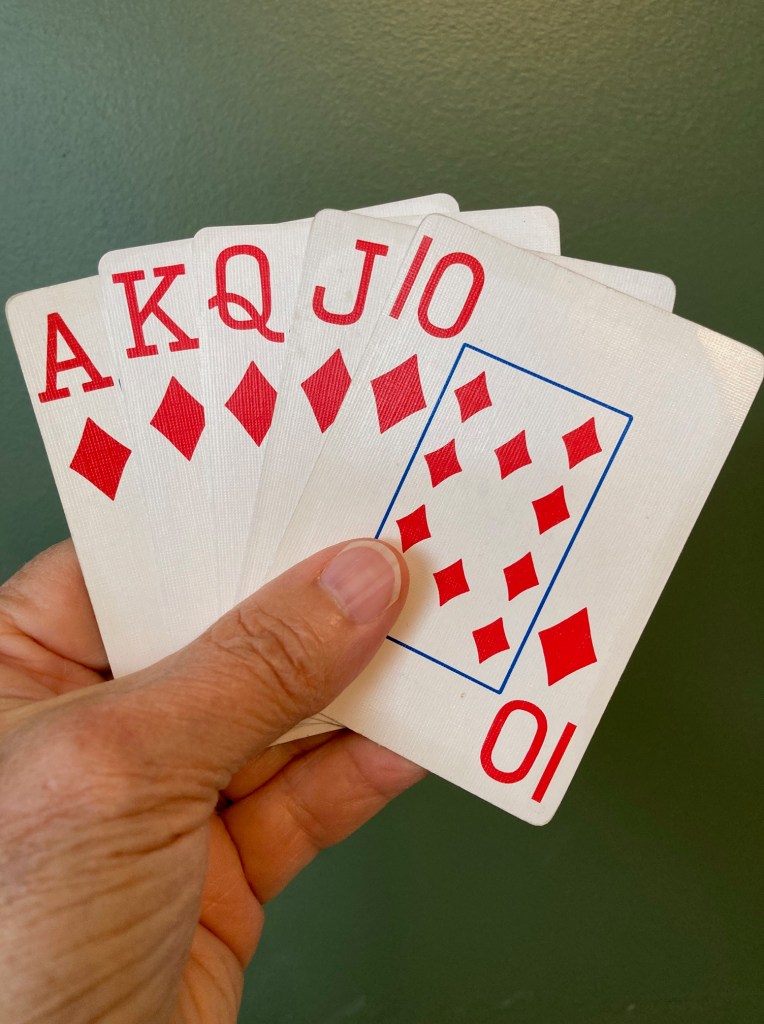
Some days when you play a game, the cards fall in your favor. Other times, no matter what you do, the cards go against you. Is that random chance or does God control the cards? But there’s a certain amount of man’s choice, too, such as how many times you shuffle the cards.
Take the following example. In the last month or two, the dollars began flying out the window—most of it not by choice, but by circumstances beyond our control.
Our air conditioner compressor goes out.
Our washing machine dies.
My Cutlas Ciera needs two new tires.
My CD burner dies.
I need a root canal.
Our youngest daughter needs some expensive health tests on her thyroid.
She falls at Fall Creek Falls and messes up her body.
She bumps her head, hard, on the car and begins to experience headaches.
She accidentally catches a strap on my rearview mirror and the mirror comes off the windshield, taking some of the glass with it.
She experiences her first flat tire.
And her first college school bill is due.
More cards to shuffle:
On Sunday evening, just as our five-day-Intensive client left, our middle daughter walked in the door after being gone for a week.
On Monday I started a new job.
On Tuesday I need to do the following:
Clean house, do laundry, shop for groceries.
Get new tires.
Be home for computer repairman and windshield repairman.
On Wednesday, I will need to get up very early to take my husband to the airport, meet with a client all day, and host a pool party for my ladies’ Bible study group in the evening.
But circumstances started changing, like cards falling right. Both the computer guy and the windshield repairman postponed, my middle daughter was here to clean for me, and she also offered to drive her dad to the airport. My youngest daughter’s thyroid test came back negative, and God miraculously healed her. A young man drove up and offered to change her tire.
Good-bad-good-bad. Each bad can actually be good—it all depends on your perspective. If a tire was going to blow, better on a back road in Murfreesboro than on the freeway. It might be the catalyst for preventing an accident later on.
But think of this: clearing Tuesday’s schedule for these two repairmen puts them coming on Thursday afternoon instead. That’s okay IF our client is finished by that time. Otherwise, it could be a double interruption. Is it God’s plan to destress my Tuesday, or Satan’s plan to interrupt Thursday? Not to worry. God has all things under control.
Rick Warren, author of The Purpose Driven Life, says he sees life as two parallel tracks—good and bad running side by side. There’s always good happening, and there’s always bad. Even in the worst-case scenario, there’s something to be thankful for.
“Sometimes you aren’t listening to your body because you’re listening to everybody else’s expectations.” AnnVoskamp.com
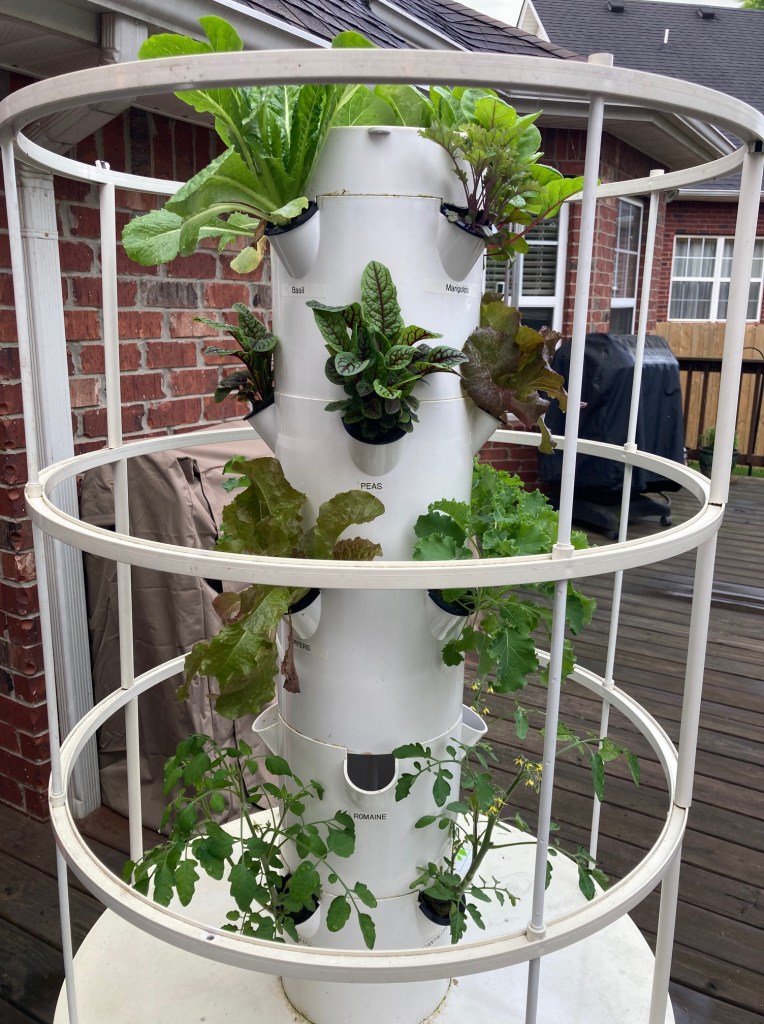
I’m reading a book entitled Plant Paradox that challenges much of what I’ve been taught. Who can I believe? Who has the answers? Opinions and research shift from one decade to the next. Eat potato skins, they say—that’s where the nutrients live; don’t eat the skins, others say, because that’s where the toxins stay. Egg yolks are bad for cholesterol; yolks and whites are best if eaten together. Don’t eat real butter—it has bad fat; don’t eat fake butter—it has too many chemicals. Aaackkk!
I just know that something has to give. I feel more tired and achy as the summer wears on—usually my most healthy season. Where is this inflammation coming from? How do I know what’s good for me and what’s not? Everyone has his or her pet opinion. And how do I balance buying organic vs. watching my budget? Or market-fresh vs. grocery stores vs. my shopping time? What’s most important to me? To God?
I eat pizza and pancakes every Saturday. And for company tonight I’m fixing a high-sugar dessert. How can I say no to that! My naturopath says to stay away from wheat and corn. The rheumatologist suggests avoiding nightshade veggies (tomatoes, peppers, eggplant)—all of which I just bought. Sigh.
I feel old when I’m tired and hurting and compare myself to an elderly couple at my church doing at their age what I don’t have the energy to do now at mine.
VISUAL: From the sidelines, I watch see this couple busily digging a ditch, while Jesus stands to one side observing us both. He hasn’t asked me to dig with these spry octogenarians, but somehow, I feel guilty.
“Look down at your feet,” He says.
I see water.
I don’t understand the significance. At first, I think, I need to bail this liquid out of my ditch. But then I realize the couple is digging for water, and I’ve already found mine. This is no reflection on them, no judgment—just an observation in the visual.
So, what’s next? I’m standing ankle-deep in clear, running water. It feels good on my sore feet. I’m allowed to stay here if I like . . . though I think, maybe I should help the couple dig for their water. Why should I stay here when others need me? So, I offer my services, but they wave me off.
“We love what we do!” they say. “If you like digging, you’re welcome to join us, but we don’t need your help. We’ve found our joy.”
Okay, I can live with that.
So, I stay here in the cool, refreshing water till something flows down my gully that requires attention. I’m grateful for those who answer the call to do. Today I am content to just be, a soft breeze caressing my cheek as I sit here on the patio of Starbucks, watching the cars go by, smelling coffee and perfume and fried food. It’s been a glorious day.
A 2024 Update. My inflammation is under control now and, fortunately, I don’t battle any allergies, or I might have a different opinion. I’ve settled on my mother’s philosophy and wisdom: eat what you want but in moderation. And eat lots of veggies.
I have been rebelling against fashion since I was in junior high boarding school. While girls were begging to wear shorter skirts, I insisted on lowering my hems. One day in home economics class we learned what colors supposedly looked good together. Apparently orange and pink was a no-no (this was before the crazy ’70s entered the scene). One of my classmates dared me to put together a clashing skirt/blouse combo and wear it to breakfast that morning. I felt proud that I had enough guts to go against established rules of fashion and confident enough in who I was to pull off the faux pas.
But, to my chagrin, one of the Aunties pulled me aside to inform me that my wardrobe choice was a less than desirable combination of colors.
“How could she think so little of me?” I thought indignantly. Even when I told her that I wasn’t ignorant, that it was done on a dare, the damage in my soul was done. I felt embarrassed where before I felt confident.
I take this emotion to Jesus, and He smiles.
“Why are You smiling?” I ask.
“I love that you have self-confidence to be who you are. Never mind the Auntie. She didn’t know. She was simply trying to be helpful. Wear whatever you choose—with confidence.”
I wish I’d known this the year we were on furlough for my junior year of high school. Someone kindly donated their rejects to the poor missionary barrel, and I ignorantly donned a dress that apparently was out of style. One ill comment, and I never wore it again.
What I choose to wear reflects who I am, and to which master I serve. I want to be confident in who God made me to be.
A 2024 Update. Admittedly, I still have poor fashion sense and find it helpful to take a daughter along with me to shop for clothes—though I maintain the power of veto. I tend to follow my mother’s advice: wear only what’s comfortable.
I made this dress in 1975. This really was in style then!
Two or three times in church today I found unwanted thoughts in my head—critiquing (I refuse to use the word criticize because I don’t want to go down that road) the person or event. We all do it—okay most of us do it.
It irritates me a little if a person says everything is perfect ALL the time. They are too delighted in everything—and then I realize as I say this, that all the people I know like this are sanguines—which I am not. Declaring everything is always perfect, good, and wonderful, feels disingenuous. It’s not reality. But neither is the doom and gloom of the pessimist. I’m somewhere in between.
What I don’t like is the unbidden thoughts I have regarding others. I used to judge and feel superior and all that nasty self-righteousness stuff. Now I just notice. But why, I ask myself, do I even need to notice? I guess the only way NOT to notice is to be blind.
Okay, I really must be honest with myself. It’s not the noticing that’s the problem. So what is it? Why does it matter? That’s where the emotion lies.
I find the memory and process it, and it feels better now. Noticing is okay; judging is unproductive.