WORD FOR THE YEAR 2019 – REST

The problem is when labor becomes the only thing that defines who we are. When we come to see things like rest as a negative space defined by the absence of work. When we fail to recognize the value of rest for building our sense of self.

(Alex Pang WordPress Hurry Slowly)

All of my life I’ve set goals for the year, for the month, for the day. I’m a task-oriented person driven to make to-do lists. In college, my schedule was so tight I kept a minute-by-minute chart (no kidding!) for each day’s goals and activities. The advantage of this discipline is great productivity; the disadvantage is that flexibility cannot dwell in your vocabulary.

Marriage, and especially children, tended to upset my neat calendar rows, and I began to relinquish my grip on defining productivity as success. Some days just keeping a child fed, dry and safe was my goal for the day.

I’m in a lovely season of adulthood right now where I get to choose how I manage my time—no school bells, no appointments unless I make them. I have no imposed time frames from outside sources. If I were not so goal-oriented, I could imagine myself sitting all day long in a comfy chair with a book on my lap. But I don’t—there is work to be done, things I want to accomplish, ministry to attend to, and relationships to maintain.

Growth and maturity and balance, for me, have come from watching people-oriented people. I’ve attempted to embrace the fact that people are more important than schedules and “being with” is just as important as “ministering to.” But I cannot change my basic temperament, and I continue to set goals for accomplishment.

After the previous year’s marathon goal of stretching myself once a month, immediately I knew my word for 2019 would be REST. But what would that look like? Did it mean I would cancel all my prayer ministry clients? Put editing Simroots on hold for a year? Hire a housekeeper? No, it meant I would cease from self-imposed goal-setting for self-improvement. I could relinquish my “have-tos” and begin to relax. Just for a year.

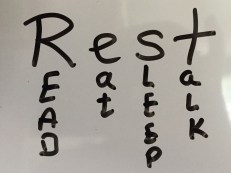
RESTWhen I put the word Rest on my kitchen whiteboard, my friend Cheryl wrote more words vertically under each letter. Pretty clever and spot on I thought. I also came up with the acronym REST G (Releasing Every Situation To God).

What I learned this year: Resting is sometimes harder for me to do than doing! Jesus is my Sabbath rest.

What was your Word for the Year? How did that go?

Click on the links below to see some of my previous years.

Word for the Year 2012 – Adventure

Word for the Year 2013 – Word

Word for the Year 2014 – Food

Word for the Year 2015 – Hike

Word for the Year 2016 – Unplugged

Word for the Year 2017 – Neighborhood

Word for the Year 2018 – Stretch

Heavenly Thoughts

From my 2009 Journal. I’m at the SIM Sebring Retirement Center. These godly old missionary saints in Florida just keep giving and giving. Some give gifts of time, others of service, some of tangible gifts. Some exude gifts of beauty and grace while others serve with gusto.

I think that whatever gifts God gives us here on earth will continue to be used in heaven to serve others. What do I have to offer though? People will have perfect knowledge and won’t need me to sit and listen for hours and pray with them. Maybe I’ll get to organize the angel wardrobes or help check in the new arrivals on the heavenly database list!

What language will we speak? The same as Adam and Eve? Will we get to meet all the people we ministered to unawares? Will we go around apologizing for all the dumb things we did and said to each other here on earth? Will we grow in knowledge? I do know that we will have the full truth that answers the need of our pain. Will we experience emotion in heaven? Will we all be smart? Wear different colors or all be dressed in white?

God’s kingdom as described in Isaiah 11 and 12 sounds perfect, glorious, fair, peaceful, delightful, comfort-filled, right, and true. I long for that kingdom now. But we must wait for it with patience. My daddy longed for it. He set his eyes on heaven in the last years of his life and didn’t want to stay here any longer. Mom, on the other hand, kept her feet firmly planted on earth and refused to look heavenward till it was time. Somewhere there’s a balance. I want to live on both planes at the same time. Yes, I long for heaven, but I must be content where I am now. The Apostle Paul felt this same conflict in his soul: Heaven is far better, but for your sakes I must stay here.

The physical world of the heavenly kingdom sounds glorious. But I can experience a taste of the spiritual realm (grace, mercy, love, peace) now, carried around like a jewel inside my heart. Heaven’s treasures and resources funnel into my heart here on earth, and I can draw on that strength any time I desire or need it.

What will it be like to meet Jesus for the first time? John the Baptist experienced Him on a physical plane—he touched Him, saw Him with his eyes, observed His works, was present for the declaration of the Father’s affirmation “This is My beloved Son; hear ye Him.” John said he wasn’t worthy to unloose Jesus’ shoelaces. We tend to brag about whom we’ve touched—people like a President, the Queen of England, famous actors or singers. What would it be like to revere someone so much that it would be an honor to touch his foot?

I feel intimate with Jesus, but on a spiritual plane, not physical. How will I respond when I see Him “in the flesh”? I have no precedent on which to base my future experience. I used to think that the second you died, you were ushered immediately into the presence of Jesus. “Absent from the body; present with the Lord” after all. Now I tend to imagine there’s a process you must go through first.

Here’s how I picture it: the angels who have been assigned to you accompany your spirit to the heavenly realm. There they offer you a drink of Living Water and give you an opportunity to bathe away your earthly impurities before they outfit you in your new pure white robes—just like Joseph had to bathe and receive clean clothes and be prepared before he could see Pharaoh. And then you’re told when your appointment is, and you’re debriefed in protocol for approaching royalty. Perhaps you’re even given a tour of your new quarters and a little view of the royal city. Perhaps you’ve even gotten to spend time with your loved ones who excitedly try to prepare you for what’s to come—your first meeting with your risen Lord. The excitement is running high. You can scarcely contain yourself.

And then the moment I’ve been waiting for—the “welcome home.” And I’m way too overwhelmed and shy to approach Him—I would not dare think of reaching out to touch His royal person. I’m flat on my face like a Nigerian villager before his chief.

But then something happens. He reaches out to me; He lifts me to my feet (“The lifter of our heads”) and embraces me, and I feel His enormous, infinite love and acceptance, and I realize in an instant how many times I failed Him on earth, how many times I responded in anger or unforgiveness or self-righteousness, and lost opportunities to serve Him. And I find myself asking for the privilege of serving Him—in any capacity—just so I get to be near Him and see Him and drink in His beauty. After all, there are millions of us up here, from every tribe and nation, and we all feel the same way—we’re all falling over each other to be near this Presence.

But He asks, “Are you willing to serve Me in the royal kitchen? In the royal nursery? As a chauffeur or greeter for newcomers? As a gardener in the kingdom? As an overseer of the mansion complex? And of course you say yes—anything for You, Jesus, and with pleasure. And the work we’re given to do will be “right down our alley.” I doubt I’ll be gardening, but I might be organizing things!

How do you picture heaven?

Shame Lifter

We all need connection, but the universal thing that keeps us from it is SHAME and FEAR. (The Power of Vulnerability, Ted Talk by Brene Brown)

From my 2009 Journal. I just finished reading Shame Lifter by Marilyn Hontz, my former pastor’s wife. She says shame was the undercurrent for all things she did or felt in life.

I, too, admit to feeling an undercurrent in my heart—the shame of inadequacy—a restlessness in my spirit that I’m hiding. It happens when I feel my mind slipping away from me—when I can no longer remember a name or recall a common word or someone tells me they had dinner at my house and I’m surprised because I’ve forgotten, or I’m asked to speak in front of a group. I feel so out of the culture, out of sync, unintelligent, afraid I’ll say something dumb.

The roots go all the way back to my Grade 6 furlough when I had to ask a friend what a word meant—a common English word that was never used in my boarding school in Africa. And even after her explanation, I misunderstood. Here’s how it went:

Someone had scrawled some words on the blackboard of the teacher next door: “Mr. Hart cut a fart.” I found Billie Bean, an African-American classmate, pulled her aside under the fire escape stairs, and asked her what a fart was.

First, I felt her hesitation and embarrassment at having to explain this bodily function. There were inadequate synonyms in sixth grade to explain, and so she pointed to her derriere and said, “It’s what comes out of there.” Okay, now I got the picture: someone was suggesting that Mr. Hart had taken a knife and cut in half a piece of excrement. Why in the world would Mr. Hart do that? And what would possess a student to scrawl that on the blackboard?

When Billie discovered my misunderstanding of this American idiom, I do not remember how she corrected it, but I believe that’s where the shame of inadequacy became planted. I believed the “should”—I should have understood—but even more I could sense her discomfort and the subject felt dirty.

Jesus is my shame-lifter. Being culturally ignorant was not my fault, and I didn’t have to take on Billie’s embarrassment. Perhaps I became the more intelligent one since I now knew that word in two languages!

What Makes Your Heart Leap?

From my 2009 Journal. What makes your heart go thump? Your first crush? Seeing an old friend after 20 years? A perfect gift? A healed heart? A sunrise?

Here is my servant, whom I uphold, my chosen one in whom I delight (Isa. 42:1 NIV).

God the Father delights in His Son. His heart leaps with joy in relationship! I want God to leap with joy at the thought of relationship with me. I want my heart and soul to sing when I think of Him. But it feels rather one-sided. He is everything. I am nothing but a dog licking my Master’s boots. I will serve Him faithfully, but I am dependent on Him for food and water and air and training and discipline. He is a kind and benevolent Master who loves me, and somehow I manage to bring Him delight as well. I am not an equal. We are different species, aliens by comparison. He is everything; I am nothing. But He chose me, picked me out of the dog pound to serve Him and be His companion. My heart leaps when I think of that.

Dogb pexels-photo-1174081

The Power of Secrets

Secrets

From my 2009 Journal. Last night I watched the movie The Mayor of Casterbridge—based on Thomas Hardy’s novel. It’s an interesting contrast between two characters. Henchard is a drunkard who, when under the influence of drink, auctions off his wife and child and then repents and regrets it. He then vows not to drink for 21 years and becomes the mayor in another town, though he’s not very gentle with his employees (he has a grain business). Farfrae, meanwhile, is the protagonist (the Christ-figure in some aspects) as he exhibits love and grace and graciousness even when wronged.

But the main theme of the story is the power of secrets. We’re not talking about temporary secrets such as Christmas presents or birthday surprises. These secrets are meant to be revealed eventually and are for the benefit of another person. Hidden secrets, on the other hand, hold power over us, propel us to do wrong things, and impact others negatively. They cover us with shame and fear of the consequences if they are discovered. We can become a slave to the one who discovers our secret and who holds it over us like a weapon.

What difference might the consequences be if one revealed one’s secret immediately rather than waiting for 30 years to expose it? Sharing one’s secret, however, must be done carefully—to a trusted person—else one becomes further traumatized.

Chronic Physical Pain

Pain pexels-photo-922436

From my 2009 Journal. I have learned a lot about handling physical pain through observing my friends who live with chronic conditions.

Friend #1: Rarely offers information, but will willingly answer my inquiries about her health. One day I asked her why. She said, “My mom was in constant pain and everyone knew it because she told you so . . . constantly. And I determined not to be like her.”

Friend #2: Occasionally mentions her chronic pain but never complaining, always enduring. “People don’t like to hear about your pain,” she observed. “I WILL praise God in the midst of it.”

Friend #3: Uses what she’s learned to teach others. “I have learned from my pain; now let me teach you. God is enough. He gives me strength.”

Friend #4: Everyone knows about her pain—because it’s the main focus and topic of every conversation. “Why doesn’t God do something about it?!”

Since I have not been tested yet in this area, I wonder how I will respond someday when it’s my turn?

Why Have You Forsaken Me?

cross

Around three o’clock, Jesus cried out with a loud voice, “Eloi, Eloi, lema sabachthani?” which means, “My God, my God, why have you forsaken me?” Mark 15:34 (NET)

From my 2016 Journal. A victim often asks the question, “Where were You, God, when the abuse happened?” In my experience, God seldom answers the “why” question immediately. Generally, there’s an emotion (often anger) standing in the way, behind the “why” that needs to be addressed first.

I believe it was Jesus’ humanity speaking when He asked, “Why have You, Abba Father, forsaken Me?” In my opinion, contrary to many preachers and songs that claim that the Father turned His back on His Son, God had NOT forsaken Him. Never! But in this moment of extreme physical torture, head throbbing from thirst, body in tatters, fighting to breathe, bruised and battered, His back on fire as it rubbed against the wood, three hours felt like an eternity. One minute would be more than the average man could handle. Minute by minute agony, waiting for the end to come. Wishing it to just be over.

Jesus had intimate communion with His Papa all along. He’d wrestled with His own will just twelve hours earlier and submitted to His Father’s plan. But in one’s pain, it’s hard to focus, to think, to use logic. The focus is all on the removal of pain.

“Where are You, Father? I can’t feel You near. I can’t see You or hear You.”

The abused take it a step further: “You could have chosen to stop it and You didn’t; what kind of a cruel God are You, anyway?”

Jesus’ anguished cry could not include sin or blasphemy or lies. “Why have You forsaken Me? It FEELS like You have.”

Jesus is quoting Psalm 22. The words, “My God, my God, why have you abandoned me?” are only the first few words of verse one. The rest says, “I groan in prayer, but help seems far away.” (Note the word seems.)

Verse 19 declares, “But you, O LORD, do not remain far away! You are my source of strength! Hurry and help me!”

Jesus knew the whole Messianic Psalm by heart. It’s a Psalm of agony and truth, but it ends in triumph. Jesus knew this had to be His lot in order to fulfill prophecy.  He did not have the physical strength to quote the entire Psalm, but He could begin it, and those Jews who heard it would immediately recognize its source and be able to fill in the rest.

The abuse victim cries out, “Where were You, God? Why did You forsake me?”

And the Father gently replies, “I was there all along.”

Should I or Shouldn’t I?

Teach us to consider our mortality, so that we might live wisely. Ps. 90:12

From my 2016 Journal. I hear of causes, movements, meetings and appeals for help that I could join. But I have limited resources, time, dollars, and energy. Each money appeal, request or event that crosses my path has to be filtered through these considerations. And I must check in with the Commander-in-Chief before I move on it—even if it’s a good and worthy cause.

A friend recently sent out an appeal on Facebook to gather items to be donated to a local charity. The words I heard in my head were “I should do that in order to fulfill God’s heart for serving the poor and needy.” It makes no logical sense to admit I feel guilty for not doing it, so I know it’s trigger-based.

Guilt and shame and “enough” are nailed to the cross, so what is in my heart that wants to hold onto this “should”?

VISUAL: Shoulds are a heavy burden to carry—like an unwieldy, large sack of potatoes. If I don’t carry it, I think, who will? Since the potatoes are my responsibility, I can’t hand them over to Jesus. For example, He can’t diet or exercise for me or walk a casserole dish over to my sick next-door neighbor. That job is mine to carry out.

“True,” Jesus says. “There are certain things you were created to carry, not Me. So here’s what you can do. Put the sack down and empty all the potatoes out onto a tarp and let’s sort them together. First, throw away the bad ones (the lies). Now sort the rest into types, colors, sizes, or any way that makes sense to you.”

So first I sort them by kind—russets, red, fingerlings, etc. Seeing different colors and sizes is easier from there.

“Today we’re going to make a stew,” He says. “We don’t need a whole sack full of potatoes. Nor do we need every kind. Only pick up what you need for right now this morning. This afternoon you’ll need a different kind.”

Whew! This feels much more manageable now.

After seeing this visual, I was able to slow my thought processes down. I cleaned house thoroughly, ran to the grocery store, got the car washed, and filled up the gas tank—all with a feeling of peace. Next I drove almost three hours through heavy traffic to attend a funeral and drove home at night. Only in the last half hour did I begin to feel tired. Thank You, Lord, for teaching me to set down my potato sack! Maybe tomorrow I’ll find time to go through my closet for gently-used clothing to donate to the homeless shelter.

potatoes-vegetables-erdfrucht-bio-162673


Who Am I Displeasing?

DispleasureFrom my 2015 Journal. I grew up in a boarding school where we had nightly devotions together as a group in the girls’ dorm. One particular spinster Auntie (as we called our dorm mothers) got frustrated one night with our continuing chatter and instructed us to all be silent. She began to lead us in a chorus, and I leaned over to the girl next to me and whispered, “Listen.” I wanted her to hear me sing the counter melody.

My punishment for this one-word infraction was to forgo afternoon playtime for a week in order to write out by hand 1,000 (yes, one thousand) times:  “I displease the Lord when I am not quiet in devotions.” You see—I remember the exact words all these years later! The repetition, or perhaps the injustice I felt, kept my anger alive until one day I chose to forgive her.

And then I laughed out loud when Jesus replaced those words to reflect His truth: “I displease Auntie when I am not quiet in devotions, and Jesus loves me even when I’m not quiet in devotions.”

But there’s more to the story. God graciously allowed me as a grownup to reconnect with this Auntie, and I was able to hear her life story and listen to her heart. And, no, I did not recount this incident to her since I felt no malice toward her anymore. That is the power of forgiveness.


Happy face

Enough Is Enough

His loyal love towers over His faithful followers. (Ps. 103:11b NET)

From my 2016 Journal. There’s a part of me that is unable (unwilling?) to receive/believe God’s love for me. Why? What in me cannot accept it?

EnoughThe word enough comes to mind—I’m always trying to earn God’s love. Where is this insidious lie buried in my heart? Somewhere in childhood perhaps. It was the culture of my boarding school to always strive for perfection. Getting anything less than 100 was unacceptable. But I discover it’s not from the teacher; it’s coming from within. Why? What do I believe about myself if I fall short? That I didn’t try enough, study enough, work hard enough? When I make “less than” I feel . . .

Memory:  A fourth-grade spelling test when I drew a blank over the word earnest. I knew it, I had studied it, but for some reason, my brain shut down when the teacher called out the word. I feel a little angst that the teacher will think less of me when she sees my paper. But so what? Because I will think less of me?

Jesus says, “Look into My eyes.” I imagine I see disappointment, judgment, and condemnation. He kneels beside my desk and asks, “Karen, why are you scared?”

“I want to be at the top.”

“Why?”

“The view at the top is more spectacular than the climb up the mountain.”

“It’s exhilarating to be at the top,” He affirms, “but the effort to get there can be fun too. You’re not going to fall. You’re roped in, anchored to Me. And to the mountain.”

“But what if I make a mistake?” I counter. “What if my pitons don’t hold? What if . . . ?”

And suddenly my visual flips to its side. The mountain is an illusion. I’m not climbing UP; I’m moving FORWARD on a flat plane. There are bumps and small hills on the path for sure, but it’s safe. And Jesus walks beside me.

“Do You really love me?” I query.

“I really do.”

“Then why do I doubt?”

“Why indeed?” Nothing can separate me from His love . . . neither height, nor depth . . .

“Enough” is Satan’s word: you haven’t prayed enough, you don’t love enough, you don’t serve enough, you are not enough.

Jesus is enough. “Enough” was nailed to the cross. “Enough” has been filled and fulfilled.

The question is not, “Have I done enough?” The question is, “Am I connected to Jesus?” While in His presence, “enough” is satisfied.

There’s a song we used to sing: “I want my Lord to be satisfied with me.” I understand the sentiment, but I think the wording is faulty. I don’t have to do anything to satisfy Him. I can simply open all the doors to my heart, release all the guilt and shame and hiding, and let Him in. But I can never do enough to satisfy Him. A child doesn’t need to satisfy a parent. A child simply trusts and obeys.

Jesus paid the price, and the Father is satisfied with Jesus. And that is enough.