The Blue Parakeet

Blue parakeetFrom my 2009 Journal. I just finished reading a thought-provoking book The Blue Parakeet—Rethinking How You Study the Bible by Scot McKnight. The author sets up two traditional ways of interpreting the Bible. The first is what he terms the “return and retrieve” approach: we return to what is literally taught in the context of the history in which it was written, and we try to obey it. This puts me in mind of another book I just finished—The Year of Living Biblically in which A. J. Jacobs humorously attempts to adhere legalistically to every command in the Law. The second approach is to “fossilize past interpretations into traditionalism.”

Why the title? Parakeets make wonderful pets, so we tame them, cage them, or clip their wings to keep them where we want them. McKnight contends that many of us attempt to do the same thing with the Bible. Instead, he proposes three better ways to read the Bible: Story, Listening, and Discerning.

With Story he suggests that we read the Bible like peering at Magic Eye photos  (take the flat, two-dimensional words off the page and see its three-dimensional depth) or like stepping into a picture on the wall and entering into it as an alive scene. He then suggests that we often try to do this with five ineffective shortcuts.

  • Morsels of Law (the dos and don’ts of Scripture). i.e. legalism—which results in our own superiority, being more concerned with being right than being good, and becoming judgmental. [I’m relating big time to this one.]
  • Morsels of blessings and promises (e.g. daily promise calendars). Dividing the Bible into chapters and verses contributes to this. “These people become optimistic and upbeat and wear big smiles . . . until something bad happens . . .” (p. 47).
  • Mirrors and inkblots. “Reading the Bible as an inkblot is projecting onto the Bible our ideas and our desires . . . it’s finding our story in the Bible instead of finding the Bible’s story to be our story” (p. 49).
  • Puzzling together the pieces to map God’s mind (systematic theology).
  • Maestros—following one “master” whether it be Moses, Jesus, or Paul. “One-chapter Bible readers develop one-chapter Christian lives.”

If we frame our relationship to God or the Bible as “authority,” then our response is going to be “submission.” But if we frame it as “love,” then our response is one of “love.” We’ve spent a lifetime being told to obey God—a term we use for a child (obey Mommy). But when we mature, our relationship to a parent grows to one of friendship, mutual respect, appreciation and love. I had to learn to obey my heavenly Father and to trust Him that He only wanted the best for me; and once I learned that, I could enter into the delights of getting to know Him better. He’s done everything for me, so relationally, I respond back to Him. I crave His attention; I crave spending time with Him—not just being subservient to Him.

If we read the Scriptures as a dialogue, a story, each author weighing in on a conversation, we get the bigger picture. For example, Paul says justification is by faith whereas James emphasizes works. This shows us that “James is in conversation with Paul or someone like Paul, or with someone who is distorting Paul.” Let’s say we had four theologians sitting around my dining room table chatting about their favorite subject. There would be banter back and forth between them, some saying one thing, another one correcting or honing in or asking questions. If we took just one statement off the table and wrote it down, out of the context of the conversation, all we’d have is a quote. We’d miss the larger picture, and we certainly wouldn’t experience the relationship that produced this quote. So . . . what’s our relationship to the Word? Love THE Word. I remember being jolted awake when I first heard the term “idolatry of the Bible”—where we worship God’s words instead of Himself.

McKnight says, “Words on a page are not just little squiggles of information on paper. Written words are personal exchanges, personal deposits of a person. Our words come from the depth of our heart and soul, and they extend who we are. That is why we care what others think of what we say . . . If you are doing good works, you are reading the Bible alright. If you are not doing good works, you are not reading the Bible alright” (p. 112). If you’re in the first group, keep it up; if you’re in the second group, make some changes!

And further: “We don’t follow Jesus literally; we  . . . pick and choose what we want to apply to our lives today, and I want to know what methods, ideas, and principles are at work among us for picking what we pick and choosing what we choose” (p. 122). The answer? Discernment.

If I were in a book club, I’d recommend this book for a conversation starter.

God’s Extravagance

From my 2009 Journal. Scott and I are out of town visiting our middle daughter who is pregnant with our first grand-baby. We needed some milk and a vegetable for dinner, so we sent Scott to the grocery store for these two items. Ladies, you can already predict what happened . . . He returned with three bags of newborn diapers (not needed for another five months), a box of cereal, some salad dressing (both of which we already had on hand but he didn’t know it), three bags of cookies, the milk, the requested veggie, and some tea.

I started to grouse about his over-kill when the Lord struck me with this thought: “This is like Me—an over-abundant, extravagant, generous, over-flowing, more-than-you-need kind of God. Do not spurn generosity.”

Thank You, Lord, for Your extravagant gifts and for my generous husband.

Groceries

God’s Enemies

From my 2009 Journal. I pray with a lot of wounded women. At some point many admit they want to see vengeance on their abuser, for they perceive the perpetrator as their enemy. But I’m struck by the prophet Isaiah’s words that God will bring His vengeance down upon HIS enemies (not ours) (Isa. 59:17-19).

There are some truly evil people in the world whom God classifies as His enemies, but there are some abusers who are not so much enemies of God as they are in bondage to their own woundedness. Jesus came to set the captive free, not to bring hellfire and damnation on their head. If I’m the one who was hurt, however, that’s a hard truth to embrace. I want to see justice not mercy for my enemy.

So who are God’s enemies, the ones who will receive His wrath? James 4:4 says that anyone who chooses to be a friend of the world becomes an enemy of God. I cannot know a person’s heart, but I do know that those who have dedicated their lives to Satan’s kingdom and chosen rejection of God’s kingdom will be or are in this category. It’s not that God didn’t call them; it’s that God called them and they refused His offer.

Not every enemy of MINE is God’s enemy. But every enemy of God is MY enemy.

God's Enemy

On Losing Weight

From my 2009 Journal. This Sunday I watched a particularly well-padded lady at church who loves to move to the music. I’m fascinated to watch human flesh respond this way in motion. Why does this mesmerize me? I feel sorry for the lady, but in truth I feel sorry for me. Here she is, obviously enjoying the joy of the Lord and (seemingly) oblivious to the fact that the people around her are watching. I feel like slapping myself for my rudeness in staring.

Here’s what I’m thinking: “If she only knew what she looked like . . .” Is that what people say when they watch me? If I don’t like what I see in the mirror, why should others?

I confess my fascination, my rudeness. Why am I not very tolerant of obesity? Why so critical? Is this self-righteousness? There’s always someone who is heavier than I am, and I’m envious of those who are thinner. I don’t like the numbers I read on the scale. I want to lose some weight, but why? To fit my clothes better? To feel better physically? To feel better about my looks?

The one I want to explore is Reason #3. Is this vanity? Where am I getting the belief that thin is beautiful, that I’ll look better in the eyes of others if my underarms don’t jiggle or my stomach is flat?

Though I’d not say I am obese, I do know I’m not at an ideal weight at the moment. What would motivate me to give up one thing in order to gain something else? My strongest drive, and the only one I think, that would work to help me lose weight, is to believe that it would please my Savior. But is that true? He loves me no more, no less, if I’m fat or thin.

What I do know is that obesity is often a symptom of a heart need. It’s just that an obese person’s issues are visible, whereas the issues of a thin person may not be. When I’m judgmental of people who are overweight, I fail to address my own hidden hurts.

Ok, now that the issue is out on the table, what do I do with it?

I’m currently reading Bill Thrasher’s book A Journey Into Victorious Praying. He states, “God wins His greatest victories in the midst of apparent defeat” and “God uses the needy moments in life to prepare us for His work.” And when anticipating temptation, “think ahead and ask God to give you a prayer burden to pray each time you are tempted to go back to your previous lifestyle . . . Make it a prayer that will damage Satan’s kingdom as God answers it” (pp. 33-35).

Suddenly I realize that I haven’t talked to God yet about my desire to lose weight. Oops.

As I pray, I hear Jesus say, “Step into the light. The mirror and the camera don’t lie.” First I have to come out of denial, acknowledge the truth, and confess my vanity. And then I ask God to reveal to me what’s really in my heart. I am willing to stop filling the empty place with food and I ask Him to fill it with something of Himself instead.

I can now see the church lady in all her beauty, loving God in full abandon. God knows her heart. It’s no longer about me.

Chocolate

You Try Walking on Water!

From my 2009 Journal. God delighted in King Solomon and showered him with honor and wealth and blessing. But it looks to me as if God’s delight was conditional: If you do it My way, you’ll get rewarded. If not, I’ll zap you (I Kings 3:14). Is that how I tend to view God? The first time calamity strikes, I ask, “What did I do to anger God?”

Visual: It feels like I’m walking a tightrope: keep my balance, walk carefully the straight and narrow path, but I’m doomed because the winds of adversity will knock me off. I might start out well, but I’ll finish with little faith. It’s easy to take my eyes off Jesus at the finish line and look down in fear. Then boom! I’m done for.

It’s like Peter walking on the water. Something about his story has always bothered me. When Peter got scared of the waves and started to sink, Jesus’ words “O you of little faith, why did you doubt?” (Matt 14:31) feel like a rebuke, a statement of shame. I feel like coming to Peter’s defense and saying, “Yeah, but he was the only one who even got out of the boat and tried! Give Peter a break already! Why slap him down after he made the attempt?”

I can hear Peter defending himself: “I tried; I did my best, it was instinctual, and my best wasn’t good enough. Yes, I have weak faith; so what? I’m human after all.”

Were Jesus’ words really a rebuke as in “What’s the matter with you? Why didn’t you calm the storm? Why are you such a scaredy-cat about the weather?” Was Jesus angry at Peter? Weary? Disappointed? Disgusted? Sad? Or were his words simply an observation about the condition of Peter’s heart? I think Jesus had just held a mirror up to Peter’s face. (“But just wait till after the resurrection, Peter. you’re going to be a rock!”)

So back to the tightrope visual. God gave Solomon a pole—the Law and God’s promises. When he started to get imbalanced, he failed to correct his course and eventually he dropped the pole and tried to make it on his own. Disaster! Yes, I too am weak, frail, and easily blown off course. But have no fear—I, too, have a pole in my hand to steady me: The Word of God and the Living Word Himself.

Live Long and Prosper

From my 2009 Journal. Why do we hold so hard onto life here on earth? Suicide, euthanasia, and murder are odious to us. Is staying alive a God-given survival instinct? What if we knew the date of our death? Would we accept it or bargain for more days?

In her last days, my mom observed, “The will to live is pretty strong,” and she fought hard till the end to stay here on earth. Shortly after she passed away, I read Isaiah 38, the record of King Hezekiah’s demise. God said to him: Set your house in order; you’re going to die.

Hezekiah wasn’t too happy about that announcement and he wept bitterly. Remember my good works and service to You,” he replied. And later, “I must depart . . . deprived of the remainder of my years . . . my sleep has fled, because of the bitterness of my soul . . . Give me back my health and make me live.

I cannot judge Hezekiah for his response. We do this all the time. The minute someone gets ill, we pray for their recovery. I don’t think that’s wrong—but I think it needs the condition “if it’s Your will.” What would happen if, when someone fell ill, we also prayed for their spiritual growth or acceptance of their plight?

We do not always know the mind of God. We think all affliction is bad, but sometimes it fulfills God’s purpose. In Hezekiah’s case, God told him directly that His will was that it was time for him to leave this earth. When we do know His will, why do we fight against God’s directions? Do we really think we know better? He knows our heart. Do we know His? Do we know the whole picture? The whole truth? (See Job).

Surprisingly, God responded to Hezekiah’s plea: I have heard your prayer. I have seen your tears. I’ll add 15 years to your life. And I’ll deliver Jerusalem from Assyria.

It is a comfort to me that the God of the Universe has an ear to His creation. He has compassion on our tears and He responds with abundance. Not only did He spare Hezekiah’s life, but He offered safety from his enemies. He answered Hezekiah’s prayer, but at what cost? During the remainder of his life, pride and arrogance took over his heart. Was 15 years on earth really better than 15 years he could have lived in heaven? I can picture Hezekiah arriving at the pearly gates, realizing the ignorance of his request, hitting his forehead with his the palm of his hand, and saying, “What was I thinking!?”

The Scriptures talk about long life being a blessing. We always assume a person’s life is cut short if he dies young. Somehow it seems easier to grieve an elderly person’s passing than a younger one. But from heaven’s perspective, the younger one has been spared an awful lot of heartache. If God’s best is for a person to live 5, 15, or 50 years, then he has lived for his full quota.

When God speaks, when He reveals His will, it is best to keep silent. I don’t think it’s wrong to struggle and work through our emotions—even Jesus struggled to accept the Father’s will—but our conclusion, in the end, must be, “God’s will be done.” I don’t want someone praying for me if they’re not praying the Father’s will!

I’m not near death’s door. When my time comes, will I, too, scramble for a foothold in order to stay bound to earth?

On Prayer—Doing It Right?

From my 2012 Journal. I started to pray for a friend, asking God to move all obstacles from his path. But then I paused. How can I be sure what obstacles are from God (remember Balaam’s angel?) and which are from Satan? And so I modify my prayer—please, Lord, remove all obstacles that belong to or originate from the enemy. And then I think again, “But what if God was the One who originated that idea (remember Job?) So again I change my prayer:  Lord, give courage, wisdom and strength to grow through all obstacles that You allow to enter my friend’s path. That sounds right.

Does God ever get tired of my asking for the same things every day? Every day, same prayers for the same people, with different words perhaps, or different needs prayed for. But same, same, same. And then I think of my three-year-old Grandson Jack. He walks in my front door, flings wide his arms, and cries out, “Hi Grandma!” followed by “Play Wii?” Every time. And my heart melts, and I delight in his childish exuberance, and I don’t mind that he asks for the same thing every time he greets me. He makes me smile. And maybe, just maybe I make God smile when I open my eyes in the morning and say, “Hi, God.”

WORD FOR THE YEAR 2019 – REST

The problem is when labor becomes the only thing that defines who we are. When we come to see things like rest as a negative space defined by the absence of work. When we fail to recognize the value of rest for building our sense of self.

(Alex Pang WordPress Hurry Slowly)

All of my life I’ve set goals for the year, for the month, for the day. I’m a task-oriented person driven to make to-do lists. In college, my schedule was so tight I kept a minute-by-minute chart (no kidding!) for each day’s goals and activities. The advantage of this discipline is great productivity; the disadvantage is that flexibility cannot dwell in your vocabulary.

Marriage, and especially children, tended to upset my neat calendar rows, and I began to relinquish my grip on defining productivity as success. Some days just keeping a child fed, dry and safe was my goal for the day.

I’m in a lovely season of adulthood right now where I get to choose how I manage my time—no school bells, no appointments unless I make them. I have no imposed time frames from outside sources. If I were not so goal-oriented, I could imagine myself sitting all day long in a comfy chair with a book on my lap. But I don’t—there is work to be done, things I want to accomplish, ministry to attend to, and relationships to maintain.

Growth and maturity and balance, for me, have come from watching people-oriented people. I’ve attempted to embrace the fact that people are more important than schedules and “being with” is just as important as “ministering to.” But I cannot change my basic temperament, and I continue to set goals for accomplishment.

After the previous year’s marathon goal of stretching myself once a month, immediately I knew my word for 2019 would be REST. But what would that look like? Did it mean I would cancel all my prayer ministry clients? Put editing Simroots on hold for a year? Hire a housekeeper? No, it meant I would cease from self-imposed goal-setting for self-improvement. I could relinquish my “have-tos” and begin to relax. Just for a year.

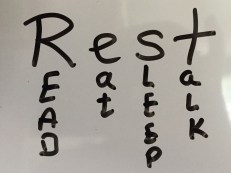
RESTWhen I put the word Rest on my kitchen whiteboard, my friend Cheryl wrote more words vertically under each letter. Pretty clever and spot on I thought. I also came up with the acronym REST G (Releasing Every Situation To God).

What I learned this year: Resting is sometimes harder for me to do than doing! Jesus is my Sabbath rest.

What was your Word for the Year? How did that go?

Click on the links below to see some of my previous years.

Word for the Year 2012 – Adventure

Word for the Year 2013 – Word

Word for the Year 2014 – Food

Word for the Year 2015 – Hike

Word for the Year 2016 – Unplugged

Word for the Year 2017 – Neighborhood

Word for the Year 2018 – Stretch

Heavenly Thoughts

From my 2009 Journal. I’m at the SIM Sebring Retirement Center. These godly old missionary saints in Florida just keep giving and giving. Some give gifts of time, others of service, some of tangible gifts. Some exude gifts of beauty and grace while others serve with gusto.

I think that whatever gifts God gives us here on earth will continue to be used in heaven to serve others. What do I have to offer though? People will have perfect knowledge and won’t need me to sit and listen for hours and pray with them. Maybe I’ll get to organize the angel wardrobes or help check in the new arrivals on the heavenly database list!

What language will we speak? The same as Adam and Eve? Will we get to meet all the people we ministered to unawares? Will we go around apologizing for all the dumb things we did and said to each other here on earth? Will we grow in knowledge? I do know that we will have the full truth that answers the need of our pain. Will we experience emotion in heaven? Will we all be smart? Wear different colors or all be dressed in white?

God’s kingdom as described in Isaiah 11 and 12 sounds perfect, glorious, fair, peaceful, delightful, comfort-filled, right, and true. I long for that kingdom now. But we must wait for it with patience. My daddy longed for it. He set his eyes on heaven in the last years of his life and didn’t want to stay here any longer. Mom, on the other hand, kept her feet firmly planted on earth and refused to look heavenward till it was time. Somewhere there’s a balance. I want to live on both planes at the same time. Yes, I long for heaven, but I must be content where I am now. The Apostle Paul felt this same conflict in his soul: Heaven is far better, but for your sakes I must stay here.

The physical world of the heavenly kingdom sounds glorious. But I can experience a taste of the spiritual realm (grace, mercy, love, peace) now, carried around like a jewel inside my heart. Heaven’s treasures and resources funnel into my heart here on earth, and I can draw on that strength any time I desire or need it.

What will it be like to meet Jesus for the first time? John the Baptist experienced Him on a physical plane—he touched Him, saw Him with his eyes, observed His works, was present for the declaration of the Father’s affirmation “This is My beloved Son; hear ye Him.” John said he wasn’t worthy to unloose Jesus’ shoelaces. We tend to brag about whom we’ve touched—people like a President, the Queen of England, famous actors or singers. What would it be like to revere someone so much that it would be an honor to touch his foot?

I feel intimate with Jesus, but on a spiritual plane, not physical. How will I respond when I see Him “in the flesh”? I have no precedent on which to base my future experience. I used to think that the second you died, you were ushered immediately into the presence of Jesus. “Absent from the body; present with the Lord” after all. Now I tend to imagine there’s a process you must go through first.

Here’s how I picture it: the angels who have been assigned to you accompany your spirit to the heavenly realm. There they offer you a drink of Living Water and give you an opportunity to bathe away your earthly impurities before they outfit you in your new pure white robes—just like Joseph had to bathe and receive clean clothes and be prepared before he could see Pharaoh. And then you’re told when your appointment is, and you’re debriefed in protocol for approaching royalty. Perhaps you’re even given a tour of your new quarters and a little view of the royal city. Perhaps you’ve even gotten to spend time with your loved ones who excitedly try to prepare you for what’s to come—your first meeting with your risen Lord. The excitement is running high. You can scarcely contain yourself.

And then the moment I’ve been waiting for—the “welcome home.” And I’m way too overwhelmed and shy to approach Him—I would not dare think of reaching out to touch His royal person. I’m flat on my face like a Nigerian villager before his chief.

But then something happens. He reaches out to me; He lifts me to my feet (“The lifter of our heads”) and embraces me, and I feel His enormous, infinite love and acceptance, and I realize in an instant how many times I failed Him on earth, how many times I responded in anger or unforgiveness or self-righteousness, and lost opportunities to serve Him. And I find myself asking for the privilege of serving Him—in any capacity—just so I get to be near Him and see Him and drink in His beauty. After all, there are millions of us up here, from every tribe and nation, and we all feel the same way—we’re all falling over each other to be near this Presence.

But He asks, “Are you willing to serve Me in the royal kitchen? In the royal nursery? As a chauffeur or greeter for newcomers? As a gardener in the kingdom? As an overseer of the mansion complex? And of course you say yes—anything for You, Jesus, and with pleasure. And the work we’re given to do will be “right down our alley.” I doubt I’ll be gardening, but I might be organizing things!

How do you picture heaven?

Witnessing a la 1970s

From my 2009 Journal. I am a witness (noun) if I’ve observed something like a murder or an accident. I take the witness (adjective) stand, and I relate what I witnessed (verb). In church circles we use the term “witness to someone” like it’s an action verb done to or toward someone. It’s always had the feeling to me of an obligation, duty, responsibility, or sin if I don’t do this activity. “Their blood is on your head” one preacher told us if you don’t use every opportunity to force your belief system onto the heathen (well, probably not his exact words, but that’s how it felt).

I think “if/when the Holy Spirit prompts me” is a better approach to sharing my faith. In my legalistic days I often lamented that I didn’t have more converts to add to my scalping belt. How horrible! Where did we get the notion that we are in any way better than someone else because our numbers are higher than theirs! What arrogance. It is not us but God who calls, woos, draws, and saves.

So what is my part then? To live a holy life and, when the Spirit prompts, open my mouth and draw people to the Light. There is no glory there for Karen. I’m just the messenger girl, the stretcher-carrier, the candle-holder.

How have your views of evangelism changed over the years?