Needing to Rest

Journal 2006

Yesterday was a test of endurance. Three people called to unload their woes on me. Then last night I didn’t know that our middle daughter was coming home to spend the night, and I could hear her rattling around the house till 2:30 a.m. At 4:30 a.m. I heard a terrific cat fight. Since K-C is an indoor cat, I didn’t think much of it, but the noise fully woke me, and I got up because I was hot. That’s when I discovered the back door was ajar and the porch light was on. The neighbor cat shot out the door leaving his sprayed male scent and fur on the floor and a terrorized K-C. For the next seven hours I tried to return to sleep without success. I was burned out from the night before, trying to get ready to teach my first class.

K-C did not last long at our house!

I think I handled the first interruption okay, worse with the second, but by the third, I just gave up and gave in. I had to quit thinking and start preparing for the class and wing it with what was left in me.

I need a Sabbath day of rest! One month with family, holidays, company, starting a new job, and driving our youngest to college leaves me with no downtime. I want to be a little bird, soaring on the wind, or a duck peacefully floating on a warm pond with the breeze ruffling my feathers. I want to be a cat, content to curl up in my mistress’s lap and go to sleep, knowing my needs will be met. I want to jump onto the highest counter to escape the world and survey the humans below. But when I do, I see the mess the world is in. Too much pain, heartache, and stress, and my world has been crazily spinning out of control, off on tangents instead of staying on its axis.

Peaches, our current feline

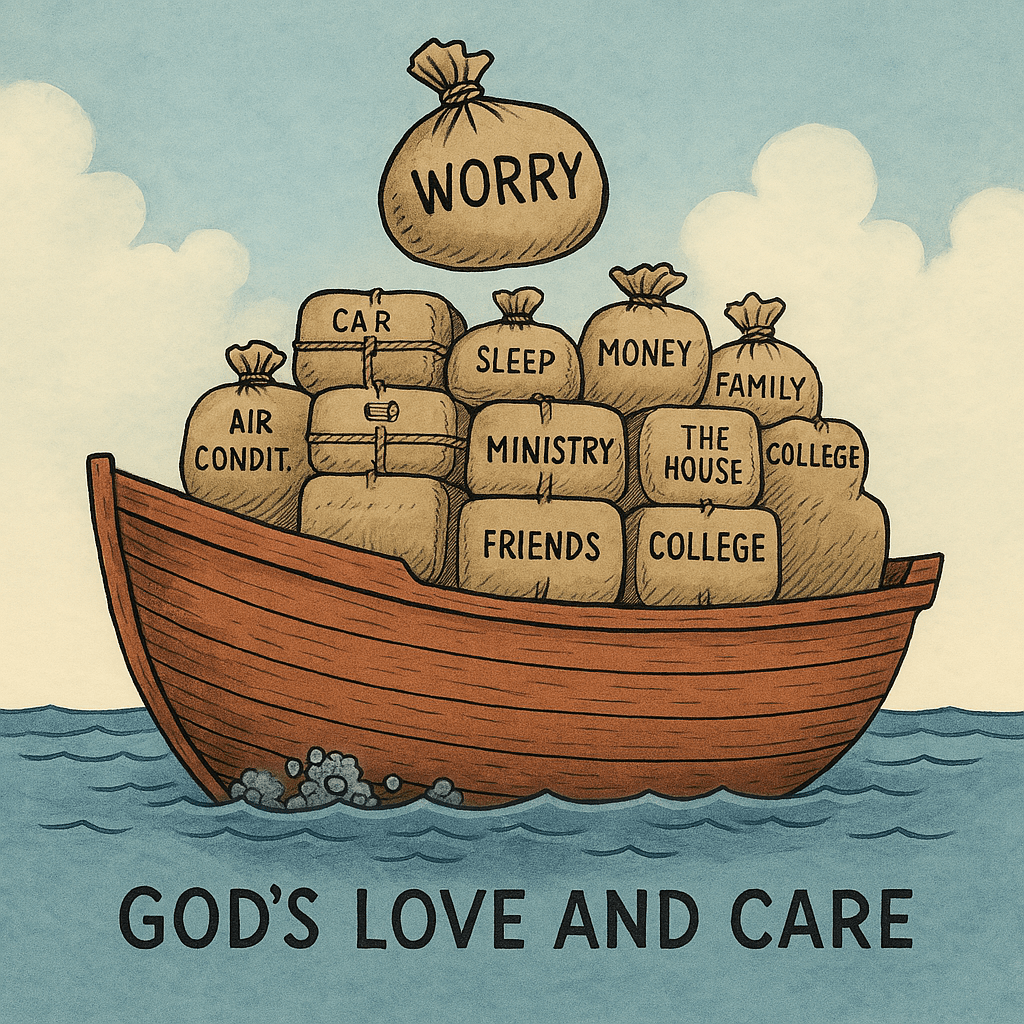
Am I crazy to take on a teaching job again? What was I thinking? But the offer dropped in my lap after I asked God to supply our needs. He’ll have to help me juggle my time. I’m through worrying about it. Meanwhile, how to get my body rested and my mind to relax … I’ve been on a treadmill for too long, and I need to get off. I’ll have to WORK at resting!

I need balance. Demands or requests for my time from other people collide with my to-do list. Are interruptions always about God’s timing? Are they sometimes Satan’s interference? How does one discern which it is? I know that people need to come before things in my priorities, but what if the “thing” is a service for someone?

When someone calls, for example, wanting prayer, do I stop what I’m doing to minister to them? Sometimes yes, sometimes no. If I’m on my way to a meeting at church and I get a phone call, do I forgo my small group time or, like last night my commitment to nursery duty, to process with this person? No, I can say a quick prayer for them and urge them to make an appointment. It’s okay to manage my time.

On the other hand, like today, I was at home preparing for my class when I got three phone calls that interrupted me—each needing a listening ear. One I gave my full attention to; the second only half-heartedly, and the third I put off till later. Should I have done that? I burned out by the end of the day. Had I rested long enough from my work to minister and pray, I might have gotten more work done.

A 2025 Update. I learned better balance from my days of imbalance. I learned that your crisis is not my emergency. I learned to listen to my body and, most of all, my emotions that drove that imbalance. It’s better to be at peace than to have to pick up the pieces.

Lessons from Moses 2

Journal 2006

In Exodus 4:11 (ESV) God said to Moses:

Who has made man’s mouth?

Who makes him mute?

Or deaf?

Or seeing?

Or blind?

Is it not I, the Lord?

These words startle me. They challenge the popular teaching that God wants everyone healed.

I’m really struggling today with my arthritis. I can tolerate the pain in my hands and feet but find it difficult to cope with the back pain and tightening muscles. I don’t want to be all-consumed with the body, yet it’s the vehicle for the soul to function. Do I just accept what’s happening, or do I seek help? Everybody I talk to has his or her pet remedy or solution. I need a diagnostic tool, but most of all, I need God’s guidance.

Can my infirmity bring more glory to Him than my healing? Is there something He wants to teach me in this situation that I could not learn another way?

AI-generated

A 2025 Update. I’m delighted to report the arthritis is gone! But that’s a story for another day.


God said to Moses, “Now go; I will help you speak and will teach you what to say” (v. 12).

When God tells me to do something, He will give me the tools to accomplish His assigned task.


In another incident, due to his wife Zipporah’s influence, Moses opposed God when he refused to circumcise his son, and God almost killed him. But the fear of losing her husband won over the distaste of the sight of blood, and Zipporah herself performed the surgery!

When God wants something done, He’ll make it happen, but how much better to cooperate with Him the first time He asks! Don’t try to out-manipulate God. He’s smarter and wiser. He’ll always win in the end.

One-Track Mind

Journal 2006

I have a one-track mind that struggles to manage multiple, simultaneous crises. At one time I aspired to become a medical doctor until I realized I didn’t have the multi-tasking skills needed for that profession. The positive side to this super-power is I can focus on a task to completion. Unfortunately, I get frustrated at interruptions, finding it hard to pull my mind away from the zone.

As I’m concentrating on a task, I’m not thinking about God. When I’m worshiping God, I find it distracting to be around people. And while I’m with people, I can’t center on my inner needs. How do I balance these areas of focus and release my feelings of worry and guilt that I’m “less than”?

So here’s my visual: With my heart in the middle, my feet perform a task, my arms reach out to minister, and my head looks up to God. When I look within, I focus on self—adjusting and changing, making goals, and removing triggers. When I look outward, I focus on relationships and the needs of others.

So, in my visual, it’s okay to be seated (feet still, no task) while I reach out to minister to others. The body is still there, whether my mind is focusing on it or not. When I watch my feet, my senses can still be alert, aware of changes in the environment that will warn me of danger. The parts are all inter-related, still in existence even if my eyes are focusing on one part only. The rest of me doesn’t go away.

So how do I find balance? Should I tithe my time? (That would mean focusing solely on God 2.4 hours in a 24-hour period or 1.6 hours if I only count waking hours). How much time should I allot to self-examination? (As much as necessary, I think, to become emotionally healthy.) If my arms are always engaged in ministry, my feet (tasks) don’t get done. If my head always faces the sky, my feet will trip. Each part must take turns. The trick is to maintain an equilibrium between the parts.

But I must not become too compartmentalized. I can focus on each in rapid succession. Micro-seconds of looking up while engaging my hands or feet will give me orientation. Checking my attitude while ministering to others is necessary. I might not be able to stop for self-care in the moment, but I certainly can take note of it and deal with it at my first opportunity.

A 2025 Update. Over time, I worked through the anger I felt at my tasks being interrupted. I find I can more quickly redirect my attention to others or return to the zone and refocus on my task without anxiety or shame. Being one-track-minded is not a character flaw.

Meltdown Day

Journal 2006

Galatians 5:19-21 lists “acts of the flesh” as “immorality, impurity, sensuality, idolatry, sorcery, enmities, strife, jealousy, outbursts of anger, disputes, dissensions, factions, envying, drunkenness, carousing, and things like these.”

I’m not too worried about drunkenness, orgies, sorcery, and idolatry. But what of selfishness? Or outbursts of anger? Or envy? Are we not all guilty of these at some point?

This is more than a list. It’s an admonition for self-examination. And so my prayer today, Lord, is for You to reveal and expose any area in my life that does not exhibit a fruit of the Spirit.

Later. That’s the quickest answer to prayer I’ve ever had! Yesterday was an emotionally draining day. It will forever be known in my mind as “Meltdown Day.”

Probably ten years ago, I got ticked off with a friend over an issue that affected me. She promised to take care of it, but she never did. Year after year, I stewed inside, waiting for her to fulfill her promise. Up to now, she’d always put up a brick wall when I brought up the subject.

Well, yesterday, the subject came up again, and I was surprised when she said she’d handle it. Now, it appeared that a little door had opened in her wall, and it felt safe to walk through it.

Wrong. She got triggered and slammed that door in my face. The why is her story, her issue. But my response was so out of character and out of line that I knew it tapped into something deep inside. I had been working through a grief issue just before this incident, and it was not finished yet. This seemed to blow it wide open.

I grabbed some Kleenex, hopped onto my bicycle, and rode to our local playground. I cried for over an hour before I started to process my anger, envy, and grief. It took another couple hours to talk it out with my friend.

Deep wounds take a long time to heal and release, I think. But why are they there in the first place? Perhaps because of our own sin. Perhaps because of other people’s sin against us. Or maybe it’s just lies we believe. Guilty. I raise my hand. Guilty.

Lord, forgive my stubborn heart.

Jesus Is the Joy of Living

Journal 2006

I have been struggling, fighting, working at getting some uninterrupted quiet time first thing in the morning. Not happening. This time is so precious to me, and when I have to give it up for whatever reason, it leaves me irritated. Why? What’s going on here, Lord? I know spiritual warfare is part of it.

I woke this morning with this childhood song in my heart: Jesus is the joy of living. But it doesn’t feel true today.

When, on this earth, will I quit struggling to keep Jesus as my joy? I get annoyed, upset, angry, peeved, frustrated, ticked off at so many stupid little things. I’m tired of it! Why can’t I just have a “poof pill”? POOF! And the anger is gone. Actually, giving up anger is the only way to make this happen, but it’s a lot of work getting to that place of peace. I’m a slow learner.

I know irritations in life are inescapable, but how I respond to them is up to me. Lord, give me peace.

A 2025 Update. I am in a different season of my life now and have more control over my schedule. Finding alone time is no longer an issue. Maybe that’s why my heart easily agrees that Jesus is the joy of living.

AI-generated

Burnout Is a Dead campfire

Journal 2006

Burnout is a dead campfire. No spark, no heat, just cold ashes. No life left to warm others. No energy to cook. Useless. It needs an outside source to reignite the wood. And rain further diminishes any chance of catching a spark. Cool and damp, I retreat to my tent.

The current image has no alternative text. The file name is: cold-rain-1.png
AI-generated

I remember my experience in Grade 6 at Camp Barakel.* One night we were scheduled to camp outdoors, but for some reason our counselor decided to forgo setting up tents. In the middle of the night, rain sent us dashing to our cabins—clothing, hair, and sleeping bags soaked. Shivering and shaking, I wrapped myself in my one dry towel for the rest of the miserable night.

I don’t know how to release the bone-chilling shivers in this memory. It reminds me of the day my dad, my brother, and I got caught in a downpour on our motorcycle on an African footpath. As soon as we reached home, Mom stoked the fire in the wood stove to heat up some water, stripped off my clothes, and plopped me into the tin bathtub. I think I’ve hated being cold ever since.

As I sit with the memories and release my anger and blame, I notice my campfire has a single flame, fed by a wick where oil flows steadily beneath it—God’s eternal supply. I venture out of my tent and savor the warmth. Perhaps I’ll have enough strength now to face tomorrow.

*I haven’t thought about this camp in years. What fun to discover it is still in existence. Camp Barakel | A Year-round Christian Camp in Northeast Michigan

Where Do I Fit?

Journal 2006

It had been an intensive week with a D.I.D. (dissociative identity disorder) client. At the end of the week she stated, “I feel so broken and shattered. What good am I? What’s the point of my life, anyhow? How can God ever use me?”

His answer came to her in a visual. “I’m going to use all your broken parts to create a beautiful mosaic.”

I may not dissociate, but like all of humanity, my life is broken in some way. The parts of my heart lie scattered on a table in a jumbled mess. I give up trying to find all the pieces of this puzzle. I need someone with more creativity, skill, and a mastermind to figure it all out. I hold just one piece in my hand right now. I don’t have the time, talent, or energy to pick up more than one piece at a time. Show me, Lord, what to do with this one piece. Keep me from cutting myself on the edges as I work with it.

I see myself wedged in sideways into the mosaic. I can only influence what I can reach—my little corner of the world. But I can see in all directions—the needs of the world. And I can pray and cheer on the other pieces. And God is making something beautiful out of my life.

Blessings and Curses—the Power of Words

Journal 2006

Why is it sometimes easier to absorb negative comments than positive ones?

When someone says something negative to me, I tend to accept the curse of their words, allow the knife’s edge to pierce my heart, and begin to believe the lie that their words are true. And then I protectively shroud my heart. But when I agree to let go of my protective cover and feel the hurt, God heals the wound, and the curse of the words dissolves. Once the curse is broken, someone may repeat those same ugly words, but this time they’ll be deflected by the shield of truth.

When someone says something positive to me, however, it’s sometimes harder for the blessing to sink in. For example, you might tell me I’m beautiful. But if I believe I’m ugly, I will deny your blessing, and it will bounce off my head and never absorb into my heart. It’s all about lies I believe.

James 3:10 (NIV) says, “Out of the same mouth come praise and cursing. My brothers and sisters, this should not be.” I am responsible for what comes out of my mouth, and I am responsible for processing what’s in my heart when it comes out of yours.

For further reflection, here are some examples of blessings and curses in the Bible.

  • God spoke a blessing after He created the earth. “This is good!” He declared. (Genesis 1:24)
  • God cursed the ground after The Fall (Genesis 3). To live under a curse is a terrible thing. Heaven will be a lifting of the curse and a return to beauty and perfection.
  • God cursed Cain as a punishment for murder (Genesis 4:11). Yet, even in the curse, God placed a mark on Cain as a way of escape. Mercy.
  • Abraham understood the power of blessings and curses.  God said to him, “I will bless you … You will be a blessing … I will bless those who bless you, and I will curse him who curses you … In you shall the families and kindred of the earth be blessed, and by you they shall bless themselves” (Genesis 12:1-3).
  • Jacob wrestled with the angel and would not let him go until the angel was willing to “declare a blessing on him” (Genesis 32). What does this mean anyway?
  • Pagan Laban said to godly Eliezer, “You are blessed of the Lord” (Genesis 24:31). He spoke true words even if he didn’t understand them.
  • The Lord blessed Potifar’s house “for Joseph’s sake; and the Lord’s blessing was on all that he had in the house and in the field” (Genesis 39:5).
  • Jesus became a curse for us. “Cursed is everyone who hangs on a tree” (Deuteronomy 21:23). If just ONE curse on our heads brings wounding, my imagination isn’t great enough to fathom the curse of the world on His shoulders. He felt all my sin, all the curses I’ve ever spoken. The world itself—that He made with His own hands—rejected Him, thrusting a giant sword through His heart. In one agonizing, painful moment He knew—He could identify with soul wounds. He never believed a lie, but He felt the curse. A terrible moment in time. But He broke the curse!
The current image has no alternative text. The file name is: image.png
I love this AI-generated photo.

Navigating Legalism

Journal 2005

Our Pastor preached through the list of kingdom qualities in Matthew’s Sermon on the Mount and asked which quality we needed to focus on. I chose “avoid judgmentalism.”

The Pharisees [hypocrites] honor Me with their lips. But their heart is far from Me. But in vain do they worship Me, teaching as doctrine the precepts of men. (Matthew 7:6)

Here’s my definition of judgmentalism based on this passage: A self-righteous attitude about how others conduct themselves—usually because I don’t do this “sin” myself. And often the “sin” in question is regarding a tradition of man rather than breaking a direct command of Scripture.

Want some examples?

  • Women were forbidden to wear pants at the college I attended.
  • Red lipstick was considered worldly in my childhood culture.
  • Going to the movie theatre was a no-no.
  • Dancing was definitely in the category of sinful behavior.
  • Modesty was defined by skirt length.

Culture has a huge impact on this discussion. What’s modest for one culture is immoral for another. I think it comes down to the attitude of my heart. I can dress like a Puritan and not have a pure heart. The other end of the continuum is harder for me to gauge. At what point do I transition from a poor heart attitude to sin? Or is it a point? Can the discussion focus on the amount of material, or should the focus be 100% on the heart?

Next, I pondered the difference between a Pharisee’s judgment and the weaker brother’s judgment (1 Corinthians 8:11). In a previous church, the pastor urged us to refrain from a particular activity (fill in the blank here), so as not to offend a weaker brother, thus causing him to sin.

The Pharisee holds his standard of righteousness for his own glory. I don’t need to change my behavior to please him. The weaker brother (one who hasn’t been taught yet) has a desire for righteousness for God’s glory, and I need to respect him.

But there’s a third category of people to consider. 1 Corinthians 10:27 says, “If one of the Unbelievers should say to you, ‘This is meat sacrificed to idols,’ don’t eat it—for the sake of the conscience of the one who informed you.” Note that this unbeliever invites you to eat with him, so this conversation is in private—not referring to a system (which is where my mind goes with my former church). So then the observation [judgment, criticism] in this passage is coming NOT from a weaker brother, but rather from an unbeliever who “knows” the Christian’s standards.

To sum it all up, 1 Corinthians 10:31 says, “Whether, then, you eat or drink, or whatever you do, do all to the glory of God.”

I cannot judge another person’s motives. I am only responsible for my own heart. I just know that I prefer hugging the mountainside over seeing how close to the cliff’s edge I can get.

A 2024 Update. Legalism with all its “shoulds” and “have-tos” had a strong hold on me for many years, but I don’t struggle with these issues anymore. God gave me a mind to ask questions and to search the Scriptures, and God’s answers have brought peace to my heart.

Peace, Joy, and Happiness

Journal 2006

There are rare few days when I wake totally at peace in my heart. Usually, I have to work through a disturbing dream or some upset emotion from the day before.

I have spent a lifetime pursuing inner peace. Even as a preschooler, I felt a restlessness that I labeled as guilt. Accepting Jesus, the Prince of Peace, as my Savior helped relieve any fear of retribution, but I continued to wrestle with negative emotions. I remember in Grade 6 doing my first Scripture word study. I looked up every verse in the Bible that contained the word peace, but that information only made me long to find more answers.

Now that I’ve finally figured out how to reach a state of peace through inner healing prayer, I wonder how peace differs from joy or happiness. Supposedly, “happy” is related to circumstances, but I’m told no one can steal my joy. Happy is an emotion. Isn’t joy an emotion too? If not, what is it? Perhaps the English language is inadequate to define these three words.

I understand peace. I’m not sure I experience as much joy or happiness. The closest I come is when I witness people hear from God and see them come to peace. That gives me great joy—but that’s also “happy” to me.

An MK (Missionary Kid) I know died yesterday. His family, surely, is not happy, but I can see them experiencing peace in the midst of the pain. Can they experience joy as well in this circumstance, as they picture him in heaven?

A 2024 Update. I am in a very different place in life since I penned those thoughts in 2006. Today I rarely wake up feeling unpeaceful. I’ve come to believe that peace and joy are the same thing—they just manifest in different energy levels. I’m generally a low-energy person emotionally, so you won’t see me wildly reacting when I’m delighted, but inside, my heart may be leaping. And happy? That’s gazing at the beauty of the sky, hearing pounding rain on a hot tin roof, tasting Ethiopian injera ba wat or savoring Lindor’s dark chocolate.

Bring on the peace, joy, and happiness!