Prayer Shame

Journal 2017

I’ve been on a journey all my life to discover the secret of prayer. When I read others’ stories, they don’t match mine. I shift between guilt (not enough) to apathy and forgetfulness, from rote to relationship, from works to worry, from self-condemnation to self-awareness.

I’m reading the biography of Rees Howells who discovered that prayers were best made when they were God-directed. For example: don’t pray for healing unless God directs me to. Yet I do pray for healing of my every ache and pain as well as for everyone in my life who is suffering. But I don’t really expect Him to heal, or I’m so surprised when He does.

Today, Lord, I want to listen, wait, and ask for what is on Your heart. I want to be a prayer warrior.

“Hmmm,” says Jesus. “What does a warrior do?”

Well, he fights—fights for truth, fights against an enemy, defends himself, defends the weak. The weapons of warfare are spiritual, not physical. I know I’m supposed to just stand once I’m fully armed. So I guess the first step is to make sure I’m fully armed. You’re faithful to point out the chinks in my armor. And I know how to stand . . .

“But . . . ?”

But I don’t know how to use words. I don’t know what to say or what to pray for.

“Then why don’t you repeat after me?”

Huh?

“Like when you learned your ABCs or the prayer I gave the disciples or The Lord Rebuke You prayer or . . .”

So it’s that simple? Repeat after You? I can do that. Okay, I’m listening.

“Dear Lord,” He begins.

Wait a minute! You’re sitting right here with me. Why do I need to address You? When I’m talking to my husband, and he’s the only one in the room, I don’t have to say his name to get his attention—unless he’s not listening of course. Do I need to start “Dear Lord” every time?

He laughs. “No, of course not,” He teases. “I was just seeing if you were paying attention.”

Very funny. Ok, try again. I’m listening.

“Hi, Karen.”

Hi, Lord.

I wait. He seems to be thinking. (God has to think? Doesn’t He always know exactly what to say?)

“Okay, repeat after Me:

            I, Karen, do solemnly swear to tell the whole truth and nothing but the truth, so help me, God.”

This is not funny! What kind of prayer is that!?

“I like honesty. I want you to tell yourself the truth as well as to Me.”

Okay, I’m all in.

“Good. Now tell Me the truth. What’s in your heart?”

Well . . . I’m worried that . . .

“Choose your words. Take your time—and be honest.”

Okay . . . I’m worried that I’ll be judged for how little I pray.

“You mean little in chronos time?”

I suppose.

“Who’s keeping track?”

I suppose I am, for one.

“And?”

And . . . I feel guilty if I neglect to pray, to ask for favors, to cover people with the prayer of protection, to intercede for their needs.

“Intercede . . . ooooh that’s a big word.”

You’re teasing me. (I’m feeling petulant.)

“What do you want, Karen?”

What do I want? What do I really want? I want a heart that is so connected and in tune with You that conversation (prayer) flows as naturally and comfortably as breathing. I want every thought I think and every breath I take to be in sync with Yours. I want our conversation to feel natural, not formal; intimate, not forced or stilted. When I pray for people, I feel like I’m straining to think up stuff to say, but I’m not always sure what to say or if that’s what their true need is. I also want to know how often I should pray for someone. Expectations are daily, and somehow if I miss a day, I believe it’s my fault if they fail or are vulnerable to Satan’s attacks. How’s that for being honest?

“That’s better. What else?”

There’s more?

“Oh, yes. Dig a little deeper.”

It’s about me, isn’t it? It’s about pride. What if someone should discover what a fraud I am? That I don’t spend x number of hours a day on my knees. Or I can’t say with sincerity, “I prayed for you today.” How would that feel? Shameful? Embarrassing? Guilty? Or, since we’re being honest here, how I look compared to so-and-so. How sick is that?

“Anything else?”

Oh, I think that’s enough shame for the moment.

“Okay, what do you want to do about it?”

Me? I thought it was Your job to lift shame and give me truth and offer something in its place.

“Why should I? I didn’t put it there!”

Then who did? Oops . . . I guess I did. Help me, Lord, please. I want to give it up. I really do. But self-shame and blame is too heavy a brick to lift by myself.

(He hands me a sledgehammer.)

I smash the brick into smaller pieces, small enough for me to carry. What to do with them, though? It seems we’re building a brick wall for some sort of dwelling. I’m not sure I understand the significance yet, but brick now feels useful—like it’s serving a purpose.

Oh! I see it now . . . I think we’re building a house of prayer. Okay . . . but still not sure about this.

“There’s more to come,” He says. “For now, let’s stop and get a bite of lunch.”

Sounds good to me!

Messy Relationships

Journal 2017

I woke up from a dream in which I felt extreme rage. My friend had rearranged all the cupboards and shelves in our bedroom, and I hated it—it was disorderly, ugly, impractical, and inconvenient. I was surprised at the vehemence I felt. Where did that come from?

I realize that these shelves reflect how my friend’s brain is organized. It’s different from mine. No wonder she has difficulty coping with life. The curious thing is why she rearranged MY shelves and cupboards. I did not give her permission to do so.

I’ve always had a strong sense of space and personal belongings. Growing up in boarding school, I owned one pencil, one pen, and one notebook, and I knew at all times where each was located. All our belongings were clearly labeled with our own names, and we understood the boundaries of personal property. The only things we traded were marbles, which were won or lost in competitions.

Order meant safety and comfort. Lack of order felt chaotic and out of control. How much of that is temperament and how much was my attempt to control my environment? My two dresser drawers were always neatly arranged because we were rewarded in the dorm for tidiness, but I seemed to gravitate toward that lifestyle anyway. My mother recalls the time that my big sister and I were instructed to set the table at home one night. In typical fashion, Grace hurriedly flung the silverware onto the table while I came behind her straightening them.

When I ask God for insight, Jesus takes me by the hand, and we fly high up into the atmosphere. “See My universe?” He says. “I like order too. The planets and atoms are all in their orbits.” Yet there’s more. Asteroids break loose and crash into the earth.

“What does all this mean?” I enquired.

“There’s a both/and.”

I scratch my head, puzzled.

“I made order. I created it. I created you (and your temperament) to have order and logic and straight lines. Yes, you function well when things are orderly. Others I fashioned more right-brained to think more creatively. They get flustered and feel boxed in when things are too lined up in a row. Do not berate yourself for how I created you.”

I knew there was a “but” coming.

“But relationships are messy. People are not robots. You can’t have a relationship with a robot. Yes, I made an orderly universe, but I also made people. People can disrupt your orderly world.”

Just then, Peaches our cat jumped onto the bed, interrupting my writing as she rubbed against my pen and demanded to be petted.

“Did you mind the interruption to your orderly thoughts?” enquired Jesus.

“No, because she made me smile. I knew it was temporary. It is relational. I can’t have relationship with a pen.”

“Exactly.”

And with that thought, my rage dissipated. I’m glad God made us all different.

Taste and Smell

Journal 2021.

If I had to lose one of my five senses, I always said I’d rather not lose my eyesight. It never occurred to me that losing taste and smell could also be so debilitating. Since I had Covid, everything smells the same, and it’s not pleasant.

“An odor pleasing to the Lord” is stated five times in Numbers 15. Of course this phrase catches my eye. I may not be able to smell, but God can. And I want my attitude, thoughts, and deeds to be a pleasing odor in His nostrils.

But I need some help with this. I’m still trying to quit complaining about my loss. I have an appointment with food three times a day, and three times a day I have to face the loss of sensory pleasure. Does giving up hope jinx it? If I give up hope, am I doomed because my mind will no longer have positive energy? We teach clients they may need to give up, or let go of, the hope that their dad will ever love them. What does letting go look like for me?

VISUAL: I’m tied to one end of a rope, and the taste of food is on the other end. As long as I hold onto my end, I’m not free to explore other things. Letting go doesn’t mean I don’t ever eat again. It means I let go of the pleasure, the drug.

And so, I let the rope drop, and it retracts into the food. The flavors are still there, in the food; they’re just not tied to me anymore. They don’t belong to me and therefore have no power over me. Thank You, Lord. Now I can pick up the food and examine it—see it, feel its texture, and experience it as I am able to sense it. It is what it is.

Responsibility

Journal 2005

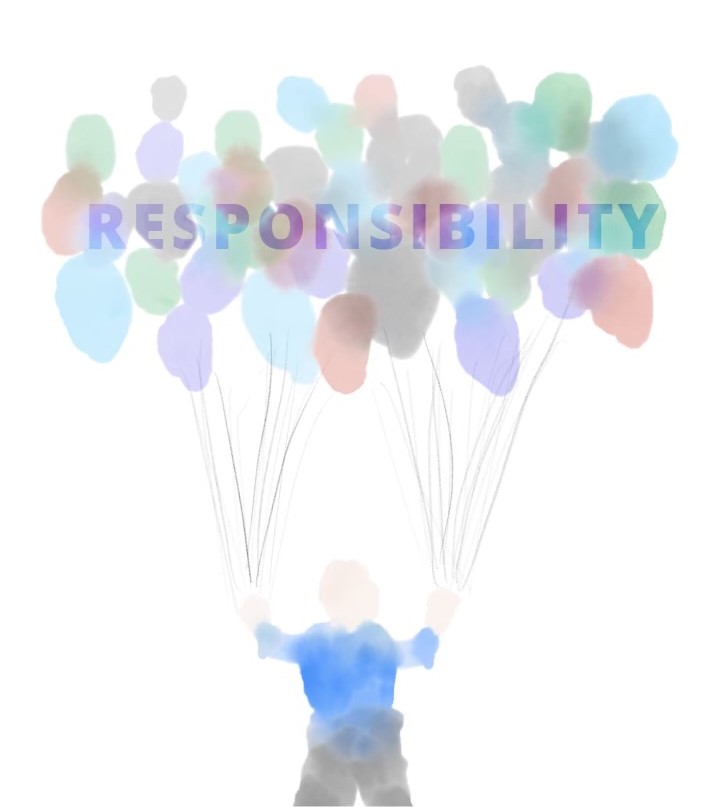
I have a long list of worries I need to shed NOW! The word responsibility is a balloon banner over my head with strings attached to each of my concerns. With hands cramping from their tight grip, occasionally one string escapes my grasp, and I scramble to grab it without letting go of the others. If I let them all go, does this mean I’m not a responsible person?

But near burnout, I wish I could let them all go. I want to be a kid again where I’m free to explore, and my meals miraculously appear on the table, and play is my most serious activity.

Suddenly the wind catches the balloons, and up, up, up, into the air I go. But now I’m in trouble if let go. My muscles are burning. I want off this ride!

“Look up,” says Jesus. I see He’s holding the responsibility banner, and I’m on a puppet stage. He’s responsible for the “responsible.” That takes the pressure off decision-making, but I’m still not satisfied. He created me with free will, and I don’t want to be a puppet. I don’t want His job as director of the play, nor can I be in the audience. What am I supposed to do?

“Let go of the strings,” He says. Willing to surrender at last, I unclench my fists and drop my arms. I do not fall. I do not collapse. I let go of worry and make life-giving choices.

Rest. Peace.

Thanks to my son-in-law Josh for the graphic.

Judgment or Discernment?

Journal 2005

I’ve been working through how to recognize the difference between God’s standard and men’s standard of conduct. For example, I came out of a system that taught it was a sin for a woman to wear pants, and though I threw that false belief out years ago, I wonder about wearing skimpy clothing. A judgmental attitude (which I’m prone to have) is a self-righteous attitude about how others conduct themselves—usually because I don’t do it myself. And often the item or “sin” in question reflects a tradition of man rather than breaking a direct command of Scripture. Discernment, on the other hand, involves understanding the intent of a command in Scripture and applying it to myself.

One’s choice of dress falls on a continuum: from a Middle Eastern burka all the way to public nudity. What’s modest for one culture may be immoral for another.* I’m sure my upbringing in an African village impacts my confusion. Does God’s Word dictate standards of dress, or does God look only on the heart? (I can dress like a Puritan and not have a pure heart.) The other end of the continuum is harder for me to gauge. At what point does my dress choice cross into sin? Can the discussion focus on the amount of material, or should the focus be 100% on the heart?

Or what about my media viewing choices? Is there a point at which what I watch becomes sin? Or is it all about the condition of the heart? I cannot judge another’s motives, but personally, I’d prefer wholesome rather than on-the-edge. Better to hug the mountain side than the cliff side in these gray areas.

*Funny story from Stormy Omartian’s book The Power of the Praying Woman. Seems an offended missionary decided he should supply the topless natives with t-shirts. The next day the ladies showed up at church proudly wearing their new garb—with holes cut out for their breasts (so they could nurse of course). Made perfect sense to me!

2023 Update. I must have worked through these questions sufficiently as I have no emotion today when the subject comes up. I know now that I am not responsible for anyone’s heart but my own, and I can trust God to convict me when needed and guide me into all truth.

On Hatred

Journal 2005

At my missionary boarding school, I was taught it was a sin to hate. Therefore, if we hated someone, we’d piously say, “Oh, I don’t hate her; I just strongly dislike her!” As if we didn’t say the words, we were not guilty of the deed.

This week the Spirit of God confronted my self-righteousness with a memory where I carried hatred in my heart. As I released that emotion, years of bondage slipped away, and I felt free. Nobody but Jesus knew that sin was there. And nobody but Jesus and the person who prayed with me for deliverance knows it’s gone. But will others sense a change in me? I don’t know. I feel the change, and I know that something is different.

The Lord Is Not My Shepherd

Journal 2005

David thought in word pictures based on his experiences, so Psalm 23 made sense to him. But it’s hard to put myself in his sandals, for I’m not a sheep-tender. I love the imagery, and I know it’s scriptural, but the concept of “The Lord is my shepherd” doesn’t touch my soul.

I am a tree-lover. Inside the fence of our African compound, my missionary dad planted a variety of tropical fruit trees for food and a thousand neem trees for firewood. Just outside our property, a stately kuka (baobab) tree called my name, and further into the bush grew other exotic fruit for tasting and flowering trees for climbing. As a child, I made it my mission to try them all.

And so, I write my own poem.
The Lord is my Living Baobab Tree.

He wraps His massive branches around my slender frame.

I hide myself in the crook of His arm.

He is my place of peace and solitude and a gathering place for social encounters.

I view the world differently from Your height.

I soar in Your high branches and rock comfortably on your lower ones.

I might itch when I touch your pods, but the inside fruit tingles sweet-sour on my tongue.

You reveal Your secrets as I spend time in You.

You spread Your cool leaves above me and shelter me from sun and rain.

You invite me to climb, but I can never attain the topmost branches.

You are too lofty for me.

I want to dwell in Your branches forever.

I run to you when I feel pain or pleasure.

I run barefoot to Your roots and climb into Your lap, content.

You restore my soul.

Is God more than a shepherd or a tree? Of course. But the symbolism focuses on the senses. Can I taste God?  (“Oh taste and see that the Lord is good.”) Can I hear His rustling branches in the Spirit’s wind? Can I smell Him in the dampness of the roots of the earth? Or the odor of rain as it cleanses the dusty leaves? Can I touch Him? When I touch the unlovely, the poor, the prisoner, the orphan child, I touch the face of God. I can’t see Him with physical eyes, but I can see His handiwork, and I get to know the heart of the artist. I see His creativity, His passion, His bigness, His attention to detail, His order, His comfortableness with chaos. I sense His emotion in the fury of the hurricane as well as the gentle caress of whispered breeze on my cheek.

A 2022 Update. One day, while trying to still my heart on a hiking trail bench, the Lord said to me, “Be a tree.” I want to be an oak tree—stable and strong, where many can come and rest in my branches. Some of my leaves become diseased when outside forces ruin their beauty, but it’s okay for the bad parts to fall off so new growth can replace them. I want to feed the squirrels and provide shade for the tired and weary. And I want my branches to whisper, “Jesus loves you. God is here. Come and find peace.” He’s the invisible sap, the life inside me, flowing from root to healthy branch.

The Lord was David’s shepherd, but He’s my tree, and I want to be like Him.

“One that would have the fruit must climb the tree.”
1980. Revisiting what was left of my old, beloved baobab.

Thunderstorms Over Your Head

Journal 2005

Being in the presence of people in a bad mood is like standing under their rain cloud. It’s their choice to stay there getting drenched, and it’s their choice to grumble and complain because they’re cold and miserable. But what is that to me? I prefer not to get wet (or worse, struck by lightning), and the easiest solution is to just walk away.

But what if I want to help that person? Or what if I’m in a love relationship and choose not to retreat? Am I willing to get wet? Take the chance of getting zapped?

Jesus says: “I am in the eye of the storm. Rest there with Me.” And the swirling wind about me will move people’s rain away so that I can be near them. I don’t have to be affected by their weather patterns.

Lord, keep me in the center of You.

On the Edge of a Cliff

Journal 2005

Going for an Oral Interpretation major in college, I once performed a reading with a powerful visual about standing atop a cliff, desperately trying to stop people from going over the edge (presumably to hell). The point was to urge believers to evangelize. I even know one missionary who went overseas because of this visual. But all I ever felt was guilt, helplessness, and powerlessness.

As I sit with my emotions, I notice there are danger signs at the edge of the cliff. In fact, there are warning signs before the danger signs. I’m praying desperately for people to open their eyes and take notice, and if I take my eyes off the scene, I’ll miss someone. Still I feel helpless. I have to DO something. If I sit down to rest, I’ll get stampeded! Where do responsibility and trust intersect?

Jesus says, “Back away from the edge of the cliff, find a bench, sit there and wait. Offer cold drinks and sandwiches to the weary travelers. Invite; don’t panic. Invite them to rest with me and talk. Tell them about the cliff and encourage them to share the news with the other travelers on their path. And if while I’m talking to one, and another passes by, I can just wave and smile. And if I need to sleep for a while, I can ask Jesus (or an angel) to tap me on the shoulder when I need to wake up and pay attention. Whew! That feels better.

Negative Energy

Journal 2005. I am an introvert who knows I need people, but some people emit negative energy like a giant, pulsating sore thumb, throbbing like a plucked low bass guitar string.

I remember a former classmate whose aura left little barbs, fingers of electric shock that kept poking and jabbing me.

When I asked for God’s help, He gave me an enveloping coat of Teflon—not to keep the person out, but so I could get close to the person without getting zapped. The droning noise got mingled with a heavenly symphony of praise, and together we looked and listened for other sounds around us. I guess I needed another focus other than myself.

Photo by Pixabay on Pexels.com