The Potter’s Right

Journal 2006

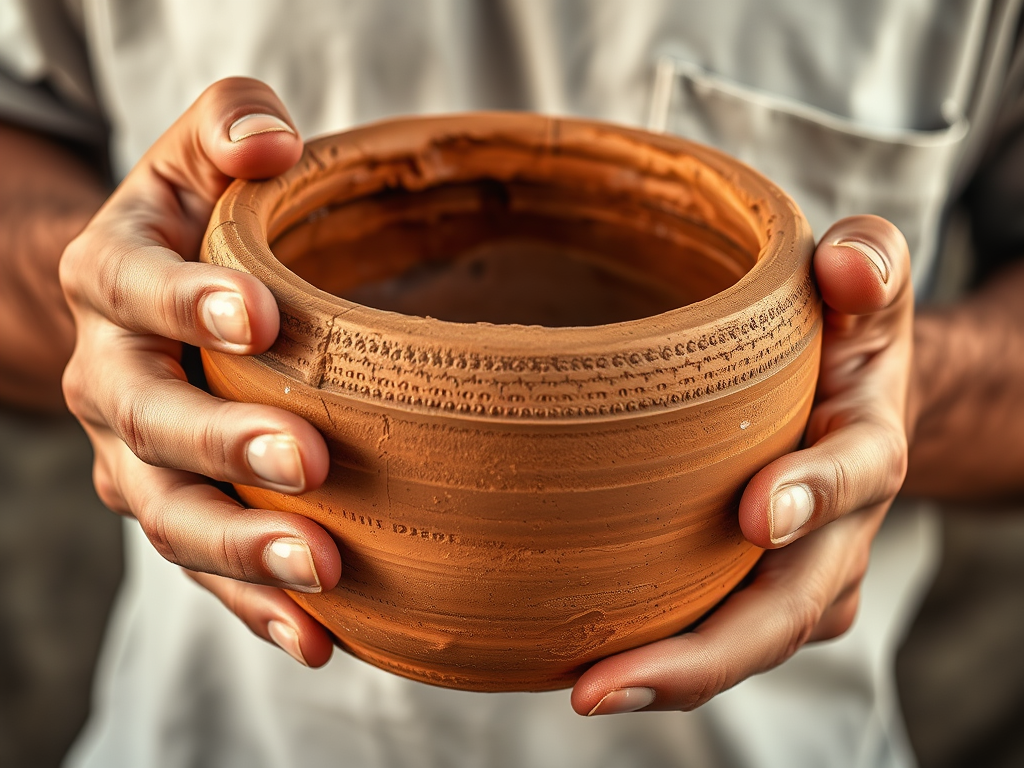
Has the potter no right over the clay, to make out of the same mass (lump) one vessel for beauty and distinction and honorable use, and another for menial or ignoble and dishonorable use? (Romans 9:21 AMPL)

The correct response to this question is yes, of course, the potter (in this context, God) has this right. But if you’re like me, you might struggle with accepting it. If I have given God the right to my life, am I willing to be a Ming vase with all its beauty and value? A cooking vessel that takes a lot of heat? Or a serviceable, smelly chamber pot?

And so, I ponder what kind of pottery He created me to be. I think He’s chosen me to be a water vessel—a practical, no frills, serviceable carrier of Living Water to those who are thirsty. Sometimes it’s a heavy load to bear—until I realize I’m not the one who’s supposed to transport it. My shape and size are created for the task He’s given me. All I need to do is be faithful. Daily. Hourly. And if He chooses to form my sister into a Ming vase or my friend into a chamber pot, that is His business. He knows what every person should be—all for His glory and purpose.

What kind of vessel do you think He made you? Are you at peace with His choice?

AI-generated

Created in God’s Image

Journal 2006

God created man in His own image, in the image and likeness of God He created him: male and female He created them. (Genesis 1:27 AMP)

What, exactly, is God’s “image”? I know what the theologians say, but the word trips me up. By definition, image implies something visible. Yet God is not visible—or is He? God is a spirit, yet Jesus now has a glorified body. Could it be possible for God the Father or His Son to have an essence that resembles Adam? What form did He have before the reincarnation? Is it possible that God possessed shape and form (like a man) only on a grand scale (like we’re miniatures in comparison) but that His spirit was as large as (or larger than) the universe. Maybe His spirit is His aura or His energy field.

And isn’t it interesting that God created two people rather than three? God is three in one, and in a sense, so is man (body/soul/spirit). Yet it takes two (male and female) to procreate. God doesn’t procreate Himself, but He has both male and female characteristics. What a mystery!

Photo by billow926 on Pexels.com

Lessons from Moses 3

Journal 2006

Moses’ Prayer

After Moses finally agreed to obey God, return to Egypt, and ask Pharaoh to let God’s people go, Pharaoh refused and made things worse for the Israelites. And Moses began to whine to God:

WHY have You dealt evil to this people?

WHY did You ever send me?

YOU haven’t delivered your people at all.

If God commands, and I obey, and things get worse before they get better, this is normal. Perseverance, endurance, and overcoming all require faith—especially when it gets darker.

When I’m in pain or distress, it’s hard to hear the Lord’s voice. Often my first response is to blame God for my predicament. After all, He’s the King of the Universe, capable of stopping it. But when I’m angry or belligerent, God rarely answers the question “Why?” Instead, He defends His character. “You are ignorant, O foolish man. I am the all-knowing. You don’t know what you’re talking about.”

I pray that in my hour of trial I will be an overcomer and remain faithful and not accuse Him of withholding His love. I feel so weak. It’s easy to trust God when there’s food on the table and my health is good.

Moses’ Anger

I wonder what ticked off Moses. Was he taking on the burdens of the people he was supposed to free? Was he mad that Pharoah wouldn’t heed his warning or obey his bidding? God doesn’t tell Moses His whole plan. He only reveals one plague at a time, and each time Moses probably thinks, “Okay. NOW he’ll let us go.” Did Moses take on the responsibility of making Pharoah budge? And when he wouldn’t, did it make him mad? I can sure identify with that! I’d like to see a few people budge!

So how do I respond when I don’t get my way? Can I trust that God has the situation under control? That He can move in the hearts of men to accomplish His will?

Moses’ Worry

God gave Moses a huge responsibility: lead a million people through a desert with no water, no food, and only armed with a memory full of miracle experiences. Everyone who had a problem came to him for a solution. What a heavy burden! Did God give him daily advice? Or did He only speak at the big crunch times?

Where do I turn when the tough times come? I can work hard to build my resources and slip backward. I can sit back and not work yet move forward. I could lose my health, my home, or my livelihood without warning. Is God on the throne if a tornado wipes us out? If the breadwinner dies?

When it happens to someone else, it’s just a story. When it happens to me . . .

Worry is a large, tangled ball of string with fear at its core. How do I get through that energy field of worry, through the tightly woven string ball to face my fear and replace it with peace?

AI-generated

Lessons from Moses 2

Journal 2006

In Exodus 4:11 (ESV) God said to Moses:

Who has made man’s mouth?

Who makes him mute?

Or deaf?

Or seeing?

Or blind?

Is it not I, the Lord?

These words startle me. They challenge the popular teaching that God wants everyone healed.

I’m really struggling today with my arthritis. I can tolerate the pain in my hands and feet but find it difficult to cope with the back pain and tightening muscles. I don’t want to be all-consumed with the body, yet it’s the vehicle for the soul to function. Do I just accept what’s happening, or do I seek help? Everybody I talk to has his or her pet remedy or solution. I need a diagnostic tool, but most of all, I need God’s guidance.

Can my infirmity bring more glory to Him than my healing? Is there something He wants to teach me in this situation that I could not learn another way?

AI-generated

A 2025 Update. I’m delighted to report the arthritis is gone! But that’s a story for another day.


God said to Moses, “Now go; I will help you speak and will teach you what to say” (v. 12).

When God tells me to do something, He will give me the tools to accomplish His assigned task.


In another incident, due to his wife Zipporah’s influence, Moses opposed God when he refused to circumcise his son, and God almost killed him. But the fear of losing her husband won over the distaste of the sight of blood, and Zipporah herself performed the surgery!

When God wants something done, He’ll make it happen, but how much better to cooperate with Him the first time He asks! Don’t try to out-manipulate God. He’s smarter and wiser. He’ll always win in the end.

Lessons from Moses 1

Journal 2006

Moses murdered an Egyptian. After the deed, he felt fear—fear of being found out. I wonder how he felt when the words, “Thou shalt not kill” appeared on the tablets of stone. Did he feel guilt? Remorse?

Sometimes I’m more concerned about being discovered than repenting of my sin. Words I’ve said in anger behind someone’s back leave me unrepentant till I’m found out by the one I slandered. Shame at my misdeed leads me to repentance.

I wonder if God’s original plan was for Moses to release the Israelites from bondage while he was still serving in Pharoah’s court. Perhaps the murder incident delayed God’s plan while He worked on Moses’ character.

God’s plan cannot be thwarted by man’s plan, but man can sure mess up God’s best or original plan! God lets us go our way until we see the error of our ways, and then He creatively works “all things for good.”

I wonder what difference it would make to our beliefs if we could see all the choices and various paths we could take in life. Would we believe sooner? Be more cautious of our words? Choose any more wisely? Every choice we make in life—every single step, word, or deed impacts us, the world, and others forever.

For example, if on Tuesday at 9 a.m. I choose to go to the grocery store, and I see a child being verbally abused by his mother, my simple smile could be the moment that freezes kindness and encouragement into that child’s life. And forty years later, God may bring that memory back to him and give him a safe place in his mind to start the healing process. Sound far-fetched? I don’t think so. If God ordained this event from the foundation of the world, and He is the One who prompts me to get groceries at 9 a.m. instead of at 10 a.m., then His plan is fulfilled.

AI-generated

But what if Satan sends a phone call that delays me by two minutes, and I miss this little encounter? Is God’s plan thwarted? I don’t think so. Perhaps He’ll send another person. Perhaps He’ll delay the mother too. Check. Checkmate. God wins!

Another checkmate example. When Moses argues with God that he’s incapable of doing what God asks, Moses gets his way—he doesn’t have to speak before Pharoah. But God gets His way when He chooses an alternate spokesperson: his brother Aaron.

Has my doubt or denial or stubbornness ever thwarted God’s best for me? Yes. But He still gets His will accomplished even though I may lose out on the best plan for me. Why is man’s heart so unbelieving? I piously think, given the circumstances, I would have been a Joshua or a Caleb or a Joseph or a Mary or an Esther. But in reality, I’m probably more like Moses.

Meltdown Day

Journal 2006

Galatians 5:19-21 lists “acts of the flesh” as “immorality, impurity, sensuality, idolatry, sorcery, enmities, strife, jealousy, outbursts of anger, disputes, dissensions, factions, envying, drunkenness, carousing, and things like these.”

I’m not too worried about drunkenness, orgies, sorcery, and idolatry. But what of selfishness? Or outbursts of anger? Or envy? Are we not all guilty of these at some point?

This is more than a list. It’s an admonition for self-examination. And so my prayer today, Lord, is for You to reveal and expose any area in my life that does not exhibit a fruit of the Spirit.

Later. That’s the quickest answer to prayer I’ve ever had! Yesterday was an emotionally draining day. It will forever be known in my mind as “Meltdown Day.”

Probably ten years ago, I got ticked off with a friend over an issue that affected me. She promised to take care of it, but she never did. Year after year, I stewed inside, waiting for her to fulfill her promise. Up to now, she’d always put up a brick wall when I brought up the subject.

Well, yesterday, the subject came up again, and I was surprised when she said she’d handle it. Now, it appeared that a little door had opened in her wall, and it felt safe to walk through it.

Wrong. She got triggered and slammed that door in my face. The why is her story, her issue. But my response was so out of character and out of line that I knew it tapped into something deep inside. I had been working through a grief issue just before this incident, and it was not finished yet. This seemed to blow it wide open.

I grabbed some Kleenex, hopped onto my bicycle, and rode to our local playground. I cried for over an hour before I started to process my anger, envy, and grief. It took another couple hours to talk it out with my friend.

Deep wounds take a long time to heal and release, I think. But why are they there in the first place? Perhaps because of our own sin. Perhaps because of other people’s sin against us. Or maybe it’s just lies we believe. Guilty. I raise my hand. Guilty.

Lord, forgive my stubborn heart.

Blessings and Curses—the Power of Words

Journal 2006

Why is it sometimes easier to absorb negative comments than positive ones?

When someone says something negative to me, I tend to accept the curse of their words, allow the knife’s edge to pierce my heart, and begin to believe the lie that their words are true. And then I protectively shroud my heart. But when I agree to let go of my protective cover and feel the hurt, God heals the wound, and the curse of the words dissolves. Once the curse is broken, someone may repeat those same ugly words, but this time they’ll be deflected by the shield of truth.

When someone says something positive to me, however, it’s sometimes harder for the blessing to sink in. For example, you might tell me I’m beautiful. But if I believe I’m ugly, I will deny your blessing, and it will bounce off my head and never absorb into my heart. It’s all about lies I believe.

James 3:10 (NIV) says, “Out of the same mouth come praise and cursing. My brothers and sisters, this should not be.” I am responsible for what comes out of my mouth, and I am responsible for processing what’s in my heart when it comes out of yours.

For further reflection, here are some examples of blessings and curses in the Bible.

  • God spoke a blessing after He created the earth. “This is good!” He declared. (Genesis 1:24)
  • God cursed the ground after The Fall (Genesis 3). To live under a curse is a terrible thing. Heaven will be a lifting of the curse and a return to beauty and perfection.
  • God cursed Cain as a punishment for murder (Genesis 4:11). Yet, even in the curse, God placed a mark on Cain as a way of escape. Mercy.
  • Abraham understood the power of blessings and curses.  God said to him, “I will bless you … You will be a blessing … I will bless those who bless you, and I will curse him who curses you … In you shall the families and kindred of the earth be blessed, and by you they shall bless themselves” (Genesis 12:1-3).
  • Jacob wrestled with the angel and would not let him go until the angel was willing to “declare a blessing on him” (Genesis 32). What does this mean anyway?
  • Pagan Laban said to godly Eliezer, “You are blessed of the Lord” (Genesis 24:31). He spoke true words even if he didn’t understand them.
  • The Lord blessed Potifar’s house “for Joseph’s sake; and the Lord’s blessing was on all that he had in the house and in the field” (Genesis 39:5).
  • Jesus became a curse for us. “Cursed is everyone who hangs on a tree” (Deuteronomy 21:23). If just ONE curse on our heads brings wounding, my imagination isn’t great enough to fathom the curse of the world on His shoulders. He felt all my sin, all the curses I’ve ever spoken. The world itself—that He made with His own hands—rejected Him, thrusting a giant sword through His heart. In one agonizing, painful moment He knew—He could identify with soul wounds. He never believed a lie, but He felt the curse. A terrible moment in time. But He broke the curse!
The current image has no alternative text. The file name is: image.png
I love this AI-generated photo.

What Does It Mean to Follow?

Journal 2006

“Anyone who does not carry his cross and follow Me cannot be my disciple” (Luke 14:27).

What does following mean exactly?

It’s walking behind Someone on a footpath. When you come to a fork in the road—a crisis like death or illness or disaster—you continue to stay behind the Leader, not stray off the path or choose another fork. It’s trusting that the One you follow knows the way through the wilderness.

John 12:26 says, “If any of you wants to serve Me, then follow Me.”

What does it mean to serve? Is that the same as following?

When Jesus washed the disciples’ feet, He said, “What I’ve done, you do.” Did He mean that we should have foot-washing ceremonies? I serve my family by cooking for them, cleaning the house, running the household. But it’s more than that. Serving others is a heart attitude.

When I serve others, I’m following Jesus. When I follow Him, I will serve others.

A 2024 Update. When I first began meeting with clients for inner healing prayer, I was appalled to learn that some of them believed that serving others meant self-abasement, self-neglect, or laying themselves down as a rug to be trampled. But lying on the pathway renders them incapable of following the Leader. Fortunately, God is patient. He will allow us to stay there until we cry out to Him for help. Once we can stand, we can follow Him.

Navigating Legalism

Journal 2005

Our Pastor preached through the list of kingdom qualities in Matthew’s Sermon on the Mount and asked which quality we needed to focus on. I chose “avoid judgmentalism.”

The Pharisees [hypocrites] honor Me with their lips. But their heart is far from Me. But in vain do they worship Me, teaching as doctrine the precepts of men. (Matthew 7:6)

Here’s my definition of judgmentalism based on this passage: A self-righteous attitude about how others conduct themselves—usually because I don’t do this “sin” myself. And often the “sin” in question is regarding a tradition of man rather than breaking a direct command of Scripture.

Want some examples?

  • Women were forbidden to wear pants at the college I attended.
  • Red lipstick was considered worldly in my childhood culture.
  • Going to the movie theatre was a no-no.
  • Dancing was definitely in the category of sinful behavior.
  • Modesty was defined by skirt length.

Culture has a huge impact on this discussion. What’s modest for one culture is immoral for another. I think it comes down to the attitude of my heart. I can dress like a Puritan and not have a pure heart. The other end of the continuum is harder for me to gauge. At what point do I transition from a poor heart attitude to sin? Or is it a point? Can the discussion focus on the amount of material, or should the focus be 100% on the heart?

Next, I pondered the difference between a Pharisee’s judgment and the weaker brother’s judgment (1 Corinthians 8:11). In a previous church, the pastor urged us to refrain from a particular activity (fill in the blank here), so as not to offend a weaker brother, thus causing him to sin.

The Pharisee holds his standard of righteousness for his own glory. I don’t need to change my behavior to please him. The weaker brother (one who hasn’t been taught yet) has a desire for righteousness for God’s glory, and I need to respect him.

But there’s a third category of people to consider. 1 Corinthians 10:27 says, “If one of the Unbelievers should say to you, ‘This is meat sacrificed to idols,’ don’t eat it—for the sake of the conscience of the one who informed you.” Note that this unbeliever invites you to eat with him, so this conversation is in private—not referring to a system (which is where my mind goes with my former church). So then the observation [judgment, criticism] in this passage is coming NOT from a weaker brother, but rather from an unbeliever who “knows” the Christian’s standards.

To sum it all up, 1 Corinthians 10:31 says, “Whether, then, you eat or drink, or whatever you do, do all to the glory of God.”

I cannot judge another person’s motives. I am only responsible for my own heart. I just know that I prefer hugging the mountainside over seeing how close to the cliff’s edge I can get.

A 2024 Update. Legalism with all its “shoulds” and “have-tos” had a strong hold on me for many years, but I don’t struggle with these issues anymore. God gave me a mind to ask questions and to search the Scriptures, and God’s answers have brought peace to my heart.

Keeping the Sabbath

Journal 2016

I grew up under the teaching that as Gentile Christians, we were commanded to “keep the Sabbath day holy.” Never mind that our instructors mistakenly called Sunday “the Sabbath” or that, as I believe, we are no longer under the Law of Moses.

The Mosaic Law spelled out some parameters for Sabbath or Shabbat observance: no fires, no cooking, no traveling. The Pharisees took the Law a little further and defined the Sabbath according to what activities and to what extent they thought were or were not permissible as per their own definitions. In 39 categories, the Talmud defined work as “any activity that creates or that exercises control or dominion over one’s environment.” These included baking, making garments, making leather, and building structures. Today their Sabbath legalism extends to not pushing the buttons on an elevator or turning on electric lights.

Reform Judaism says, “One should avoid one’s normal occupation or profession on Shabbat whenever possible and engage only in those types of activities that enhance the joy, rest, and holiness of the day.” According to this definition, if I were to “keep the Sabbath,” my normal activities would be housework, computer work, and the business end of ministry. It would not preclude ministry itself according to Jesus’ example. He preached and healed all week long. You’d think He’d refrain on the seventh day and take this day off from “work.” But apparently His work wasn’t classified as labor.

Jewish law prohibits work, but it isn’t the same definition as our English word for work. The word Shabbat literally means “to cease” or “to sit.” While resting is implied, it’s not the meaning of the word. God created for six days, and then He ceased. He didn’t need to rest. I may not be Jewish, and yes, Jesus is my Sabbath rest, but I do need to “cease” on a regular basis. I need the change of pace, the chance to recoup, refresh, and recharge my body, mind, and soul.

So . . . generally, once a week, I turn off my computer, refrain from cleaning house, and occupy myself with things I enjoy doing—guilt-free, such as reading, doing a puzzle, or golfing with my husband (after church of course!)

What does “ceasing” look like for you?