From my 2009 Journal. Do we have any rules we need to abide by as believers? Moses’ Law says “Don’t murder.” Jesus says it’s what’s in your heart that’s important. Is “don’t hate” a rule? I suppose you could say that. Rules generally govern actions, and hatred is not an action (unless it’s acted upon). But if you take care of the attitude (hatred) in your heart, you’ll have no temptation to do the action (murder).
We usually judge a person’s actions, though I have to say I’m guilty of judging a person’s heart based on their actions. I wouldn’t know what’s in their heart if I didn’t see their action.
Romans 14 refers to religious activity: eating meat offered to idols and special observances of days. I have freedom, Paul says, to eat meat or not eat meat, to observe a day “unto the Lord” or not. It’s not the action that pleases God, but the attitude of the heart. Are you doing it out of obedience to your conscience or out of disobedience? Are you doing it with a grateful heart? If you do it but aren’t thankful, what good is it?
Bottom line: don’t judge someone else’s religious activities (assuming they are believers) and don’t put an obstacle or stumbling block in another person’s way. Verse 14 says food offered to idols in and of itself is not unclean. But if in your heart you believe it’s unclean, then to you it is. Don’t do it!
GUILT is like treading on a sandy beach leaving visible footprints. SHAME tries to smooth sand over the prints, but as you walk away, you create more footprints.
GRACE is God sending His wind (the Holy Spirit) and blowing across the sand, erasing all the prints. And even if you fail again, the wind continues to blow.
But how much better to scramble up onto a rock where no footprints can imprint, and no guilt and shame exist.
At my missionary boarding school, I was taught it was a sin to hate. Therefore, if we hated someone, we’d piously say, “Oh, I don’t hate her; I just strongly dislike her!” As if we didn’t say the words, we were not guilty of the deed.
This week the Spirit of God confronted my self-righteousness with a memory where I carried hatred in my heart. As I released that emotion, years of bondage slipped away, and I felt free. Nobody but Jesus knew that sin was there. And nobody but Jesus and the person who prayed with me for deliverance knows it’s gone. But will others sense a change in me? I don’t know. I feel the change, and I know that something is different.
I was reared in a small African village without the basics of running water, electricity, or flush toilets and, thus, no TV or movies. I remember as a first grader on furlough being mesmerized by black-and-white cartoons flashing across the screen of my Grandpa Peterson’s small TV set, and then again four years later, on our next furlough, unable to unglue my eyes from this novelty.
I struggle to navigate parenthood without experiential knowledge in monitoring entertainment. What makes a good story great? What details make it acceptable? What scenes are suitable for my children to watch? What images will leave them with nightmares and fears? At what age do I allow exposure to realistic scenes? When is violence and sexual content and adult language appropriate and for what audience? I don’t think I can predict what that limit is . . . until it’s too late. These decisions for my children are messy ones for each stage of their growth. How can I be wise, balanced, and sensitive to their needs? How can I push back against the culture?
Unfortunately, some children experience far too much reality for their age; others are exposed to it by their peers. How long can I or should I shelter their innocence? Information, should they desire to gain access, is readily available but, as a parent, I have a responsibility to guide them.
Sometimes I learn more truth through other people’s processing than I do through my own. Yesterday, while praying with a client over the phone, God answered a question for her that answered a question for me: If we have the Holy Spirit, why do we need the Bible? And if we have the Bible, why do we need the Holy Spirit?
Now, I could have given her a plausible explanation that would have satisfied me. However, it made the most sense to her when she visualized a classroom. We need both the Teacher and the textbook. A student gets information from the text—facts, history, stories, and even poetry, but she has a relationship with the Teacher. The Teacher asks and answers questions about the text; He explains, expands, and embellishes it. And how does He know so much about the textbook? He’s the author!
Lynda Graybeal, administrator of Renovare (www.renovare.org) suggests we need a “balanced vision” of 6 streams or dimensions of the Christian life (Conversations, Vol 3:1, p. 52). Though I was reared in one particular stream, I have dipped my toes in each of these tributaries and found grace in each of them. All make up the body of Christ. All have partial truth. All can learn from the others.
Contemplative – The prayer-filled life
Holiness – The virtuous life
Charismatic – The Spirit-empowered life
Social Justice – The compassionate life
Evangelical – The Word-centered life
Incarnational – The sacramental life
Which stream refreshes you the most? Which one challenges you?
My eyes are continually toward the Lord… (Ps. 25:15)
Sometimes I look at the back of Your head as You say, “Follow Me down this path.” Sometimes I look into Your eyes, and I see tender love and compassion. Sometimes I look sideways toward You—for companionship and fellowship. Other times I look up at You like an expectant child looking toward her father—waiting for the surprise, the delight, the gift, the promised reward. It’s hard to look toward You when I’ve disappointed You. My eyes are downcast then, so I won’t see Your disapproval or displeasure with what I’ve done or thought. I look around me, behind, above, below me—and You are there. No matter where I look, I am “toward you”—if only I open my eyes!
I’m reading The Bible or the Axe: One Man’s Dramatic Escape from Persecution in the Sudan, by William O. Levi. The author’s childhood in an African village parallels the stories in Wes Stafford’s book Too Small to Ignore. I note the idealism of the simplicity of life, where there’s community and comradery and a commune with nature that is severely lacking in my current world. Am I mourning the loss of my childhood home where TV was unknown and family was all we had and the stars were so bright and there were amazing trees to climb?
What kind of a childhood did I give my kids? How can they appreciate nature when they’re cooped up inside the house in front of the TV all day long? (An exaggeration of course.) So, they’re grown now and can make their own decisions. What am I afraid of?
Today one daughter showed me the website where all her friends have gathered in cyberspace. With a click of a mouse, she can tell me the 56 other people who like Princess Bride. I marvel at this, for my boarding school classmates balk at joining a chat group!
Technology has taken over our lives. Entertainment rules. What happens to relationships in this media-crazed world? How do I find balance? I need to work out how I feel about TV, movies, entertainment, computers, cell phones, microwaves, telephones, digital cameras, Blackberries, iPods, iPads, etc. Funny, I never did learn how to program the VCR—but now there’s little need to because we have TIVO.
I remember my dad recalling how HIS dad lamented when farm machinery was invented. He said with a horse or mule, you both got to rest at the end of each row! And my Grandpa Peterson didn’t like gas-powered lawn mowers because they were so noisy. Does each succeeding generation chafe under the advancement of technology?
As I see it, there are two choices—complain that the world is leaving me behind—or stay caught up and use the resources that are handed to me. Would I really want to go back to the days of the washboard? I doubt it. I’m not hardy enough.
Later. The family gave me the heavenly gift of 24 hours with no TV. Silence meant more family time and interaction. I have strong opinions about entertainment, but I’m over-ruled and I’ve quit fighting it. I think there must be moderation and balance in all things. Lord, show me where I’m off-balance in my heart.
Principles to consider:
Does this activity, whatever it might be—TV, computer, social media—push me closer to God or away from Him?
Is it a moral issue?
Does it harm others or myself?
Is it used as a painkiller? An opiate? A coping mechanism?
Is my conscience pricked?
Check my emotions and my motivation if I do or do not do this activity.
A 2022 Update. What’s a VCR, TIVO, Blackberry, or chat group? How quickly our technology has changed. I remember when my nephew took a typewriter to school for show-and-tell and when my then two-year-old grandson showed me how to turn on his LeapPad. In those days I had no idea what the universal on-button looked like, much less what this gadget could do. I’m way behind in social media knowledge and pop culture. I think I’ll just go for a nature hike and leave it all behind!
The Lord will deliver him in a day of trouble (Psalm 41:1 NASB).
The Psalms are a mystery to me sometimes. I believe David’s words are inspired Scripture, but I don’t read them as universal truths or commands. For example, Psalm 41:2 says, “The Lord will protect him and keep him alive.” If this statement were a truism, a promise from God, and God didn’t protect him just ONE TIME, then this statement is false. So what does this mean? That David meant it figuratively (that he’d be kept alive in heaven?) or was it true for him and he said this applying to all men? Was this simply his perception?
Matthew Henry’s commentary suggests: “Either this is about David, or this is about how his friends have treated him.” This is not a universal promise to all mankind, but more of a comfort to David in his present circumstances.
David writes about himself, his wishes, prayers, and struggles and how he views his world. I think we’re looking into the heart of a man who expresses himself poetically. Perhaps a better understanding of Hebrew poetry is the key.
Anyone care to jump in and wrestle along with me on how to interpret the Psalms?
David thought in word pictures based on his experiences, so Psalm 23 made sense to him. But it’s hard to put myself in his sandals, for I’m not a sheep-tender. I love the imagery, and I know it’s scriptural, but the concept of “The Lord is my shepherd” doesn’t touch my soul.
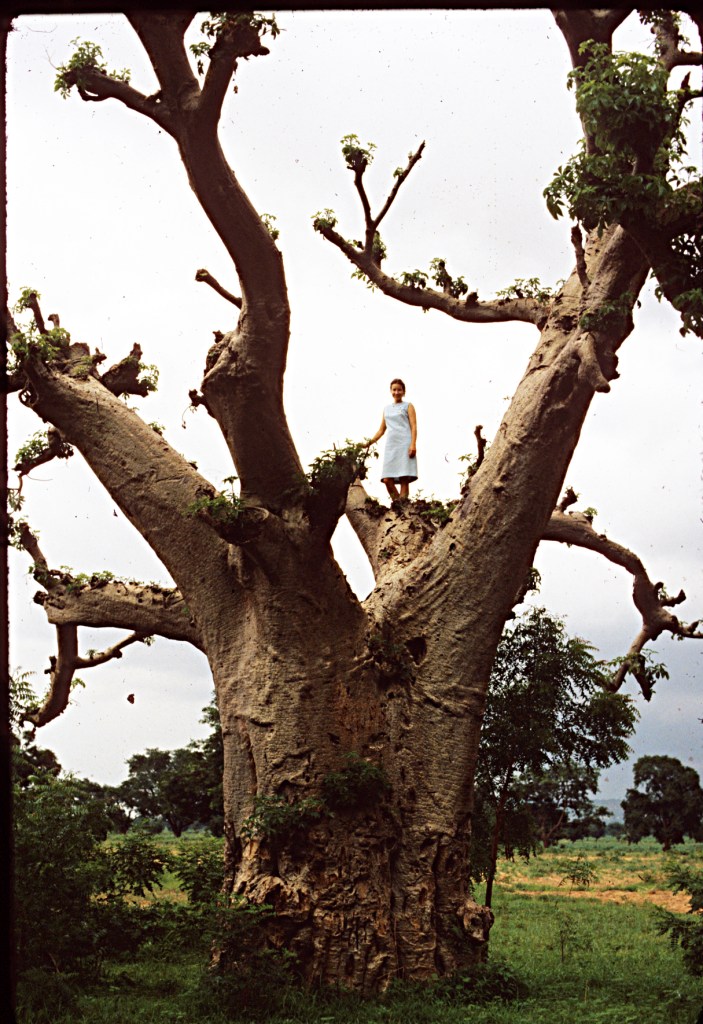
I am a tree-lover. Inside the fence of our African compound, my missionary dad planted a variety of tropical fruit trees for food and a thousand neem trees for firewood. Just outside our property, a stately kuka (baobab) tree called my name, and further into the bush grew other exotic fruit for tasting and flowering trees for climbing. As a child, I made it my mission to try them all.
And so, I write my own poem.
The Lord is my Living Baobab Tree.
He wraps His massive branches around my slender frame.
I hide myself in the crook of His arm.
He is my place of peace and solitude and a gathering place for social encounters.
I view the world differently from Your height.
I soar in Your high branches and rock comfortably on your lower ones.
I might itch when I touch your pods, but the inside fruit tingles sweet-sour on my tongue.
You reveal Your secrets as I spend time in You.
You spread Your cool leaves above me and shelter me from sun and rain.
You invite me to climb, but I can never attain the topmost branches.
You are too lofty for me.
I want to dwell in Your branches forever.
I run to you when I feel pain or pleasure.
I run barefoot to Your roots and climb into Your lap, content.
You restore my soul.
Is God more than a shepherd or a tree? Of course. But the symbolism focuses on the senses. Can I taste God? (“Oh taste and see that the Lord is good.”) Can I hear His rustling branches in the Spirit’s wind? Can I smell Him in the dampness of the roots of the earth? Or the odor of rain as it cleanses the dusty leaves? Can I touch Him? When I touch the unlovely, the poor, the prisoner, the orphan child, I touch the face of God. I can’t see Him with physical eyes, but I can see His handiwork, and I get to know the heart of the artist. I see His creativity, His passion, His bigness, His attention to detail, His order, His comfortableness with chaos. I sense His emotion in the fury of the hurricane as well as the gentle caress of whispered breeze on my cheek.
A 2022 Update. One day, while trying to still my heart on a hiking trail bench, the Lord said to me, “Be a tree.” I want to be an oak tree—stable and strong, where many can come and rest in my branches. Some of my leaves become diseased when outside forces ruin their beauty, but it’s okay for the bad parts to fall off so new growth can replace them. I want to feed the squirrels and provide shade for the tired and weary. And I want my branches to whisper, “Jesus loves you. God is here. Come and find peace.” He’s the invisible sap, the life inside me, flowing from root to healthy branch.
The Lord was David’s shepherd, but He’s my tree, and I want to be like Him.
“One that would have the fruit must climb the tree.” 1980. Revisiting what was left of my old, beloved baobab.



 In the Pursuit of Peace