Shame on You

From my 2009 Journal. Having a judgmental spirit is like trying to cast shame on another person.

Shame Ben

At my boarding school, kids were adept at using a little gesture that meant “shame on you” or “naughty, naughty.” Left pointer finger pointed at the victim. Right pointer finger perpendicular to the left one. Slide right finger repeatedly across and down left finger. Shake the head. “Tsk tsk.”

Why did we do that? Did we learn it from the grown-ups who said to us, “Shame on you!” or “You know better than that.” Do those words actually correct behavior, or do they simply cause the child to cower, believing there’s something wrong with him? Why can’t we discipline and correct without the shaming?

My judgmental spirit and attempt to shame a person is simply self-righteousness. And shame on me for doing so! I am not your judge. When a kid pointed a finger at us in judgment, we’d remind him that three fingers pointed back at himself.

I should just put my shaming fingers in my pocket.

Guilt and Forgiveness—a Visual

Karekare Black Beach 491

Karekare Black Beach, NZ

Guilt is like strolling on a sandy beach—you leave footprints for all to see. You may try to cover your shame by smoothing sand over the prints; but as you walk away, you create more footprints.

Forgiveness is God sending His wind (the Holy Spirit), blowing across the sand, erasing all the prints. And even if you fail again, the wind continues to blow.

But how much better to scramble up onto a solid, flat rock where no footprints can be made and no guilt and shame exist.

I’m on the Rock, hallelujah,

I’m on the Rock to stay,

For He lifted me from the miry clay—

I’m on the Rock to stay.


Stereotypes and Pharisees

From my 2009 Journal. I think I’ve uncovered a misconception I’ve held for too long. In my mind, I have a stereotype of the Pharisees that says they were all hypocrites, bad leaders, and out to get Jesus. And many of them were. But, unfairly, I’ve lumped every religious ruler in Jesus’ day into the same lump of clay. Sure there was Nicodemus, but in my mind he was the great exception.

When I read Luke 13:31, it broke up that myth. Some Pharisees came up and said to him, “Go away from here, for Herod is determined to kill you.” Apparently, there were some religious leaders who were genuinely concerned for Jesus’ welfare.

One day Jesus ate a meal at the house of one of the prominent ruling Pharisees. The other Pharisees and teachers of the law muttered, “This man welcomes sinners and eats with them” (15:1). It was a big party, and Jesus had lots to say to the guests. He exposed their sin and faulty thinking, no words minced or held back. But maybe this host was a genuine seeker of truth—inviting Jesus to a social event in spite of the criticism of his peers.

Today? I fight the tendency to lump all our political leaders in the same mold: they’re all corrupt;  they’re all self-serving. Not so. There are godly ones as well as scoundrels.

I wonder what other group prejudices I have been harboring.

Presidents

More Thoughts on Prayer

From my 2009 Journal. I want to learn to pray. I really do. It’s been a drive, a passion, and a pursuit of mine since junior high. It’s one of those spiritual disciplines that one never seems to master. I think I am motivated by what others do, say, preach, and model. I listen, attempt to imitate or explore, try to learn from . . . but ultimately, this conversation is between me and my Creator, no one else. Is He satisfied with my performance (or non-performance)? Is my heart right? At peace? Are my motives pure? If they’re not, can I trust God to reveal them to me? To expose me? I keep learning, trying, applying, but it never seems “enough.”

It’s the word enough that trips me up. More implies time. Is one minute a day in prayer enough? Is one hour? What about 20 hours? If I talked to my husband nonstop for two hours, I’d be tired. It’s okay occasionally, but I don’t make a habit of talking that much. I prefer to listen. So . . . if prayer is also listening, I can increase my “time” easily. But does a certain amount of time spent with someone indicate how much you care for them? No. but choosing to do so out of delight in being together does. “Having to” is totally different from “longing to.” [2020 Note: I’ve since learned that enough and more are not quantifiable and never satisfied, and that’s why Satan loves to bind us with them. Relationship is about connection more than just time spent, though time spent can certainly impact relationship.]

I recognize that some people are more naturally gifted in the art of communication. And I also know that it’s not just the words themselves that communicate. When I smile at someone, or when I frown, I’m communicating. Cannot God, who made me, interpret every nuance, know every secret longing, and read between the lines, or does He expect me to use words every time? Those who have been given a prayer language would say words aren’t always necessary.

So how do I go deeper? How do I find that place inside that is deeper than words? Are visuals the key for me? The word pray sounds so formal: on the knees, head down, petitioning the King for a boon or a favor. Sometimes prayer is like that. But sometimes it’s chatting with your best Friend around the dinner table. Or snuggling up in your Papa’s lap and telling Him how much you love Him and appreciate Him. And sometimes prayer is begging for mercy for having disobeyed Him while He’s holding the chastening rod. Perhaps prayer is just breathing in and out.

candySometimes my prayers are so shallow, without thought, childish, and me-centered. But Jesus understands that we’re frail and immature and ignorant. He doesn’t mind our childish babble—when we’re children. When my kids asked for candy, I knew it wasn’t always best for them and often said no, and I said no because of my love for them. But sometimes I said yes because it was fun to give them a treat. Candy before dinner on an empty stomach? Not such a good choice. But if they insisted and persisted and perhaps secretly ate some anyway, hopefully they soon learned from experience that getting a sugar high and crashing or feeling sick afterward or getting a headache wasn’t worth it. And so I can relax with my prayers. I can ask whatever I want but trust God to run interference for me if I run my mouth off the wrong way.

Bottom line: I delight in spending time talking to and listening to God. It’s not a chore. Sometimes I make appointments with Him, and I like to keep those appointments. And if God makes an appointment with me, I won’t miss it. He’ll make sure I’m there. He knows how to get my attention.

The Worry Worm

From my 2020 Journal. Everyone is jumping on the bandwagon of trying to give us encouraging words and uplifting things to focus on during our forced isolation from COVID-19, and I’ve purposefully tried to stay away from the topic on my blogs. We’ve heard and seen enough for a lifetime on the news and in social media to bring fear and anxiety into our hearts. I am not afraid, so don’t tell me not to be afraid! But then it hit me. I’m may not be afraid, but I did identify some worry. Oops. So here’s my response.

Worm dried

Worry

Is like a worm,

Weaseling its way into my brain,

A virus that goes viral,

With nothing to stop the corruption.

Too late to quarantine,

It’s already done its damage.

All I can do is holler for help and pray and praise

To arrest it in its tracks and

To wash away the filth of the residue

Praise Him, praise Him, all ye little children,

God is love, God is love.

Ahhh, sweet peace.

Going Home

From my 2009 Journal. Home, to me, will forever be Nigeria, but part of me got left behind in Indiana. Every 4 years we packed up our suitcases and returned to our passport country to visit our supporting churches. In 1966 (my 6th grade year) we landed in Elkhart, Indiana, and then again, one more time 4 years later, when I was a junior in high school. When my missionary parents returned to Africa again, I stayed behind with a local family for my senior year. These 3 years of my life left me with strong memories, and in July my big sister Grace Anne and I decided to revisit our old haunts.

It’s the middle of the night and my thoughts are ricocheting so fast I can’t sleep. How does one record thoughts, emotions, and impressions, and for whose benefit? I’m experiencing this trip with my sister, which is hugely satisfying since we share the bond of one year’s memories, and I’m eager for the next day’s adventure to begin.

First, we drove over to the old Lindahl’s home where Grace Anne lived during her senior year of high school. Then on to Concord High where she’d attended. Those memories are hers alone, but I’m happy to go with her. We stopped by 137 Parker Ave, where I lived with the Muehlbergs, my host family for my senior year. The new owner invited me inside to see their renovations. “Uncle” John got me my first job working at Accra Pac, an aerosol packaging plant where he was a chemist.

We drove to Central High School where I attended for two years and from which I graduated with 900 other seniors. Too many memories to recount of race riots, loneliness, and cultural adjustments.

DIGITAL CAMERA

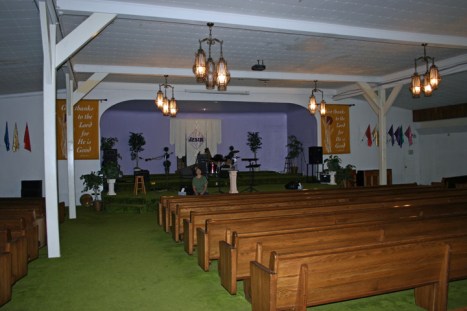
Next, we visited the Grace Bible Church Tabernacle on 2nd Street where I dedicated my life to the Lord. I’d forgotten there was a laundromat next door. I recall Sunday school, Wednesday night prayer meetings, playing marimba duets with Grace, the ladies giving a Tupperware shower for my mom to take back to Africa, and hanging out with Debbie and Dennis and other kids my age. The elderly saints in the church left such an impression
GBC Tabernacle 2009

Grace Bible on 2nd Street

on me. The current pastor (the 7th occupant of this building), who has a ministry to inner city dwellers, invited us in to look around. The ceiling had been lowered, there was no central aisle, and the platform was changed. I was glad to see that God is still at work here.

Two blocks down the street on the corner of 2nd Avenue and Pottawattomi Drive was the old parsonage, our home where I first learned to use the telephone. This is my story, my history. I’ve relived it in my mind many times. My mom was sick with Hodgkin’s that year, and we didn’t like Dad’s cooking! Snapshots in my mind of Grace Anne collecting fashion photos, of finding marbles in the heat register in my brother Paul’s bedroom, of packing for our summer trip across the USA.

I wanted so much to peek inside and see my old upstairs bedroom and feel the pulse of my mother’s piano and experience again the joy of the Young People’s gathering at our house when we played “rhythm” and ate cherry cobbler with red hots (my mom’s favorite dessert) in the living room. Christmas excitement and playing with Duke our dog and ironing in front of the TV in the basement. Marimba lessons and slip-sliding in the oversize bathtub and begging my mom to buy a new brand of toothpaste because I’d seen it advertised on TV, another novelty to us.

The neighborhood is seedy now and multi-racial. The neighbor across the street came out to chat and fill us in on the state of the house: it’s in foreclosure for $10,000 and no one lives there. So sad.

Jingle Jump

I stood outside our home and “watched” my 6th grade self playing Jingle Jump on the sidewalk. I saw me climbing the tree out front with my boyfriend Terry Bunn and climbing out the bedroom window onto the roof. I see the black walnut tree in the back yard and me practicing baton twirling. When I pose for a photo in front of this old house that’s falling down around itself, my immediate thought is that I want to send the snapshot to my mom who died earlier this year.

2nd and Pottawattomi 2009

The parsonage, now condemned

My best friend Kathy lived on the same block, we walked to school together each day, and we lived at each other’s houses and formed the TGTG (The Glued Together Girls) club. She taught me to make snow angels, and we played king of the mountain. Besides hundreds of

DIGITAL CAMERA

Kathy’s house

 games of Yahtzee, we biked down to McDonald’s in the winter for a warm bite of hamburger and French fries; and when the A&W opened a root beer stand, we were in heaven. It was the year that Kathy preferred to be at our house because her daddy was raping her at hers, and I was too ignorant to know. Grace and I drove slowly past her house, and memories flooded back.

My Samuel Strong School building now houses a business. Memories, memories. How do I record them all? Open stall bathrooms in the basement, volleyball in the low-ceilinged gym, cheerleading for the guys’ teams, fire drills, skating on ice for the first time, giving my testimony in class, being teased for being the teacher’s pet. My teacher, Mr. Mann, got saved that year. One time I picked dandelions on the way to school to present to him, and the boys ridiculed me for giving him weeds. (How was I to know?) I was elected to be a crossing guard, but I was too scared to accept since I didn’t know what that was!

DIGITAL CAMERA

Samuel Strong School

Kathy and I would stop on our way home at a Mom-and-Pop grocery store to buy candy cigarettes (yes, I did) and wax pop bottles or wax lips filled with sweet liquid. We sucked on enormous icicles dripping from the eaves in winter and kicked fall leaves across the sidewalks.

DIGITAL CAMERA

Next, Grace Anne and I attended the evening service at Grace Bible Church (now located on Edwardsburg Ave) where in high school I had sung in the choir, attended youth group, taught Sunday School and determined where I’d go to college.

The next day, we drove by the 1432 Okema Street house where Mom and Dad and I had lived for my 11th grade, and where I learned to babysit for the first time. I rang the doorbell, and I could sense movement inside, but no one answered.

DIGITAL CAMERA

2009 in front of our Okema Street house

Our short visit had come to a close, and my heart was full. These are MY memories. With whom do I share them? I record them for myself so that in my old age I have somewhere to refresh and keep the memories alive. I don’t share these with my children because they weren’t there. But maybe someday they’ll visit one of these spots in Elkhart and stand there and say, “My mother’s spirit was here.”

You Made Your Own Bed . . .

From my 2009 Journal. A few years ago, I had a friend (A) who adopted two girls from another country. One day my friend injured her leg and she struggled to take care of them. Another friend (B) dismissed it with the attitude “Well, she asked for it.” (i.e. she had no business adopting if she couldn’t afford them.) I was shocked and surprised at B’s attitude. Yes, Friend A had made that choice, and yes, she has to live with her choices, but it wasn’t A’s fault that she injured her leg and needed compassionate help.

Perhaps I should examine my own heart, however. A smoker I know is struggling with emphysema, and I don’t feel like giving him any sympathy. Of course I would never withhold getting an oxygen tank to him if he ran out, but I’d still roll my eyes and think he made his own bed and must lie in it! I guess I’m no better than Friend B and her judgment.

Or I think of someone who struggles with physical challenges because she is obese. Do I withhold compassion and mercy when she has a stroke? In a way, you could say she asked for it, but I don’t think that’s the right response. Instead, I need God’s compassion for her in her debilitating state. In the same way, I need God’s pity and mercy for my own struggles that keep me bound and powerless to change.

The thing is, I can readily see the solution to everyone else’s problem, but find it harder to deal with my own. Quit smoking! Lose weight! Turn to Christ! Let go of your anger! Forgive that person who hurt you! But when I look inward at my own issues, I find I can easily make excuses for my own actions and attitudes.

You may have made your own bed and must lie in it, but I can choose to help you change your sheets.

monkeys in bed 2

Rule-Keeping 101

Rules

From my 2009 Journal. I’ve been reading Romans 14 and thinking about biblical rules. Old Testament rules included “Don’t murder.” but Jesus said it’s what’s in your heart that is most important. Is “Don’t hate” a New Testament rule? I suppose you could say that, but rules generally govern actions, not attitudes. For example, I may be imprisoned for murder but not for hating someone in my heart. But if you take care of the attitude (hatred) in your heart, you’ll have no temptation to do the action (murder).

In context, Romans 14 seems to be referring to religious activity: observances of meat offered to idols and special observances of days. I have freedom, the Apostle Paul says, to eat meat or not eat meat, to observe a day “unto the Lord” or not. It’s not just the action that pleases God, but the attitude of the heart. Am I doing it out of obedience to my conscience or out of disobedience? Am I doing it with a grateful heart? If I do the religious activity but am not thankful, what good is it? Verse 14 says food offered to idols in and of itself is not unclean. But if in your heart you believe it’s unclean, then to you it is. Don’t do it!

When I see someone’s action, I may or may not know their heart or their motive, but I confess I have been found guilty of unfairly judging them. It’s long past time for me to quit the Old Testament rule-keeping and be grateful for God’s grace and freedom to live according to the only two rules I find in the New Testament: love God and love each other.

Bottom line: examine your own heart, and don’t judge another believer’s religious activities. Can I hear an “amen”?

When Should We Disobey the Government?


From my 2009 Journal. Following up my recent blog post about The Blue Parakeet—Rethinking How You Study the Bible, I remember Scot McKnight’s injunction to read the Bible as a dialogue that includes different facets of a topic. We can get into trouble when we quote one verse or phrase in the Bible out of context, and we can come up with some pretty bad theology or advice. For example, I hear Paul saying in Romans 13 that you should never disobey government; and if you oppose government, you bring condemnation on yourself.

Let everyone be subject to the governing authorities, for there is no authority except that which God has established. The authorities that exist have been established by God. Consequently, whoever rebels against the authority is rebelling against what God has instituted, and those who do so will bring judgment on themselves. (Romans 13:1-2, 7 NIV)

Yet when Peter and the early apostles were instructed to stop preaching, they said to the high priest, “We must obey God, rather than men.” And God honored Daniel, Shadrach, Meshach, and Abednego when they defied the king and refused to bow down to his statue. Apparently it’s okay to practice civil disobedience if it conflicts with God’s law—but you’ll pay the consequences if you’re caught.

And so I think it’s wrong to apply Paul’s statement in every situation. In context, I think he was saying “Do what’s right.” There’s nothing morally wrong in paying your taxes and obeying the speed limits and [practicing social distancing, to apply this blog to 2020]. You don’t want to be slapped in jail for doing something the government opposes. But if the government forbids assembling together as believers [and I’m not saying as a temporary measure to avoid the corona virus], then disobedience is legit and the church must go underground.

Let’s dialogue. Over what issue would you disobey the government?

Flag

Relationship with Adult Children

From my 2009 Journal. I’m still learning what is appropriate and what isn’t in relationship with a newly-adult child under our roof. Is it reasonable to expect our daughter to pick up after herself in family living areas? To help with the dishes? With cooking? With cleaning the house? And if she chooses not to, when is it permissible to speak to her about it? I realize communication at this point can be tricky. My expectations and desires for a neat and tidy house must be subservient to maintaining relationship. Therefore, I am far more tolerant of mess than I would be if I were still trying to train her.

Living in a dorm situation she discovered firsthand what it feels like to have a roommate who never assists in the kitchen. So when she came home from college, I was delighted to hear of her intentions to help out more in the kitchen. But if she’s too tired to help out for a couple days, why do I hold her to her good intentions? Why do I feel resentful when I return home to find breakfast dishes still in the sink? So she slept late that day, worked the entire day, and ran out of energy before the work was done after supper . . . I do not fault her, but I do have to figure out why I feel what I do and what is an appropriate response.

VISUAL: As a young mom, I had three girls in a wagon, and I was pulling with all my strength, trying to get them to follow me. If I tried to get them out of the wagon to assist or to walk on their own, they whined and cried “We’re too tired!” and then they pushed and shoved and fought each other. What am I doing wrong?

How did a friend of mine get her children out of the wagon and behind the thing or in front to help? I don’t know. I just know that I have to quit pulling. It’s time I drop the wagon handle and walk away. There’s work to be done. The trick now is not to become resentful or nagging or whining myself.

The trouble is when people in the wagon get comfortable there, they begin to expect you to bring their food to them and clean the playpen for them. But now they’re old enough to clean their own area . . . and they don’t, and I trip over the toys and have to clean around them. It’s a perpetual issue with a husband too (sorry Scott). Relationships are messy!

I feel so many times like a Martha. Lord have mercy, and God forgive me!

So . . . I can “whistle while I work.” Praise God that I have two arms and two hands. Praise Him that I’m not in a wheelchair and unable to stand at the sink. Change my attitude and enjoy the brief time I have with my daughter. What’s a little mess matter when I can have her company. She’ll soon be gone and I’ll miss her.