Lessons from Genesis, Part 2

Journal 2018

Genesis 36, Genealogy

This chapter details a long list of people who lived on this earth before us. We know nothing about them except their names being documented in the greatest book on earth… a lifetime of living recorded in just one word.

Millions of names never get recorded anywhere (except in heaven), and time marches on.

Long line of people waiting at a registration point inside an old building

Our lives are preserved in tiny snapshots of memory. How long do we remember a person? At the very most, we might know our great-grandparents, and we might live long enough to meet some great-grandchildren. I can’t even recall my own journey past what’s recorded in my journals, and when I go back to read them, I’m often astonished at discovering what I have forgotten. Our minds cannot retain all that information. This digital age generation will be the most recorded in human history. Thousands of photos and bits of information are available about us and our families at the click of a button.

Like all humans, I desire to be known, to be heard, to have purpose for my existence. The movie It’s a Wonderful Life reminds us that every human being impacts another in some way. It’s easy to see that if I didn’t exist, neither would my children or grandchildren. We cannot know the impact they will have on future generations. My great-grandparents didn’t know who I would become. They didn’t even know I would exist.

What really matters in light of eternity? Who cares? What’s really important? The thousands of meals I’ve prepared? The number of floors I’ve vacuumed? The hugs I’ve dispensed? The money I’ve spent? The love I’ve freely given? The lessons I’ve learned or passed on?

Thankfully, God knows my name.

Genesis 39, Joseph’s Story

How long, I wonder, did it take Joseph to learn a new language in captivity? How many of those 13 years were spent in prison? How did the jailer notice Joseph had integrity? So many questions.

And then I read this amazing Hellenistic novella titled Joseph and Asenath. The document didn’t make it into the Canon, but the story is plausible and intriguing.

Unlike his dad, grandpa, and great-grandpa, we are told of no character flaw in Joseph. Some say he boasted when he shared his dreams, but there’s no proof in that. We only see his family’s triggers. He was upright and blameless. Where did Joseph learn that? Who modeled it for him?

Betrayal Theme

By all rights, Joseph should have been a psychological wreck from all the betrayals he experienced:

  • By his mother’s death in childbirth
  • By his own brothers into slavery
  • By his formerly trusting master, Potiphar
  • By his seductress, Potiphar’s wife.
  • By his fellow prisoner, the cup bearer

Yet somehow, with God’s grace and favor, he managed to rise to the top. Where did he get such strength of character? He certainly had poor role models: a father whose life was characterized by deception and favoritism, the lack of a mother, and jealous sibling rivalry. This guy should be in a counseling office crying his eyes out. Instead, he had the fortitude to withstand temptation, the capability of leadership and organization, the heart of forgiveness, and the unfailing trust in God’s design for his life. What an amazing comeback!

Clothing Theme

What an interesting theme! I’m sure there are many lessons in this one.

  • From a spectacular multi-colored coat to a stolen, besmirched garment
  • From new clothes from Potiphar to a stripped cloak by the wife
  • From dungeon rags to changed clothes to appear before Pharaoh
  • And finally, the donning of new robes of fine linen as a ruler in Egypt.
You’re Going to Wear That?

Journal 2005. While I obsess over what I’m going to wear at my next school reunion, my mind hopscotches over the years to comments such as:

  • You’re going to wear THAT?
  • Are you pregnant?
  • What an ugly lime green dress!
  • What were you thinking!
  • Your skirts are too long.
  • Those colors don’t match.
  • You could be pretty if you would just . . .
  • Why can’t you dress like . . . ?
  • Frumpy Missionary Kid!
  • You look like a cowgirl.
  • You wore THAT at your wedding?
  • You have no sense of style.
  • Let me fix your makeup.

How powerful words can be! Even when I dress up, I feel frumpy on the inside. Lord, have mercy on me if my words have ever hurt another person.

Why should other people’s opinions matter? First, I guess they want me to care. And I do—to a certain extent. But sometimes I don’t. I can’t live my life by other people’s standards. Who gets to decide, anyway, what is fashionable or ugly? What’s fashionable may not look the best on me. While teens and pre-teens go through their identity decisions, their wardrobe choices may look strange to me, but they fit into their culture of acceptance.

I find I shop best when I have someone along to give an opinion. Why don’t I trust my own judgment? My family would say it’s because I don’t have good taste. But why does one person get to decide for another what clothing is acceptable or not in society? Who gets to decide what’s in and what’s out?

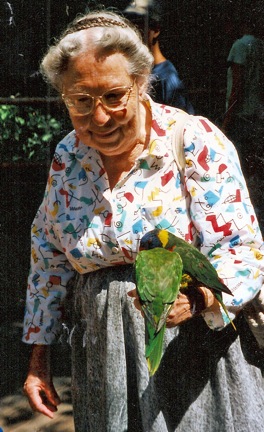
My sweet mom

Do I dress to match who I am on the inside? Or do I dress to cover up what’s inside? Maybe some of both. I dress comfortably—I learned that initially from my mom but reinforced it through experience. If I’m uncomfortable, my focus is on self. On the other hand, if I dress casual when the situation calls for formal, I stick out. My philosophy is to try to blend in and avoid extremes.

The visual: I’m on a stage in the center of a spotlight, and the audience is laughing at me. But then I hear, “Man looks on the outward appearance, but God looks on the heart.” The spotlight fades, and a strong beam shines into my heart revealing the impurities as well as the lighter spots where truth has entered. Better to be more concerned about getting rid of the dark spots than worrying about the body, which is now hidden in shadows.

Clothing is just an outer shell, but if it draws attention to itself instead of to the light inside, it may be time for a wardrobe makeover, both inside and out. Perhaps I should ask the King of Kings about His opinion rather than my family’s or my peers’.

A 2022 Focus. My insecurities about clothing choices have faded with the healing of hurtful words. I now understand that comments reveal more about the heart of the person who said them. But I also acknowledge the benefit of a second opinion when I go shopping. Anyone care to go with me?

On Clothing

pexels-photo-296881

From my 2007 Journal. I dreamt* last night that I couldn’t decide what to wear. One thing was too hot, another too cold, and another was out of date. Agony! If I choose the wrong one, I’ll suffer. Too hot, too cold, uncomfortable, self-conscious.

I loathe clothes shopping. I have a hard time finding something that fits, and even when I do, I can’t seem to make up my mind if I really want it or need it. More often than not, I’ll just walk out of the store empty-handed. That’s why I invite a daughter or a friend to come with me and give their expert opinion. But even then, I may return an item after trying it on at home.

Somewhere there’s a balance between the outward trappings of style, comfort, available resources, and cultural sensitivity versus inner beauty. Does it please God more to spend huge amounts of time on the outward appearance or to ignore it altogether? To dress so as not to draw attention to oneself or to dress with flair and self-expression? Some have more fashion sense than others (sadly I’m not one of them). It just isn’t that important to me—that is, until someone makes a negative comment. I enjoy seeing someone all dressed up, but I don’t want to be that person. I prefer sweatpants and t-shirt comfort.

Here’s my order of priority: #1 Modesty #2 Comfort #3 Budget #4 Appropriate for the occasion. #5 Fashion. Don’t judge me, girls; it is what it is, and it’s harder to change the older I get.

It’s interesting to me how others reverse these values. I’d love to do a study on this. What order we rank these items, I suppose, depends on personality or temperament, cultural norms, giftedness, spirituality, budget, woundedness, and our value system. Any other factors you can think of?

What’s your order and why?

*Note: My spellcheck didn’t acknowledge the word dreamt, and so I had to look it up. The TCK syndrome strikes again. Apparently that’s the preferred British spelling with which I grew up. You learn something new every day!