Grumbling and Complaining


IMG_3757

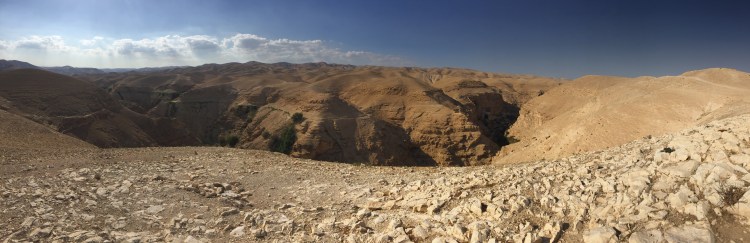
Wadi Qilt in the Judean Wilderness

And the people grumbled and deplored their hardships, which was evil in the ears of the Lord (Numbers 10:37).

May, 2018. When I first heard this verse as a little girl, I piously thought that if I’d been an Israelite, I would never have complained about my lot. Indeed, I determined then and there to stop grumbling when I didn’t get my way. (I may have kept that vow for a whole day.)

Scott and I recently came back from a trip to the Israeli and Jordanian wilderness. After experiencing miles and miles of unrelenting drought and rocky mountains and heat, I have a new appreciation for why the Israelites complained. Of course my observation comes from the cushioned seat of an air-conditioned bus, but still . . . .

The Israelites were fed up. They were sick and tired of manna sandwiches, manna soup, and manna salads, and they lusted after their flavorful Egyptian dishes. They declared, “Now our soul (our strength) is dried up.” And no wonder! With only six inches of rain a year, where is there enough water in a desert for a million or more people? And so they wept and they complained to Moses. I can picture the little kids whining, “Are we there yet? I’m so tired, hot, and thirsty. My feet hurt.” And the moms, carrying their extra loads, not knowing how far they’d have to walk each day, worried about dehydration (they didn’t have ice-cold, bottled water provided by the bus driver).

The result? God’s fire burned the edges of the camp.

The people’s reaction? They cried out to Moses.

Moses’ response? He cried out to God. “Why? Why? Why? Where? I can’t. I’m not able. Kill me. The burden is too heavy.”

So what’s the difference between the words of the Israelites and the words of Moses? The difference is to whom they complained. Moses directed his words to God. The words were melodramatic, to be sure, but honest. His was not an attitude of lust and rejection of God’s provision. His were words of despair because he was carrying too heavy a burden and his knees were starting to buckle.

God’s response: He came to Moses’ aid. He had him choose 70 men to help carry the load.

And the fire in the camp subsided, and they named the place Kibroth-hattaava (the graves of sensuous desire) because they buried there the people who lusted and whose physical appetite caused them to sin.

Buried in the desert? I used to picture the Sinai Peninsula as gently rolling hills of silty, Sahara-like sand. But as we had to carefully watch our footing over rocky ground, I wondered aloud how the wanderers accomplished this feat. I still don’t have an answer.

Anyway, I came away with two thoughts: I have no right to judge another person’s struggles until I have walked 40 years in their dusty sandals. And second, what can I do when I find myself in the desert? Talk to God instead of whining to other people.

Curious Thoughts on Exodus 32

Desert

When I read a chapter like Exodus 32, I end up with more questions than answers. I hope this doesn’t sound sacrilegious, but this inquiring mind wants to know.

Here’s the scene: After 40 days on Mount Sinai, Moses and Joshua (yes, he was there also) come down the mountain, 10 commandments in hand, after negotiating with God regarding not annihilating the whole Israelite nation. They have been in the very presence of holiness and purity.

While standing at the gate (What gate? What was it made of? Why was it there?), Moses calls out for the people to join the Lord’s side. How did Moses get their attention? How did he speak to a million people at the same time without a PA system? Did he yell at everyone near him to go to his or her own tent and they each passed the word to their neighbor? Or were they all together in a mob and the front guys passed the word back to those behind them? (Like playing the game “gossip” or “telephone,” I can imagine how that message would have gotten garbled!) Or did Moses just speak to the elders of each tribe who spoke to the clan leaders who fanned out to relay the message to those under them?

By this time, Moses had already ground down the golden calf and made them all drink it. (How do you force someone to drink something nasty anyway?! It’s not like he held a gun to their heads.)

So now Moses has all the Levites standing with him (Levi, the original brother, was no saint, but somewhere down the line, someone made some godly choices), and God honors that, and He gives them instructions to kill/murder/slay their fellow Israelites who aren’t on God’s side. And the Bible says they slew 3000 men! Does that include women and children? If not the women, can you imagine all those women being left widows? Knowing God’s dealings at other times with rebellious people, I suspect that whole families were annihilated. It says, “They went from gate to gate (there are those gates again).”

Apparently they had divisions between them—maybe to separate the tribes? Maybe to contain their animals? BTW, how did they find enough grazing food—not to mention water—for all those animals in the desert? The statistics are mind-boggling.

How difficult was it for the Levites to obey God? What residual emotional and psychological effects would they have had after this massive slaughter? Who had to bury all the corpses? And how do you bury that many people in the desert? I suppose they cremated them, but what a stench that would have been!

And didn’t the victims try to fight back? I’m sure they didn’t just stay put when they saw sword-wielding Levites coming toward them! They must have tried to run and hide . . . but where? . . .  or attempted to defend themselves. Chaos! Maybe the Levites came after the victims while they all slept! (I doubt it.)

And who inherited all their stuff—their tents and clothes and cooking utensils and sheep? (Can you imagine all the trading and bartering that went on in a camp that size? The entrepreneurs getting rich off their neighbors . . . ) Or maybe they burned their stuff up with the bodies.

My mind can’t wrap around the logistics of such an endeavor. What would it feel like to voluntarily kill your fellow man? Perhaps being clannish, it didn’t feel so bad, but verse 29 says, “Slay every man his brother, companion, and neighbor.” Is this literal or metaphorical? That would mean everyone who had not stepped over the line to join Moses and God. So if your brother or son did not join you, you were instructed to kill him. I can’t let my mind go there.

Following this, God sends a plague. You wonder if in the process of burying or burning this many people with rotting flesh in the desert (it had to be done very quickly) and grief being so strong, they would get ill from it. This is not to negate the miracle of a plague, but to understand the enormous stress they were under. Perhaps the plague weakened them so they wouldn’t seek revenge on the Levites.

God—who can understand His ways? He wipes out humanity with a flood, but keeps a remnant. He wipes out 3000 in one day and keeps the Levites. He allows a holocaust but brings a remnant of Jews back to the land. Abraham asks God to spare Sodom and Gomorrah, but God only brings out Lot and his women. (I don’t think it was God’s initial intention. Wouldn’t it have been better to have destroyed Lot’s lineage?) But God listens to a man. God wants to wipe out the entire nation of Israel, but Moses intervenes and asks God to spare them. God agrees—but only partially. He knew what was best.

Whose side am I on? Will I be willing to do the hard thing when You ask it of me?

Holiness, holiness is what I long for.

Holiness, holiness is what I need.

Holiness, holiness is what you want from me.