When I give someone instructions (a recipe, directions to my house, how to send a file in an email) [yes, this was written a few years ago!] I give clear, precise information. If I don’t, the food may be tasteless; the person will end up at the wrong destination; I won’t be able to open the file.
When God gives instructions, He is the expert. He knows the intended outcome as well as the steps to achieve that goal. His instructions are clear and precise. When God speaks, we better listen . . . and obey to the letter.
God said to Jeremiah (26:2):
Stand in the court of the Lord’s house (where and with what posture).
Speak to all the cities of Judah that come to worship there (what to do and to whom).
Speak all the words that I command you to speak; diminish not a word (what to say—precisely, fully, accurately).
So . . . Jeremiah obeyed. But AFTER he finished speaking, the people, priests, and prophets seized him and threatened death. Obedience does not guarantee comfortable results!
Jeremiah’s response, however, is most interesting and gratifying. He had already grappled with the fear of the results of his actions.
Be assured, however, that if you put me to death, you will bring the guilt of innocent blood on yourselves and on this city and on those who live in it, for in truth the LORD has sent me to you to speak all these words in your hearing.” Jeremiah 26:15 (NIV)
I have learned the hard way that disobedience to God’s clear instructions brings only heartache. I would have saved myself a boatload of angst had I obeyed the first time!
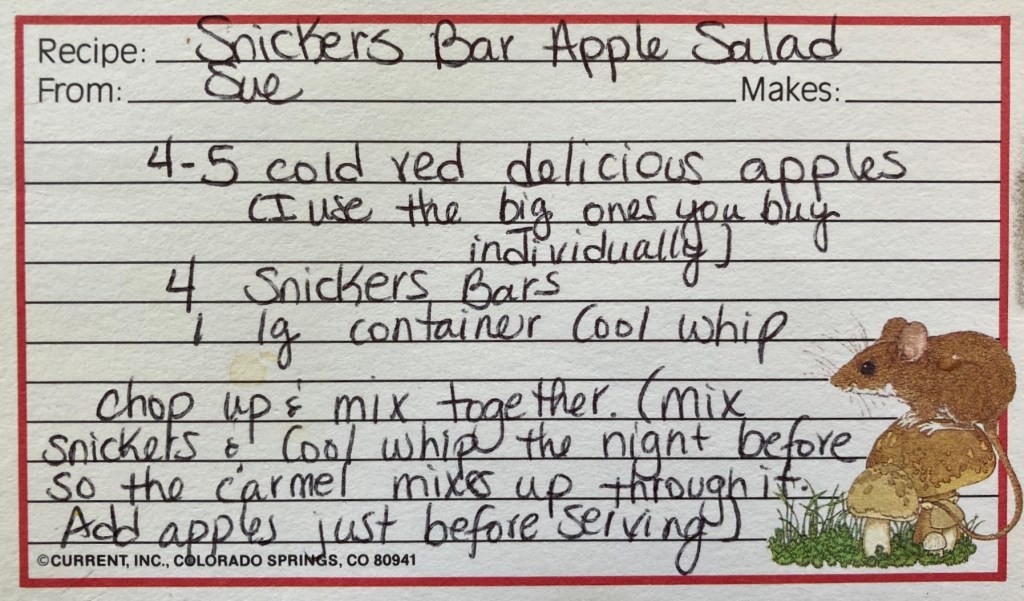
There is on-going debate in our family over whether this is a salad or a dessert.
Why do I struggle with the concept that God has the right to do as He pleases with His creation? I want fairness, and it doesn’t FEEL fair for God to choose one person for special purposes and another for common use.
Does not the potter have the right to make out of the same lump of clay some pottery for special purposes and some for common use? (Romans 9:21 NIV)
With my great power and outstretched arm I made the earth and its people and the animals that are on it, and I give it to anyone I please. (Jeremiah 27:5 NIV Emphasis added)
I can view my story from an egocentric viewpoint or a theocentric one. I can read the story of Pinocchio through his eyes or through the Woodcarver’s who created Pinocchio in love for a relationship. The only safe place for Pinocchio was in his father’s house and under his creator’s care. He could have had greater adventures, in safety, had he stayed with Geppetto, but he ran away. His rebellion resulted in grief, but then he found redemption when he returned to his maker.
When I think “birth” instead of “creation,” I have a paradigm shift in my response to “unfair.” I am a baby, then a child, adolescent, and adult in God’s kingdom. But even as an adult, I never outgrow the need to be loved and cared for. The danger as an adult is to think I’m self-sufficient.
I can name five people right now who are in crisis emotionally. I am not indifferent to their pain; I am concerned and praying for them. But I wonder at my emotional detachment from these good friends. I realize that with the healing in my own heart, I’m not jerked around so much by other people’s issues. I’m sure a doctor goes through this process having to take care of sick bodies without getting too emotionally distracted.
The prophet Jeremiah said God’s burden on his heart to prophecy was like a fire in his soul if he didn’t speak. David also had a fire in his soul—but it was driven by guilt. The key, I think, is recognizing the difference between the Holy Spirit’s burden on my soul to pray for someone and my own triggers that reveal insecurities and fears.
James said, “The effectual fervent prayer of a righteous man availeth much” (5:16 KJV). Can prayer be effective if emotions aren’t involved? “Fervent prayer” implies strong emotion. When I’m in crisis, I have strong emotions, and my prayers are deep. But what if I’m not feeling anything? Are my prayers just as effective? I say yes—if my motives are pure and my heart is right before God.
When I pray with someone who is demonized, I don’t have to raise my voice, wrestle, be stern, or give in to fear. The power is not in my desire to see someone delivered and getting all excited emotionally. The power is in Jesus’ Name.
So if I’m praying for someone, interceding on their behalf, I don’t have to drum up some emotion to get God’s attention. Remember the prophets of Baal who had strong emotion, pleading, crying out, jumping around, and cutting themselves? But Elijah? He just appealed to the God who made the fire and the rocks and rain. The power is in the Person. Using God’s Name means I’m accessing the power of the universe. Therefore, be careful what I ask for!
“Your words were found and I ate them, and Your Word was to me a joy and the rejoicing of my heart; for I am called by Your name, O Lord, God of Hosts.” (Jeremiah15:16)
Thought #1. What did Jeremiah mean by eating God’s words? I think about the word biblio-idolatry (the worship of the Bible). This is the person who studies every word, shade of meaning, and explanation but never falls in love with the author (The Word Himself). It’s the person who can’t let go of the literal to read in context. Or the one who boasts in the ability to find any verse, quote any passage. They’ve fallen in love with the beauty of the language, or they use verses to beat people over the head.
That was not the case with Jeremiah. He had a relationship with the author of the words, and therefore the words were sweet to him. When my husband says to me, “I love you,” I cherish his words. If an acquaintance says, “I love you” because I happened to be kind to her, the words do not hold the same impact as someone I deeply cherish. I can thank her politely and then flick them away. I don’t “eat her words and enjoy their sweetness” like I do when Scott says them.
Thought #2. What does it mean “I am called by Your Name”? My maiden name was assigned by default from my father, and I inherited my last name by marriage. My given middle name, however, belongs to my paternal grandmother. I am “called by my grandmother’s name” means I’m associated with her. And though I never knew her, I want to “do her proud,” as Grandpa would say. But to be called by GOD’S name? Wow! Here’s the relationship as I see it:
I want to learn to pray. I really do. It’s been a drive, a pursuit of mine since junior high. It’s one of those spiritual disciplines that one never seems to master. I keep learning, trying, applying, but it never seems “enough.” I recognize that some people are more naturally gifted in the art of communication. And I also know that it’s not just the words themselves that communicate.
When I smile at someone, or when I frown, I’m communicating. Cannot God, who made me, interpret every nuance, know every secret longing, read between the lines, or does He expect words every time? Those who have been given a prayer language would say words aren’t necessary. But that’s not been my experience.
So how do I go deeper? How do I find that place inside that is deeper than words? Are visuals the key for me? Or am I missing something?
I think I am motivated by what others do, say, preach, and model. Yes, I listen, attempt to initiate or explore, try to learn from . . . but ultimately, this conversation is between me and my Creator. No one else. Is He satisfied with my performance (or non-performance)? Is my heart right? At peace? Are my motives pure? If they’re not, can I trust God to reveal them to me? To expose me?
Why do I want to learn to pray? Help me, Lord, to be honest with myself here. I think it’s the word more that trips me up. More implies time. Is one minute a day enough? Is one hour? What about 20 hours? If I talked to my husband nonstop for two hours, I’d be tired! I prefer to listen. So . . . if prayer is also listening, I can increase my “time” easily. Does a certain amount of time spent with someone indicate how much you care for them? No. but choosing to do so out of delight in being together does. “Having to” is totally different from “longing to.”
Bottom line: I delight in spending time talking to and listening to God. It’s not a chore. I have chosen to make an appointment with Him every morning, and I like to keep those appointments. And if God wants an appointment with me, I won’t miss it. He’ll make sure I’m there. He knows how to get my attention.
A 2023 Update. I have since learned that the words more and not enough often have their source in the evil one. They are shamed-based words that keep me bound: You aren’t doing enough; you should do more. But there is no shame in wanting more of God.
The word pray sounds so formal: knees bent, head down, petitioning the King for a boon or a favor. Sometimes prayer is like that. But pray simply means to talk to God.
Sometimes it’s chatting with your best Friend around the dinner table. Or snuggling up in your Papa’s lap and telling Him how much you love Him and appreciate Him. And sometimes prayer is begging for mercy for having disobeyed Him and He’s holding the chastening rod.
Sometimes my prayers are shallow, without thought, childish, and me-centered. But the Father knows, and Jesus understands that we’re frail and immature and ignorant. He doesn’t mind our childish babble—when we’re children.
When my kids asked for candy, I knew it wasn’t always best for them and often said no—because of my love for them. But sometimes I said yes because it was fun to give them a treat. Candy before dinner on an empty stomach? Not a good choice. But if they insisted and persisted and perhaps secretly ate some anyway, hopefully they soon learned from experience that a headache from crashing from a sugar high didn’t feel so good.
And so I can relax with my prayers. I can ask whatever I want, but trust God to run interference for me if I run my mouth off the wrong way.
It’s always bothered me that Jesus reprimanded His disciples. In Matthew 8:23-27 it was over their fear of the storm on the sea. Another time over their lack of understanding. In the Garden of Gethsemane, it was for succumbing to sleep. He sounds impatient, and impatience isn’t a fruit of the Spirit.
Perhaps it’s because I identify strongly with the disciples, and I feel the sting of the rebuke on my cheek. The God of the universe claims to understand my frailty because He came to earth to experience it . . . and now I get smacked for it. I feel their shame.
I remember a teacher’s rebuke. Blindsided. I didn’t know I’d done something wrong.
When you choose to wrong someone deliberately, you deserve rebuke. But when the act is mere childishness, a misunderstanding, it feels unjust to have harsh words aimed at you. God deals with children differently than He does adults. I understand that. Would it sting worse to get rebuked as an adult? “Scolded” is a child’s word. That’s what it feels like to me. Like He’s treating them like children.
If a rebuke is unjustified, it’s the adult’s trigger. If I feel anger, revenge, or shame, that’s my issue. If the rebuke is justified, and it’s done in love, it’s discipline and for my good. It has always FELT to me like Jesus was triggered. But that’s impossible because it implies (by my definition) that He believes a lie somewhere.
Conclusion: I don’t like to think that Jesus was angry or even irritated at His disciples (that’s how grownups sometimes get when they discipline children). I think He was discipling, disciplining, and training. In the boat incident, He instructed them to go by way of the sea. I suspect He knew there was a storm coming, and He wanted to test them. At best, he followed the Father’s prompting to travel this route.
Matthew Henry states, “He slept at this time to try the faith of His disciples.” Maybe. Or perhaps His body was simply bone weary from all the ministry. In any case, I give the disciples credit for looking to Jesus as the source of their salvation. “Lord, save us.”
He asks, “Why are you fearful?” Does He answer His own question when He responds, “You have so little faith”?
I want to jump up and defend the disciples. Storms are fearful things! And who among them had the power or faith to rebuke the sea? None of them. Not I. Were they guilty of sin? Or of mere human frailty? Yes, I have weak faith as well.
While in the Garden, Jesus said, “Couldn’t you stay awake and watch for an hour?” (Matthew 26:40). It felt like a scolding and that He was unaware of and insensitive to their needs. But today I see it differently. It’s like He warned them to stay on the safe side of the fence, but they kept crawling over it. Finally, He put barbed wire on the top so they got the point (pun intended)—your obedience could be a matter of life and death. There’s danger on the other side. Don’t you see it? It was less a scolding and more a warning, an urging—look out! Your only weapon is prayer. The Evil One is lurking about. Be ready. Prepare for the attack. But they were unaware of the danger. And though they were willing intellectually to obey, their bodies were their masters.
I am God’s child, and I accept His rebuke if I go astray. But shame is not from Him.
Preachers love to quote God’s statement in Malachi “I hate divorce,” shaming those who end up in divorce court. But after reading Jeremiah, I now know why God hates divorce: He knows its heartache firsthand.
God said He was Lord and Husband to Israel. After giving them the best, He thought in return they’d call him “My Father” and would not turn away from following Him. His bride, however, in her adultery, “polluted and defiled the land” and “I, the Lord, put faithless Israel away and given her a bill of divorcement.” He gave Israel opportunity after opportunity to repent and return to Him, but eventually God divorced her!
Some divorces do not fall under biblical guidelines, but God said it was permissible if there was an unfaithful spouse. He knows what that feels like.
I wish I could sketch Jeremiah’s word pictures. With strong imagery, he describes the marriage relationship between God and Israel. He betrothed her in Egypt, married her at Sinai, and gave her fruitful land as a wedding gift. But Israel spurned her Lover’s gift as well as her Lover.
God is appalled, horrified sad, and rightly angry. He’s never seen anything like it. “Has a nation ever changed its gods (even though they are not gods),” He said. They have committed two evils: 1) “They have forsaken Me, the fountain of living waters,” and 2) “They have hewn for themselves broken cisterns that can’t hold water.” What an amazing visual! He gave them something more special than the warm springs at Yankari Game Reserve, and they are playing in empty rain barrels with holes in them.
And then Jeremiah uses more visuals:
I broke your bond and yoke to free you, but you shattered and snapped the bonds with Me.
I planted you, a choice vine, wholly of pure seed. But you turned into degenerate shoots of wild vine.
You wash yourself with much soap, yet your guilt and iniquity are still on you. You’re spotted, dirty and stained.
You’re like a female camel or donkey in heat! (Lots of lovers).
The images go on and on. It strikes me that God experienced pain, rejection, and abandonment long before Jesus experienced it on earth.
Jeremiah is preaching to God’s lover who forsook Him. This is Israel’s story. What is mine?
Before I formed you in the womb I knew you, before you were born I set you apart; I appointed you as a prophet to the nations. Jeremiah 1:5 (NIV)
Jeremiah was a Preacher’s Kid (his father was a priest), and God spoke directly to him. Pretty heady stuff when you do big things for God . . . until you realize it is God’s doing all along. God may choose (Moses, David, Samson, Jonah, or me), but we have a choice how we’ll respond (argument, submission, courage, rebellion).
What excuses do I make for not following God’s command? She’s too hard to love; he won’t listen; I can’t because; I don’t know how; I don’t have time; I don’t have the money. . .
Fear of the people’s response was Jeremiah’s driving objection. God’s answer? “Don’t be afraid because I AM with you.”
Then God touched his mouth and said, “Behold I have put My words in your mouth.” How cool is that! This book is Jeremiah’s story, his testimony. God will not respond to everyone the same way. He’s too creative for that. But we can glean principles from Jeremiah’s life like: the antidote to fear is experiencing God’s presence.