Ten years ago, on November 17, 2007, at 8:30 a.m. I got word that my dad was unconscious and at death’s door. By 11:10 a.m. I was on an airplane headed for Sebring, Florida, arriving at the nursing home at 6:30 p.m. Dad was unresponsive but alive. God gave me a special gift that night. I was 53 years old and had never before witnessed the dying process. Kay Breid, an MK friend from boarding school in Africa, was one of my dad’s caretakers and had been sitting by his bedside all afternoon. Kay coached me on what to expect. At 10:30 p.m. my precious daddy slipped quietly, peacefully into Jesus’ arms. I could almost feel the brush of angel wings. A holy moment.
Wednesday, November 21. I’ve shed no tears in the last three days. I don’t know why. Too much activity, too many decisions, visitors, family. Or is it that the suspense and waiting are finally over? I remember talking to a friend one time shortly after her husband died, and she called this initial season of grief “the blessed numbness before the pain.” Or is it God’s peace that’s carrying me?
We buried Dad on the day before Thanksgiving. I made sure there was a hanky in his outer pocket and a toothpick in his inner one (two things Dad always had in his possession). My mother was distraught. My own tears began to flow at last, but my sorrow for Dad was pain-free because of the hope we have of seeing him alive in his heavenly body. He was at peace and so was I.
The next day we flew Mom home to Tennessee with us for a while to rest and recover from the trauma. Thanksgiving dinner consisted of Chinese food in the Orlando airport.
That first week, I couldn’t seem to get back into a routine. It was like I was deep in the ocean with choppy seas above me.
November 26. As long as I stay well below the surface of the ocean, things are calm, peaceful, serene, and beautiful. But isn’t that escapism? How would it feel to rise to the top? Overwhelming. Bumpy. Desperate. How long may I stay down here? Emotionally, it feels too hard to surface. I’ll have to struggle and kick and survive and gulp seawater and flounder. Down below I can breathe and enjoy the fish and the coral in the pristine water.
What am I afraid of, Lord? I am willing to go to the top.
Quickly the scene changes. I find myself in shallow water. I can stand up, walk or wade toward shore. The sea is no longer threatening. There’s beauty in the sky and on the beach. I’m on solid ground.
Reality is not so scary after all.
November 28. I’m memorizing my mother’s face. How long does she have on this earth? One year? Ten? How precious this time is with her. Can I sear it into my brain? Is it only a week ago that we buried my father? [Mom died 14 months later.]
November 29. A priceless gift—or is it a gift from a Price?! Jim and Jean (Price) Cail sent Mom and me a breath-taking gift—a framed photo of my dad and mom taken a week and a half before he died. Mom and I cried together.
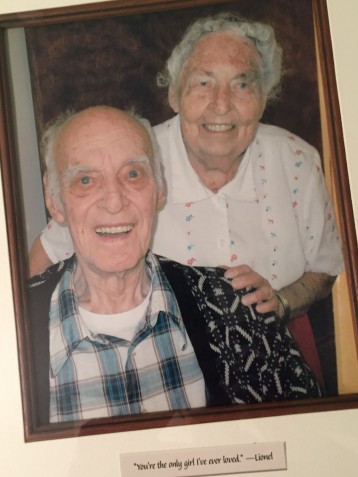
“You’re the only girl I’ve ever loved – Lionel
November 30. I took a walk in my neighborhood, trying to release more grief. My Daddy was gone. I was excited for him; not so much for myself. And in my grief, a curtain parted slightly so I could catch a glimpse into “heaven.” There stood Jesus and my daddy (in his vigorous youth) in bright white light. I wanted to run to his big strong frame, to my earthly hero, and throw my arms around him and tell him how much I missed him.
But he looked at me and said, “I’m not your daddy anymore.”
Startled, I turned to Jesus and asked, “Is that true?!”
“Yes,” He responded. “In heaven there is no marriage and giving in marriage. Relationships are not the same up here.”
“But I need my daddy!” I cried.
And my earthly father turned and pointed to Jesus. “He’s your father now. I was given to you only for a short while—your stay on earth.”
“But what about your daily prayers for me?” I protested. “I NEE D them.”
“It’s okay,” responded Jesus. “They’re all safely stored up here in boxes. I know where each one is, carefully logged and categorized. And now it’s time for you to become the next generation of prayer warriors.”
Quickly, I deposited prayers of my own into each of my own boxes: for my children and their spouses and their children and my great-grandchildren to come. My prayer for each of them is III John 4 that my daddy used to pray for me: that his children would walk in truth.
On Dec. 9 Mom celebrated their 60th anniversary with a special cake. I think Dad would have liked that. It made me smile.





 asks again: Are you willing to be uncomfortable for Me?
 another VISUAL: I’m a tour guide in a cave. I can point out the beauty along the way, and I’ll give my lecture to those who keep up. I can wait for a few stragglers to catch up before I begin lecturing, but if they are talking in the back and not listening, or if they turn back to the entrance of the cave because they got too tired to keep on going, I have to let them go. It’s their choice if they don’t listen. And it’s not my fault if they are physically incapable of keeping up. I can provide a wheelchair, but unless they get someone else to push them, they’re stuck. I have six people in my group who need wheelchairs! What is my job? To keep teaching, keep lecturing, keep pointing the way with my flashlight.
