Woe to me! The Lord has added sorrow to my pain; I am worn out with groaning and find no rest. (Jeremiah 45:3 NASB 1995)
God said,
“Are you seeking great things for yourself? Do not seek them; for behold, I am going to bring disaster on all flesh,” declares the Lord, “but I will give your life to you as booty in all the places where you may go.” (v. 4)
Sounds like Baruch was struggling to accept God’s plan for Israel because it messed with his personal goals and life. Sound familiar?
“Each man’s eternal rewards are proportional according to his faithfulness and not to his earthly recognition or the lack of it.” (Commentary on Jeremiah)
Jeremiah predicted doom and gloom to all of Israel, and it made the king mad, and he shut Jeremiah up in the court. Jeremiah must have been having some doubts, so the Lord told him ahead of time his cousin would come to him and sell him a field. When it happened, just as God said, God then told Jeremiah to have the deed buried in a safe place. And just as God accurately predicted the scenario with his cousin, He would assuredly fulfill His promise to bring Israel back to the land and prosperity.
When Jeremiah still struggled with the prophecy, God said this famous quote: I am the Lord, the God of all flesh; is there anything too hard for Me?
A rhetorical question: No!
Jeremiah 33. God’s Word gives hope.
God sees the big picture; He knows the end from the beginning. Our sight is limited and finite, and the amount we know is miniscule, according to the will and desire of the Creator.
I fear I think like an American—individualist instead of tribal. What good did it do Jeremiah to learn that God would restore Israel and he’d never live to see it? Who cares how many descendants David’s throne would have when he was hurting, mocked, and imprisoned? The future won’t affect him personally!
But there’s that thing called “hope.” This earth, this life, isn’t all there is. There’s a bigger picture. I’m just one speck in the Grand Plan. My part is miniscule, but important, in God’s eyes. It’s not all about me and only me. God was showing Jeremiah that his life was not in vain. That His calling on his life was important for the greater good.
I am in awe of Jeremiah’s dogged persistence and obedience to the Lord. He was asked to do some pretty bizarre things, and he was given the very unpleasant task of telling bad news and warning people and no one listened—at least not the kings. His life was threatened. He was persecuted. But he continued to trust.
“Obey the Lord and it will go well with you” (38:20) was a promise to the king, but it has application for today. We cannot conclude, however, that God will always spare our lives if we obey Him. But we do know disobedience reaps consequences.
There are certain commands in Scripture we know we are to obey (love your neighbor, don’t lie or steal) and when we’re given a direct nudge from the Holy Spirit. There are consequences to our disobedience and blessings when we obey.
Because of one man’s obedience (Abraham), God blessed future generations and individuals. They didn’t earn it or deserve it.
Jeremiah 29 records that, because of Shemaiah, a false prophet in Babylon, his offspring would also be punished. Actually, verse 32 implies he wouldn’t even have any offspring (but if he did, they wouldn’t ever get to see “the good that I will do to My people.”) His children would suffer for their father’s poor choices.
How blessed I am to have been born into a godly heritage. I only knew two grandparents, but both were godly men who loved Jesus. And though I never met them, I know my grandmas did too. I didn’t do anything to deserve this honor, but I am eternally grateful.
My husband did not experience the same blessing growing up, but he became the chosen one to stop the line of unbelief in his family. In God’s mercy, He gave him Halsey, his godfather, to encourage him in the right direction.
My choices affect future generations.
A 2023 Update. My children are blessed because of their heritage, and to their credit, now my grandchildren are being taught in the ways of the Lord. I pray for them daily to walk in the godly steps of their great-great grandparents.
Poor Jeremiah. He prophesied for 23 years, right up to the Babylonian captivity. That’s a lot of doom and gloom. That’s a lot of ridicule and abuse and no positive response from the people. Was He a true prophet then?
There are several Scriptural guidelines for telling a true prophet from a false one, including if all his predictions come true.
But the prophet who prophesies peace will be recognized as one truly sent by the LORD only if his prediction comes true. (Jeremiah 28:9 NIV)
Jeremiah predicted 70 years of captivity, and it happened.
Hannaniah predicted 2 years and it didn’t happen.
Jeremiah predicted Hannaniah’s death, and it happened. So who was the true prophet?
God says false prophets do not stand in His council and do not hear and perceive and mark His words, but they SAY they hear. False prophets claim they have dreams and visions and even use God’s name. But it comes out of the deceit of their own hearts.
God did not say He doesn’t give dreams and visions. He does. But His words are like fire and like a hammer that breaks the rock into pieces (Jeremiah 23:28). So how would the people know which prophet was God’s mouthpiece? A God of peace sounded more appealing than a God of war. I may have been duped as well had I lived in Jeremiah’s day.
Finally, Jeremiah said a true prophet profits the people (23:30).
I think it takes discernment, spiritual maturity, and sometimes time to recognize and identify a false prophet. Deception is so . . . well . . . deceptive.
As a literalist teen, trying to obey the Bible, I felt unspiritual because I wasn’t visiting orphans and widows like James instructed.
Pure religion and undefiled before God and the Father is this, To visit the fatherless and widows in their affliction.” James 1:27 (KJV)
I knew no orphans and had contact with only one widow (who seemed more well off than I was). And I conveniently ignored the rest of the verse: “and to keep himself unspotted from the world.”
I think James may have been quoting the prophet Jeremiah who said bad people don’t “judge and plead with justice in the cause of the fatherless and defend the rights of the needy” (Jeremiah 5:28). But his instructions are broader than that. Jeremiah adds:
IF you:
Practice justice between neighbors
Don’t oppress the alien, orphan, or widow
Don’t shed innocent blood
Don’t walk after other gods to your own ruin
THEN you can dwell in the land. (7:5 NASB)
This list of instructions for piety included more than looking after widows and orphans. Different things were required for God’s blessing. And in verse 9 he added keeping the 10 commandments.
A 2023 Update. I understand, now, that spirituality is far more than completing a specific list. It’s a matter of the heart and motives. And I won’t even go there with the promised consequence of keeping this list means I’m going to “dwell in the [promised] land” when I happen to live in America. I need not feel guilty if I don’t specifically visit widows and orphans, but I can minister to any who are needy in my community or overseas. Here are some organizations I recommend.
When I give someone instructions (a recipe, directions to my house, how to send a file in an email) [yes, this was written a few years ago!] I give clear, precise information. If I don’t, the food may be tasteless; the person will end up at the wrong destination; I won’t be able to open the file.
When God gives instructions, He is the expert. He knows the intended outcome as well as the steps to achieve that goal. His instructions are clear and precise. When God speaks, we better listen . . . and obey to the letter.
God said to Jeremiah (26:2):
Stand in the court of the Lord’s house (where and with what posture).
Speak to all the cities of Judah that come to worship there (what to do and to whom).
Speak all the words that I command you to speak; diminish not a word (what to say—precisely, fully, accurately).
So . . . Jeremiah obeyed. But AFTER he finished speaking, the people, priests, and prophets seized him and threatened death. Obedience does not guarantee comfortable results!
Jeremiah’s response, however, is most interesting and gratifying. He had already grappled with the fear of the results of his actions.
Be assured, however, that if you put me to death, you will bring the guilt of innocent blood on yourselves and on this city and on those who live in it, for in truth the LORD has sent me to you to speak all these words in your hearing.” Jeremiah 26:15 (NIV)
I have learned the hard way that disobedience to God’s clear instructions brings only heartache. I would have saved myself a boatload of angst had I obeyed the first time!
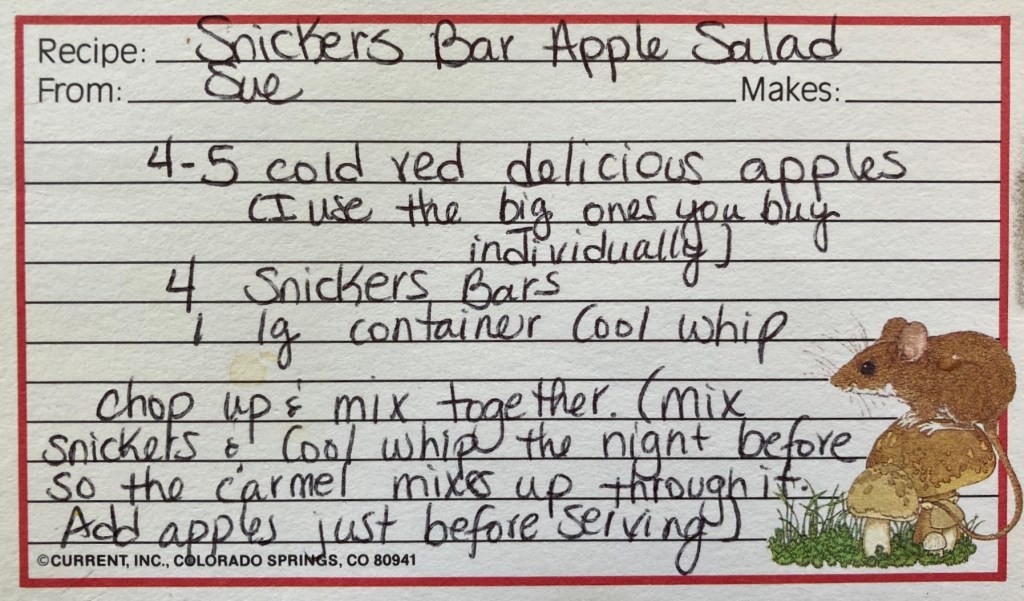
There is on-going debate in our family over whether this is a salad or a dessert.
Why do I struggle with the concept that God has the right to do as He pleases with His creation? I want fairness, and it doesn’t FEEL fair for God to choose one person for special purposes and another for common use.
Does not the potter have the right to make out of the same lump of clay some pottery for special purposes and some for common use? (Romans 9:21 NIV)
With my great power and outstretched arm I made the earth and its people and the animals that are on it, and I give it to anyone I please. (Jeremiah 27:5 NIV Emphasis added)
I can view my story from an egocentric viewpoint or a theocentric one. I can read the story of Pinocchio through his eyes or through the Woodcarver’s who created Pinocchio in love for a relationship. The only safe place for Pinocchio was in his father’s house and under his creator’s care. He could have had greater adventures, in safety, had he stayed with Geppetto, but he ran away. His rebellion resulted in grief, but then he found redemption when he returned to his maker.
When I think “birth” instead of “creation,” I have a paradigm shift in my response to “unfair.” I am a baby, then a child, adolescent, and adult in God’s kingdom. But even as an adult, I never outgrow the need to be loved and cared for. The danger as an adult is to think I’m self-sufficient.
“Your words were found and I ate them, and Your Word was to me a joy and the rejoicing of my heart; for I am called by Your name, O Lord, God of Hosts.” (Jeremiah15:16)
Thought #1. What did Jeremiah mean by eating God’s words? I think about the word biblio-idolatry (the worship of the Bible). This is the person who studies every word, shade of meaning, and explanation but never falls in love with the author (The Word Himself). It’s the person who can’t let go of the literal to read in context. Or the one who boasts in the ability to find any verse, quote any passage. They’ve fallen in love with the beauty of the language, or they use verses to beat people over the head.
That was not the case with Jeremiah. He had a relationship with the author of the words, and therefore the words were sweet to him. When my husband says to me, “I love you,” I cherish his words. If an acquaintance says, “I love you” because I happened to be kind to her, the words do not hold the same impact as someone I deeply cherish. I can thank her politely and then flick them away. I don’t “eat her words and enjoy their sweetness” like I do when Scott says them.
Thought #2. What does it mean “I am called by Your Name”? My maiden name was assigned by default from my father, and I inherited my last name by marriage. My given middle name, however, belongs to my paternal grandmother. I am “called by my grandmother’s name” means I’m associated with her. And though I never knew her, I want to “do her proud,” as Grandpa would say. But to be called by GOD’S name? Wow! Here’s the relationship as I see it:
In Matthew 23, Jesus lambasted the teachers of the Law and the Pharisees. Rude, in fact, according to the rules of polite conversation. I’d be shocked if someone spoke that way to another human being in public. I’ve never attended a church where this type of language was tolerated. Why was it okay for Jesus to be less than genteel? Because He knew their hearts? Because He’s God and He’s allowed to judge? I’m fascinated that He never spoke this way to the sinner, the downtrodden, the hurting, the repentant. Not even to all rulers or rich people. Only to those who were willfully blind, proud, arrogant, self-centered, and self-righteous.
Who or what would be a modern-day equivalent? A lesbian who is seeking truth and struggling would receive Christ’s compassion, whereas a militant, arrogant, in-your-face preacher would get yelled at.
It still rattles me that Jesus spoke this way (as did John the Baptist). Why? My Momma always taught me, “If you can’t say anything nice about a person, don’t say anything at all!” Jesus broke that rule.
But like an illusion, “Things are not always what they appear to be.” The religious leaders appeared to be white, pure. But inside, they were black. Jesus could see right through their illusion and tell it like it is. They were rotten on the inside.
“Woe to you, teachers of the law and Pharisees, you hypocrites! You are like whitewashed tombs, which look beautiful on the outside but on the inside are full of the bones of the dead and everything unclean. In the same way, on the outside you appear to people as righteous but on the inside you are full of hypocrisy and wickedness.” (Matthew 23:27-28 NIV)
“You snakes! You brood of vipers! How will you escape being condemned to hell?” (Matthew 23:33 NIV)
It’s always bothered me that Jesus reprimanded His disciples. In Matthew 8:23-27 it was over their fear of the storm on the sea. Another time over their lack of understanding. In the Garden of Gethsemane, it was for succumbing to sleep. He sounds impatient, and impatience isn’t a fruit of the Spirit.
Perhaps it’s because I identify strongly with the disciples, and I feel the sting of the rebuke on my cheek. The God of the universe claims to understand my frailty because He came to earth to experience it . . . and now I get smacked for it. I feel their shame.
I remember a teacher’s rebuke. Blindsided. I didn’t know I’d done something wrong.
When you choose to wrong someone deliberately, you deserve rebuke. But when the act is mere childishness, a misunderstanding, it feels unjust to have harsh words aimed at you. God deals with children differently than He does adults. I understand that. Would it sting worse to get rebuked as an adult? “Scolded” is a child’s word. That’s what it feels like to me. Like He’s treating them like children.
If a rebuke is unjustified, it’s the adult’s trigger. If I feel anger, revenge, or shame, that’s my issue. If the rebuke is justified, and it’s done in love, it’s discipline and for my good. It has always FELT to me like Jesus was triggered. But that’s impossible because it implies (by my definition) that He believes a lie somewhere.
Conclusion: I don’t like to think that Jesus was angry or even irritated at His disciples (that’s how grownups sometimes get when they discipline children). I think He was discipling, disciplining, and training. In the boat incident, He instructed them to go by way of the sea. I suspect He knew there was a storm coming, and He wanted to test them. At best, he followed the Father’s prompting to travel this route.
Matthew Henry states, “He slept at this time to try the faith of His disciples.” Maybe. Or perhaps His body was simply bone weary from all the ministry. In any case, I give the disciples credit for looking to Jesus as the source of their salvation. “Lord, save us.”
He asks, “Why are you fearful?” Does He answer His own question when He responds, “You have so little faith”?
I want to jump up and defend the disciples. Storms are fearful things! And who among them had the power or faith to rebuke the sea? None of them. Not I. Were they guilty of sin? Or of mere human frailty? Yes, I have weak faith as well.
While in the Garden, Jesus said, “Couldn’t you stay awake and watch for an hour?” (Matthew 26:40). It felt like a scolding and that He was unaware of and insensitive to their needs. But today I see it differently. It’s like He warned them to stay on the safe side of the fence, but they kept crawling over it. Finally, He put barbed wire on the top so they got the point (pun intended)—your obedience could be a matter of life and death. There’s danger on the other side. Don’t you see it? It was less a scolding and more a warning, an urging—look out! Your only weapon is prayer. The Evil One is lurking about. Be ready. Prepare for the attack. But they were unaware of the danger. And though they were willing intellectually to obey, their bodies were their masters.
I am God’s child, and I accept His rebuke if I go astray. But shame is not from Him.