The People’s Choice Award

KingLike a child begging a parent for candy before dinner, I wonder if there are times when we beg too hard for what we want, and God gives it to us—but it’s not for our best. Better to examine our hearts, motives and emotions to discover why we’re begging for something. Better to ask, “according to God’s will” and from a heart of peace that is aligned with what God has predetermined is best for us or our loved one.

Once more, just before the public declaration of God’s choosing, the prophet Samuel warned the people of their folly in desiring a king (I Samuel 12). It’s like the Israelites begging for meat in the wilderness: God answered their prayers, but then they suffered the consequences.

So why did the people want a king? “To be like the other nations” it says in one place. But verse 12 gives us more insight:

But when you saw that Nahash king of the Ammonites was moving against you, you said to me [Sam], “No, we want a king to rule over us”—even though the Lord your God was your king (NIV).

Their folly began with bending to the culture, followed by fear of the enemy, which led to stubbornness and rebellion against God.

What gives me hope is that even after God granted their request for a king, He still gave them a second chance to do right.

If you fear the Lord and serve and obey him and do not rebel against his commands, and if both you and the king who reigns over you follow the Lord your God—good! (v. 14). [But IF the opposite is true, watch out!]

Even when we sin and foolishly ask for something that’s not good for us, God can still redeem the situation—IF we repent.

Sibling Rivalry

sibling rivalry

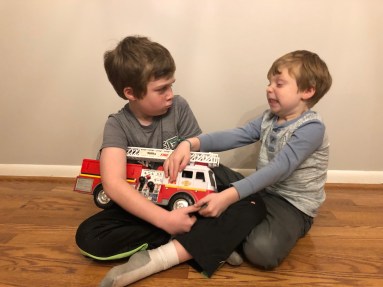
Yes, this was staged by my grandsons. They are actually perfect little angels, of course.

Every evening after supper, my dad would lead us in family devotions. After reading a portion of Scripture, each person, starting with the youngest, was expected to say a prayer. Too young, perhaps, to come up with my own, Dad would prompt me: “Help me not to fight with Grace Anne and Paul!” Thankfully, any sibling conflicts we had as children have long been resolved and forgotten, and we three sibs feel only love and adoration for each other today. But not every family is so fortunate.

The famous David and Goliath story (I Samuel 17:29) begins with David’s dad Jesse sending him to the Philistine battleground with food and supplies for his older brothers. David arrives at the site, sees Goliath, and starts asking questions. Eliab, David’s oldest brother, gets angry and attacks him verbally, sarcastically. And David responds with, “What have I done now? Was it not a harmless question?”

You wonder how long this sibling conflict has been going on. We can only imagine, but I suspect that Eliab is sore that David got anointed king instead of him, the firstborn. There’s hurt, pride, and jealousy.

And David? It’s not his fault that he’s been chosen by God. It’s inevitable, it seems, that others will criticize, put down, and try to discourage God’s anointed one. But David did not take pride in his own strength; instead he gave the credit to God: The LORD delivered me from the bear and the lion . . . and He will deliver me from this Philistine.

The Result:  God replaced the curses of his big brother with the blessings of a new and better brother:  Jonathan.

It’s interesting to note that after David flees from King Saul, his family (including his brothers), hear of it and come to him. I wonder what Eliab thinks of him now? And how will he feel when David becomes his ruler?

Do you have a sibling (or a sibling in the Lord) who has shunned you, picked on you, or criticized you?  Or maybe you’re jealous that your sister or brother got all the attention, good looks, and talents. How do you respond?

PRAYERS and PRAY-ERS

From my 2011 journal. Yesterday I heard a report about a group prayer session for someone who is very sick with cancer. The reporter mentioned how a lady in the group could really pray—she really connected with God, a real prayer warrior. My reaction was multi-faceted:  I’d like to be like that; I’m not like that; I wonder what pain she’s been through; I wonder what her temperament type is.

In my mind, I saw a visual of this prayer warrior lady piloting a large ship while, in contrast, my prayers were akin to clinging onto the side of the vessel, just going along for the ride.

When I talked to God about it, He said to let go and drop into the water. Really?! Ok . . . so I did . . . and found I didn’t drown as expected because the water was shallow enough to wade in. Then He told me to go back to the dry land and enjoy watching the monkeys and playing on the beach, and just spend time with Him. That’s when I noticed the prayer warrior lady was sailing around and around the island, keeping the bad things away from the island.

We each have our own job to do. I’m glad mine is to play on the beach and watch monkeys! I’m no “prayer warrior.” I’m a stay-in-His-presence-and-enjoy-Him kind of pray-er. Is that okay?

MK_HANDS_LO-002Somewhere, somehow, I find myself believing that my puny prayers—I mean the intercessory kind where my heart and brain are only half engaged—make very little difference.

It’s like when my girls were little and I was focused on what I was doing and one of them would approach me with a question. If it was a simple question like “May I go outside to play?” I could answer her without breaking focus. But, if she asked a question that demanded some thought, I’d have to stop what I was doing and turn to her and think about it.

Which of those interactions was meaningful and connected? My first thought is—only the second one. In the first, my mind was elsewhere. And sometimes I think my prayers are like that—the words are spoken, but the mind is elsewhere. But—and here’s the point—is communication of information any less valid or effective for my child? She still got a response from me even if my attention wasn’t fully on her. God wants communication from me. He’s always fully focused on me. It’s me who has a hard time tuning in fully.

And so I’ve somehow come to believe that a quick “mindless” prayer isn’t fully valid. Maybe there’s some truth to that. But on the other hand, it is a connecting point. I have voluntarily connected with my child. I have not turned her away. And I wasn’t in relationship with the neighbor’s kid. I have relationship with my own. Is it okay not to fully engage?

I think of Bill Rudd, my former youth pastor. I’ve never met a man who was so focused on each person he spoke to. Total attention and eye focus. Is this how my prayers should be? Preferably, yes. But the question is, “What if they’re not?” Is the communication any less valid? Is God’s answer dependent on how long, hard, or deep my intensity in prayer is?

When my child asks, “May I play outside?” she doesn’t have to beg and plead and cry to get me to answer yes. It’s a no-brainer if I know it’s safe outside and she’s old enough to handle that much independence. But what if there’s a lightning storm out there? No matter how much she pleads, I’ll say no for her safety’s sake. Other times, it’s just a preference for me whether I say no or yes, and her begging might change or help me make up my mind. The more she pleads and gives me good rational arguments, the more I’ll be apt to change my mind. (Moses did that with God.)

So . . .  let’s say I pray for someone who’s sick. My prayers come from a different place in my heart if it’s “a friend of my co-worker’s cousin” who is ill versus my own child who’s in the hospital. One is a prayer “in passing” and the other is on my knees or face to the ground pleading for mercy.

What’s my question, then? Is it okay, effective, permissible, worth it, important, necessary, whatever, to pray for someone’s request if my whole focus, heart, and mind aren’t in it? The request is still valid. Perhaps the urgency isn’t there, but is it any less valid or effective? I don’t know. Is it ever a waste of time? Whew! How could that be? Surely any communication is better than none at all . . . .

The word I’m working on is “doubt.” If I ask in doubt, what’s the point in asking? It’s worth a try! There’s no harm in asking. If you don’t ask, you don’t receive. So there you have it. Just ASK! And then surrender to whatever answer my Parent gives me. But ask!

What kind of pray-er are you?

Please Come to My Funeral

He passed away, to no one’s regret (II Chronicles 21:20 NIV).

This verse, to me, is one of the saddest statements in the Bible. Jehoram was a bad, bad king who killed all his brothers, put back all the idols that his father had removed, and forsook God. His punishment? His whole family gets wiped out, his possessions captured, and he dies a horrible death of an intestinal disease. And the sad end of his life? His people made no funeral fire in his honor, as they had for his predecessors (v. 19). No funeral memorial for him! Ouch!

What makes a man choose a good or godly heart? It’s more than just his parents’ example. Jehoram had a good father. But maybe he had an absent father. Perhaps something burned him as a child. Was he arrogant because he was the first-born and spoiled? Was he picked on by his brothers? Did his lustful appetites draw him into sin, and he followed after forbidden fruit? What need of his heart went unmet that he would deliberately close his eyes to the victories he witnessed in his father’s time?

Memorial services tend to focus on the positives of a person’s accomplishments or character. We say we don’t like to speak ill of the dead, but how awful to have lived so poorly that no one shows up at all!

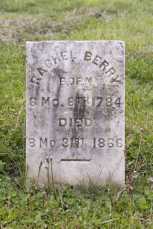
rachel (white) berryI want to go to my grave with no unfinished business. I don’t even want to go through today with unfinished business of the heart. I’m so thankful for my godly heritage. I want to learn my lessons from my parents—follow their godly choices, reject any inconsistencies, love everyone—to the end. You all are invited to my funeral!

Whom do you want to come to your funeral?

Labeled

“Doubting Thomas.” How did Thomas, one of the twelve disciples, feel to have that label attached to him? Why don’t we remember him for his faith? After all, when Jesus declared His imminent death, Thomas was the one who stated, “Let us also go, that we may die with Him.” And when he saw the risen Christ, Thomas declared, “My Lord and my God.” According to tradition, he was the only disciple who made it to India (outside the Roman Empire). I wonder if the other disciples would have responded the same way as Thomas had they not been in the room that day when Jesus appeared to them? Perhaps. But Thomas is the one who got stuck with the label.

What if people took the worst day of my life and labeled me with it? Yikes!

labelOther Bible characters are given more positive labels: David the Shepherd Boy, Abraham the Man of Faith, Meek Moses. Yet their lives were not always exemplary. So why do those labels stick? Some people are able to shed their labels. Paul the Persecutor is better known as Paul the Apostle. Jacob the Deceiver became Jacob the Patriarch.

What label will be attached to my epitaph? What do I want to be labeled? What label do I need to shed? What is God’s label for me?

Dry and Thirsty

O taste and see that the Lord is good . . . (Psalm 34:8).

From my 2010 journal. I had company here for a couple weeks, and my alone time with the Lord suffered as a result. Each day my spirit felt thirstier and thirstier. Strangely, I felt like I was sitting on the edge of a paved parking lot facing the road with no cars in sight.

I asked the Lord what He wanted me to do, and He said, “Go back inside the store.”

marketAnd when I turned around, I saw that it was one of those exotic Asian stores where everything smells pungent, but you have no clue how to cook with any of the ingredients. Jesus is with me, and I’m glad, but something else needs to be done.

Ahhh, at the far side of the store are endless supplies of samples to taste. Some things are tasty to me. Some things are tastier to others. It’s all good food, but I don’t have to like it all. I can eat my full and then it’s okay if I’m back in the parking lot for a while. I’m close to the food supply! My soul and spirit feel refreshed.

What do you do to refresh your soul?

Trembling at the Foot of the Mountain

From my 2010 journal. I realized today that I’m doubting my worth in Christ. I continually question whether or not I’m doing enough to please God. Why is it such a hard thing to believe? I’ve never doubted His love for me. Perhaps that’s because I felt my parents’ love. I do feel accepted by God. It’s not that.  Perhaps my feelings are born out of my childhood perception that God is watching: you better behave. I sense a fearsome reverence that doesn’t allow me to get too close.

mountainVisual:  I am the Israelite at the foot of the mountain who is forbidden from getting too close to the mountain. I’m never Moses and Joshua who climb the mountain and see God face-to-face. I stand at the foot and tremble at the smoke. Only the chosen one is permitted on the mountain. (The funny thing is, Moses had nothing to do with God choosing him. And besides that, he had a flawed character.)

In my visual, I realize that I want to be chosen.

As I surrender my feelings to God, I see myself as a little child, hanging onto the rope barrier at the foot of the mountain. The grownups have all returned to the camp to party, but I want to be close to God.

I see Jesus approach me from the mountain. He picks me up and carries me up the side of the mountain away from the noise of the camp, away from the revelry and the debauchery and sin. It’s quiet up here, silent and peaceful. And Jesus allays my fears that my parents will worry about my being gone.

Soon the sun begins to set and I shiver in the cold. He builds a fire and gives me a cloak for warmth as we sit down for an intimate conversation. In the end I understand that though I might not be chosen for Moses’ job or role,  I was chosen because “I sought the Lord and He heard me” (Ps. 34:4).

Now when the mountain trembles, I feel safe. Jesus will protect me. I’m His child. And He promises that He will “never leave me or forsake me.” He will not leave me on this mountainside by myself. When I pray to Him, He’s not far away anymore. He’s right there, close and intimate. We’re just having a conversation.

Does God feel far away to you? Or near?

So Fix It Already!

When you try to fix people, things only get broken. (Eric Swann, Believers’ Chapel)

From my 2011 journal. Two incidents happened this week that held a mirror up to my face, and I didn’t like what I saw. I like to be kind and gentle—but I can also be bossy and take charge and can step on people’s toes, albeit unintentionally. I tend to push my way in where I’m not invited. This week I butted in where I should not have. I stuck my nose in someone else’s business and got kindly and gently rebuffed.

It’s a tricky thing—when to step in and be helpful and when to keep my mouth shut. I like to solve problems and find solutions—if I know the answer. But if the person doesn’t need or want my help, then I can be a hindrance.

black-and-white-close-up-equipment-210881I see a problem. It needs fixing. Then fix it already! What is that inner drive? Is it temperament? Genetics? Wounding? This drive can accomplish good things, or it can be a catalyst for ill. The thing is, when I see it in myself, I try to fix it. When I see it in others, I want to fix it myself or encourage them to fix it. I wonder: Why would anyone want to continue to wallow in the mire when there’s an answer for their pain?

So how does it feel when things aren’t right and in their proper order? My brain likes things orderly. Words should be spelled correctly. Punctuation in its place. Pictures straight. No clutter on the table. Other people are wired to enjoy and thrive in clutter and mess and chaos. Why can’t I be more tolerant of other people’s messes?

The key? I am not the solution to everyone’s problems. Imagine that! We were taught in evangelism class to be aggressive, to push forward, to get people to make decisions and “draw the net.” Unfortunately, those tactics can actually cause more harm than good and can drive people away.

I want to be honey that attracts, not vinegar that sets people’s teeth on edge. I want to learn to be content with people’s messes, but not content with my own. I can only fix ME.

Later. So now that I’m tuned into it, I caught myself once again giving unsolicited advice. It was unappreciated and inappropriate. How do I break myself of this habit?

This second incident occurred when a visitor came to drop off his two girls at my Grade 5 Sunday school class. When I discovered that one of the children actually belonged in Grade 2, I ran after the parent to inform him of his mistake.

“But the sign said her class was here!” His tone was angry and insistent.

My first response? Fix it, of course! I wanted to prove he’d read the sign wrong. I wanted to walk him to the next wing and show him how to find his daughter’s classroom (but I couldn’t leave my 5th graders alone).

This same emotion shoots me back to a memory when I used to work in a dime store where I was assigned, happily, to the fabric department. I was fresh off the mission field and had never worked retail before. I didn’t even know how to count out change in American money. One day a lady came in with a bag of material and dumped it angrily on the cutting table. She claimed it had been measured incorrectly. Well, my grandpa, who had owned a hardware store in Des Moines, Iowa, had taught me that “the customer is always right.” So, without re-measuring or checking it against the receipt, I pulled out the bolt of cloth and proceeded to cut another length as she specified and exchanged it.

That’s the day I learned the rule that when there’s a problem, you’re supposed to defer it to your supervisor. Oops! My boss was kind about it, but I knew I’d messed up.

So . . . what was I feeling when this lady stormed into my section of the store? I felt for her. How annoying to be sold the wrong length of cloth! I’d been there myself—trying to make a garment when I’m short of material. It’s like I could feel her dashing water all over me.  In my visual, I can see her tripping over a log or something and losing her pail of water. I feel bad for her. I’m more concerned that she’s okay than that I got wet. “Are you okay? Did you get hurt? Can I help you draw more water?” I ask. That’s how I respond. Fix the problem.

Psychologically, I know I’m not capable of taking another person’s emotions or pain for them. I can only feel what I feel. So . . . I mentally climb into this lady’s shoes and feel what it feels like to trip and lose my balance and lose all my water. But as I do that, I begin to laugh—amused at myself for not seeing the log in time.

For some reason that helps. Now in the memory, when the lady walks in with her material, I can say, “Oh how disappointing it must have felt to start a sewing project and become stymied.” And I can look at the Sunday school parent and say, “It must be annoying to find you’re in the wrong spot and you still have to drop off another child before you head to the worship service.” No more emotional response; no need to fix the situation. It is what it is. Just acknowledge it and move on.

Who are you trying to fix so that you can feel better?

Trial and Error

notebook 2From my 2010 Journal. In my counseling training, I heard one instructor say, “If something doesn’t work, try something else. Keep trying, keep working. Doing something is better than nothing, and it’s all good.”

I’m not sure how this fits theologically, but apparently even God practiced trial and error! Today I read Jeremiah 36 where God tells Jeremiah to write down all the words of doom, gloom, judgment, and disaster that He’d previously given him orally concerning the future of Israel, Judah, and the surrounding nations. And then these intriguing words:

Perhaps when the people of Judah hear about every disaster I plan to inflict on them, they will each turn from their wicked ways; then I will forgive their wickedness and their sin. (v. 3 NIV)

Perhaps? Maybe? God had tried out-loud preaching to get their attention. God had tried using metaphors. Now He’s going to try to reach the visual learners—those who need to see the words in writing. Try and try again.

It’s not the counselor’s fault if the client doesn’t find freedom or ends up in suicide. The client has a choice—always—to repent, to come out of hiding, to lay down bitterness, to lower walls of defense, to face the truth, to forgive and to accept forgiveness, to relinquish hate, to release pain. Each person has been given freewill to turn toward God and seek Him, to be healed of heart wounds and find peace—or not. But the counselor keeps on trying different methods to help the client discover what’s in his or her heart. God did!

What will it take for God to get through to my heart?

My Mother, My Inspiration

DIGITAL CAMERAIn honor of the 10th anniversary of my mother’s death (has it really been that long!), here’s a piece I wrote for Mothers’ Day, 2005. Though hard to tell here, the original poem was in the shape of a pink (her favorite color) dress. She never wore a pair of pants in her entire life, and her unbraided hair reached down to her waist. I still miss her. For those who knew her, what would you add?

Yarn-knitter          Baby-maker

Salt and pepper-collector / Go-getter

Potato masher-collector / Accordion-performer

Children-entertainer / Care package-sender

Needlepoint-sewer / Hospitality-offerer

Grandma-perfecter / Braille-endeavorer

Animal-intolerator / Laughter-infector

Home-maker / Hat-crocheter

Pie-server / Idea-getter

Wound-binder

Hard-worker

Africa-longer

Public-speaker

Pioneer-adventurer

Sunday School-leader

Music-lover / Bangs-curler

Puzzle-doer / Pickle-canner

Dress-donner / Movie-nixer

Oyster-eater / Sugar-shunner

Word-repeater / Braid-wearer

Jump rope-tryer / Dune-climber

Husband-server / Hygiene-seeker

Reading-teacher / Chocolate-lover

Necklace-wearer / Eyesight-dimmer

Cake-decorator / Fresh bread-baker

Medicine-dispenser / Dr. Laura-listener

Cello-player / Pillow-sewer / People-pleaser

Dispensary-worker / Des Moines-originator

Piano-plinker / Mill-displayer / School-teacher

Book-reader / Stuffed-toy-creator / Example-doer